For all my best intentions to read the stack of books I had planned to tackle with the new year, I keep getting side lined by new releases. And I am, it would seem, still caught in a South African vortex. This time I have been swept into the hypnotic landscape of words and images that is The Alphabet of Birds by S. J. Naudé. Originally published in Afrikaans, this debut collection of short stories has just been released in the UK and America in the author’s own English translation. A fascinating communication between Naudé and fellow countryman Ivan Vladislavic posted on the Granta website drew my attention to his work and I was not disappointed by a single story in this amazing collection.
Trained as a lawyer, Naudé spent many years working in New York and London before returning to South Africa to pursue a career in writing. As a result, most of the stories in The Alphabet of Birds explore the complicated existences of ex-pat South Africans who find themselves losing their footing abroad but are uncertain how to negotiate the emotional dynamics of family and the socio-economic realities of a new South Africa. Home is increasingly elusive, fleeting attempts to find meaning fall into emptiness. In one of my favourite stories, “A Master from Germany,” the desire to escape a soulless corporate existence leads to a fantastical hedonistic adventure that turns into an achingly sad domestic vigil at a parent’s bedside. There is a profound sense of alienation that runs through all of these tales: a husband unable to rescue his wife from herself, scattered siblings across the globe, men seeking solace with male lovers who are either too elusive or too intrusive.
These are not stories for those who prefer a traditional narrative arc. Naudé writes with a cinematic eye. The violent storms that stretch across the open South African skies in “The Van” are breathtaking, the slow and painful disintegration of a parent dying of cancer portrayed “A Master from Germany” and “War, Blossoms” are heartrending. Images and motifs recur. Illness and death. Sex and drugs. Love and loss. Music and birds. With a language that is poetic and precise, he focuses his attention on sounds and silences, brutality and fragility; opening wounds and blurring boundaries between identities. His characters tend to become increasingly opaque, mysterious even to themselves: “simultaneously armour-plated and flayed.”
I have been slow in coming to appreciate what can be done within the medium of the short story. In the Granta discussion Naudé explores his fascination with the processes at play in the work of W. G. Sebald and Thomas Bernhard, among others. As those two writers are a key focus for me as a critical reader this year, I was keen to see how such influences would play out in his work. In terms of possibilities for storytelling I find myself very excited by this collection. I simply did not want it to end.
The themes of borderlessness and alienation that drive these tales are very human and have far reaching relevance beyond the South African experience. Now that it is available to an English speaking audience, thanks to the subscription funded publisher And Other Stories (I just had to subscribe too), The Alphabet of Birds will hopefully reach a wider audience. I suspect it will likely be one of my favourite reads of the year too, and it’s only January.
Every year, rather than rushing through a book before the clock strikes midnight just to push up the book count of the year that is slipping away (an inclination likely idiosynchratic only to those who of us would rather read than party on New Year’s Eve), I prefer to walk into the coming year in the company of a great writer, allowing the experience to end one year and launch the next. My companion of choice to see out a year marked by loss, the resurgence of mental illness and a recognition of not only my own isolation, but my role in facilitating that condition; was the late German writer W. G. Sebald. More specifically his haunting and heartbreaking novel The Emigrants (translated by Michael Hulse). As a curious coincidence, the Word of the Day email from Meriam Webster that appeared in my inbox this morning for January 1 is:
emigrate\EM-uh-grayt\
verb : to leave one’s place of residence or country to live elsewhere
If you have never read Sebald, his work almost defies simple description. It must be experienced. Adjectives from admirers abound: mesmerizing, beautiful, subtle, sublime. Long evocative sentences unfold into even longer reflective paragraphs – at times running for pages – enhanced with the insertion of grainy photographs of people, scenery, pages from notebooks, objects, sketches. The reader is pulled in, guided along through landscapes, recollections, side observations and historical reflections by a narrator who is present, patient and human in the face of the incompleteness afforded by memory and the passage of time.
The Emigrants may well be the most accessible of Sebald’s work that I have read, especially because it forms its structure around the apparent biographies of four men who have emigrated or been exiled from their homelands. Three of the four have a Jewish heritage and World War I and II form a critical backdrop to the four very different accounts. Our narrator encounters each of these men, in person, even if only as a child, but in most cases he pieces together part or all of their life histories through the recollections of others, and the diaries and memoirs that he acquires along the way. In some cases he even attempts to revisit the locations that impacted the lives of his subjects, finding only decay or even complete obliteration in his vain efforts to find traces of a past that cannot be revisited.
There is such a deep and abiding melancholy that runs through these pages, that I don’t think I could have chosen a better literary companion to mark the passing of this difficult year. But it broke my heart and drove me to tears on more than one occasion. The first two chapters end with suicide. In the first we meet the eccentric Dr Henry Selwyn who, by the time the narrator and his wife come to know him, has taken to dwelling in the garden of the house owned by his wife from whom he is long alienated. He confesses to a greater sense of loss over a friend who had disappeared into the crevice of a glacier years before than any regret for the dissolution of his marriage. A Lithuanian Jew who had sought to conceal his heritage after emigrating England, the gentle doctor would eventually put his hitherto unused rifle to final lethal use.
In the second chapter the narrator revisits a beloved childhood teacher, Paul Bereyter, upon hearing of his suicide. Through his own reflections and conversations with a French woman who became Paul’s friend in his later years, an attempt is made to piece together the roots of the melancholy that had been hinted at when Paul was an unconventional but enthusiastic teacher; yet grew with the realization that even being 1/4 Jewish was sufficient to make him an exile in his own country. Meticulous and pragmatic to the end, the former teacher carefully researches his decision to end his own life. But although you know it is coming, the recounting of Paul’s final day is none the less devastating for the reader.
The narrator then traces the history of his own great-uncle Ambros Adelwarth in the third section. I found this portrait at once the most moving and the most devastating. Here the emigrant destination is North America and, for a change we are in settings with which I have some connection. Eccentric and meticulous in presentation and decorum, Ambros rises quickly in the hotel industry of the early 1900s and, once he joins his siblings in the US, secures works with a wealthy Jewish family on Long Island. He is given charge for their son Cosmo, a young man driven to reckless excess and, as we will also see, its dark counterpart so recognizable to those of who are bipolar. Ambros and Cosmo embark on a tour of Europe and the Middle East, marked by gambling, daring aerobatic performances and a certain display of personal affection that raises the eyebrows of the elite that inhabit the rarefied world of wealth and glamour in the years just before the First World War.
With the outset of war though, Cosmo begins to plummet into despair and despite the best remedies that money and contemporary mental health care can buy, he will end his days in a private sanatorium. After staying on and looking after the family, Ambros retires to live in quiet isolation. But he is seemingly haunted by a deep unbearable grief. Suicide would be too messy, one imagines, for a man who dresses and presents himself as a formal gentleman to his dying day. Rather Ambros opts for voluntary commitment to the same sanatorium where Cosmo died, stoically submitting to an extreme regime of ECT as if the only way to truly destroy traumatic memory is through one bone blasting jolt at a time.
The final chapter, one which Sebald admitted was based on the amalgam of a landlord he once had and a well known artist; finds our narrator in Manchester, England. The city centre is in rapid decline. Here he meets Max Feber, an artist who, having emigrated from Germany, has for decades been single-minded in his efforts to find refuge through art. He devotes himself to this task seven days a week, drawing and erasing his work repeatedly, beyond the patience of his models. The narrator is curiously drawn to this anti-social, unusual character and they form an odd friendship but it is not until he revisits Max 25 years later that he realizes that there is here another story of loss to be fleshed out. But the lasting impression of the emigrant experience is as one in which both the realities from which emigrant has come and those to which he arrived (in this case in Germany and in Manchester) are both subject to decay, dissolution and the vagaries of memory and time.
Copyright JM Schreiber, 2011
I have never been one for family history. My mother’s family emigrated from Ireland to Brooklyn, New York in the mid 1800s, my father’s mother’s family would have arrived in Toronto from England probably around the turn of the 20th century whereas his father’s family were United Empire Loyalists, making him a 7th generation Canadian. My parents met in New York City in the late 1950s, an era to which my father repeatedly tried to return long after it had ceased to exist. My brother and I were born in New Jersey but, after exploring a variety of options, my family pulled up stakes and moved to western Canada away from everyone they knew and settled here when I was only a few years old, soon adding another son.
Apart from that rough sketch, I am not inclined to family trees, I have only two photos of myself as a child and by the time my own children were born I had developed such a strong aversion to having my picture taken that I sometimes worry that I may have failed to take enough photos of my own children when they were growing up. Many years ago I finally understood why the person I saw in pictures or in the mirror was so at odds with the person I knew myself to be and started on a journey to correct the discord. Having reached my intended destination I no longer know how I fit into my family tree. In a very fundamental way I am an emigrant who has become exiled in his own life, still seeking to define what that means for me.
As the richly imagined portraits in The Emigrants illustrate there is a melancholy, anxiety and despair that can haunt the emigrant experience. I found myself wondering about origin, that is, how much of the melancholy was carried into the experience and how much owed its origin to dislocation and loss? As a person with bipolar disorder recovering a from a serious breakdown, questions of cause and effect always simmer. In the end it is impossible to distinguish loss leading to despair from despair that enhances a sense of loss. Having experienced both this past year I enter 2015 with a cautious mix of anxiety and anticipation.
I cannot remember ever really wanting to be anything other than a writer. How then did I get to mid-life believing that my aspirations would never extend beyond the inevitable writing and editing of newsletters and promotional material with every job or volunteer position I have ever held? Why have I been hit with a curious mix of pride and anxiety every time someone has commented on my facility with words?
In truth, there was a point in my late teens or early 20s in which I made the conscious decision to wait until I had lived a little before writing. I assumed a little experience would provide material and perspective. I had not bargained for the complicated experiences that awaited me or how long it would take for me to wade through and unravel it all. And when I did find my way through I found myself unwilling to bare my soul on the page. But every writer has a story they were born to tell, or as James Baldwin said about Go Tell It On the Mountain, the story they have to tell if they tell no other. Frequently it is a coming of age story, a coming out story, a tale of childhood loss or trauma. But that not need be the case. Nor is it necessarily the first story a writer sits down to tell. It can be recounted in fiction or presented as memoir, but the telling is essential, cathartic and close to the bone; even if no one beyond a few friends or relatives ever see the manuscript or hold a copy of a self-published book.
As I look back, I finally understand why I decided to put my writerly aspirations on hold so many years ago. I also understand the barriers I have placed between my impulse to protect myself and my identity and any story I thought I might tell. In this context those reasons are not important. I have also come to recognize the story that I really need to tell is one which I have only recently come to understand myself. So with the unexpected time that my present inability to return to work has afforded me, the gift of introspection and a desperate need to get this story out onto the page and hopefully gain some distance; I want to see what I can do.
But the challenge with stories that find their source close to life lived, is that this same life not only belongs to me. It cannot be divorced from real people. Or real experience. I am not certain how to balance the need to breathe truth into an experience and the desire to protect those I love.
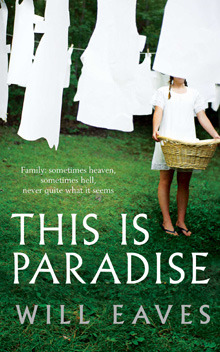
My latest read has inspired these questions. After my enthusiastic encounter with Will Eaves’ The Absent Therapist, I turned to his 2012 novel This Is Paradise, which I have had on hand for nearly two years. The right book, at the right moment it seems. A relatively spare novel that is at once intimate and ambitious in scope, this book opens with Emily Allden’s difficult pregnancy with her fourth child, and closes decades later following her death. Benjamin, the youngest, unborn at the beginning is an enthusiastic traveller on his first chance to join his older siblings and parents on their regular holiday trip to France in the first half of the novel. In the second half Benjamin, now grown becomes the lens through whom we see the family – his well meaning but emotionally distant father; his intelligent but volatile older brother Clive (who is clearly dealing with perhaps aspergers or a mental health disorder) and his two sisters, the capable Liz and the delicate Lotte – as they cope with their mother’s increasing dementia, the decision to place her in a care facility, and the lingering final days of her life.
Eaves’ deft ear for the nuances of conversation, sensitivity for the complex social dynamics that bind and divide family, and keen eye for visual detail allow him to create a coherent interplay between the members of this large family and a handful of supporting characters across the decades. He does this by employing a style that is at times fragmentary, sometimes reflectively slipping back into passing remembrances, but always evocative of the way that we tend to think about and experience our lives over time. The result is rich with wonderful moments that add depth and resonance.
Yet as I was reading This Is Paradise, I was especially struck by the pivotal account of Emily’s illness, the details of her physical and mental disintegration, and the mixed emotions that rise and fall between the various members of the Allden clan throughout this process. It rang true in a way that made me wonder if it was grounded in lived experience. It was then no surprise to find that Will Eaves had in fact published an essay in The Guardian about his mother’s struggle with Alzheimer’s. When he recounts an event repeated in the novel I naturally wanted to know where reality and fiction intersect in his story. And how does an author decide what to paint clearly and what to disguise?
To be honest I am not generally drawn to family dramas, especially ones with such a sprawling cast and ambitious reach across the years. Mind you in another writer’s hands this would likely be a book at least 600 pages long. In half that length, we trace a loving portrait of a complex and deeply human family from childhood spats through adult stresses and concerns to the bonding moment of shared loss.
And since it is from my own immediate family that the story I want to tell arises, I suppose I will be paying closer attention than ever to the way such dynamics are played out in literature.
It has taken me over a week to come down after volunteering with and attending events at our recent word festival. I entered into the week slightly down and was spiraling up within a few days. If it was a test of my ability to return to regular work, this is clear evidence that my mixed state is still far from stable. But I would not have missed it for the world.
It was an absolute thrill to mingle with people who are passionate about books and listen to Canadian and international authors talk about their craft. Whenever an author was asked about his or her influences, a love of the magic of books and literature shone through in their responses. If asked about advice for want-to-be writers, the common answer was read, read, read… read widely and drink deep from the wealth that books have to offer.
The stash of books I bought at the event, not including the titles I purchased or read in advance. Volunteering in the bookstore can be expensive!
And so there was this man I crossed paths with at various venues throughout the festival. He told me he was a writer. Patting the breast pocket of his jacket he indicated that he felt he was getting ready to pull together his work. He had a gold pass so I saw him a number of times but always alone, ordering a coffee or buying a glass of wine at the bar. He would acknowledge me and we would exchange a few words on whatever interview or panel we was waiting for. But I never witnessed him engaged in animated discussion with fellow attendees.
The solitary man at a venue where excited discussions about books were regularly erupting between strangers is an anomaly.
On Saturday afternoon I encountered him in the lobby. He was carrying a copy of Sweetland by Michael Crummey. I got the impression he was done with the festival regardless of the major authors still to come. He said, “I have decided, this is the one that impresses me. Let’s see if he writes as well as he talks.” I responded that I had recently obtained a copy of his previous work Galore, the novel Crummey described as the one he feels he was born to write and that I wanted to read that first. He looked at me with surprise and said, “You mean you have heard of him?”
Suddenly it dawned on me that this man, the self-described writer, does not read at all. I suppose he thought he he would be able to absorb all the final inspiration and direction from this one book. If he did not know one of the best known Canadian contemporary authors and poets, even if he had never actually read one of his books, I could not help but wonder how he imagined himself ready to pull his accumulated scratchings into a final product.
With a full evening and day still ahead, he had selected his role model. I never saw him at the theatre again.
Even if it left me swinging up on my attempt to stablize this recovery from my recent manic episode, I was deeply inspired by the talks I attended, delighted by the company of fellow book lovers and especially grateful to a few authors who took a little extra time to encourage me as writer. I was regularly reminded that it is never too late to start.
And I am never lacking for books. In fact they seem to multiply in my life on their own as any truly avid reader knows.
Wordfest, our annual literary festival is underway. After several months struggling with the fall out from a serious mental health episode this week is my first serious self test, my chance to explore my level of stamina and commitment. It is also an opportunity to spend time with people who love books and listen to great writers talk about their work.
I started with two volunteer shifts and some selected presentations I wanted to see and, as you might suspect, the volunteer commitment portion quickly expanded.
Am I exhausted yet? A little. I will likely sleep for a day when it’s all over but I have so desperately needed to get out in the world. Admittedly I am buffered with medication but the creeping anxiety stays in the car when I get into the venues.
Now if I can find a way for the medical system to prescribe a literary solution I might just be able to live with this bipolar beast. I just have to be able to afford to eat too!
Today has lifted my spirits more than I can remember in months. I had one single volunteer shift as a bookseller at one of the smaller venues, but I was nervous simply because I was expecting a panel discussion featuring one of my favourite authors. When I arrived to discover that the other writer had been forced to cancel at the last minute, the presentation had been redesigned as an hour long one-to-one interview with South African novelist Damon Galgut.
The host was scrambling but I could not have been happier.
American edition of Arctic Summer in case anyone is wondering -a nicer cover than the Canadian/UK I think.
I have always been apprehensive about meeting my heroes, for fear of disillusion. Nonetheless I had come prepared to have my books signed and hopeful for even a few words with a writer whose works I admire so much. Although we did have books to sell I noticed that I was not the only person who had arrived with their own copies of his latest work, Arctic Summer, already in tow. This novel is an imagined biographical account of the complex personal and emotional factors that led E M Forester through the extended writer’s block that ultimately produced his greatest work, A Passage to India. As an historical novel it is a departure for Galgut (and one he admitted he would be in no rush to repeat) but rich with a deep affection for India and the driving forces of unrequited desire.
I confess I abandoned my post presentation bookselling duties early to make sure I didn’t miss out on the opportunity to have my copies of In a Strange Room and Arctic Summer signed. To be honest I have yet to see an unpleasant author at any of the events I’ve helped with, but it meant more than I can measure for Damon to take the time to, ask me about myself and encourage me that it is never too late to start writing. I am grateful for his kind words.
This experience, simple and important for me, has lifted my spirits in a way that feels healthier than the meds alone. It feels good to be human again. I have commitments with Wordfest right through until Sunday evening, but for now I am enjoying this warm feeling.
“There are no people anywhere who don’t have some mental illness. It all depends on where you set the bar and how hard you look. What is a myth is that we are mostly mentally well most of the time.” – Mark Vonnegut, MD
A couple of years ago I happened to hear an interview on CBC radio, as part of a series on mental illness. I was, at the time, of the mind that my own issues with mental illness were well managed. A present fact but a distant reality. However, something about this conversation stayed with me.
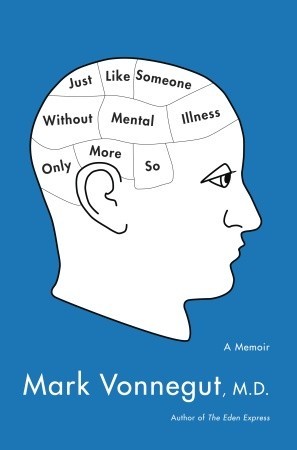
The guest was Mark Vonnegut, son of the late author Kurt Vonnegut Jr. Mark grew up in Cape Cod, in the years before his father’s writing brought fame and fortune. I listened with interest to his very personal account of how, despite diagnosis with a serious mental illness, he applied and was accepted to Harvard Medical School. He went on to become a respected pediatrician. After my breakdown this summer I debated returning to the the fine accounts, like An Unquiet Mind, that had originally guided me to an understanding of my newly acquired label. Then I remembered Mark’s memoir Just Like Someone Without a Mental Illness Only More So and within minutes it was on my Kindle. But I only decided that I really needed to read it this weekend as my symptoms and anxieties continue to persist.
Mark writes in an honest and matter of fact way about the trail madness has left through his family, tracing a legacy of depression, suicide and alcoholism going back generations. His mother heard voices and received message from license plates but once the episode passed she was able to rationalize it. When Mark’s aunt and uncle died within a month of one another leaving four troubled orphans, his parents took them in even though they had neither the money nor the capacity to manage. His oddly prescient mother had been stockpiling supplies for their arrival in advance, as her helpful voices had advised.
Mark was a loner spending a lot of time fishing and playing imaginary games in the woods around his home in Cape Cod. The oldest child of the family he grew up poor in the fallout of the the Depression. His father was a ineffectual used car salesman for many years. Mark was 21 before his father became a rich and famous author seemingly overnight.
Caught up in the hippie movement of the 60s, Mark followed many of his peers to Canada to join a commune in BC. He lived off the land, contemplated the meaning of life and experimented with drugs. And that is where he first encountered his own voices. In 1971, at the age of 23 he experienced three major psychotic breaks that landed him behind the locked doors and plexiglass windows of a Vancouver hospital.
“Among the things I grew up thinking about mental illness was that it was caused by other people or society treating you badly.I also knew that once people were broken they didn’t usually get better and the ones least likely to get better were paranoid schizophrenics, which is what I seemed to be.”
Retrieved by his father, Mark returned to the US where, with ongoing treatment, he continued to recover. The voices faded to the background. He published a book about his experiences and articles advocating for an understanding of mental illness as a biochemical condition, in strong opposition to the RD Laing inspired philosophy that was popular at the time (and has recently resurfaced). Somewhere along the way he decided that he wanted to go to medical school himself. Against all odds, and with pathetic math and science marks, he applied to one school after another. Incredibly Harvard gave him a chance.
Over the years that followed, Mark dedicated himself to his studies and his internship. By this point he had recognized that he was bipolar (not a schizophrenic who responds to lithium as he had been told), but even then, the schedule of an intern is grueling. During these years he also married, bought a house and started a family. The model of normal and healthy he figured his mental health issues were history.
Then 14 years after his third psychotic break, several years into a successful pediatric practice, the voices returned to taunt him. The trigger was his realization that he was fueling his high stress schedule with a two pack a day smoking habit along with 5 or 6 beers, half a bottle of wine, a few shots of bourbon and a sleeping medication to round off the day! Hardly a surprise then that his effort to quit cold turkey should trigger a psychotic break.
Although he sensed things were falling apart he resisted seeking help in a hospital. Driven by an absolutely irrational fear planted in his head by his voices he attempted to throw himself through a third story window. The window smashed but he fell back into the room. Unfortunately he ended up in a straightjacket on a gurney in the hallway of the very hospital where he had completed his internship and taught a course.
Although my own manic resurgence following an extensive period of wellness was somewhat less dramatic than Mark Vonnegut’s, it is only a matter of degree. Yet in time he was able to return to work and it has now been more than 25 years since his last manic break. His ability to rebuild his life and career even in the face of abject humiliation is an inspiration. And I am fortunate that I have neither smoking or alcoholism to contend with. But his story stands as stark reminder that with bipolar you must take the medication that keeps you stable and monitor your own level of energy. If we become complacent we risk an unwanted replay, no matter how long we have been well.
This book was published in 2010, so It was not available when I was first coming to terms with my diagnosis. Perhaps if I had read it when I first heard the interview I might have been able to head off my more recent experience. But then again, a manic person is a slow learner because that high just feel so good. Especially in contrast to the draining and despondent opposite end of the cycle.
I would recommend this memoir to anyone interested in mental illness, especially those who understand what it is like to experience psychosis. Its casual, relaxed style makes for an easy read but, as a practicing physician, Vonnegut has some depressing observations about the decline of health care in his own country. Most importantly though, he leaves those of us who live with mental illness with a sense that we can get better, we can stay better and if we fall, we can get up and move forward.
That is exactly what I need to remember right now.
For someone who recognizes the swings of bipolar disorder reaching back into late adolescence or early adulthood, I have had precious little acquaintance with depression. Unfortunately I remember it best as a stepping stone on the way to hypomania and, at worst, the door into a hallway leading up to eventual mania.
Now, on the heels of a drawn out period of manic and mixed state agitation I am settled into a pit of anxious depression. Bone weary I find it hard to sleep. With long days to fill I find it hard to focus. Plans and decisions loom on the horizon but I find it hard to concentrate. I make an effort to go out somewhere everyday but before long I feel nauseated and eager to get home. And now my psychiatrist is unavailable so my faithful doctor has set about looking for someone else to help me assess the effectiveness of the medication I have relied on for so many years, just in case it is time for a change.
And the thought of a medication change is about as comforting as the thought of having the carpet pulled out from under me without warning.
Copyright JM Schreiber 2014 No sign of last week’s storm
Today I made my own small effort to take back some control. It was a glorious warm September day, with only the piles of branches that litter the streets, sidewalks and parks giving testament to last week’s unexpected snowstorm. I made my way downtown to the offices of Wordfest, our annual literary festival, to see if they might still have a need for any volunteers.
One advantage of my current inability to work is that for the first time in years I am free to take part in this major festival. Typically it coincided with the busiest time of year at my former job, so volunteering or attending events was impossible. Now I am committed to helping out with two events on the 14th of October. I was cautious to warn them that my energy reserves are uncharacteristically low at the moment but it is my sincere hope that in a month there will be a little more juice flowing. I can’t quite picture it getting worse.
In the meantime I have a plenty of reading to occupy my time in advance of the special visiting author events I hope to attend over the course of the festival. The support of my doctor and therapist is vital, I know, but Wordfest gives me a tangible goal to look forward to – an essential light at the end of the tunnel when everything else seems so uncertain.
I started this blog in a fit of manic energy not realizing how very close I was to running over the edge into full blown madness. And now I find myself writing in and around the experience as best I can, unpacking and worrying myself into the future with a level of anxiety that seems to greet me refreshed every morning before I even crawl out of bed.
Taken in the aftermath of major flooding last year this looks like how I feel sometimes… Copyright JM Schreiber 2013
With my original diagnosis I read all the available materials and although it was pre-internet (imagine!) I spent a lot of time at the library. This time around I find myself in world where so many fellow travelers on the road in and out of sanity are busy scribbling their way along. I have been and will always be selective in what I chose to share about myself with others. Great for maintaining privacy, not so great for making new friends. So I struggle every day with how or what to add to the dialogue.
I think I am personally drawn to creative expressions… photography, poetry and writing but am not sure where to start. I suspect madness, sanity and that huge area in between is best met sideways. So no memoirs for me. Photography is good outlet but I lack the discipline to take it to the next level. I would like to capture that moment when reality and one’s experience of reality begin to part ways. It is such a subtle process with manic depression the way I experience it and I imagine I am not alone in this regard. To those outside, unless they are highly attuned to changes in your patterns of behaviour, the transition can be unnoticed for a time.
And then before you know it you are picking up the pieces or retreating from the world or both.
To date, the finest literary account of slowly growing madness, that I have read, is William Golding’s The Spire. This novel imagines the construction of a 404 foot spire atop a medieval cathedral (inspired by Salisbury Cathedral in England) and is narrated from within the mind of Dean Jocelin. The dean is a man who has attained his position by curious family connection rather than earning it on a solid foundation of faith. As he envisions and directs the construction of the spire, tuberculosis in his spine advances to the point of driving him into a psychotic state. At first he interprets the sensation caused by his infection as angels at his back, sure evidence of God’s blessings. However as his pain and madness grows he becomes increasingly erratic, unstable and irrational. It drives him to conflicts with the master builder, sexual obsessions with a woman, paranoia, jealousy and possibly murder.
Reading with an online reading group added to the richness of the experience of this novel, but for me personally it captured so vividly the sensation of gradually and fully losing grip on reality that I had during my first severe manic episode. By the final moments before the ambulance arrived to whisk me away I was no longer able to distinguish between what I had interpreted as a mental breakdown that I could handle and the creeping fear that the Devil was tormenting me. It was a horrifying moment.
For poor Dean Jocelin because he is not only mad but dying of tuberculosis, his last days and hours are vivid mental and physical torment. It is up to the reader to decide if his soul finds any peace at the end.
Luckily my more recent manic episode did not end with as much drama as the first because someone finally commented on how fast I was talking and I had the shocking realization that I was sick. But the damage was already done all the same. I just wish I could help those who experienced my behaviour understand but I am not certain they wish to listen. And honestly, can I be a more reliable narrator of my own manic experiences than The Spire‘s mad dean?
During the past year, I was haunted by an overwhelming pressure that I needed to be able to slow down, take stock of my feelings. I was becoming aware of a wall coming down between myself and my emotional grounding.
At work a toxic environment was brewing as our director became increasingly paranoid and unstable. My daughter was trying to impress an unreasonable employer at her own workplace while, at home, my son who has long struggled with his own mental health and addiction issues was going through an especially difficult, potentially violent series of conflicts with friends. Just to keep my head above water I was going through the paces. A familiar process. Single parents tend to develop this coping skill.
It is strange how life gives you time to reflect when you need it the most.
Although I have lived with the ups and downs of a mood disorder for most of my life, a full manic break and diagnosis did not come until I was in my mid 30s. Until that time I felt like I was lost at sea, battling waves I could not put a name to, but hanging on and, as much as possible, faking my way through the years. After all, unless you know better, you figure that everyone else is essentially doing the same thing.
With the diagnosis and other critical underlying issues that subsequently came to light, my life started to make sense. I felt I had some answers, some sense of a guideline. It was not an easy prescription and there were costs, including the end of a long marriage, but I prided myself that I had persevered, that I had survived. Although I was late to the game I was able to build a career that allowed me to support my children, buy home and start to put away some money for the future.
Now the reality of the diagnosis has cruelly returned to confront me leaving me unable to know if returning to the job I had is either possible or even desirable. I find myself re-evaluating what I want for myself.
Something that haunts me this go round is the notion that people with mental illnesses, bipolar in particular, have a shorter life expectancy. Although the reasons, methods of study and populations under consideration is not clear this is not a factor I ever considered before. Funny thing, we are bombarded with the message that we have to be prepared to support ourselves financially for longer than previously expected and yet we see people die prematurely – of natural or unnatural causes – all the time.
Fact is, life offers no guarantees.
Read. Travel. Write.
Either everything has meaning or nothing has meaning.
It should be a luxury to be freed from the demands of a regular work schedule, with no shortage of books to read and time to stop and reflect on where one is at in life. In fact that is the mandate, so be it, of my present circumstances. I am on sick leave with no pressure to return to the workplace and an expectation of a reasonable income to see me through the next few months. At the moment I know I am too fragile to consider working anywhere and my employer has been less than forthcoming as to whether they foresee a place for me in the future. I just know it would be reckless to engage in any employment related discussion or decision making for a while yet. So I find myself with time on my hands.
I should be reading more. Yet I feel like I read more when I had barely a minute to spare.
I have been cocooning myself with stacks of books and, like any book addict, have continued to browse for and purchase more. I have four underway – two old school paper format, two electronic – one serious literary, one non-fiction, one genre fiction and a collection of short stories. Each one is excellent but I seem to be struck with some inability to stay put without great anxiety building and the sense that I should be somewhere else. Or rather in some other book. So I put down one and pick up another.
Sometimes I try to take a walk, grab my neglected camera hoping to find inspiration, or at least distraction, in these gorgeous summer days. That’s what I did today, but I happened across a sidewalk sale outside the most fantastic bookstore along my way and came home with six more books!
I’m not used to anxiety. It seems to eat away at an ability to focus in a way that neither the ups or the downs of my regulated mood disorder ever has. The overwhelming sense of unease, the unknowns, the uncertainties appear to be keeping me from finding solace in the written word.
Hopefully this shall soon pass because it would be a crime to worry away such valuable reading time.
 For all my best intentions to read the stack of books I had planned to tackle with the new year, I keep getting side lined by new releases. And I am, it would seem, still caught in a South African vortex. This time I have been swept into the hypnotic landscape of words and images that is The Alphabet of Birds by S. J. Naudé. Originally published in Afrikaans, this debut collection of short stories has just been released in the UK and America in the author’s own English translation. A fascinating communication between Naudé and fellow countryman Ivan Vladislavic posted on the Granta website drew my attention to his work and I was not disappointed by a single story in this amazing collection.






 roughghosts