Passing another milestone

So, I turned sixty-five the other day. I am now one of those characters that the blurb on the back of a novel sometimes refer to as “elderly.” In fact, over sixty is usually enough to warrant that description in a synopsis. Of course, once you get here you realize that “old” is one thing—you can feel that in your knees—but elderly, surely that must be closer to eighty.

American Presidential age.

With senior citizenhood come certain benefits, especially if you are of modest means, but the application processes can be fraught and demeaning. However, I did manage to take advantage of one of the services that come with age—I claimed my annual free eye exam. I’ve been struggling for some time, assuming that all I needed was new glasses and determined to wait unitl my birthday because the meagre benefits applicable toward glasses on the benefit plan I’ve been paying for also roll over this month and I would at least be able to save something on what is inevitably an expensive purchase. Ah, but I don’t need glasses after all. At least not yet.

I need cataract surgery.

If I was struggling with eye strain and dizziness before, now it seems ever more profound and constant. Especially because surgery (fortunately covered by government insurance) is probably six months away. Or more.

I’m not sure if this is where I thought I would be at this age. Are we ever where we thought we’d be? So many of my contacts are much younger, fretting about turning thirty (imagine), agonizing over turning forty (as if). But if there is one thing about getting older, the more milestones you pass, the less ominous they seem. I thought fifty would be profound but it passed without comment and ushered in a decade that would be upended by illness, grief, and unexpected opportunities to travel distant lands. Then sixty arrived in the pandemic and my plans to mark it with flair faded.

So here I am. Living in the city, but walking every day through forests and along the river. Reading interesting books. Content to be writing about them on my own site—an exercise I take very seriously. Happy to have a rewarding (volunteer) editing gig with a great team. And grateful for a local group of friends who are my age or older to remind me that getting older does not mean you have to act your age!

Photographs copyright Joseph Schreiber

A reflection for Winter Solstice 2023

As soon as we pass the longest night of the year, there is a noticeable change in the quality of light. The afternoons immediately seem brighter as the days begin to lengthen, minute by minute, week by week. I can remember more than a few winter solstices that found me mired in a darkness that was soul-black and heavy. But this year, as the world, at home and afar, is facing so many serious threats, it feels essential to remain focused on what needs to be addressed—war, climate change, increasing polarization, a pandemic that is still causing illness and disability, and so much more. Heaven knows there is much to worry about, many reasons to be angry, ample cause for despair, but, at the moment, as someone who has known deep depression borne of chemistry rather than circumstance, what I tend to feel is a positive anger, that is, an emotion that fuels a desire to be more active in my speech and action as the new solar season dawns. There is an opening up to the other that, after years of relative isolation, has been reignited in me in recent months and I hope I can keep that energy in motion.

This past year was one of connection and reconnection. In mid-September I returned to India for the first time in four years—my first trip anywhere since 2019. As I made my way from Bangalore to Calcutta, Delhi, Pune, Mumbai, Jaipur and back to Bangalore, I enjoyed so many long and meaningful conversations over coffee and meals, and in cars, autos and trains, with friends old and new. I was looking for the inspiration and confidence to write again after a prolonged period of silence, and by the time I was getting ready to fly home I was beginning to feel a renewed creative drive. And then, the outbreak of conflict in the Middle East diverted my attention, shifted my reading, left me distressed and found me treading words with caution, shocked by the ability of apparently reasonable people to rationalize the massive destruction of infrastructure and indiscriminate killing of innocent children, women and men that we have witnessed these past two and a half months. Even now I know that whatever I say or don’t say, someone will take offense. This is the deeply fractured world we now inhabit.

Here in the northern hemisphere, the days grow longer as a new calendar year approaches; in the south, summer solstice marks the longest day of the year. What will we do with this light, that we either presently have or are eagerly anticipating? There is no condition—conflict, climate or clinical—that we cannot resolve, but, as human beings, we have to be able to do the one thing that seems to drive us apart over and over again: we have to recognize that every person is of equal value and deserving of dignity and life and commit to working together toward that end.

I will let you decide for yourself if that is a dream worth holding on to or justification for accepting that our problems are impossible to solve.
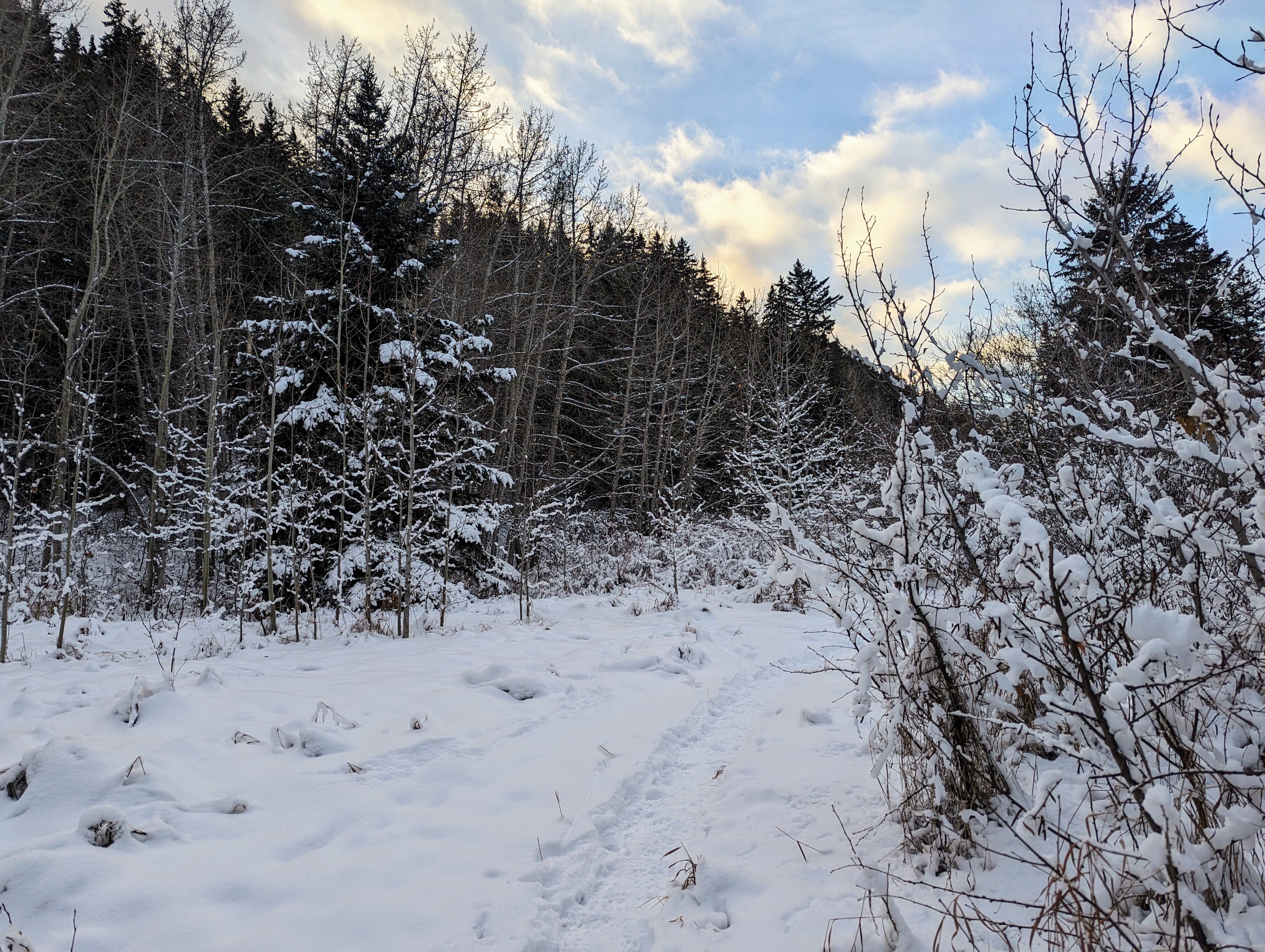
Photo by Joseph Schreiber

Some thoughts about two months of reading Norwegian literature

I started 2022 with a personal decision to focus on Norwegian fiction for at least January and February. There was no particular reason apart from a couple authors I wanted to visit or revisit and a general sense of Norwegian literature fitting nicely into a Canadian winter. Canada is a similarly northern country, albeit much larger, and I have often felt “at home” in the climate and landscape that emerges in much of what I’ve read from Norway. Of course, although I had a number of Norwegian books already on my shelves, this little project inspired the purchase of more, a trend that continued during the reading.

So, I have some thoughts about this experience. I read a total of seven novels or short story collections by five male and two female writers. This was the first issue. I had difficulty finding female authors of interest, although I have since become aware of a number I’d like to explore. My initial searches brought up a predominance of writers of noir and historical fiction—neither genres of particular interest. And then I inadvertently purchased a few titles that turned out to be Danish, not Norwegian, enough that I could probably do a month of reading female Danish authors. I will confess, though, that I was curious to read recent work by male authors my age or a little older, and in that respect, four of the novels I chose fit the bill.

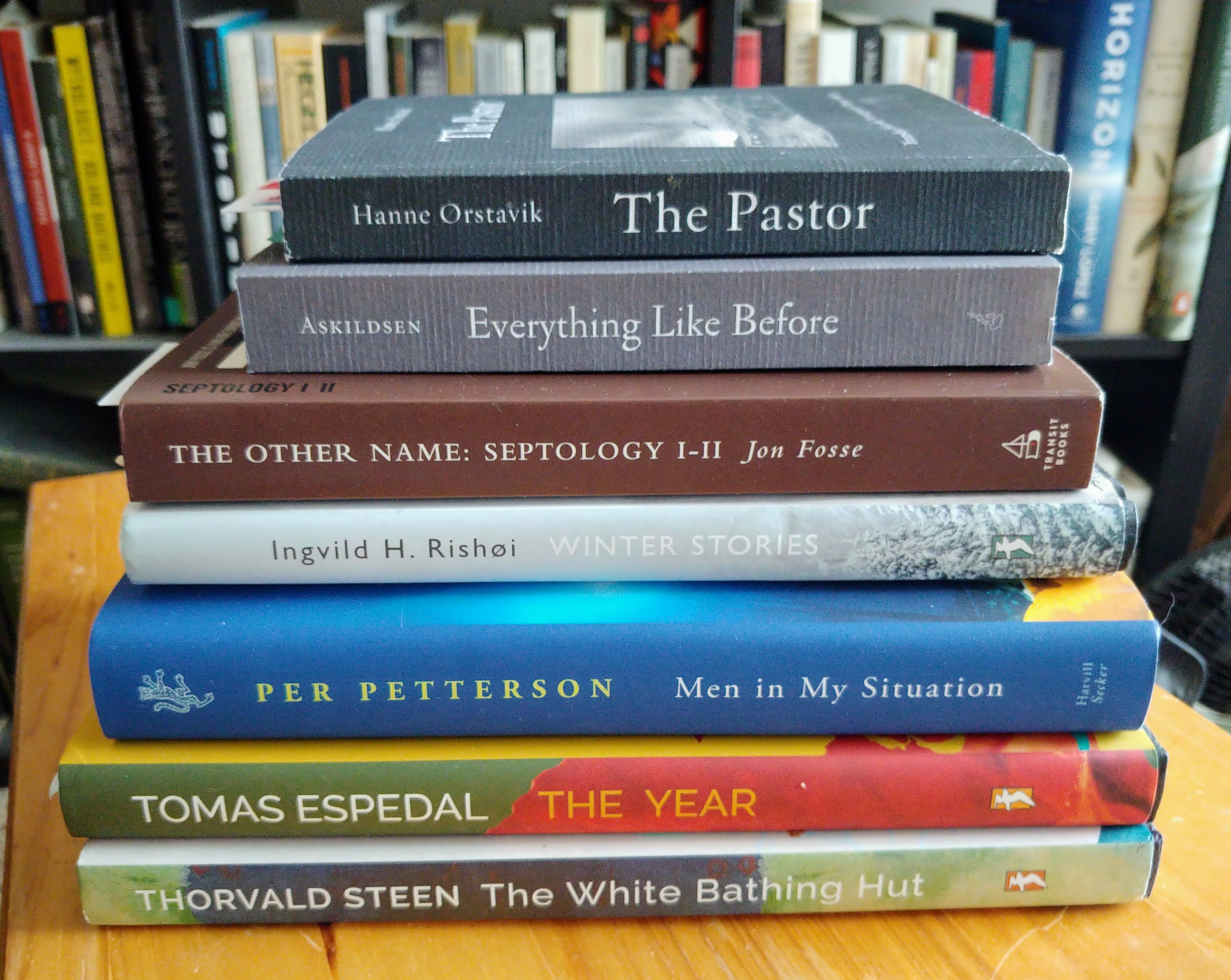
I really enjoyed five of my selections, had a few minor issues with a sixth and was decidedly underwhelmed by a seventh. I decided not to review that title, as I felt there was little to gain by dissecting a novel I found so disappointing—I’m ready to accept that the problem is probably with me—but my response does deserve a few words here. The book is The Other Name: Septology I–II by Jon Fosse (translated by Damion Searls–Transit Books/Fitzcarraldo). I have yet to read anything but praise for this work which extends for seven parts over three volumes and I honestly expected it to be a book I would have liked. But, not so.

It’s the story of an aging artist, a widower, who is a misanthropic loner with a rather religious temperament. In the nearby city lives another artist with the same name, matching the same description, whose life has followed a very different course. He is drinking himself to death. Other characters in this small cast also echo one another in name and biographical details but live different lives. Or so it seems, because our narrator, Asle #1 as I thought of him, and no one around him, appears to notice the duplication beyond the name. The story unfolds in a ponderous leaden prose—a glacial stream of consciousness—ostensibly a single sentence, but one that reads more like “sentences” with an absence of full stops. Other punctuation occurs and any dialogue is off-set in the text. However, I could not help but feel that the author has given himself too much runway for the story he is trying to tell. It not only drags on, but his imagined memory episodes, like two sections where Asle watches (and listens to) a young couple (obviously himself and his late wife) in a park, made me irritated rather than impressed. The general narrative style and the potential metaphysical questions at play appeal to me, but the execution did not. I did finish it, if only to see if I caught the spark others have felt, but although the second part was an improvement, I can’t imagine going any further.

I could not help but wonder if The Other Name suffered in part from the fact that I picked it up, halfway through this project, after beginning with two books that I loved, my favourites overall as it turned out. Tomas Espedal’s The Year is a stream of consciousness novel in verse about aging and loss that is intelligent, humorous and sad, whereas The Pastor by Hanne Ørstavik is likewise a deeply internalized narrative, dark and meditative that also deals with grief and matters of faith. These first two reads were so strong—that is, perfect for me at this moment—that I filled in the rest of my Espedal collection and bought Ørstavik’s earlier novella Love. It’s worth noting that I was not put off Fosse altogether either, but rather than looking ahead to complete his Septology, I bought one of his very short novellas. I think I might appreciate his work more in a very tight space.

The balance of my Norwegian project featured three new-two-me authors, Thorvald Steen (The White Bathing Hut), Ingvild H Rishøi (Winter Stories), Kjell Askildsen (Everything Like Before)  and one long-time favourite, Per Petterson (Men in My Situation). When I think about it, the one theme that binds every one of the  books I read is isolation. That is, perhaps, a significant aspect of the appeal for me.

All in all, this little Norwegian project has been a rewarding experience—I read a lot of great books and bought even more. This is the first time I have set a solid goal early in the year and met it. I have also read and reviewed several nonfiction and poetry collections and one other short story collection since the beginning of January. It feels good have been so productive, slow reader that I am, but it will also feel good now to think about reading without any strict self-imposed objectives for a change. However, I do hope it bodes well for 2022, reading wise. I mean, we’re still dealing with the pandemic despite the willingness of many governments to believe it’s over and the worsening situation in Ukraine and ongoing conflicts elsewhere are terrifying. Then, of course, there’s climate change and so much more. I would suggest we need literature and art more than ever at this time.