On the tree trunks the same two initials are always carved. By what knife, what hand, what heart?
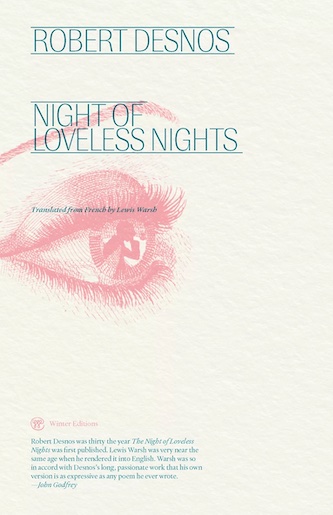
In 1973, Issue 10 of The Ant’s Forefoot, a New York City based poetry journal (originally started in Toronto) was devoted to one single epic poem—Lewis Warsh’s translation of Night of Loveless Nights by French poet Robert Desnos. As such, it was the first English publication of a book by Desnos, more than forty years after its original limited French release in 1930. The chemistry between Desnos, one of the early Surrealists and Warsh, a member of the second generation of the New York School of poets produced an translation that is attentive and sensitive to the original despite the fact that Warsh was born the year before the Desnos’s death. The context of the creation of Night of Loveless Nights is as fascinating as the story of its first appearance in English. Long out of print, this translation has now been rereleased in a special fiftieth anniversary dual-language volume from Winter Editions, complete with an afterword by poet David Rosenberg, the editor who originally gave Warsh’s translation a home.
 Robert Desnos was born in Paris in 1900. He published his first poems in his teens and, in 1921, he was introduced to the Paris Dada group and André Breton through poet Benjamin Péret. He became an active member of the Surrealists and demonstrated a particular gift for automatic writing. But he began to move away from Surrealism due to political differences and this led to a falling out with Breton. By 1929 the rift was more or less complete as Desnos joined Georges Bataille’s journal Documents. During the Second World War, he was active with the Resistance and, in February 1944, was arrested by the Gestapo. He died of typhoid in Terezin in occupied Czechoslovakia in 1945.
Desnos began writing Night of Loveless Nights, which he titled in English, in 1926 and completed it in 1928–29. It was inspired, like several other pieces he composed during this period, by his hopeless romantic obsession with night club singer Yvonne George. Although his love was not returned, he remained devoted to her through her increasingly crippling addiction to drugs and alcohol, to her death from tuberculosis in 1930. His epic unfolds over one anguished and feverish night filled with sleepless dreams, slipping in and out of opium delirium and infused with blues and jazz tones. Lewis came to Loveless Nights with little translation experience and less than full confidence with French, but he connected with the imagery, irony and rhythms of Desnos’s verse and felt he could carry it into English.
In his afterword, American poet and Biblical translator David Rosenberg recalls how he and his friend Warsh were both drawn to Desnos’s poetry over that of his contemporaries:
We were twenty-somethings when we took the French avant-garde poets in primarily the 1920s, from Max Jacob to Pierre Reverdy, as our forefathers of deadpan, no less than Louis Armstrong: it was the decade in which American jazz riveted Paris. Stein, Breton—they were too pragmatic for our sensibilities, though Stein was in our blood and manifested later. But Robert Desnos. . . was in-between; he seemed to push through surrealism and come out the other side as a literal dreamer, in search of reality and lost love. Desnos’s dreamer was parallel to a soul, disembodied—not the disordered mind’s “we must change life” of Rimbaud. Desnos was more grounded by loss.
Warsh was a regular contributor to Rosenberg’s The Ant’s Forefoot when he shared with him his Desnos translation for potential inclusion in the magazine’s upcoming issue. As they read it together over a shared joint, Rosenberg marvelled at its length and wondered if it would be feasible to turn an entire volume over to a single text. Excerpting it did not seem to be an option; it had to be reproduced in full. Desnos’s original publication was a collaborative effort with painter Georges Malkine who provided illustrations to accompany the text. Financial constraints and devotion to a minimalistic aesthetic guided the layout and production of the English edition which included archival photos provided by Lewis. The cover featured original artwork by Rosenberg himself, which is reproduced in the present fiftieth anniversary edition. Otherwise, the materials and production techniques employed in issue 10 of The Ant’s Forefoot are now lost with a graphics art scene that no longer exists. But the Winter Editions anniversary edition now has the advantage of extra space—the French text runs alongside Warsh’s English version, allowing a bilingual reader to appreciate how poet meets poet in this now-classic translation.
Night of Loveless Nights opens with vivid imagery that leans toward the surreal, but with the long initial section of rhymed quatrains, Desnos is adopting a classical form. Warsh does not attempt to reproduce the rhymes, but focuses on staying to true to the mood, tone and important motifs that will recur throughout the long dream-soaked night that follows. One can almost smell the foul air:
Hideous night, putrid and glacial,
Night of disabled ghosts and rotting plants
Incandescent night, flame and fire in the pits,
Shades of darkness without lightning, duplicity and lies.Who sees the rivers crashing inside himself?
Suicides, trespassers, sailors? Explode
Malignant tumors on the skin of passing shadows,
These eyes have already seen me, shouts resound!
Quatrains like these carry much of the poem, broken first by a section of landscape inspired prose poetry and then by stanzas that vary in length and form. Desnos then returns to the stricter quatrain format before falling into longer, often incantatory, free verse as the night stretches on and the speaker wearily and warily faces the brightening sky and his growing fatigue.
Desnos never names the object of his desire, but his longing and unrequited passion is laid bare. His romantic desperation is tangible:
I give everything to you, down to the heart of the ghosts,
Submit it to my fatal and delicate torment
Leave in order to disappear in two lines of a book
Without having invoked the evening of lovers.I am tired of fighting the destiny which conceals me
Tired of trying to forget, tired of remembering
The slightest perfume which rises from your dress,
Tired of hating you and blessing you.
Although Desnos had, perhaps, as Rosenberg suggests, “pushed through surrealism,” it is not entirely behind him here. Beyond a surreal quality to much of the imagery, Warsh’s translation retains a suggestion of Desnos’s experiments with automatic writing and especially something he called “sleep writing,” especially later in Loveless Nights where the verses become freer, the poet seeming to riff on an image, such as in an extended chant-like passage featuring hands which in part reads:
Hands that stretch hands that soften
Is there a sincere hand among them
Ah I no longer dare to shake hands
Lying hands loose hands hands that I mangle
Hands clasped in the prayer of one who trembles when I look him I the eye
Is there still a hand I am able to shake with confidence
Hands on the lover’s mouth
Hands on the heart without love
Hands cut by false love
Hands founded on love
Hands closed to love
Hands dead to love
Hands straining for love
Hands rising for love
And on it goes. It feels, when one reaches this passage, that the poet is drifting off while writing, until the hint of dawn at the windows pulls him back to attention. To read this poem is to accompany the lovesick speaker into the haunted and lonely night, but somehow the dark beauty and the underlying sense of opium-enhanced irony keeps it from feeling impossibly bleak. It is as if Desnos is aware that the depth and futility of his romantic and sexual obsession is the real drug that fuels his poetry and keep his pen on the page.
The fiftieth anniversary edition Night of Loveless Nights by Robert Desnos is translated from the French by Lewis Warsh, and published by Winter Editions.
 roughghosts