In this violent solitude: Light, Grass, and Letter in April by Inger Christensen

But do not grieve for me
do not grieve for your lonely
to and fro
My hour has rusted
My poem has left
your beaten track
Do not grieve My young poem
is more deeply kissed by life
Deathly it creeps
over under through me
Poetry is murdered hope.

(from “In the wild loneliness of the mountains” / Light)

Having read most of the poetry of Inger Christensen (1935-2009) that is available in English translation, to return now to her earliest published collections, Light (1962) and Grass (1963) is somewhat like experiencing the formative spirit of a writer who will soon make her mark as an original and experimental literary force. And yet, it is clear in these poems composed in her mid-twenties, that she is already exploring the themes and perspectives that will define her most ambitious—and most popular—poetic works. This is perhaps to be expected because only six years separate the publication of Grass from the release of her monumental 200-plus page book-length cosmic poem Det in 1969 (“It” in English translation, 2006).
The present volume contains her first two collections, along with her fourth, A Letter in April (1979), a collaborative project that followed ten years after Det. Light and Grass being only one year apart, share much in common and reflect the time in which they were written. Yet as translator Susanna Nied (who has translated all of Christensen’s poetry and is thus well acquainted with her oeuvre) says regarding these two books:

Her lifelong themes are already evident: boundaries between self and other, between human beings and the world; our longing and struggle for direct connection beyond boundaries; the roles of language and writing as mediators of that connection; the distances between words and the phenomena that they stand for.

Images drawn from nature, domestic settings, and corporeal existence feature throughout these poems, with a strong sense of the landscape, the seasons, and the musicality of her homeland. Many of the pieces in both volumes tend to be shorter and lighter in form, though the not necessarily in content, but notably, the final poem in Grass, the sequence “Meeting,” is longer , closer to prose poetry, and seems to presage  sections that will later emerge in Det/It.

The unknown is the unknown and gold is gold I’ve heard, one
.      winter the birds froze fast to the ice without the strength
     to scream, that’s how little we can do for words with words
the books press close to one another and hold themselves up,
.      backs to the living room, our buttoned-up words huddle
.      on the shelf, the queue-culture of centuries, inexorably
.      built up word by word, for who doesn’t know that the
.      word creates order

(from “Meeting: V” / Grass)

The third work collected in this volume, Letter in April, seems quite different in tone, quieter and more intimately focused. It arose as the result of a collaboration with graphic artist Johanne Foss who began with a series charcoal-on-parchment drawings based on Etruscan artworks. Christensen and Foss had known each other for a number of years and both had spent time at an artists’ residence in Italy and explored Etruscan ruins. Taken by Foss’s drawings, Christensen chose some and began writing responses to her images. These responses began as prose pieces, but she ended up discarding them and beginning again in poetry. Their project developed over two years as they worked together during the summer months while their children played. Several themes emerge in this work including parenthood, wonder, nature, and the account of a woman who travels to a foreign country with a child inspired by a trip Christensen took to France with her young son as part of her writing process.

Unpacking our belongings,
some jewelry
a few playthings
paper,
the necessities
arranged within
the world
for a while.
And while you draw,
mapping out
whole continents
between the bed
and the table,
the labyrinth turns,
hanging suspended,
and the thread
that never leads out
is, for a moment,
outside.

(Section I,  º )

However, more than a series of poems and drawings, Letter in April follows a complex yet unassuming structure. Each of the seven sections contains five segments marked by a sequence of small circles in varying order. For example, Section I follows the pattern: º º º º º, º º º º, º, º º, º º º .  Section II begins with º º º , and likewise each section begins with the same marking as the final segment of the one preceding. These markings link poetic segments with shared motifs, allowing  the entire work to either be read straight through, or by following the each pattern individually (i.e. I º, II  º, III  º, IV  º, and so on).  This flexibility reflects Christensen’s musical and mathematical instincts,  which are also apparent in the arrangement of elements of Det/It, but will be given full reign in her wonderful numerically and alphabetically framed poem Alphabet (1981).

Light, Grass, and Letter in April is a rich compilation of poetry that offers insight into Christensen’s development as a poet from the mid-twentieth century inspired modernism of her earliest work, through to a collaboration (unique in her oeuvre) that incorporates visual and dynamic elements. It is essential for those who already know and love her poetry, but can also serve as an introduction for those who have yet to encounter her masterworks.

So here we sit
in this violent solitude,
where bulbs work
underground,
and we wait.
Around noon
when the mountain rain stops,
a bird stands
on a stone.
Around evening
when the heart stands empty,
a woman stands
in the road.

(from IV  º º º º º)

Light, Grass, and Letter in April by Inger Christensen, is translated from the Danish by Susanna Nied, with Drawings by Johanne Foss. It is published by New Directions.
The words / created their own states of being: “it” by Inger Christensen

It may seem hard to imagine that a single poem (or sequence of poems) extending over 200 pages could become an instant hit upon publication, embraced by critics and the public alike, but that is exactly what happened when Danish poet Inger Christensen released what would become known as her masterwork, it, in 1969. What, you might wonder, does this simple pronoun, “it,” refer to. It might be simpler to ask what “it” does not refer to, for here it is simply the personal pronoun for the impersonal verb “to be”—as in “it is.” Danish, like English, necessitates such a construction, so this epic, moving as it does from the most basic elements, expanding in relation to one another, on into a world formed and named in its process of coming into being, and finally differentiated into individual, experiential existence, is a grand orchestral exploration of the nature of life. But it is also a piece that pulls you into to its rhythms, echoes and images. In Denmark it has become so iconic that sections have been set to music and certain lines from it have entered the daily lexicon.

In her introduction to the 2006 English translation by Susanna Nied, poet Anne Carson views Christensen as a contemporary counterpart of Greek epic poet Hesiod combining elements of his hymn of creation, Theogyny, and his moral guide, Works and Days: “Her det [it] is at once a hymn of praise to reality and a scathing comment on how we make reality what it is. The dazzled and the didactic interfuse in det.” However, the requirement for a personal pronoun for “to be” which does not exist the same way in Greek, means that her cosmogony is also a cosmology—a condition made explicit in the structure and realization of it. In a 1970 article, “In the Beginning was the Flesh” (quoted by Carson but since made available in its entirety in the essay collection The Condition of Secrecy), Christensen talks about some of the thinkers and artists, including linguist Noam Chomsky, whose ideas contributed to the genesis of what she a began to realize would be a creation poem:

Then I started thinking a little about this sentence: “In the beginning was the Word . . . and the Word was made flesh,” I thought, what if we could think the unthinkable: that flesh could speak, that one cell could signal to another, so that the whole inarticulate world suddenly partook in the following impossible (to human awareness) experience: In the beginning was the flesh, and the flesh was made words . . .

To maintain a hold on the duality of these two paradoxical conditions, she started to write as if she wasn’t there, “as if it (“I”) were just a bit of flesh talking, a bit of protoplasm, acted as if I were just following along, while a language, a world, took shape.” She called this part, the opening of her work, the time before consciousness, PROLOGOS. However, although it first emerges as a pre-sentence entity, the poems that comprise this section follow a strict mathematical formula. Each line consists of 66 characters (in the original Danish) and there is one 66 line poem, two 33-line poems, three 22-line poems, six 11-line poems, eleven 6-line poems and so on until the final set of sixty-six single-line poems. (The translation is unable to preserve the character count of each line, but does keep the number of lines.) Thus, PROLOGOS sets the cosmological grounding for the poem to follow, moving from the most fundamental elements—beginning, of course, with “It. That’s it. That started it. It is. Goes on. Moves. Beyond. Becomes.”—and moving through abstract form and function, slowly evolving over time. Cosmic. Geological. Natural. Communal. And, finally, individual.

It’s come around. Come to stand on its own, confront itself. To disengage from the mass and stand out. It’s engaged in an evolution, shifted its stance, attained eminently engaging expression. Has pursued itself and accidentally found itself. As a natural result. Has come to stand for itself. And can begin by itself. To experiment with sets of freestanding, free-floating expressions. Occasionally with straight-swimming ones. Dreaming. In another world. To imply itself.

(from PROLOGOS)

The main body of the poem, LOGOS, explores the word as creative principle, or, as Christensen puts it: “The place where things are consciously staged, put into action, into relationship.” It contains three sections, STAGE, ACTION, and TEXT which are each further divided into eight subsections of eight poems each (Christensen, as ever, loves mathematical and musical structure). The inspiration for the subsections came from a work titled Præpositioners teori (A Theory of Prepositions) by Viggo Brøndal, an attempt to classify the words languages use to show relationship. She selected:

eight terms that could stay in a state of flux and at the same time give order to the indistinctiveness that a state of flux necessarily must produce: symmetry, transitivity, continuity, connectivity, variability, extension, integrity, and universality.

And thus, the stage was set, so to speak.

It is perhaps not surprising that the poems that comprise the first section, STAGE, are more varied in structure and form than those we will see later, order comes with time. Words are at work: “The words / created their own states of being / made a world out of ‘world.’” (STAGE, symmetries, 7), but it not a smooth operation. Here the imagery moves between descriptions of natural processes, and the intentional creation of sets, painted and varnished to “represent” mountains and scenery. A tension exists between what is and the way it can be expressed:

And when it’s said that words fly
(like birds that fill an end-
lessly vanishing space)
it’s probably to conceal the fact
that words are not one
with the world they describe.
Words do not have wings.
And neither do they flower nor will
but they take potential flowers
and set them in a garden
which they then set
in an image of a garden
in an image, etc.
The words stay where they are
while the world vanishes
This is a criticism of the way language is used
Because it’s a criticism of the way things are.

(from STAGE, connectiveness, 1)

When “I” becomes part of the dynamic, the relationship between humans and language becomes more complex, and existential questions begin to arise. This first part also introduces a wide variety of images, motifs, and refrains that will recur throughout the work as a whole, providing a coherency to it when read and experienced (as it is meant to be) as a single long poem.

With ACTION and continuing on through TEXT, Christensen introduces more structure—employing both formal and experimental forms— to the poems within each subsection, adopting a consistent line count, verse pattern and rhyme, if relevant, for at least the majority of the eight poems (Susanna Nied’s award-winning translation preserves form and rhyme whenever possible), thus adding an ever-shifting musicality to the poetry. Thematically, the net she casts is wide, taking in the natural world (deserts, forests, gardens), human awareness (self-identity, hope, despair, sex, death), and community engagement (cities, hospitals, factories). Her vision encompasses the personal and the political, always returning to the power of language, the fundamental quality of the word, creating and mediating the world as we know it, alone and in relation to others:

A society can be so stone-hard
That it fuses into a block
A people can be so stone-hard
That life goes into shock

And the heart is all in shadow
And the heart has almost stopped
Till some begin to build
A city as soft as a body

(ACTION, symmetries, 8)

Throughout the ACTION section, one can see the influence of the 1960s on Christensen’s  worldview and some of the imagery she employs. Of course, the more political and economic currents change, the more they stay the same. Poetry is timeless and this vibrant, life-affirming epic aims to reach beyond the limits of time—as does language—and as such, the third part, TEXT, offers poems that begin to speak to passion and meaning in living and loving. The tone, if not strictly prescriptive, carries positive energies. There are no promises that things will be easy or pain-free, but it is worth trying, even in a world that contains darkness and corruption.

After the fourth morning I seek
the lips’ speechless expression

Again and again I stand completely
still so the wheel goes around and
there’s no cause for panic

What you gave my thought is no-
where, with a body that’s a
gift to the earth

What you gave me is pure rest / restlessness

My passion:  to go further

(TEXT, variabilities, 4)

By the close of this section, the “I”, the speaker, has come to an understanding of her interconnectedness with the world, and all that it contains.

Then, finally, comes the EPILOGOS. Beginning and ending with “That’s it” this piece works its way through the many shades and facets of fear we encounter as embodied beings, to slowly embrace words as the very cells of the body, and ultimately find freedom in letting go:

Erotic attempts
when the body
in its blind
sexual
activity
strives to be invisible
the cells are words
when the body
is lost
in it all
and lost
as it is
persists
survives
surpasses
itself
and its limits
the cells are words

(from EPILOGOS)

This is a work that, the deeper you get into it, benefits from longer, sustained reading sessions (especially if inclined, as I tend to be, to move slowly through a collection of poems). Although any one of the poems in this extended, structured sequence could stand on its own, they speak to one another, repeating and re-imagining phrases and imagery—a quality that tends to mark Christensen’s poetry and prose—so that the reading builds its own exhilarating momentum. it is an experience.

it by Inger Christensen is translated from the Danish by Susanna Nied with an Introduction by Anne Carson and published by New Directions.

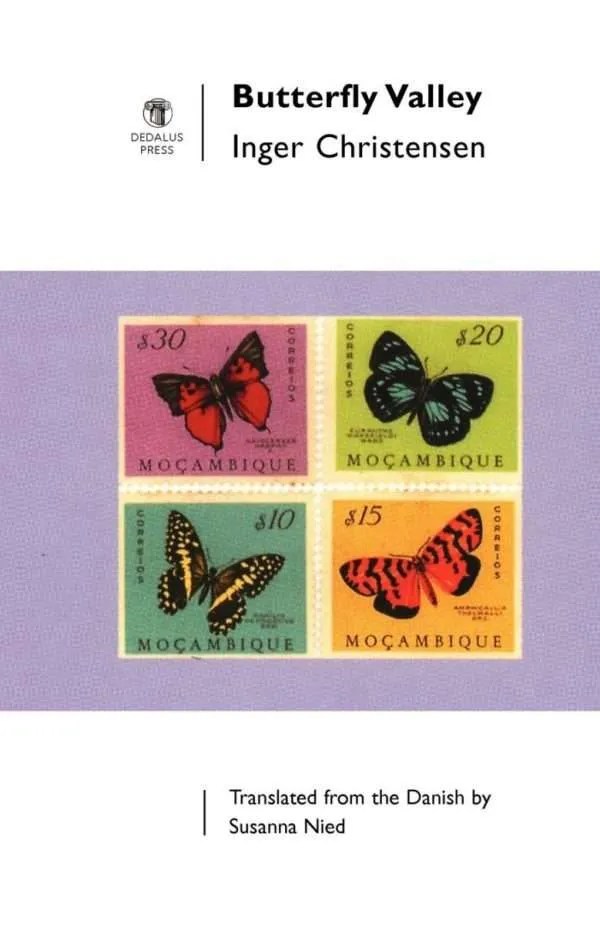
Elegy on the wing: Butterfly Valley by Inger Christensen

Since reading The Condition of Secrecy, a collection of essays by Danish poet and writer Inger Christensen (1935–2009) In January, I have set out to read one of her works each month until I run out of available volumes. This past month was largely absorbed by working for and worrying about the Canadian Federal election which has just passed, so my reading was scattered at best, and most suited to poetry and short fiction. I am squeezing this brief reflection on this single-poem volume, Butterfly Valley, as National Poetry Month draws to a close. Note that this is a dual-language edition, whereas the US edition from New Directions entitled Butterfly Valley: A Requiem contains this same translation by Susanna Nied, Christensen’s longtime poetry translator, along with three other medium-length poems, but does not include the original Danish. I intend to get that book eventually, however I would suggest that having the original and the translation face-to-face allows a reader to appreciate the complexity of Christensen’s achievement as it is possible to gain a sense of the musicality and rhyme structure present in the Danish, even though it would be unsatisfactory to attempt to reproduce that fully in the English.

“Butterfly Valley” is a fifteen part sequence of sonnets, the first fourteen linked by first and last lines which are then gathered form the final powerful poem. Christensen was a lover of form, structure, and imagery drawn from science and nature. Musicality was also very important. These qualities all come into play with this sequence which features the fourteen lines of the sonnet presented as two quatrains and two tercets with the rhyming pattern: ABAB CDCD EFE GFG (several follow ABBA CDDC in the first two stanzas). The poems are linked by repetition—through the first fourteen sonnets, the last line of each sonnet becomes the first line of the following one. VI, for example, closes with:

Here gooseberry and blackthorn bushes grow;
whichever words you eat, they make
your life butterfly-easy to recall.

Perhaps I will cocoon myself and stare
at the white Harlequin’s sleights of hand,
delusion for the universe’s fool.

And VII begins:

Delusion for the universe’s fool
is the belief that other worlds exist
that there are gods who bellow and roar
and call us random tosses of the dice

The fifteenth sonnet is composed of all of these repeated first/last lines, in order, with the typical rhyming pattern maintained. Each individual sonnet is thus crafted with an eye (and ear) to the finale.

Within this sequence, a host of colourful butterflies rise and fall through the Brajcino Valley’s noon-hot air. Christensen, who believes that poems are composed of words, first and foremost, employs butterfly-related imagery and the names and colours of different species, directly and metaphorically, along with a mythologically-tinged sensibility. But her themes are the very human, even existential, reflections on life and death, love and loss, art and nature.

When with their image-language, butterflies
can use dishonesty and so survive,
then why should I be any less wise,

if it will soothe my terror of the void
to characterise butterflies as souls
and summer visions of vanished dead. (X)

As ever, Inger Christensen’s poetry is an intricate and articulate celebration of language, meaning and life itself. This slender volume highlights these qualities well.

Butterfly Valley by Inger Christensen is translated by Susanna Nied and published in a bilingual edition by Dedalus Press.

“somewhere I am suddenly born”: alphabet by Inger Christensen

I write like the wind
that writes with clouds’
tranquil script

or quickly across the sky
in vanishing strokes
as if with swallows

I write like wind
that writes in water
with stylized monotony

or roll with heavy
alphabet of waves
their threads of foam

(from “alphabets exist”)

In her essay “It’s All Words” (included in the collection The Condition of Secrecy), Danish poet Inger Christensen offers a very simple, yet possibly unexpected, statement about the nature of poetry:

But poems aren’t made out of experiences, or out of thoughts, ideas, or musings about anything. Poems are made out of words.

It’s through our listening to the words, to their rhythms and timbres, the entirety of their music, that the meanings in them can be set free.

This particular essay happens to be about her stunning work, alphabet, a book-length sequence of poems in which each piece builds on, remixes, revisits, and expands upon what has come before. It is project that began as process of collecting words and, as she was foraging through the dictionary, she happened upon what would become her form: the Fibonacci sequence.

The concept was introduced to the western world by the medieval Italian mathematician Leonardo of Pisa (later referred to as Fibonacci by 19th century scientists) in his Book of the Abacus in 1202, although the calculation originated with Indian poetics and mathematics as far back as 200 BC. This sequence in which each successive number is the sum of the two preceding it (0,1,1, 2, 3, 5, 8,13, 21, 44, 65, etc) describes an exponentially increasing mathematical pattern that often occurs in nature as in the spiral growth seen in certain plants.

By combining this formula, or “wordless universal poem of numbers,” with the human-made alphabet, Christensen conceived of a structure (or implied form) for an unfinished sequence of poems. A framework upon which she could weave “a kind of spell”:

A prayer that apricots, doves, melons, and so on could continue to exist in the world. And at the same time, a prayer that atom bombs, hydrogen bombs, dioxin, and so on could disappear.

And herein lies the special charm of alphabet. Fourteen chapters, running from [a] to [n], each containing a single poem or series of poems that total a corresponding number of lines from 1 to 740.

The first poem simply reads: “apricot trees exist, apricot trees exist,” the second: “bracken exists; and blackberries, blackberries; / bromine exists; and hydrogen, hydrogen” and so the essential pattern is set, introducing the existential aspect of the everyday matter around us—that which is good and beautiful, that which is toxic, and an element that can either be vital to life or destructive. As the poems become longer and more complex, these early images reappear and the alphabetic aspects are more or less evident. As each chapter expands there is, as in life, an increasing and startling diversity and variety to be found.

life, the air we inhale exists
a lightness in it all, a likeness in it all,
an equation, an open and transferable expression
in it all, and as tree after tree foams up in
early summer, a passion, a passion in it all,
as if in the air’s play with elm keys falling
like mama there existed a simply sketched design,
simple as happiness having plenty of food
and unhappiness none, simple as longing
having plenty of options and suffering none,
simple as the holy lotus is simple
because it is edible, a design as simple as laughter
sketching your face in the air

(“life”)

Christensen is a poet who delights in form, but prefers to set her own rules. Each poem has its own structure, but the use of repetition and recurring motifs contributes to the overall hymn-like quality of this work. She celebrates the beauty of everyday moments, delights in magic of the natural world and, as in her essays, shows an acute concern for the legacy of the atomic bomb and the nuclear fears of the Cold War (this book was first published in Danish in 1981). Her vision moves back and forth between these poles of existence threading words into verse.

Translator Susanna Nied had translated several of Christensen’s volumes of poetry before alphabet was even written (including her masterpiece It), so when this book was published in Danish, the poet sent her a copy. In an interview in Circumference, she describes how she sat down to read it as soon as it arrived. She read straight through and began to translate almost immediately without telling Christensen.

I did eventually show that preliminary alphabet translation to Inger, who pronounced it flot (high praise) and went over it with me, asking excellent questions, musing and reminiscing about how she had written the poems. We had a long tussle over whether the key verb should be “exist/exists” or “is there/are there.” Inger ultimately won, thank goodness, though it took me several months to capitulate. As we worked together during the six weeks I spent in Copenhagen, I recognized the content of alphabet in Inger’s daily life and in her memories. I recognized its cadences and phrases in her speech. Again, invaluable.

She goes on to describe working on the translation for years and, even once it was published she was still thinking of ways it could be improved. Nonetheless, the long working relationship between poet and translator is reflected in the care with which Nied realized the many intertwined and contrasting elements in this unique and engaging work.

I would like to imagine that this is an experimental poem (or sequence of poems) that is not only original, but accessible to those who might fear poetry. Meaning can be found, or revealed to a reader, in a very natural and yet personal manner. Sometimes the defining letter has a major role, other times less so. Her poems take off and move in unexpected directions before returning to call up familiar images in new ways. It’s a truly wonderful work and a fantastic, award-winning translation.

alphabet by Inger Christensen is translated from the Danish by Susanna Nied and published by New Directions.

An inexhaustible landscape of words: The Condition of Secrecy by Inger Christensen

Writing poems is just as much a mysterious miracle. Not that there’s anything mystical or ceremonial about it. Or anything religious. It’s a neutral miracle, so to speak, granted in advance, because in the process of writing we need to use language in its whole, indissoluble connection with reality. It’s that connection with reality that’s a mysterious miracle. And that’s what poetry has to enter into.

It is clear from the essays collected in The Condition of Secrecy, that Danish poet, novelist, and essayist Inger Christensen (1935–2009) was not only in love with words, but that she understood language—and the way we seek to give meaning to the world—as part of the dynamic process of nature. For those who are already familiar with the experimental writer’s poetry and fiction, this collection offers insight into her view of the world, which was heavily influenced by a lifelong interest in science, mathematics, and linguistic theory, and the questions she was inclined to ask about her own engagement with language. For those who are new to her work, myself included, her philosophical musings and poetic investigations are no less interesting, and may well serve as an invitation to explore her work further—and fortunately there is a good selection currently available in English translation with more forthcoming this year.

What is most immediate in this compilation of essays, originally published across four decades, from the 1960s through the 1990s, and arranged intentionally rather than chronologically, is the sheer force of Christensen’s intellectual curiosity. At its most basic, it is a book about writing and meaning, but a book by an original inventive poet trained in German, mathematics, and medicine, who read six modern and two ancient languages. And, as a child of the Second World War, social and political concerns are never far from her mind. The Cold War and the fear of nuclear annihilation casts a clear shadow on a number of pieces. So, although this volume only numbers 138 pages, Christensen encourages her reader’s close engagement with ideas as she herself works her way through her own questions about the world and the way we find meaning in it through language.

Words are, of course, essential and she has a wonderful way of employing them. Her opening sentences are often quite special. “Interplay,” an essay about coming to understand time and one’s place in history as a child in Denmark at the end of World War II, begins:

When I was nine years old, the world, too, was nine years old. At least, there was no difference between us, no opposition, no distance. We just tumbled around from sunrise to sunset, body and earth as alike as two pennies.

Another piece, one of several more explicitly about words, meaning, and form, especially in the art of poetry, “Silk, the Universe, Language, the Heart,” opens:

Silk is a noun. All nouns are very lonely. They’re like crystals, each enclosing its own little piece of our knowledge about the world.

This playful essay, in conversation with the Ars Poetica or Wen Fu of Chinese poet Lu Chi (261–303 AD), examines the personalities of nouns, adjectives, adverbs, and verbs, along with the ever important prepositions that hold them in relation to one another.

Another essay that explores the interconnectedness of words, meaning, and writing poems, “It’s All Words,” moves from an analysis of what it means to say: “The word creates what it names” with all its Biblical overtones, through an existential (and anthropological) notion of naming the world into existence, to try to answer the question of why poetry is not a common practice when it requires no special tools beyond a paper and pen.

As it is right now, when the world has existed for so long, words come from everywhere, and they’re never there for the first time. Not only that. Although there may not be an infinite number of them, nor an infinite number of combinations, nevertheless there is an inexhaustible landscape of words, there are more than any one individual could manage to travel through. This is where it ends and where it begins, if a person is going to write poems: in the imagined concept of this mysterious landscape. For poems are created exclusively from words.

What makes this piece especially intriguing is that it leads into a discussion of the creation of one Christensen’s most inventive book-length poems, Alphabet. She began collecting words and then, in her gathering, she happened to come across Fibonacci numbers, a formula of increasing numbers that describe a pattern present in the growth principles of many plants. By employing this structure, she had a framework upon which her poem could eventually grow and bloom.

Most of the essays in this volume are short, some are only a few pages long, but midway through, the longest piece, coming in just shy of 30 pages, marks a turn of focus to more philosophical and political themes—not without abandoning talk of writing poetry and fiction, mind you. “The Regulating Effect of Chance” is an extended discussion of the role that chance plays in the world—fundamental, as she sees it, in accord with Jacques Monod’s Chance & Necessity—and in our experience of the world, our tendency to assign a notion of fate or destiny, and our understanding of art, creativity, imagination and much more. The later essays turn their attention to subjects such as the nature of truth, the depiction of night and, in a futuristic and somewhat fatalistic effort, “Snow,” the idea of the inevitability of nuclear winter.

This collection is one that I have owned for a number of years, without any previous experience of Christensen’s poetry or prose. Several times I pulled it from the shelf, but it did not seem that the time was right. Now I am especially keen to read her poetry. There are four volumes available in English, all translated, like The Condition of Secrecy, by Susanna Nied who enjoyed a close collaborative relationship with Christensen when working on her poetry. So, all things in good time; the words will be waiting.

The Condition of Secrecy: Selected Essays by Inger Christensen is translated from the Danish by Susanna Nied and published by New Directions.