Everything here is dead: Brothers by David Clerson

My first book of 2017 is not the cheeriest of novels, but all the same, it came as a very pleasant surprise. The story is a dark fable, decidedly not for children, but then, the fairy tales we remember from childhood were much bleaker, gruesome affairs in their original incarnations. So imagine, if you will, a scene taking place just off the edge of a canvas painted by Bruegel the Elder, where two deformed boys play on the shore of a wild sea, dreaming of escape to fantastic lands, and you will evoke the setting—and the mood—of Brothers by Quebecois writer David Clerson.

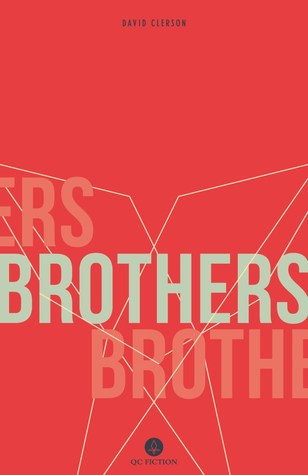
The third title to be released by QC Fiction, a new subscription-based imprint of Baraka Books, Brothers is quite possibly the Quebec publisher’s most daring and impressive offering to date (I reviewed the first release, Life in the Court of Matane for Numéro Cinq last July). This slender volume with the striking red cover—QC Fiction has chosen a most impressive graphic design for their books—cbrothersontains a world that overflows with mythological adventure, shocking violence, and nightmarish beauty.
Brothers plays with and twists themes pulled from myth and legend. The central character, “older brother” is born of the union between his aging mother and a wild dog. She does not want her son to face the world alone, so she cuts off his left arm and from that limb she fashions a “younger” brother who has two very short arms. The two disfigured boys spend their days running through the fields and marshes around their clapboard house, fishing off the pier, and scavenging oddities that the waves bring in.

One day the sea offers a wreck of a boat, another day a wooden puppet washes up. Together the brothers work to patch the boat as best they can, dreaming of the day that they cross the waters to distant lands populated with monstrous creatures in search of their “dog of a father.” When they find a drowned dog, they know that the time has finally come. With the older brother dressed in the animal’s tanned pelt, one of the puppet’s arms strapped to his shoulder in place of his missing limb, they set to sea, leaving their aging, desiccated mother behind. She has withdrawn from them so completely they doubt she will notice their absence.

The first days it took a long time to get away from the shore. Not by choice, but because the wind kept them there, or they didn’t know how to handle their sail, to make the boat go where they would have wanted. Instead, they followed the coast, in a direction they had never been, not toward the marshes and the neighbouring village, but out to where the coastline fell away steeply, with cliffs sliced by creeks and a multitude of shrieking birds soaring above.

The brothers are ill-prepared for their adventure. Illness levels the younger boy, storms rage, and ultimately, disaster strikes. The older brother eventually ends up alone, on a farm, chained to a doghouse. Yet he finds, for a time, a certain peace in this new existence, save for the torments dished out by the six pig-like children who also live there. He will even experience a mixture of love and lust with a grey dog—the daughter of a dog of a father—whose life has been much lonelier and harsher than his. But this respite does not last, and it does not end well.

If there is a moral here, it is that life is brutal—that goodness and evil are both instinctual survival mechanisms. The former is weak and the latter consumes. Redemption is elusive.

So why read it? The prose, beautifully translated by poet Katia Grubisic, is crystalline, spare, and unsentimental. The balance is just right… it holds you in awe. It is surreal, grotesque and beautiful in turn. The older brother is self-reflective. He notices his contentment, contemplates the stirring of love, and knows he is helpless against the escalation of murderous revenge. The cruelty he has experienced, the violence he has perpetrated, the guilt that haunts him, and the kindness he cannot accept leave their mark, shape him. He has existed at the intersection between beast and man—more whole and complete for the months he lives as a dog, as harsh and mean as they are—but in the end, in the absence of the brother who completed him—he can find comfort only in the company of a murder of crows. And it is insufficient.

This book is not, as I had feared, magic realism. This is not a human tale with a magic element—it is a magical tale with a human heart. Like a folktale for a post-apocalyptic future, Brothers, in all its grotesque surrealism, reflects a truth in which we recognize ourselves, with an equal measure of horror, sadness and shame.

Originally published in 2013 as Frères, this first novel won the Grand prix littéraire Archambault 2014.

Looking ahead to 2017: Finding light in the darkness

It may be a reflection of the year we have just endured as a global community, or the uncertain variables that cause 2017 to look like such a grey zone, but many people I know seem to be afraid to make any resolutions or commitments moving forward. A month or so ago, when I was still buried under a black cloud of grief and depression, I could not even imagine the utility of existing into the new year. I was in a peculiar space. I was receiving enthusiastic feedback for my work as a writer and critic—even selling a few pieces—but I felt empty and hollow inside. I could stand back and observe my malaise, but I could not bring myself to find an essential light to believe in.

Then, as suddenly as it had settled in, the darkness lifted. My parents are still dead, my friend is still gone, and I have not yet found a job. However, the stubborn, stupid optimism I always cherished as part of my character has returned. Wiser and soberer perhaps, and not at all naïve about the very real threats that the coming year holds. But with good books and the comradery of the many people I have come to know and respect, at home and afar, over the past couple of years, I resolve to try to read and write and photograph my way through 2017, come what may.

31760687801_ea5acb48c8_b

I have been making piles around the house lately and considered photographing them but have decided against being that committed in a public way. Suffice to say there is a healthy stack of fiction including a fair number of recent releases or purchases to which I am adding other titles I feel most guilty about ignoring to date. I have also been reading a good deal of poetry lately, new and classic, so I keep those handy. And then there is a growing collection of essays and memoirs which reflects my own interest, as a writer, in the variety of ways that personal experience or observation can be addressed. As much as I flirt with ideas of writing fiction, I seem to fall back into essay, at least as a starting point. If I end up taking a piece in the direction of storytelling or prose poetry, all the better, but the process has to be dynamic. I am learning to let my writing follow its own course as much as my reading does.

And this leads me to what might be thought of as my resolutions:

Reading: Some surprises surfaced when I added up my completed reads from 2016. I discovered that I read more German literature, than I had expected—11 titles, not including some Sebald that I am presently dissecting or the Kafka that I am always reading. I read 12 English language works (more actually, I have several essay collections and other books in process) and 8 translated from French. As for the balance of the translated literature I read, Spanish, Catalan and Portuguese accounted for a total of 10 books with many more waiting, while I read three Slovene, two Czech, and one each from Dutch, Korean, Arabic, Bosnian, Italian, Icelandic, Hebrew, and Polish.

Contrary to my previous pattern, I only read one South African, title though I added more and still have an embarrassing number of books crammed on to my bookcase. I had also intended to read more Arabic and North African lit and, again, failed. There are also a few key independent publishers I did not read from this year. So, all of these considerations will, if nothing else, be reflected in the piles I build. As to what I read—well, I’ll see…

Writing: I want to continue writing critical reviews but I am being very selective. Looking ahead I am especially excited about writing about new releases from Can Xue and Fleur Jaeggy for Numéro Cinq, while I also have a couple of other interesting reviews booked or underway. I continually debate the value of critical writing (this month the “Top of the Page “at Numéro Cinq features seven reviews—including one of my own—that I selected to highlight some books and reviews that impressed and inspired me). So often critics seem to be held in disdain and yet to write about a book sensitively and intelligently is challenging and creative—but it can be draining. Nonetheless, I have learned so much from the writing and from being edited, all of which has helped make me a better writer. Now that I am also involved with The Scofield as an editor I have further opportunities to continue to grow and contribute to the vital community of online literary magazines.

On the other hand, I am hoping to shift the focus of my blog a little, away from attempting to “review” books that I read (unless it seems appropriate). Rather I would like adopt a more personal reflection on the reading experience—try to pinpoint why the writing works, what ideas are generated, or simply celebrate reading for reading’s sake. I don’t ever want to feel obligated to write about everything I read, but at the same time I am increasingly reading books written by writers who are becoming friends and mentors. I want to be able to write about this work, in an informal, yet valuable way.

Finally, with what I call my “creative work,” I have several projects in mind or in process. One is an experimental, constraint-based project in honour of my father which may or may not lead to anything of interest to others. Otherwise, as much as I thought I was done with writing about the body, it seems that there is still a lot of unfinished business or baggage. It is inextricable from either my interest in being and authenticity, or my now expanded and complicated grief work. I am fortunate to have been approached by several online journals/sites that have invited my contributions and I am very excited about being able explore some ideas in smaller creative spaces to see where they take me. At the same time, I have a few other topics that I want, or even need to examine within, shall we say, a more conventional personal essay format.

Photography: After a long hiatus, I am inspired and eager to return to photography. A dear friend has kindly suggested —insisted— that I should incorporate more images into my writing. This possibility excites me and offers not only a direction for myself as a photographer, but also provides an opportunity to repurpose older shots, cropping and radically reprocessing images that were average and turning them into an integral part of a larger project.

So, even though it is impossible to know what the new year holds, I want to aim to face 2017 ready to build on what I have learned over the last two years which have held, for me, some of the most difficult and most rewarding moments of my life. It is really the only way I can think of to navigate what is bound to be a most interesting and surreal time.