Hardly at a loss for words: Aphasia by Mauro Javier Cárdenas

Imagine this: a novel about a would-be novelist, a writer of “so-called” fictions, or stories inspired by his life in Bogota, Colombia, now living in California, who steals time to write, avant-garde music flowing through his headphones, in the cubicle he occupies at Prudential Investments where he works as a data analyst. When the work day is done he heads home, no not Home, but to The Other Home, a studio apartment in building adjacent to the building (containing Home) and joined to said building by a shared laundry room. This arrangement allows our “hero” to maintain a connection and an illusion of family life with his former wife, Ida, and his daughters, Ada and Eva. Add an unstable sister and a mother, both across country, and a selection of past and present girlfriends, serious and casual, and you have the psychological landscape in which one Antonio Jose Jiménez exists (and sometimes tries to pretend he does not exist).

Aphasia opens during Summer #8 of Antonio’s semi-domesticated or post married life, and his former wife has, as is her custom, taken the girls to her native country, Czechia, to spend time with her parents. Normally their absence would be a green light for him to engage with previous lovers and/or pursue new romances. But this year he is worried about the potential threat such romances might pose to his precariously balanced family life, so he signs up for Your Sugar Arrangements, a site for wanna-be Sugar Daddies and Sugar Babies to connect under the name Arturo Ventanas. What could possibly go wrong? Or rather, what does this piece of information, offered on the very first pages of the book, tell us about our friend Antonio? Well, that he is quite capable of reasoning at cross purposes—in fact the entire novel could be described as an exercise in the tangling and untangling of his thought processes through an ongoing stream of remembrances, distractions and denials. A conventional narrative it is not, an absorbing reading experience it is.

This is the second novel by Mauro Javier Cárdenas featuring Antonio though the two Antonio’s don’t line up exactly. In The Revolutionaries Try Again he is an avant-garde music loving data analyst in California who returns home to Ecuador (which, rather than Colombia, is the author’s own native country) where, together with a school friend, he attempts to rekindle the political dreams of their youth. It is a boisterous experimental endeavour with multiple threads and an explosion of narrative styles. By contrast, the present incarnation of Antonio with his creeping middle-age anxieties is a quieter affair, but no less ambitious. Unwinding in a feast of long sentences that extend for pages without a break, Aphasia reads almost like a transcription of its protagonist’s thoughts and experiences shaped by what he thinks, knows and what he thinks he knows. Along the way, the incorporation of transcriptions of conversations he has taped with his mother, his former wife and his sister expand the world in which he exists.

This Antonio-centred world depends on a healthy amount of distraction, imagination and avoidance. His writing and reading drive much of it, his former girlfriends, Dora and Silvina, still occupy his mind, his occasional sugar arrangements complicate matters, his daughters command his affections, Nicola Carati, the hero of the Italian family saga, The Best of Youth, provides him an idealized alter ego, and, when required, Antonio even submits to his role as a data analyst. It’s a busy existence, one that clutters up the file cabinet in his cubicle at Prudential Investments because, if anything, Antonio is a master at compartmentalization. There is plenty he’d rather not think about, including a volatile family life with his father back in Bogota. However, the major elephant-in-the-room element is the current affairs of his sister Estela who, suffering from what seems to be schizophrenia, involve serious medical and legal challenges that continue to surface throughout the course of this novel:

—I don’t intend to write about my sister here, Antonio writes, among my so-called sugar arrangements—nor do I want to give you the impression my so-called sugar arrangements are a diversion from thinking about my sister’s misfortunes, Antonio writes, because of course my so-called sugar arrangements are a diversion, but so are all other activities that allow me to pass the time without thinking of the misfortunes that have happened are still happening to my sister—and although of course Antonio’s ashamed of his avoidance, no one needs to know, he won’t tell anyone, and thankfully he no longer believes in a god that can strike him for avoiding his sister’s misfortunes…

So, what will Antonio write about? Everything he insists he won’t write about and more. What he won’t/can’t write about the third person narration carries because what he writes and what he thinks and feels are often at odds. The recordings worked into the text allow key people in his life to speak for themselves to bring their own realities into the mix although not without Antonio’s questions influencing their disclosures. The narrative shifts perspectives multiple times within the same extended sentence yet remains internally driven by Antonio’s thoughts and experiences.

The style with its long circuitous sentences, intentionally repetitive and often uncertain and self-contradictory, will immediately call to mind Thomas Bernhard, and he is among the many literary presences in this book. Antonio, as a writer, tends to perceive and frame things in terms of literature, film and music, so writers and their works—including Sebald, Krasznahorkai, Beckett, Chekov, Virginia Woolf and many more—appear among these pages, sometimes employed in the most unlikely contexts. Encountering these elements is part of the fun of reading this work. And Aphasia is fun to read, falling into the rhythm of the long passages, and riding the waves of Antonio’s contradictory thinking and overthinking.

Essentially, this is a novel about what is going on in the presumably ordered if cluttered mind of its central character and, as somewhat of a counterpoint, in the disordered, psychotic mind of his sister. What has happened and what might happen is secondary to what Antonio thinks about these things, consequently he often acts without seeming to think at all which is, of course, what we all do so much of the time, for better or worse. Yet, this is, at heart, a book about family—the family histories that form us, the obligations they bring, and the complicated emotions involved in creating our own families whether accidental (as for poor Antonio) or otherwise. These are, of course, the themes troubling much of Antonio’s mental real estate. Whether he reaches any insights or not is secondary to the journey itself.

Aphasia by Mauro Javier Cárdenas is published by Farrar, Straus and Giroux.

A map of your absence: If You Kept a Record of Sins by Andrea Bajani

Some novels greet you at the door—or in this case, just beyond the baggage claim—engage your attention, and hold you, sentence by sentence, through the past and the present, until you reach your final destination. If You Kept a Record of Sins, by Italian writer Andrea Bajani, is such a book. Yet the magic of this story lies entirely in the telling—in the delicate balancing of select, sharply depicted images within a spare, measured narrative that simmers with barely restrained emotional tension. On the surface, it’s the tale of a young man grieving his mother’s legacy of repeated departures and arrivals, the mainstay of his childhood, while he attends to her final dispatch in Romania, the ultimate faraway destination from which she would never return. His prospect of achieving closure, however, is tenuous for beneath the surface, complex and conflicted feelings remain unresolved.

The novel opens with Lorenzo’s arrival in Bucharest and his initial contact with Christian, the driver who will serve as his guide to the city and his means to understanding some elements of his mother’s life. Although she is dead, she is never far away—Lorenzo’s account is essentially directed toward her—but his tone speaks to an unbreachable distance. After enough time, absence no longer to makes the heart grow stronger. Addressing her is perhaps the only way to make sense of his loss:

You started leaving when I was young. The first trip was for pleasure, to go meet some friends who were off trying to strike it rich. You drew the world on a sheet of paper the night before, to show me where you were going. We’re here, you said, and tomorrow I’ll be right down here, in this spot. You drew a line with a red marker from home to there. It’s a bridge, you said, it’s like crossing the river to the other side. And under the bridge we colored everything blue; we filled in the water of Europe. Then we taped the picture to the refrigerator, and that’s where it stayed for years to come.

His mother’s trips became more frequent. Promotion of her egg-shaped, sweat-inducing weight loss machine takes her around the world. The souvenirs she brings home multiply in her son’s room, mapping her absence. When she is home, the increasing presence of her business partner in her life begins to put a strain on her marriage. Before long, the partner and the promise Romania holds as the ideal base for their enterprise is too strong and finally she is gone for good. Left behind in Italy, Lorenzo and his dad will never see her again; even the phone calls will dwindle as the years pass.

Now grown and finally in Romania himself, Lorenzo is reunited with Anselmi, his mother’s business partner, a loud, brash Italian who has clearly found a level of success and self-importance that would have eluded him at home. He is of a breed, not uncommon in the country—latter-day middle-aged foreign opportunists—and Lorenzo will encounter more than a few men of this type, including another long-time friend of his mother who reveals to him the shocking and sorry state of her final years. No one is exactly forthcoming with details, but Anselmi has taken up with a young Romanian woman named Monica who seems less than thrilled with her circumstances and rather attracted to the young Italian she has been ordered to attend to. Lorenzo, however, is seemingly most comfortable in the company of Christian, his mother’s long time driver. With him he is able to be present without pressure. Together they visit Ceausescu Palace, spend time in the city, share both laughter and silence. Lorenzo is gently attentive to the hidden strengths Christian seems to carry, leaving a faint erotic tension in the air.

If You Kept a Record of Sins offers an account that rides as much on what is unspoken as on what is shared. The narrative is economical and precise, moving from one finely honed image to another. Lorenzo’s mood is lonely, detached. He is cautious in his engagement with others. The abandonment he felt at a young age comes through even as he recalls tender moments of play or adventure with his mother. As an adult he appears to be grasping at something to feel for someone he hardly ever knew. Her own family, he is aware, were oddly unforgiving and remote themselves, while her final years in Romania were marked by romantic betrayal and self-destruction, but how to make sense of the damage she was responsible for between those two ends? A mixture of love and ambivalence fuels this bereaved son’s ongoing one-sided conversation with this mother as, for example, in this account of his first night in her apartment:

The mirror was too low—it cut off my head—and to think there was a time you used to lift me up, to look into my eyes. I was still wet when I left the bathroom, a trail of droplets behind me. I turned off all the lights, except the nightstand lamp. I took my pajamas from my bag, put them on, and went over to your bed. I dropped onto it, tried to bounce, then slipped under the covers. And it was almost as if I felt your bones, under there, that I was lying between bone and muscle and had to stay very still, or else I’d hurt you.

This is a novel at once sombre and hopeful. Beautifully translated by Elizabeth Harris, it never falls in to oversentimentality. Grief is idiosyncratic, sometimes elusive, and Bajani captures this complexity well. The cast of complicated secondary characters add depth to Lorenzo’s experiences without ever distracting or weighing them down. Reading fiction this well-crafted is a joy.

If You Kept a Record of Sins, by Andrea Bajani is translated from the Italian by Elizabeth Harris and published by Archipelago Books.

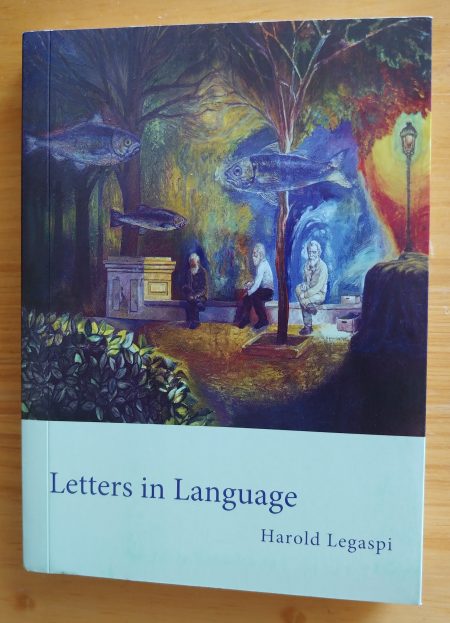
Troubling the alphabet: Letters in Language by Harold Legaspi

What can a language reveal? What can it obscure? If your memories were birthed in one culture, can they be retrieved elsewhere? What is gained and what is lost when you migrate from one land to another, from one language to another? How does this shift affect the spelling and the telling of a life?

Wittgenstein’s aphorism: ‘The limits of my language mean the limits of my world’ is false; there were thoughts that lacked words. We doused ourselves in neologisms. Dorothy repeating ‘there’s no place like home.’ A memory burn: the first time I saw a man kissing another man. (from Chapter 9)

The thirty-nine part prose poem that comprises Australian poet Harold Legaspi’s pocket-sized volume Letters in Language seem to dance around these questions, indirectly entertain them. Flirt and tease. Lean in closely. Look away. Catching, again and again, his own reflection.

Drawing inspiration from American Language poet Lyn Hejinian’s My Life, Legaspi has entered into his own experimental autobiography. Hejinian’s ground-breaking work, as published in 1980,  featured thirty-seven non-narrative prose poems, each thirty-seven sentences long—one for each year of her life at the time of writing. A second edition, revisited the project, growing with the poet, to forty-five pieces of forty-five sentences each. These sentences refuse direct connection to one another, defying the sequential illusion of conventional life writing. How do we remember ourselves? In fragments and moments, yet somehow, through the translation into language, patterns  and a sense of wholeness emerges. But is it real?

To read My Life is to let the words, the sentences, flow over you. There is a continuity of voice, and of the nature of images that interconnect when memories arise—details of a childhood for example may include activities, rooms, sounds, objects, and observations from a mature vantage point—but the intentional corralling of these images into narrative form distorts the truths it endeavours to preserve. The reader is invited, not to interpret and decode, but to respond from their own experiences of life.

Letters in Language mines a similar domain—life lived—but within the context of a Filipino family, a displaced culture, and multifaceted  questions of identity. I don’t know the author’s age at time of writing, but he does not hold to constraints of length. Legaspi’s language is playful, sentences often clipped and short, with images drawn from pop culture, even current realities like Covid-19 tossed in. The lines tumble over one another, appear connected for a stretch and then not, punctuated with aphorisms, self-reflection, rhetorical questions. The sentences have a transitory relation to one another, as if meaning is, at any single moment incidental and yet sensible. Not unlike the way the fragments and pieces of our own lives are shuffled and reordered each time we pull a memory card from the deck. New contexts constantly reshape who we think we are, refashion our ever-fluctuating histories.

Ever present amid the poems that fill these pages is the author’s lola—his memories of his grandmother fuel his own. The opening sentence reads: “My lola swept autumn leaves with walis tiniting, burned them in a can, wearing her grand billowy housedress.” Walis tingting is a Tagalog word for a broom constructed of coconut midribs. It sweeps its way through Filipino households. Likewise, the expression sweeps its way through these poems—a recurring image or an action that seems to signify the way we sweep through our memories, sweeping some to the forefront, others under the rug.

I who thirsted for knowledge. My niche unknown. Underneath the black economy. Where dry spells quelled my dysphoria. Fixed under the shade of a Bodhi tree. Away from air-conditioned air. Reborn. Conquered. A tangential awakening. Slid straight through, vagina dentata. The tip of my bayonet inched in her spine. Folk tales whispered, they got rid of me efficiently, like a baby out with the dingo. My mother, no shrinking violet. Did what was necessary. To cover up the blame. Walis tingting. As for the men, whose words were carefully chosen—passed on their phobias. My uncles. After thirty-nine years of solitude. Raised me like their own. Classed as a freak, unable to procreate like their sons and daughters (from Chapter 26)

So who is the “I” who lurks in this extended prose poem? A poet who exposes himself through his passions—emotional, intellectual, sexual and spiritual—played out against a formative soundtrack of music, films and books; bound by friends and lovers, and framed within a multigenerational Filipino family. Letters in Language never drifts far from the unresolved reality of the migrant existence, from the feeling of being defined by and yet disconnected from a land that is now somehow alien. After his grandmother, his unaltered link to the Philippines, has passed, Legaspi becomes aware of a kind of anchorlessness. One that rests in language, between a present language that cannot contain the loss, and an ancestral one not comfortably in hand: “Where English was an oblique mirror to my alter ego. I found myself faint with anxiety, a fictional object my truth. A truth with no original, veiled, forsaking to journey where it all began.”  The need to acknowledge this fundamental lack of grounding is then reflected in the closing sections of this text. Chapters 34 to 37 are composed almost entirely in Tagalog, a shift accompanied by translated versions. Thus, of all the questions of identity that surface and resurface throughout this poem, it is the poet’s own bilingual identity that troubles the deepest waters. Casting uncertainty on what has come before. What, if anything, has remained unarticulatable? Lyn Hejinian’s original autobiographical project is essentially unfinished, with material appended over time. Like life. What of Letters? That is not a question to anticipate in advance. Like life.

Letters in Language by Harold Legaspi is published by flying island books, ASM, and Cerberus Press.