
Nothing comes to the surface in solitude except that which is already deep within us. I suddenly became aware of many fears. In front of me was a meadow, ploughed and moonlit, reaching all the way to the wall of the Monastery. And a human being, any human being, is afraid of emptiness. I was afraid to enter the meadow that was exposed from every direction. There were some olive saplings that looked like faint shadows, like ancient monks in their dark habits…
In his mid-forties, with the bittersweet weight of a cancer diagnosis on his heart and mind, Palestinian poet, writer, and philosopher Hussein Barghouthi made the decision to return to the village near Ramallah where he was born after what he describes as thirty years of self-imposed exile. If “bittersweet” seems an unlikely adjective for such a serious circumstance, it is appropriate only because Barghouthi was initially led to believe his symptoms might be indicative of AIDS—a condition he feared he would have most certainly passed on to his wife and young son. So when news that he was, in fact, dealing with cancer came, he greeted it with joy. At least at first. But as someone who had, by his own admission, “perfected ‘beginnings,’” his journey home would be an “imperfect ending.” Among the Almond Trees, his meditation on life, death and rebirth, captures his thoughts and experiences as this ending nears.
 Barghouthi’s only other work currently available in English translation is The Blue Light, a weird and wild account of his years as a graduate student in Seattle in the late 80s and early 90s, interspersed with recollections from his childhood and earlier adult years. But with the off-beat urban terrain he frequents, the eccentric, marginalized characters he befriends, and the exploration of mysticism and madness that he pursues, it can best be described, as I noted in my review, as a memoir with hallucinations. By contrast, Among the Almond Trees, composed around the same time, has a much more contemplative, grounded tone. This is still a work with strong spiritual, mystical and philosophical elements, but here he is focused on memory, family mythology, and the longing to understand himself within the cycles of life and death. All of this is deeply rooted in the land.
Having intentionally kept himself apart from the village of his birth for so many years, Braghouthi’s return inspires him to embrace his ancestral connection this location, with its mountains, valleys and trees. He is seeking to reinforce a spiritual connection to his family history, a line which reaches into the past and will extend into the future. Central to this exploration is Qaddura, an uncle of his family’s, who had adopted his mother when she was orphaned. Qaddura is a near mythical character, an imposing figure, known to have been a robber, who lived, it was said, with his brother in an abandoned Byzantine monastery on the mountain above the village. The stories of Qaddura and Snuffie, the woman who was married to both brothers in succession, run through this meditation, and the Monastery itself, as an actual ruin and as an inner mystical space, is an important image. The other key figure is the almond tree, notably the orchard outside his mother’s house.
This is, then, a lyrical monologue steeped in memory and emotion (including the occasional exclamation mark), woven with the history and folktales of his family and his people, insights drawn from Sufism, Buddhism, Egyptian mysticism and Western literature, and threaded with lines of poetry and song—especially that of Mahmoud Darwish and the Lebanese singer Feiruz. Much of the “action,” such as it is, takes place on moonlit nights, like the account of a nighttime pilgrimage Barghouthi makes to the Monastery during which he reflects not only on the importance of this site in his family lore, but on his childhood memories of the mountain, its promises and legends. Yet there are also the realities of the present day—the settlements ever expanding in the valley, the ongoing second intifada, and the disease spreading through his body that often keeps his moonlit wanderings closer to home:
As for why I am now recalling these tales of the Mountain while walking, as always, among the moonlit almond orchards around our house, barely breathing and facing the spectre of death because of a new swelling in my lungs—that is another matter. Perhaps with these tales I can breathe the air of other places and other times in order to sense another moonlit space inside my being and return to whatever inner monastery there was in my spirit that would grant me the strength of beginnings so as to face the cruelty of endings. For imagination is power.
Subtitled A Palestinian Memoir, Among the Almond Trees is, of course, more than one man’s search to come to terms with his “beginnings” to prepare for what is coming, it is the story of a husband and father thinking beyond his death, no matter how painful the idea may be. As someone with a longstanding interest in Buddhism and Sufism and ideas of reincarnation, Barghouthi looks to his young son Áthar, as a guide, so that he may “return to the dormant child” within, “so as to walk the earth as a child-prophet, if not in this life then in the next one.” He marvels at the enchanted eyes through which a child sees the world, and the ability to ask, as Áthar does, magical questions even when an Israeli warplane is passing overhead. Peace is, he knows, elusive, but when he decides he wants to build a house for his wife and son to live in, below the Mountain, he has come full circle and will be leaving them in the best place he knows of. Rather, he won’t be leaving them at all, he will be resting nearby, among the almond trees
As a poetic text rich with literary and traditional allusions, Among the Almond Trees benefits from (but does not strictly require) a detailed translator’s introduction and extensive footnotes. Ibrahim Muhawi, as a Mahmoud Darwish scholar and a folklorist, is perfectly suited to bring to the reader’s attention some of the finer details of the material Barghouthi is referencing. This is a short work—the text is only about 80 pages long—but filled with so much wisdom and beauty, even with the shadow of cancer looming over it, that it welcomes and rewards rereading on its own and alongside The Blue Light.
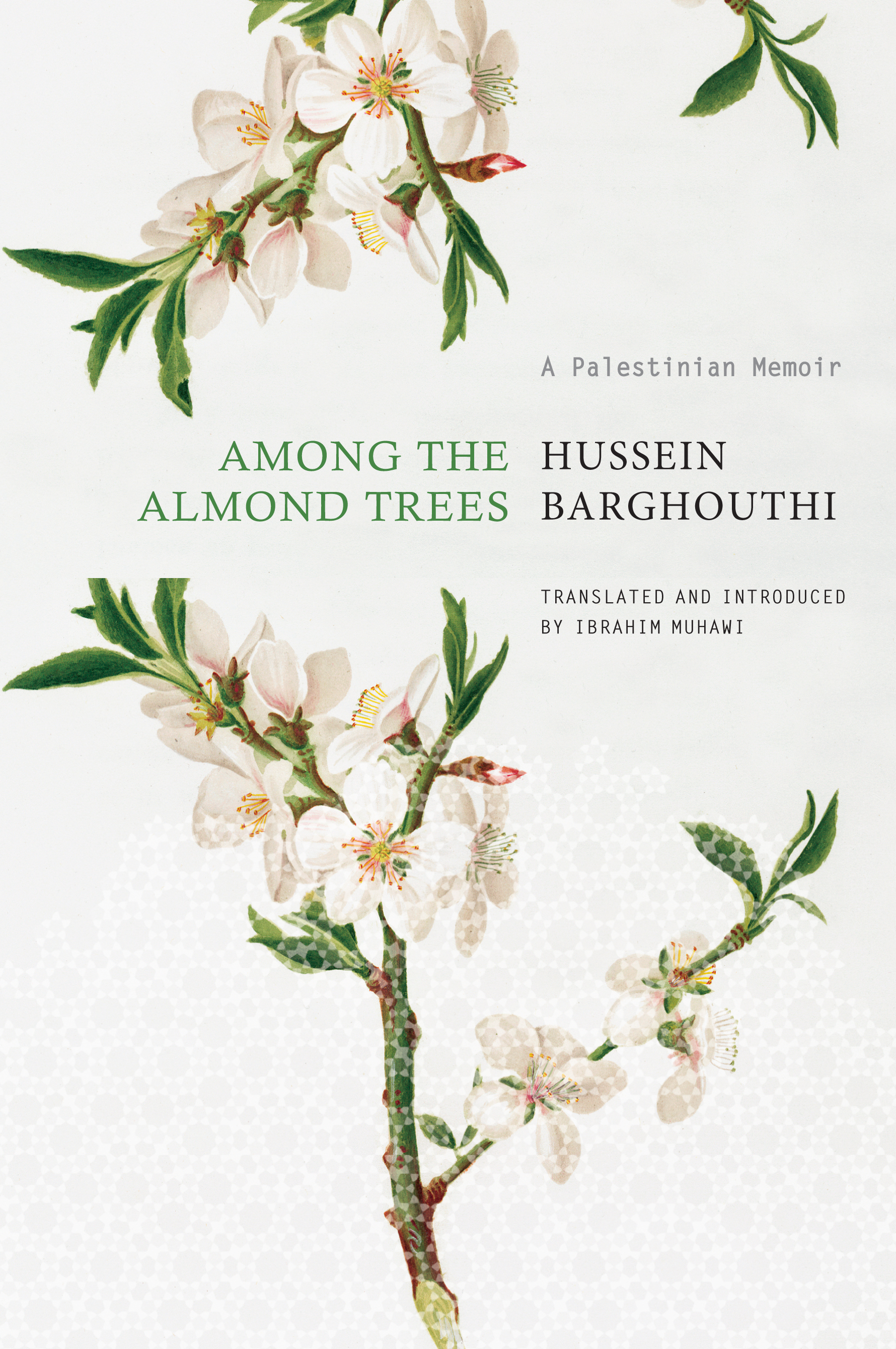
Among the Almond Trees: A Palestinian Memoir by Hussein Barghouthi is translated from the Arabic by Ibrahim Muhawi and published by Seagull Books.

 roughghosts
I look forward to reading this, Joe. Beautiful review.
LikeLiked by 1 person
I’m certain you will love it, Theresa.
LikeLike
Such a touching book of place and memories I found I busted ordered blue light
LikeLiked by 1 person
Blue Light is great. Both books are quite different, but complement each other beautifully.
LikeLike