all paths
lead to the same place
journey is illusion’s horsebackthe world’s embers
blacken its wanton footstepthey burn
our anxious tongueswithin its form
the poem seeks itself
Poems for wanderers, or the poem as a series of wandering, emergent forces, Walking the Earth by Amina Saïd hums with an intoxicating, primal energy that speaks to something fundamentally vital and human, in a sense that is too easily buried in the noise and chaos of our constantly plugged-in contemporary reality. Born in Tunisia in 1953, to a French mother and Tunisian father, Saïd was raised in both Arabic and French. At the age of sixteen she moved to Paris with her family where, when she entered university, she decided to study English literature so not to have to choose between her two native languages. Her poetic vision, however, draws on French and Arabic sources and the sunlit Mediterranean landscapes of her birthplace.
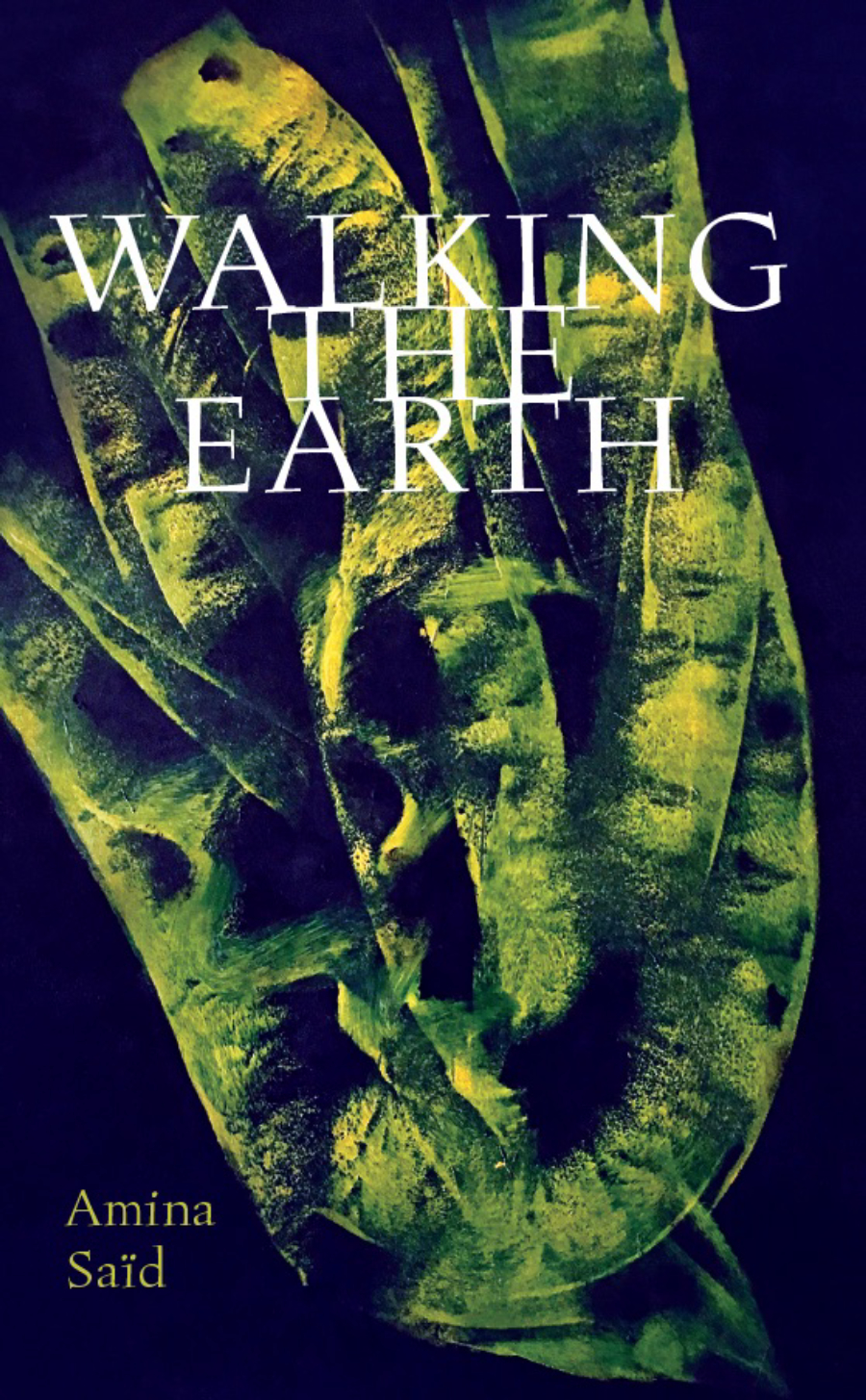 Today, Saïd can be considered, according to Hédi Abdel Jaouad, the author of the Preface present text, as the “most potent—and prolific—poetic voice in Tunisia today, if not in the whole of Francophone Africa.” Yet, until this point, no complete, single volume of her work has been made available in English. Now, thirty years after its original 1994 release, Walking the Earth (Marche sur la terre), in Peter Thompson’s translation, finally corrects this oversight.
This haunting sequence of poems, untitled and distinguished only occasionally by dedications, or by shifts in format or theme, has a hushed meditative quality reinforced by the poet’s spare, concise language, subdued and mystical tone, and the recurrence of common motifs. The world her speakers evoke is shaped by primordial elements in concert with journeys across a vast unformed terrain:
earth is this round dream
in its heart
stones fusingtheir fire tongues
gouge the pathways of blood
where another fire burns
In her prefatory Note, Saïd writes that this, her seventh book, can be understood as a search for “place”—one that moves from the intimate to the universal—her own journey and that of many who pass through spaces “as much geographical as mental.” She is thinking of the displaced, those driven to move by war or disaster, but also the wanderer and traveller. Wandering is a theme of particular importance in Maghrebi (Northwest African) literature, and one that touches the poet, as someone who writes to hold an intermediary space between the Orient and the Occident, deeply:
My belonging to these two worlds both legitimizes the quest for place and generates a proliferation of doubles: shadows, voices, witnesses, angels, those who keep vigil. . .
This quest for place is born of a profound feeling of exile. Isn’t any creative person “exiled,” a nomad, an eternal wanderer seeking a place—a utopia, a place imaginary, impossible, dreamed of—which poetry can, with a sudden flaring, show in an unforeseeable image?
The quest that stretches across the pages of Walking the Earth is rich in mythological and archetypal images. The recurrence of specific motifs—light, darkness, stones, deserts, shorelines, blood, fire, tongues, voices, screams, silence—contributes to the cyclical feel of the work. Walking is an existential act while language and words are formative elements:
a voice recites
a voice despairs
the choir takes hearta hand inscribes
ancient alphabetsthe light awakens
As the sequence progresses, it becomes clear that the search for “place” is ultimately a search for meaning. The poem itself is the journey, even if the end is but another beginning. It is a path a reader can walk over and over again, and arrive at a different “place” each time.
the poem scents itself
with deepest nightI inscribe myself with sand and dust
in the nostalgia of a world
from before this worldI’m absent
from the mirror of the tribe
Walking the Earth by Amina Saïd is translated from the French by Peter Thompson with a Preface by Hédi Abdel Jaouad and published by Contra Mundum Press.


Sounds a great collection I imagine the Maghreb language is a language filled with words around the constant movement one would see in a nomadic lifestyle they use have in the past
LikeLiked by 1 person
The collection is translated from French. Maghreb refers to Tunisia, Algeria, Morocco, Libya and Mauritania. It is the region she comes from and it’s cultural traditions and landscapes feature heavily in her poetry. It is a lovely book that has, to me, a desert atmosphere.
LikeLiked by 1 person
Just when you said Maghreb literature sorry it had sent me to think it from Maghreb Arabic or even Berber sorry
LikeLiked by 1 person
Yes, you’re right. There are many cultures in that region, but also French because of the colonial history. This poet grew up speaking both Arabic and French.
LikeLiked by 1 person
May add it to the list I’m planning in 2026 to concentrate on African and Arabic literature
LikeLiked by 1 person
Sounds like a good plan. You will find, of course, that much of African, and some Middle Eastern literature, is also in French, Portuguese, and Spanish thanks to the lasting impact of colonialism.
LikeLike
Those are lovely extracts Joe – not an author I know so thanks for sharing.
LikeLiked by 1 person
It is a wonderful book. I was attracted to it on the strength of the publisher and have since learned that before this there was only one English translation of her poems, a selection from 2000-2009. I hope there will be more, she has published at least 20 books to date.
LikeLiked by 1 person
a very enticing review…will look for her work
LikeLiked by 1 person
It’s a beautiful book. I hope more of her poetry will be translated.
LikeLike
Thanks for this discovery. I see her books are hard to find in French: much of her work seems to have been published with Éditions de la Différence which sadly went out of business several years ago, and no one has picked up their catalog. They published e.g. the complete works of Abdelkebir Khatibi, Abdelatif Laabi, and many other underrated francophone writers and (especially!) poets. I suspect that legal issues in the wake of the publisher’s folding may have sth to do with the scarcity of translations from their book list… (just a guess).
LikeLiked by 1 person
Thank you for this information. It’s a shame to hear that the work of such a prolific and important poet is hard to find. I hope that changes.
LikeLike
Especially the last lines you quoted stand out to me. Thanks for drawing attention to her work.
LikeLiked by 1 person
I was glad to find it myself. This book was a favourite this year.
LikeLike