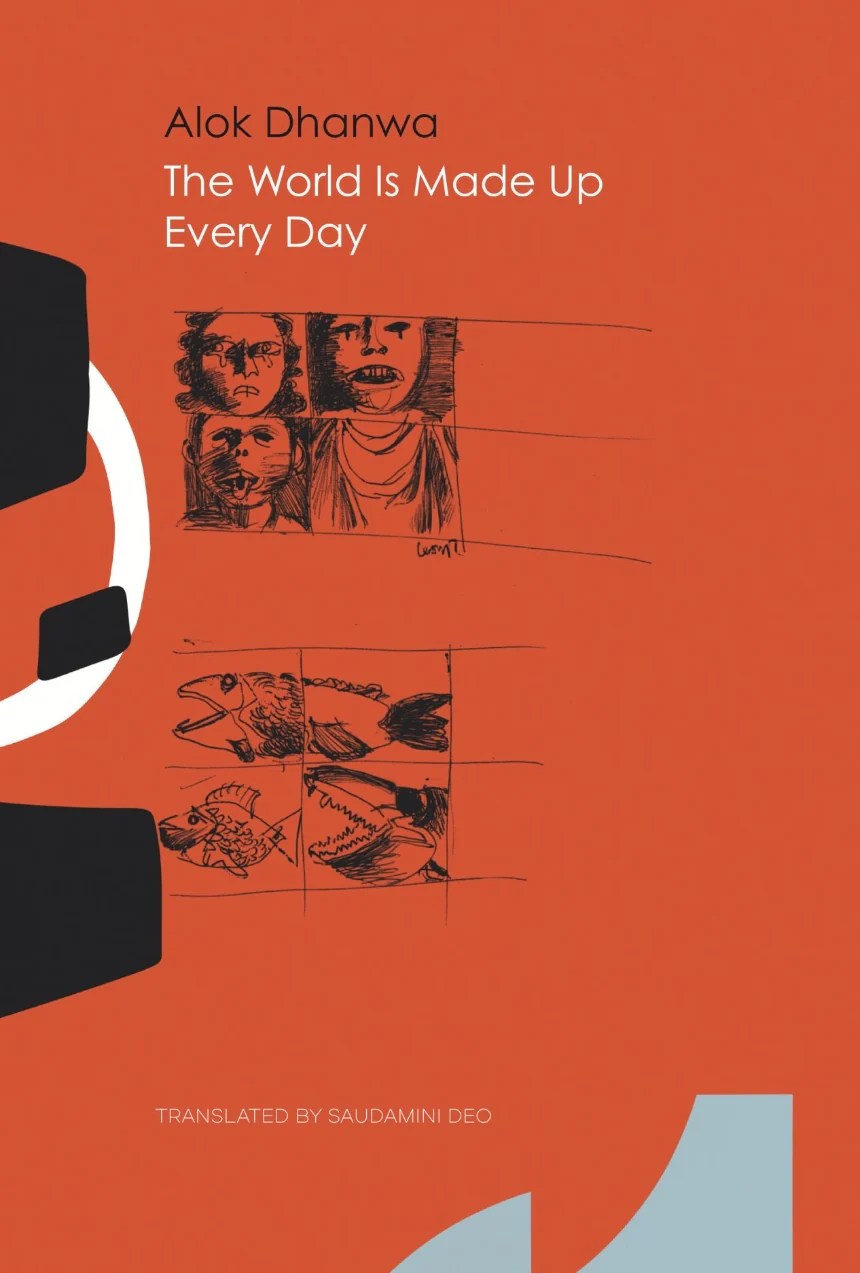
Even in these half-dark times: The World Is Made Up Every Day by Alok Dhanwa

The lights on the bridges
have no end
My nights are full of them
I will remember
the lights
even in the face of death

– from “Theatre”  (1996)

In recent years, Seagull Books has been bringing the work of under appreciated Hindi cult writers to English audiences, via the translations of Saudamini Deo. The latest writer to receive this attention is  Alok Dhanwa whose defiant and socially engaged poetry combines the personal and the political with deep emotional and intellectual intensity. Born in Bihar in 1948, just one year after India’s independence, Dhanwa grew up alongside his country, witness to its many growing pains. Against the backdrop of the rising Maoist, Naxalite and other Communist movements in the late 1960s and the tumultuous 1970s under Indria Ghandi’s leadership, including the twenty-one month Emergency (1975–77) during which constitutional and civil rights were suspended, there was much for a young working-class poet to speak to—and against. Often drawing on rural themes and imagery, his poems addressed, directly and indirectly, the struggles of ordinary people, earning him a popular cult like status in Bihar and neighbouring states of northern India.
Unsurprisingly, relatively little of his poetry was published during these earlier years. His first collection, The World is Made Up Every Day, did not appear in Hindi until 1998 and was, until recently, his only published volume of work. Now his voice can finally be heard in English, through the resounding notes of Deo’s translation. (Brief YouTube videos of Dhanwa reading in Hindi can be found online and offer a taste of his tone and character that can be carried into reading his poems.) And although the particular political context of his poetry—even when the settings are decidedly bucolic—is essential, in her Translator’s Forward, Deo cautions that to read Dhanwa simply as a poet of the past would be a mistake:

Contemporary Indian milieu is far more complex, with its growing shift towards majoritarian politics and authoritarianism. His lines ‘that India no longer exists / the one in which I was born’ hauntingly resonates with the contemporary reader. Or when he writes: ‘Homicide and suicide are made to look alike / in these half-dark times. Do spot the difference, my friend,’ it feels as though he is speaking about present day India. And, perhaps, there is no end to these half-dark times.

One might venture that such a sentiment has a resonance far beyond India these days. As such, in Dhanwa’s poetry, there are many notes that may ring familiar.

There are direct, often angry, even despairing, references to political violence and oppression in some of the poems collected here, and a certain melancholy when the poet considers his country and the men and women he sees, be they gathering in city centres or working on farms. Dhanwa demonstrates a wonderful facility for employing striking imagery from nature and from everyday objects to  address the concerns that trouble him, as a man and as a poet. The poet, in his vision has a critical role, he or she is tasked to speak to both the immediate and the future. Thus, his is not merely an artistic role, it is at once ancient and urgent, yet he takes it on with a measured humility. In “Water” (1997), he begins with his imagined mission:

People, but not just people,
I believed I would teach
even water to inhabit India.

I believed
Water would be simple—
like the East,
like a straw hat,
like candlelight.

In the golden hour,
the other side is barely visible,
leading us to wander
in a country
yet to appear on the map.

But he ends up wondering if all the words we write are wasted, leading to ruin as water follows its own course in spite of us. He asks:

Do the voices of water
remain in the voices of women?
And what of other voices?

In a sad and broken heart
there is only the night of water.
There lies hope, and there lies
the only path back into the world.

Many writers have, over the years, been described as giving voice to the marginalized, but for Dhanwa this is not simply a matter of speaking on the behalf of those who cannot. In his world, those who might be imagined to be on the disadvantaged side of the endless class struggle are not content to stand by quietly. And he is standing with them. He also holds a perspective that extends beyond the joys and the demands of the everyday—it is civilizational in scope. His world view is not static; it is in motion. In one of the longer pieces in this book, “Canvas Shoes” (1979), he begins with a pair of old canvas shoes left by the railway tracks and imagines a life for this worn and humble footwear that entails a long journey that echoes the history of the world:

These canvas shoes
soft and filled with air
as cigarettes and handkerchiefs.
Woven like nests—
against solid things in this world like murder and rape,
these liquid shoes stand
bending with grass and language,
edging closer to salt—
And for the rats, these canvas shoes are like the alphabet—
it’s where they begin to nibble.

Here, simple shoes carry the density of human existence—in the day to day and over  vast swathes of time. By the final verse the journey is complete yet eternal:

Those canvas shoes are now so old
that one might say,
wherever they move, Time doesn’t exist—
even Death would no longer want to wear them.
But poets do wear those shoes
and tread across centuries.

In the end it is the poet who is tasked with continuing the journey and translating it into words. To speak to the indefatigable human will to resist, to survive. Something that Alok Dhanwa is well versed to do.

The World is Made Up Every Day: Selected Poems by Alok Dhanwa is translated from the Hindi by Saudamini Deo and published by Seagull Books.
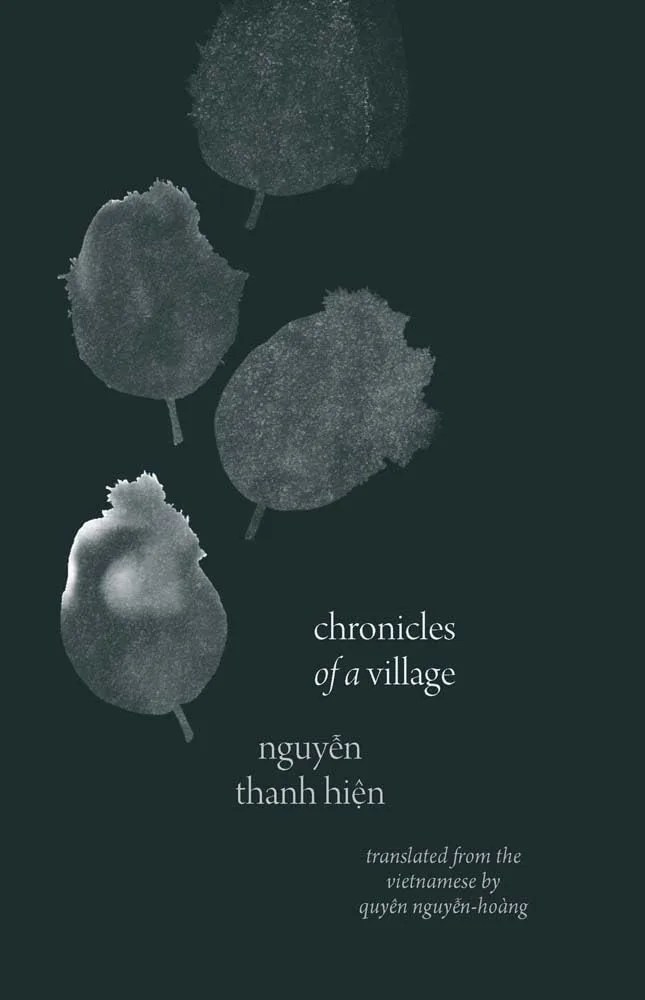
“at nightfall, the night herons no longer called”: Chronicles of a Village by Nguyễn Thanh Hiện

these are the chronicles of my village, the vessels of remembering and reminiscing, tale upon tale of yesterday, yesteryear, yestercentury or yestermillennia, now plainly precise, now hazily adrift, an abundance, or maybe an overabundance of news that reads like some kind of a novel, some kind of novella or some kind of essay reshaped into fictional form, they, the news, the chronicles, constantly expand, contract, compel, pressure, evoke and awaken before culminating in a perhaps inevitable explosion, shattering all the burnished grandiose narratives that so desperately try to conceal the fatal historical disabilities of a land.

In a small village, nestled at the foot of Mun Mountain, somewhere in Central Vietnam,  a scribe is recording a history—of his life, his family, his village, his community. Mythical visitors, birds and beasts, dynastical rulers, colonizers, invaders, and ghosts pass in and out of his amorphous, fragmented, non-chronological account. But binding it together are memories, of childhood and family, and of the routines of agricultural life. Nguyễn Thanh Hiện’s lyrical Chronicles of a Village cannot easily be categorized. Is it a collection of stories, a novella, a documentary or a prose poem? Labels do not matter. It is a mesmerizing evocation of the passage of time—a record of what is lost, what is gained, and what remains—a shifting portrait of a land and its people.

Chronicles opens with an account of the disruptive arrival of “sightless humans” marching into the village. No one is quite prepared for the danger these outsiders represent. They march the residents out into the open and when the narrator’s father dares to address the invaders, he is tied up and taken away. This narrative is followed by a detailed note further explaining the nature of the man who has been captured and who will, in time, be freed. At this point this work appears to be presenting itself a historical document of some kind, which it is in its way, but what unfolds in the ensuing pages refuses to follow conventions a western reader might anticipate, the story to be told exists on many levels at once. Even the scribe himself is unable to clearly define his project, as in the quote above and at many other points where he approaches the question of fictions and truths, histories and unhistories.

The mythic and magic of Mun Mountain rises above the quotidian routine defined by rice and fabric. The cultivation of fields and the weaving of cotton have supported this small community for centuries, skills originally brought to them by god-like travellers who arrived in the Land of the Upper Forest—or so the legend goes—taught to the people, and passed down from father to son and mother to daughter. The scribe, using the lowercase “i” as first person pronoun, favours commas over full stops to affect a living, breathing quality to the tales he shares. In long, unbroken sentences that that often extend for pages, he writes of his childhood, his parents and older brother, and other important characters of his hometown, of his “birthsoil.” He writes of the forest, the birds, and the mystical creatures that could be imagined in the formations atop the mountain. And, of course, along with stories of the rising and falling political dynasties of the distant past, he recounts the ways the outside world began to impose control, first over his nation and eventually his local region in more recent times.

At first, he recalls, war in his country caused by the French colonists seemed so far away. To adolescent boys it seemed romantic, their heads filled with images of troops fighting on horseback as in the wars they had learned about in school. It seemed romantic, like a fairy tale and they set about secretly weaving grass into horses. But when adult war suddenly arrived, with fire bombings and destruction, the magic was incinerated as were many homes and villages. The lives of classmates, friends and first girlfriends, were lost.

the sound was abrupt yet belonged to an eternity, and afterwards, young maiden, you didn’t come around here anymore, at nightfall, the night herons no longer cried among the dews, my fellow villagers went their separate ways, in two distinct directions along the horizon, to tell the truth no one wanted that to happen, somebody said it was because a venomous wind blew past and entangled everyone’s way of thinking, it was true that my homeland was then tumbling into the sorrowing pages of history

The chronicles, as they unfold, weave together fragmentary, often dreamlike stories that seem, at first glance, to be unconnected. However, each chapter is linked to the next  through images and ideas—that which closes one is picked up  and carried, perhaps in a new direction, in the next. Motifs and phrases repeat, within chapters and across the work as a whole, imbuing the prose with an incantatory rhythm and meditative feel. It honours the past, acknowledges the devastation of war, and offers the hope of continuity, of  resilience:

i’d like to speak of the tokay geckos that lived in the hollows of the sandbox trees by the village entrance as if i were delivering , on behalf of my fellow villagers, a note of gratitude to the descendants of the beastly dinosaurs, those creatures that existed back in the Triassic days of the Mesozoic Era, if those geckos living in the hollows of the sandbox trees by the village entrance were the legitimate descendants of those dinosaurs, evolution might stand a chance of brightening up, for centuries the gecko families had been living in the hollows of those sandbox trees by the village entrance, but once the war began, the trees were all knocked down by bombs and bullets, there was not a single plant left by the village entrance, but in the night one could still hear the sound of the geckos, ‘this century-long exile of the tokay geckos’ . . .

By putting words to the page, the village scribe is preserving the story of his people, and a way of life that is disappearing under the weight of modernization, but he is not alone in his task—the ghosts of his loved ones, now gone from this life, visit him still. In his words and his visions, dead live on.

For all the sorrow running through it, Chronicles of a Village shimmers with a unique beauty, one that runs clear and crisp against a misty backdrop. Translator Quyên Nguyễn-Hoàng has taken great care with the selection of words, creating unique expressions when needed, to best reflect meanings that do not have a direct English equivalent. In a conversation with Alex Tan that can be found here at Minor Literature[s],she shares her approach to some of the language and literary aspects of the original and talks about translation as she understands it.

Chronicles of a Village by Nguyễn Thanh Hiện is translated from the Vietnamese by Quyên Nguyễn-Hoàng and published by Yale University Press.

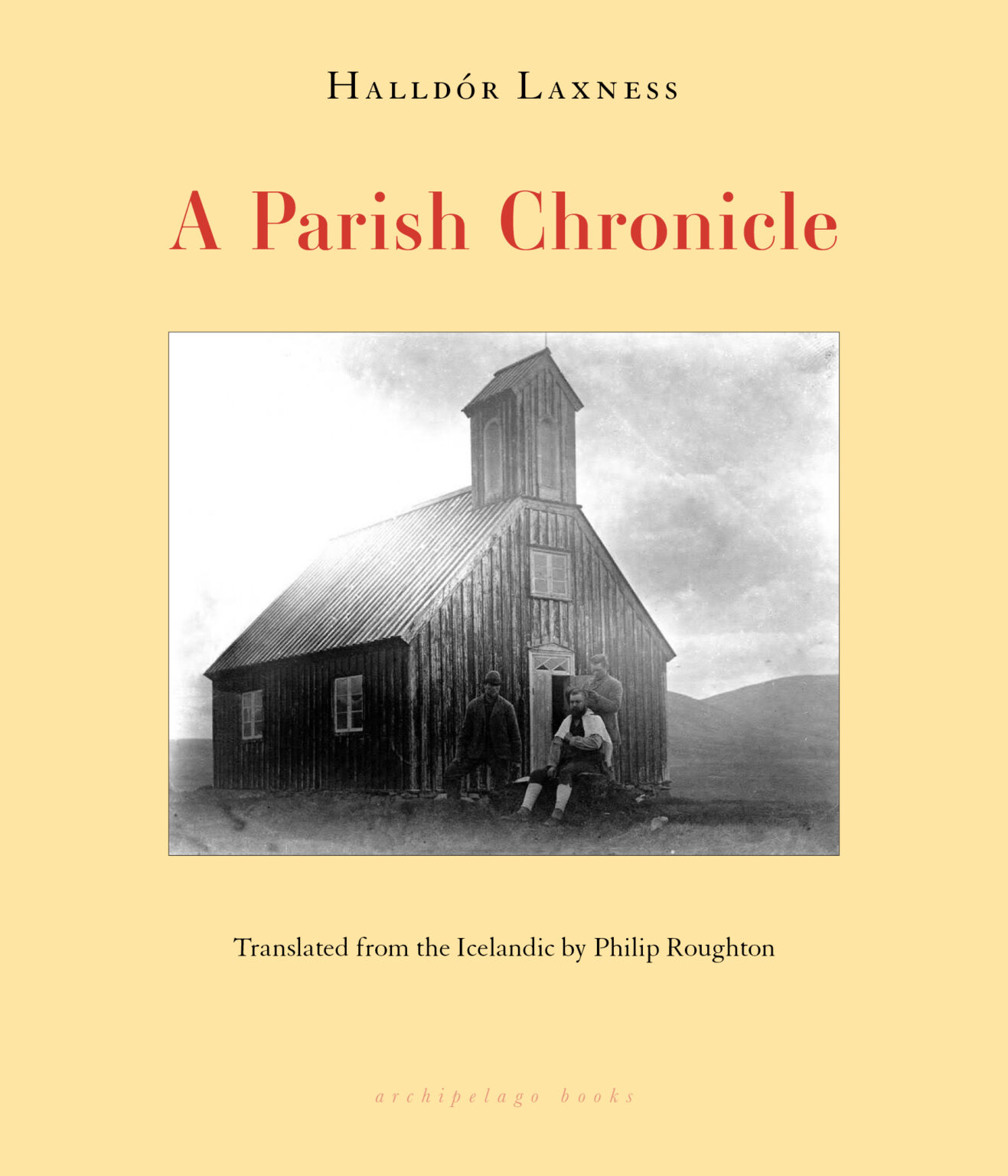
The church that falls again will rise again: A Parish Chronicle by Halldór Laxness

This is the story of a church, one that exists whether it is standing or not. Standing high above the Mosfellsdalur Valley in southwest Iceland, not far from the nation’s capital, Mosfell Church has,  at the time of the telling of the storymid-twentieth century—been recently rebuilt, but it holds a history of rising and falling that reaches back a thousand years. Somewhere along the way it became associated with what parishioners believed were the bones of 10th century poet and national hero, Egill Skallagrímsson. However, the self-named inkman who is committing this account to paper has a more specific focus: he wants to put right a report of the events leading up to the last time the building was destroyed, and resolve the questions that lingered in the wake of that event:

Here, the story will be told of how the church was dismantled and razed to the ground for the third time in the latter part of the 19th century. It will be shown how powerful exponents worked together to destroy this church ever since the Danish king ordered its removal in 1774, although one hundred and twenty years passed before that order was implemented. For almost four generations, consequential parties laid their hands to that plow, such as the government in Denmark, the Icelandic Alþingi time and again, the church authorities one after another, bishops and deans as well as lesser parish authorities; finally, local farmers and honest housewives and robust men belonging to this parish, until no one remained to defend this church but a certain aged farmer at Hrísbrú named Ólafur Magnússon, and an indigent girl, a maid of the priest at Mosfell, named Guðrún Jónsdóttir.

In his introduction to A Parish Chronicle, Salvatore Scibona describes the circumstances surrounding Nobel Prize winning Icelandic writer Halldór Laxness’ decision to begin to work on this novella while vacationing in Rome in 1969. In spite of all the successes and accolades he had received by that time, he still felt like a failure because he felt had not yet gained the international readership he longed for and, at the age of sixty-seven, he may have assumed he was closing in on the end of his productive life. Having already lived two decades longer than his own father, he could not have imagined that he still had twenty-eight years and six more novels ahead of him. But he did, and the first would be this spirited tale, originally drafted six years earlier. First published in Icelandic in 1970,  it has finally been made available for English language readers in Philip Roughton’s lively translation.

With its folksy tone and wry humour, this tale begins as the story of a parish and the social rather than religious role of the church in the everyday lives and politics of a rural community, but expands to offer a colourful sketch of the impact of increasing modernization on a nation with a long and deeply rooted culture and history. It attempts to adopt a documentary approach, but the events are often exceptional and the characters are eccentric, larger-than-life heroes and heroines of a homespun saga in which Icelandic poets are quoted more than any Bible passage is, even if a church (or its emptied yet still consecrated grounds) stands at its centre. Some of these folk even had real-life counterparts with the same names living in the Mosfellsdalur region. To be on the safe side though, Laxness included a note to the first Icelandic edition that read: “References to named individuals writings documents places times and events do not serve a historical purpose in this text.”

When it appears that the long overdue order to consolidate two parishes into one and construct a new church, was finally going to be implemented, old Ólafur of Hrísbrú, the crusty farmer and sheep herder, sharpens the blade of his scythe and, accompanied by one of his sons, arrives at the church and threatens to lead a revolt. But, in the absence of locals willing to take up the cause with the same steely vigour, a petition is launched instead. In the end, the only other person willing stand by his side, at least in writing, is the maid,  Guðrún Jónsdóttir, or, as she is known Big Gunna. Their letter fails to hit its mark and the church is taken down and carted away.

For the inkman who is doing his best to faithfully record the events that occurred before his own birth, Big Gunna becomes an important source of information. His interviews with her when she is an old woman are worked into his narrative. Never inclined to take a husband or to accept money for her labour, she relied on the support of the community to carry her through the long years following the demise of the church and the end of her job there. But she is not a charity case. Delightfully plain-spoken, with her own commendable value system, she describes how she traveled around the region offering her services for almost any work that needed doing—the tougher and dirtier the better.

Then in the latter part of the book, a third key character enters the scene, a young runaway who is, against all odds, taken into the home of old Ólafur and unofficially adopted. This young lad turns out to have an uncanny sense of a good deal, an inexhaustible love of automobiles, and boundless generosity. In his own way, he carries the folks of the Mosfellsdalur Valley into a new era in style.

This book is my first encounter with Halldór Laxness and, I am inclined to think it is as good as any place to start as any. Especially with the excellent introduction (reproduced here at LitHub) to the varied and shifting nature of the Icelandic master’s oeuvre.  Known for his ability to be very funny, even in his longer, bleaker novels, the narrative tone of A Parish Chronicle rests on an irresistible sly, understated humour that runs throughout. This passage, for example, describing the typical encounter travellers would have as they passed by Hrísbrú where Ólafur and one or more of his sons invariably could be found standing outside their buildings, captures the centrality of sheep to the rural consciousness:

The folk at Hrísbrú were rather pleasant of manner apart from old Ólafur when he was wrangling with the priest, but showed no particular interest in dragging people out of the mud bordering the walkway and inviting them inside. They asked for news of sheep from all over the country, because life in Iceland was, as it still is today, all about sheep. For example, when talking about the weather, it was only from the perspective of how it suited the sheep. Good weather was the weather that was good for sheep. A good year was one in which enough grass grew for the sheep. A beautiful landscape in Iceland is one in which there’s good pasturage for sheep. People’s livelihoods and outlooks on life were determined by that creature. The Hrísbrú folk were kept informed by travelers of the circumstances of sheep all over the country, and for their part, told stories about the welfare of sheep in the Mosfell district. They remembered exactly what the weather had been like for the sheep year by year for thirty years back. Those people never wore coats, but their woolen cardigans and sweaters stood up to water and wind like the fleece of an Icelandic sheep. All homemade and in the sheeps’ natural colors, mainly russet.

The world Laxness paints is, for all its quirkiness, one shaped by an abiding affection for the land and its people, his land and his people. This is, after all, the area in which he grew up and the inkman dipping his pen into the ink bottle, is a stand-in for himself. There may not be, as he once insisted, a historical purpose to the details of the account he has presented, but it is a thoroughly entertaining story.

A Parish Chronicle by Halldór Laxness is translated from the Icelandic by Philip Roughton with an Introduction by Salvatore Scibona and published by Archipelago Books.

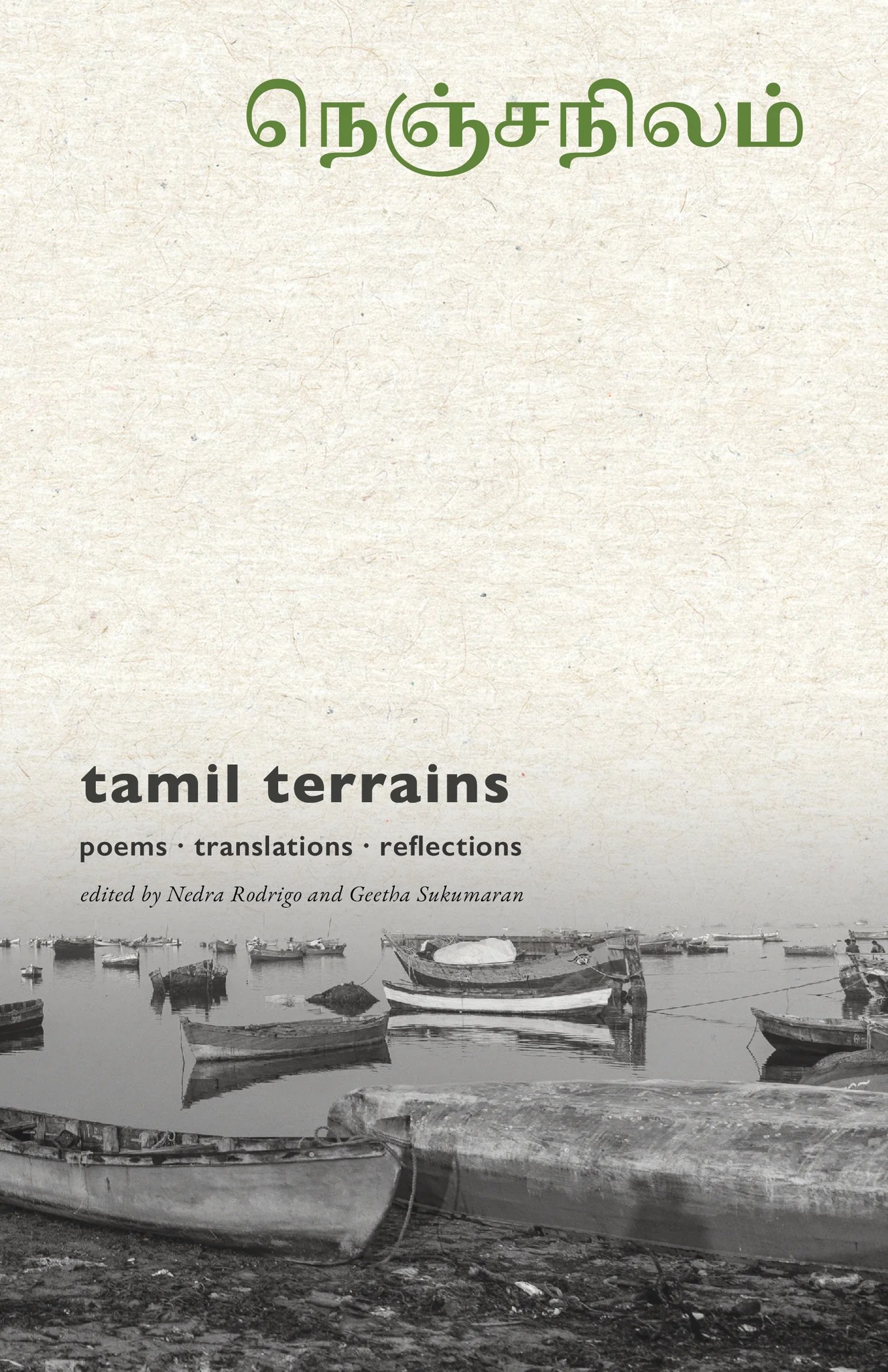
The landscapes that shape us, the landscapes we carry with us: Tamil Terrains, Edited by Nedra Rodrigo and Geetha Sukumaran

Raging winds howl to the vakai trees as their pods tremble in fear.
A land cloaked with countless peaks
yet not an ounce of soul.
It was this cold grim path that he,
the ruler of my heart, chose
over lying in my tender embrace.

“What the Heroine Said” – Avvaiyat (translation by Gobiga Nada)

The second in trace press’ translating [x] series, Tamil Terrains, arises from a series of online workshops conducted over six weeks in Autumn of 2022 and Spring of 2023. Editors Nedra Rodrigo and Geetha Sukumaran invited poets and translators from India, Malaysia, Singapore, Ilankai (Sri Lanka), and Canada to explore classical and modern Tamil poetry and enter into conversation about “what it means to translate in anti-racist, feminist, and decolonial ways.” With a history that extends back over two thousand years, Tamil is a language that is deeply entwined with its indigenous landscapes—mountain, forest, field, desert, and coast. But this relationship to land has long been troubled by conflict, colonization, and displacement, so this project also seeks to ask how a connection to these terrains, with its layers and accumulated losses, can be understood in traditional Tamil speaking communities in South and Southeast Asia and throughout the diaspora.

As both Nedra and Geetha, and a number of the participants in the workshops, live in Takaronto (so-called Toronto, Canada), the workshop discussions opened with the question of how diasporic translators “who occupy Indigenous lands as refugee and immigrant settlers, might critically engage with, and contest, ongoing erasures carried out on the Indigenous Peoples of Turtle Island.” This raises a perspective often ignored, or at best simply addressed with rote land acknowledgements, but one that has deeper, and in our present day, significant implications. In recognition, then, of the ways in which translation has been employed to dismiss the cultures and peoples of Turtle Island, this book opens with Tamil translations of work from two Indigenous poets—Mi’kmaw poet shalan joudry and Michi Saagiig and Nishnaabeg poet Leanne Betasamosake Simpson. The volume closes with an essay by Thamilini Jothilingam, whose family was forced to flee civil war in Jaffna when she was a small child. She reflects on the two places where she feels most at home—her current home in the Fraser Valley of British Columbia and the Vanni region of northern Sri Lanka. Both places carry a legacy of colonial violence.

Another distinctive feature of this project and the collection that emerged from it, is the desire of the facilitators to gather people who identify as Tamil, regardless of individual fluency, thus opening a point of connection and collaboration to those who may have grown up away from their ancestral homelands. As a result, the approach to translation explored in the workshops and reflected in Tamil Terrains is varied and creative. Participants are encouraged to engage in retelling, re-creation, expansion and commentary, especially with ancient and classical poetry and traditional folk songs. Nedra Rodrigo describes the decision to differentiate types of translation for the workshops—Root, Branch, and Driftwood:

Root as a direct translation from the source text; Branch as a translation supported by a bridge translation; and Driftwood as a transcreation that was inspired by the source text or that archived some aspect of the text.

The invaluable nature of this approach is clearly reflected in the work selected for publication.

The original texts are presented Tamil script, with a few exceptions where the original poem was written in English or where the decision made to use transliteration. At times, several translations of a single poem may follow, perhaps by translators from different geographical areas, or employing different approaches. Sometimes a translation or transcreation may also be accompanied by a reflection that allows the translator to express the thoughts, experiences, and emotions guiding their personal approach to the piece. Such insights are particularly interesting and add another layer to the process of translating or re-imagining a poem or song.

Finally, translation is also recognized as an act of resistance, speaking to the dislocation from homelands due colonial actions, war, and migration, and the displacements of the Indigenous Peoples of Turtle Island. The poetry selected for the workshops from more recent and contemporary Tamil poets, much of it touched with a measure of darkness and grief, was chosen to encourage exploration of these concerns, understanding that “(r)esistance here does not mean shutting out but opening up to each other, to allow each other the chance to dwell in our imaginations.”

I remember
the Saamiyadi resting after his trance
swatches of vermillion scattered
all over the entrance.
Withered betel leaf, with shrunken veins.
Everyone standing in the dark smoke
yearning for something
enchanted by the words of the Saamiyadi.

I remember
we were no further than an arm’s reach.
Even so
between us the distance widened
like these ones on one street
and those ones on another.

From “Tree with Broken Shade” by S. Bose (translation by Yalini Jothilimgam)

This volume, reflective of the collaborative spirit of the workshops that led to it, offers an opportunity to appreciate the many complex ways Tamil speaking people, and their descendants who may be spread far and wide, can maintain a connection to the landscapes, traditions, and histories of their respective homelands through poetry and other cultural elements such as art and film. Reaching from the Sangam era (300BCE – 300CE) to the present day, the translations, transcreations, and reflections gathered here combine to make reading this book a very dynamic and moving experience.

Tamil Terrains is edited by Nedra Rodrigo and Geetha Sukumaran and published by trace press.