
In recent weeks, talk, at least in the literary circles I circle, has turned to literary prizes and prize winners, more explicitly to the question of the use of AI to at worst generate complete stories or at best, toss ideas around in the creation of said stories. So, wanting a fresh, pre-artificial intelligence take on the matter of awards honouring writers and artists, I naturally thought of Thomas Bernhard and his short volume My Prizes: An Accounting. An acerbic take on the whole enterprise of prize giving seemed in order. And Bernhard delivers in spades.
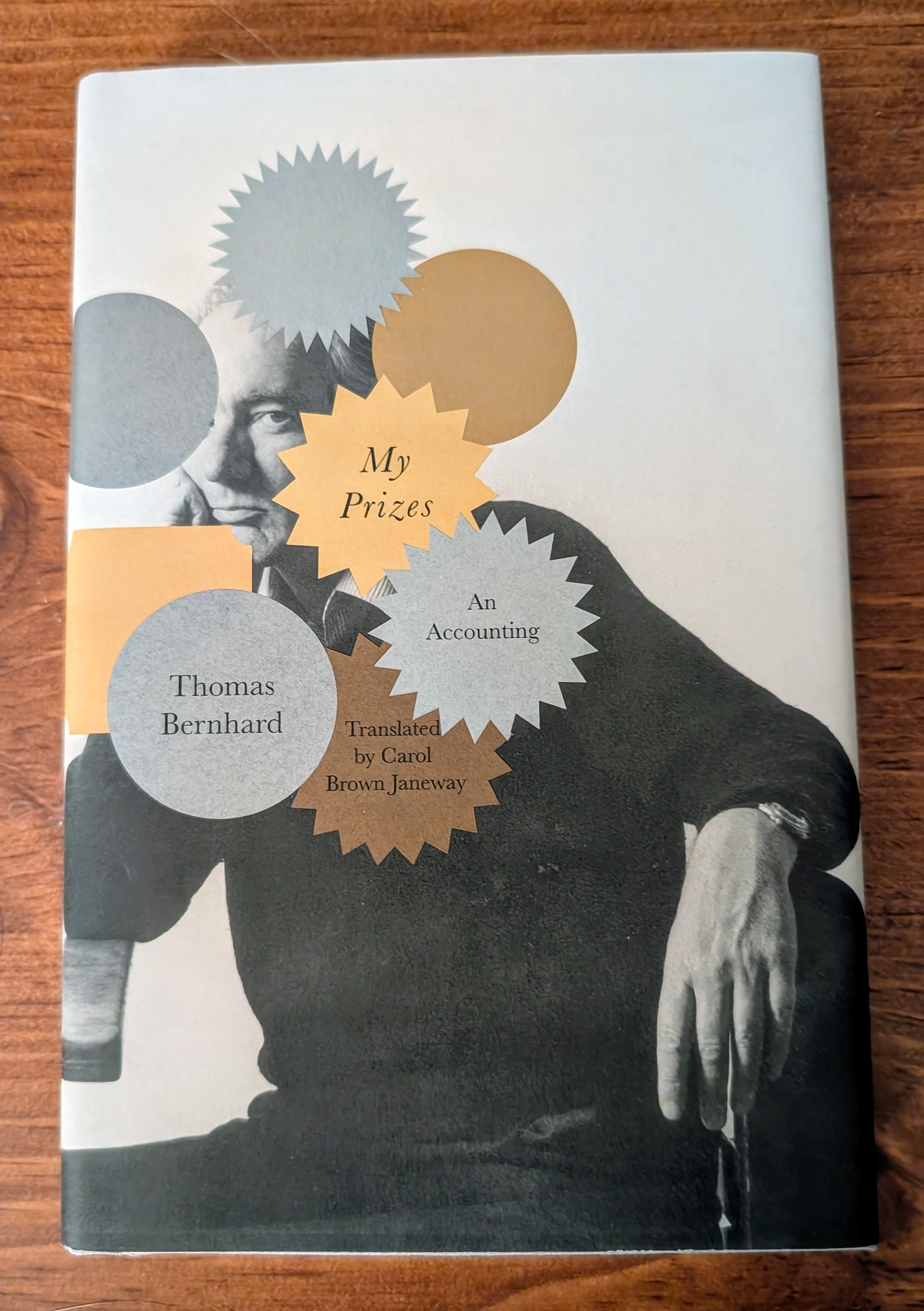 With the characteristic venom of any one of his characters, less the intensity of his typical rant-filled nested narratives, Bernhard makes it clear what he thinks of literary prizes in general and more specifically a number that he has been awarded over the years. In each instance, were not for the cash that accompanies the honours, its likely he would decline the prizes. But like most writers, debts pile up and there is always a need for money!
In each chapter, Berhard recalls the circumstances surrounding one of the many prizes he received during the 1960s and 70s. In the first, on the occasion of the awarding of the Grillparzer Prize of the Academy of Sciences in Vienna, he is faced with the need to acquire something more formal to wear to the ceremony than the grey wool trousers and bright red pullover combination he was inclined to wear absolutely everywhere and, naturally, he leaves the task of purchasing a suit to 9:45am, a mere one hour and fifteen minutes before the event is due to start. In his haste he chooses an outfit that, following lunch with friends and family following the ceremony, he realizes is uncomfortably tight. So he exchanges it for a larger size, a circumstance he can’t help but recognize as absurd.
Winning the Austrian State Prize for Literature in 1967 affords him plenty of opportunity to rail against Austria, an obsessive pastime of many of his fictional protagonists, when it turns out that he is to be awarded the so-called Small State Prize, typically given to young writers in their twenties, rather than the so-called Large State Prize acknowledging a so-called life’s work. (That classic Bernhard qualifier “so-called” is applied generously through this short collection.) Already in his late thirties, the fact that he is merely getting the award normally reserved for youth embarrasses and annoys him and he takes great pains to correct his impressed friends who think “Austrian State Prize” sounds very impressive indeed.
And so what is the Small State Prize? they asked and I replied that the Small State Prize is a so-called Nurturing of Talent and so many people have already won it you can no longer count them, and now I’m one of them, I said, for I’ve been given the Small State Prize as a punishment. Punishment for what? they asked and I couldn’t give them an answer. The Small State Prize, I said is a dirty trick if you’re over thirty and as I’m almost forty it’s a huge dirty trick. But I said I’d sworn to come to terms with this huge dirty trick and I had no thought of declining this huge dirty trick. I’m not willing to give up twenty-five thousand schillings, I said, I’m greedy for money, I have no character, I’m a bastard too. People didn’t give up, they drilled down. They knew exactly where to drill to drive me crazy.
He spends much time defending his feeling of dishonour with the award and his country, and then goes on to channel it all into what turns out to be a rather disastrous acceptance speech. Great fun.
We are also treated to Bernhard’s hilarious accounts of a few of the impulsive purchases he makes with his prize money over the years. He buys a red Triumph Herald in one case, failing to even consider whether the vehicle is a sound investment. In another instance he describes his hasty commitment to a decrepit house—the walls of his own he has longed for. His poor aunt who accompanies him on the viewing tries to talk him out of a rash decision. He signs the paperwork anyhow but then has to wonder whether he has the fortitude to see the house transformed into a liveable domicile.
The perfect antidote to the seemingly endless arts and entertainment award season, this little volume offers a personal reflection that is at once cynical, funny, and when you least expect it, sentimental. Sometimes Bernhard is almost pleased, even honoured with the acknowledgements he receives. But he rarely lets that colour the speeches he is forced to give in response, many of which are gathered at the end of the book. He tends to the short, if not so sweet, when he gets on stage—after all, a brisk award ceremony is always a welcome one.
My Prizes: An Accounting by Thomas Bernhard is translated from the German by Carol Brown Janeway and published by Knopf, as a stand-alone text and together with his memoirs Gathering Evidence.


I often wonder how near his characters in real life Bernhard was especially when I read this a few years ago but there was a certain truth in his views on Austrian society at the time. I need read a biography of him at some point but still a few of his books to read I’ve reviewed eleven of his books over the years maybe time to do another Thomas Bernhard week ? I’ve frost on my tbr
LikeLiked by 1 person
I should hope that many of his characters are intentionally pushed to the absurd extreme, but many of his “softer” works like Yes and Wittgenstein’s Nephew and much of his shorter fiction feels closer to home. A good biography would be interesting.
LikeLiked by 1 person
Yes I felt the characters in the cheap eaters were believable
LikeLiked by 1 person
Sounds very entertaining Joe – I suspect a lot of people might turn down awards if there was no cash attached!!
LikeLiked by 1 person
True, and Bernhard, bless his heart, is honest about it!
LikeLiked by 1 person
Not one of his best ones, but great fun all the same 🙂
LikeLiked by 1 person
Perhaps, but I have a soft spot for the “so-called” minor Bernhards!
LikeLiked by 1 person
So either a dirty trick or a huge dirty trick: I can see the appeal of this one!
LikeLiked by 1 person