
What is a mother?
A mother is someone who puts plasters on knees and hearts. Your first cradle. Your confessional. Your ally against the world. A warm embrace. Someone who sings away trolls. Someone who possesses neither gender nor looks, but who just is.
That is, until she is no longer what she once was. . . but then who do you become? This is the existential question resting at the heart of Sólrún Michelsen’s novel On the Other Side is March. Set in the rugged, windswept landscape of the Faroe Islands, nestled between mountains and the sea, a woman in her early sixties is navigating the uncertain terrain between being a wife, mother, grandmother, and daughter as her own mother is slowly and steadily slipping away. And, as she seeks to balance the emotional demands of this generational crossroads, she examines what it means to be facing the final and shortest leg of her own life’s journey.
Unfolding in a fragmentary, meditative fashion, the narrative tends to be guided by the strange suspension of time that settles in when one is caring for an aging loved one with dementia. A growing sense of loss, a longing to hold on to what is gradually disintegrating guides logic and emotion. The protagonist is haunted by memories of earlier times when she was a young girl and her mother a beautiful, capable woman. She is nostalgic for a simpler time and the world of imagination within which a creative young girl could escape the harsh circumstances of Faroese life. In the present day, she finds that childhood magic lingers on in her grandchildren who delight in making snowmen or find an imaginary friend in a sock stretched over a hand, while at the same time reminding her that growing up somehow reduces our capacity to delight in the wonders in our immediate vicinity.
We grow. And shrink. The distance between head and feet determine whether we see what is right before our eyes. We become half blind. Stop marveling, relishing.
I used to see better. I knew them all. Every single house had its special people with their own particular behavior. Nobody was the same. Not even the ones who always wore black were the same. I knew their names and their appearances, but not only that. I also knew what they were like as people. Whether they had warm or cold eyes. Whether they would give you a penny to run an errand. What their gait was like. Whether to clear off or wait for a slice of cake. Whether they were fond of animals. Whether they told the truth or lied. Every single house in the village had its own household scent.
If the narrator’s world has become more ordered and pragmatic with the demands of adulthood, her mother’s world, once so full of friends and activities, is now on another plane altogether. One that is shrinking to the confines of her house. Increasingly filled with holes. Each visit finds a changed and changing woman. Sometimes disoriented, sometimes absent, and sometimes, for a few precious moments, once again the friend and confidante her daughter longs for. But it never lasts for long, suddenly evaporating into strange comments and irrational demands. As her mother’s health, mental and physical, continues to decline, their roles have shifted completely:
Somehow I feel pushed along. Shunted further and further onto a sidetrack, though I try to muster as much resistance as possible. Try to pretend that everything is the way it used to be. But being mother to my mother makes me feel older. I constantly have to remind myself not to treat her like a child. To show her the dignity she deserves. But she behaves like a child. Comes to me like a child. Obeys me, the way I once obeyed her.
Although there is a thread of sadness and grief running through this novel, it is so much more. As a meditation on aging, caregiving between generations—a primarily female task to look after both the youngest and the oldest family members—memory, and, above all, the intricacies of loving, it is charged with quiet emotion and dark humour. The narrative moves with a gentle rhythm of its own. The past continually reflects and enhances the present, seasons fall out of order, and fragments of traditional Faroese hymns and ballads are woven in along the way. As well, there are no proper names in the narrator’s account; rather, translator Marita Thomsen has maintained family titles (mama, pápi, omma, langomma) and terms of endearment in the original Faroese without translation. The result is a deeply moving evocation what it means to be alive and what it means to lose a beloved parent. It is also the perfect introduction for Sólrún Michelsen, the highly respected Faroese writer and poet, to an English audience.
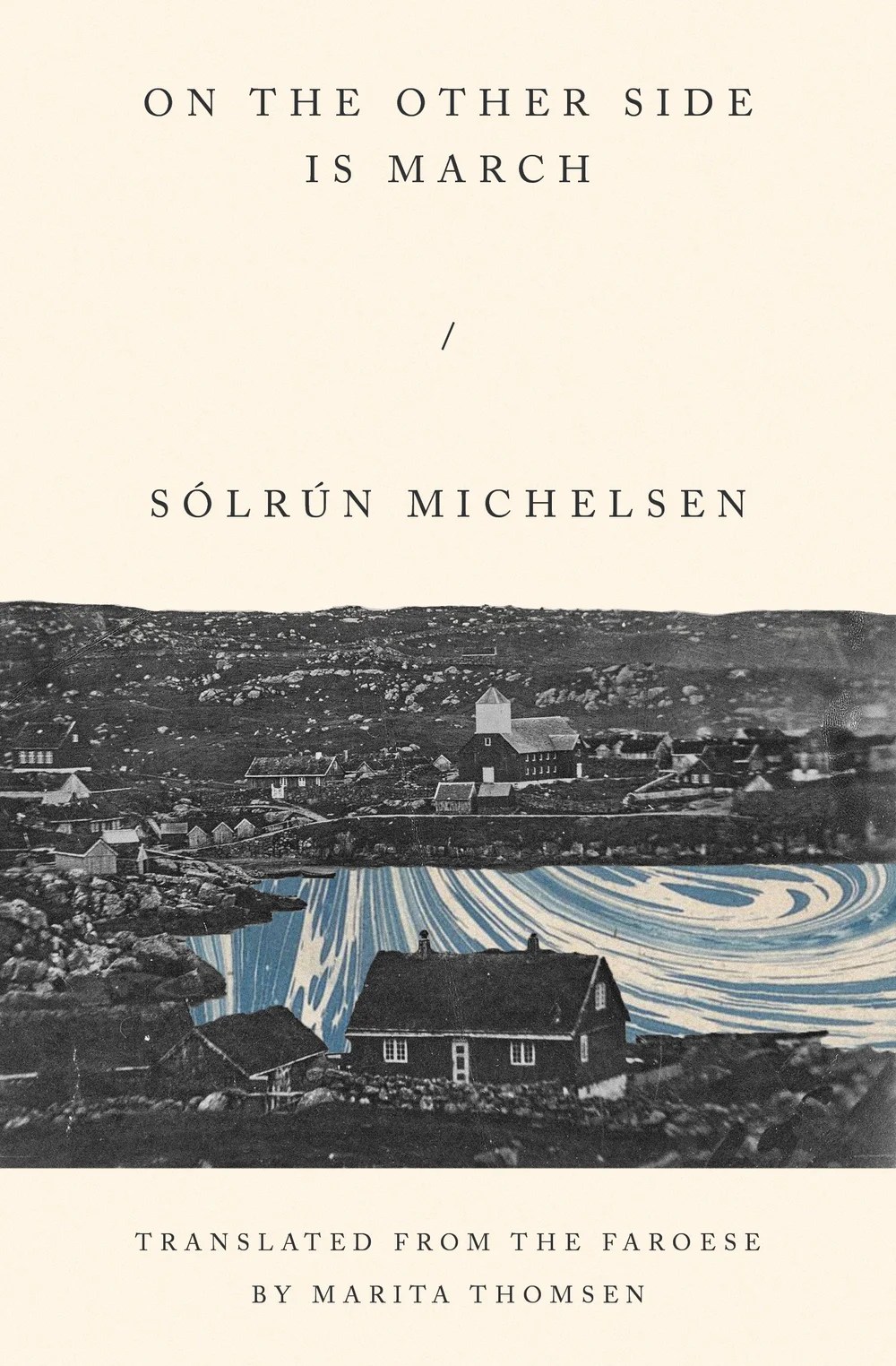
On the Other Side is March by Sólrún Michelsen is translated from the Faroese by Marita Thomsen and published by Transit Books.

 roughghosts
This sounds really fascinating, Joe – I’ve never read anything translated from Faroese!
LikeLiked by 1 person
It is a lovely book, and although it is primarily about caring for someone who is (slowly) dying, it is somehow filled with life.
LikeLiked by 1 person
Is the reflection about losing the sense of the marvellous or the ability to relish things the narrator’s view or her view of what her mother would have thought or just a general narrative truth of sorts? It’s something I’ve seen happen and sometimes I do think it’s a common thing, but the idea that it’s inevitable tilts the whole scenario towards melancholy for me, but overall your impression is it’s more about life/living than death/dying?
LikeLiked by 1 person
Melancholy is definitely present in her her meditation, after all she is trying to care for her dying (and mentally fading) mother who really should not be living on her own (the care home wait list is endless). The fatigue and frustrations of this kind of caregiving definitely comes through, but it is also filled with warmth and humour. So, while the narrative does not shy away from the complicated and conflicting emotions that arise, the ultimate sensation it leaves one with is life affirming. It truly is a beautiful book.
LikeLike
Mmmmm. so taking a particular element of the story, seems to be over-thinking… that it’s more about the foundation of her view of the whole situation that is coming through. I see what you mean: I’ll go looking for a copy.
LikeLiked by 1 person