By the wine-press house, the road turns off
to the right, I see low village roofsthrough the mountains, on roads burnished blue,
I’m a stranger here, for I intrudeno one in sight, only acacias, vineyards
sand-built houses beneath antennasbetween wine cellars, under the Pannonian sky
a small donkey—grey prophet—walks bywaves back with ears of mother-of-pearl
respectable plebians once lived herefive hundred years ago, the wandering carts
of merchants left their traces in these parts(from “Under a Pannonian Sky” by Ágnes Gergely, translation Ottilie Mulzet)
The Pannonian or Carpathian Basin is an extensive lowland area located in southeast central Europe that contains most of modern Hungary, and extends into a number of surrounding countries. It carries, in its soil, a rich geological and historical legacy that reaches far back in time. Many different cultures have passed through the region, and the poem above, by Ágnes Gergely, kindles the spirits of those who have, in the past, sheltered under the vast skies, and made the land their home. As such it is the ideal piece to lend its title to this remarkable anthology celebrating ten amazing Hungarian women poets, many who are appearing in English translation for the first time.
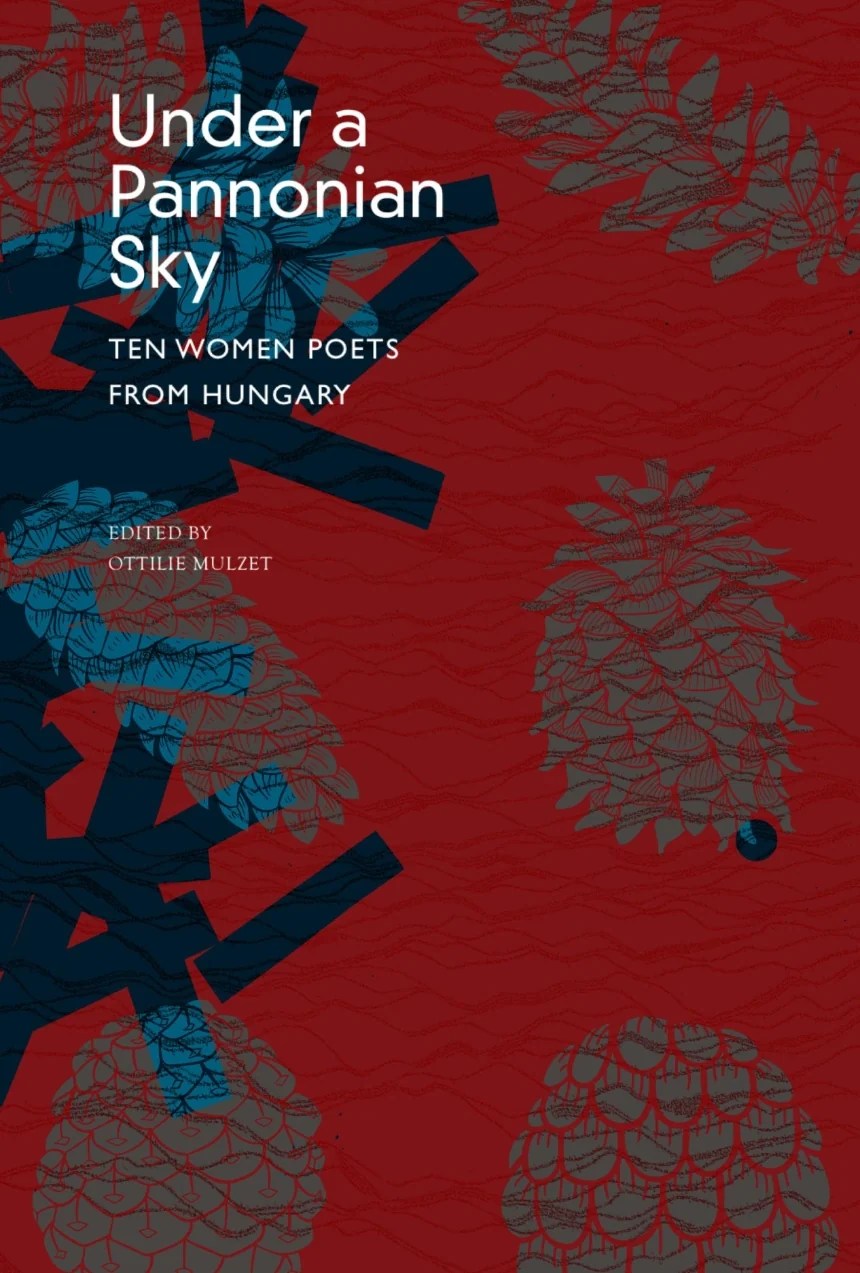
Edited by translator Ottilie Mulzet, the poetry collected in Under a Pannonian Sky spans several generations from Ágnes Nemes Nagy, born in 1922 , one of the most widely recognized Hungarian poets, to Anna T. Szabó born in 1972, whose work examines closely the motherhood and the role of women in contemporary Hungarian society. Naturally the turmoil and dramatic upheaval witnessed over the past century—the Second World War, the rise of communism in Hungary, and the disorientation of the early post-1989 years— feature throughout this anthology and all leave their mark, sometimes in deeply personal ways, on the lives of these women.
In her extensive and detailed Introduction, Mulzet sets out the origin and evolution of this project, which took place over a number of years, and offers a general framing of the authors at hand within the context of the restrictions faced by writers in the immediate post- war years, which was then followed by a significant cultural relaxation in the 1960s, 70s, and 80s. Mulzet notes that none of the poets in this volume were forced to make accommodations to censorship and that “it is a tribute to the strength and continuity of Hungarian literary culture that women writing today are still influenced by this seminal cohort of poets.” She then proceeds to consider each woman individually —the anthology is ordered chronologically—considering her background, her formative experiences, and the unique inspirations and qualities of her work. With such a substantial volume, and such a generous selection of poetry from each contributor, one might be well advised to read this introductory section in segments, one poet at a time, so as to best acquaint oneself with each poet’s history, style and tone just before reading her poems. Further, this anthology not only celebrates the work of ten poets, it also involves the dedicated work of six translators—Mulzet herself, of course, plus Anna Bentley, Erika Mihálysca, Clare Pollard, Ivan Sanders, and George Szirtes.
Although each writer comes from a unique background with her own distinct points of reference, the intersection of the personal and the political is clearly reflected in the voices of every poet featured in Under A Pannonian Sky. Between Nemes Nagy at one end of the chronological spectrum and Szabó at the other, we are invited to spend time with the work of Zsuzsa Beney (1930–2006), Ágnes Gergely (1933– ), Gizella Hervay (1934–82), Magda Székely (1936–2007), Zsuzsa Takács (1938– ), Zsófia Balla (1949– ), Zsuzsa Rakovsky (1950– ), and Krisztina Tóth (1967– ). Their creative years may span some eight decades (while some are yet at the height of their careers), but there are concerns that recur throughout, albeit in differing forms and intensities.
For some, a devastating personal loss—of a parent, spouse, child, or extended family members as a result of deportation, tragedy, or misfortune—directly influences their poetic explorations, but, for women writing through successive periods of major historical and social change, it is not unexpected to find an underlying sense of loss and grief expressed more broadly. Likewise, it not uncommon to find attention to metaphysical questions, meditations on mortality, reflections on identity, and a focus on memory in the poems gathered here. In fact, it is striking in reading this anthology, how these poets tend to be willing to take on big questions of life and death, be it through grand scenes, mythology, dreams and fears, or in the significance of everyday affairs as they confront what it means to be a woman in her many dynamic relationships with others, and a Hungarian citizen in the modern world. Each poet, in her own way, confronts these challenges with a particular strength and resilience.
Now, if an anthology so rich and varied demands an Introduction that looks at each contributor separately, it would be cumbersome for a general review to attempt a passing glance at every poet. Rather, I wanted to be able to express how impressed I am by the power and diversity of the work presented here, and note how intrigued I am by the darkness that so often comes through. Gizella Hervay, for example, had an especially tragic life. She was born in Romania in 1930, and experienced a difficult, impoverished childhood in Budapest during the height of the war and the siege of the city. After the war she moved back to Romania where she studied Hungarian literature and began to write. By the early 1970s, she was becoming recognized for her poetry, but misfortune soon followed when her poet ex-husband died by suicide in 1976 and she lost her fifteen year-old son in the 1977 Bucharest earthquake. She would ultimately take her own life before reaching the age of fifty, but before that she published more than eleven volumes of poetry. Her work tends to be terse and grim, speaking to the traumas she witnessed:
Blood Dries
on the face of the earthworries
tear up the trees from the rootnights squat
under pimpled skyin shop windows
smashed in browsskulls studded
with stones(“Blood Dries” translated by Erika Mihálycsa)
Sixteen years younger than Hervay, Zsuzsa Rakovszky grew up in Sopron on the Austrian border which was closed until 1989, and where she still lives today. Her father died when she was very young, but she recalls a peaceful childhood and early exposure to literature. Her work draws inspiration from objects and photographs from the socialist years of the 1950s and 60s, and calls attention to the fate of ordinary lives, not only in an era of restraints and restrictions, but in the confusion of the immediate post-1989 years. The imagery of her poetry is often strikingly crisp and vivid, but it carries a heavy sense of history and alienation. The past is a ghostly presence, reflected in the dreams and hallucinations that frequently appear. In, for example, “In an Alpha State” (translation Otillie Mulzet) surreal visions of heaven, and maybe hell, evoke the mood of the early 1990s, the hopes and fears of citizens as they faced the chaos of disruption and regime change:
‘I saw a city which exists in no land.
Between earth and sky: the meeting place,
lengthwise, of two points. There was neither sun nor moon,
no season ever passed, no time of day.
Into the narrow intervals, yellowish fog loomed,
nothing could be seen beyond the window frames.
Like a giant amoeba’s body, the fog swallowed it all,
began to eat away at the borders of all things:‘no more difference between the living and the dead,
between dark and light, between good and bad.
I saw a man breastfeeding a snake,
I saw a woman swear allegiance
to a microwave. My own mother became
a fire hydrant. Behind the dense fog
endless battles raged, houses fell to rubble,
the main bus station swept away by floods,
boats sunken in flame-devoured water.
Yet none of this was real in any way.
It would be difficult to pick a favourite among the ten exceptional Hungarian women poets presented in this excellent anthology, but Rakovszky, who is also a well-respected novelist, is one that I would definitely like to come to know better. There were, however, so many poems that simply stopped me in my tracks throughout this volume, as a flurry of page markers erupting from my copy attest. For anyone interested in Hungarian poetry in general, and the responses of Hungarian women writers to the shifting social and political terrain of the twentieth and early twenty-first centuries in particular, Under a Pannonian Sky is essential reading.
Under a Pannonian Sky: Ten Women poets from Hungary, is edited by Ottilie Mulzet and published by Seagull Books.


This sounds like a remarkable collection, Joe. I am woefully ignorant when it comes to Hungarian writing in general, and even worse when it comes to women poets. Sounds like the perfect book to explore further!!
LikeLiked by 1 person
All but one of the poets were completely unknown to me and I was so impressed by the strength of the poetry gathered. Hungary (and Hungarian speaking areas of Romania) has produced some amazing writers over the past century or so.
LikeLiked by 1 person