
On a spring evening, in a quiet side room of a busy tavern in a mountain town, the hero of “Delend, or the Phantom of Fantasy,” notices a strange shift in two stars in the still light sky and senses an inexplicable change in the atmosphere:
Delend suddenly gave a start — and timidly, almost fearfully, he looked around the room — just like when a sudden onset of vertigo throws off your balance . . . What was that? Something had surged deep inside him, something — but what, impossible to grasp, even though powerful. A strange terror remained in its wake — chasmic, magical, seductive, a pleasurable terror, followed by something so strange, so delightfully, intoxicatingly other . . .
In no time, he will experience a vision, as a woman’s face materializes between the two stars. It is as alluring as it is terrifying. The ghostly woman brings to mind someone he once loved dearly. Is it fantasy, a memory, or a spirit of the dead returned. He tries to walk off the experience, alternately berating himself for his cowardice and questioning his sanity, and as the night goes on, he is increasingly unable to distinguish hallucination from reality. He wonders if there is any difference between the two after all.
His creator, Czech author and philosopher Ladislav Klíma, would insist there isn’t.
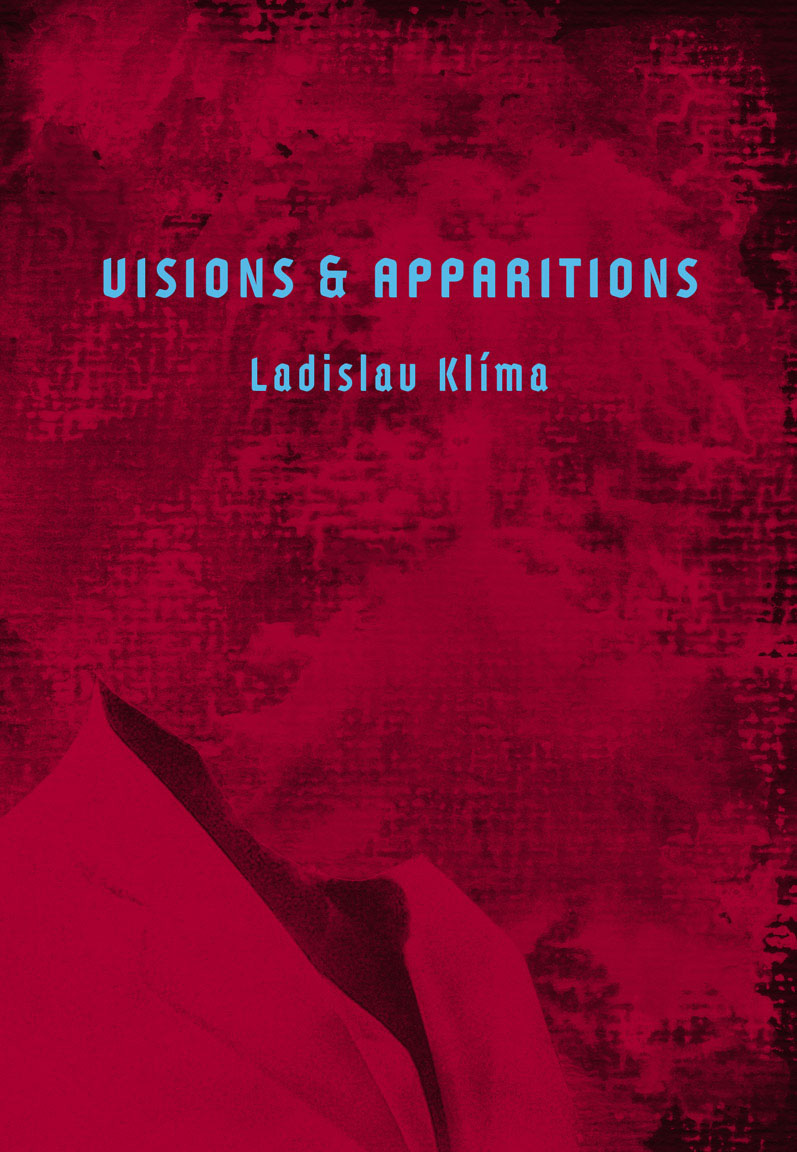
Visions & Apparitions, recently released from the inimitable Twisted Spoon Press in Jed Slast’s translation with collages by Alexander Booth, gathers together a selection of Klíma’s “tales of the uncanny.” This collection of stories in the horror and ghost story vein is reminiscent of the work of Poe, for Klíma was a radical subjective idealist who believed that an absolute subject creates all of his or her own reality. Born in Domažlice in western Bohemia in 1878, Klíma lived a life not too different from that of many of his protagonists. His father was a fairly wealthy lawyer, for a time he was a promising student, but things soon became unstable. To be fair, Klíma lost two brothers, both sisters, his mother and grandmother when he was still young and that may have contributed to his unwillingness to engage in society as expected. He was expelled from one school after another for criticizing the ruling monarchy and left the only placement his father managed to secure for him after half a year. Normal life was not to be his style. He moved around a lot, burned through any money he came by, and likely tested the generosity of his friends. He ultimately settled in Prague where he published his first philosophical treatise, The World as Consciousness and Nothing, in 1904. In this anonymous, self-published work he argued, inspired by Berkeley, Schopenhauer, Nietzsche and the symbolist poet Otokar Březina, that the world is a fiction. His own fiction reinforced this view, especially the fantastic tales which he apparently enjoyed writing “to pass the time.”
Unsurprisingly, his characters typically find themselves struggling against distortions fueled by dreams, hallucinations, and madness whether they are pining after a distant duchess or lost in the middle of a dense forest. They often find themselves in predicaments as a result of an unfortunate combination of insecurity and hubris, but the suspicion that the ghosts, monsters, and plain evil human beings they encounter may not in fact be “really real” is of little comfort. Their thought processes frequently fall into fractured internal self-debates. Nor is there necessarily an easy way out even if they are, in theory, “divine” architects of their own destinies—many of the stories simply break off mid-sentence or were published with endings of uncertain origin. Detailed bibliographical notes at the end discuss each tale’s publishing history and questions about what may or may not be additions to the original.
Painstakingly drawn from Klíma’s literary corpus, most of the stories in this collection are entertaining in the spirit of classic ghost stories, but a couple are somewhat more disturbing, as one might expect. Others offer a sense of his absurdist humour. Most interesting perhaps is his unwillingness to give up even when he was too sick to hold a pen. “Edgar: A One-Act Horror” was dictated to his life companion, Kamila Lososová, as he was dying of tuberculosis in 1928. This melodramatic vampire drama about a man confronting his cruel, criminal undead grandfather on the anniversary of the latter’s demise carries an intensity that may well be heightened by the feverish context of its genesis. But then, a similar feverish energy, appears on and off throughout this “phantastic” collection. It’s part of its charm.
For a taste of Klíma’s fiction, you can find “Me and My Uncle” from this volume, reproduced complete with notes, on Minor Literature[s].
Visons & Apparitions: Selected Tales of the Uncanny by Ladislav Klíma is translated from the Czech by Jed Slast with collages by Alexander Booth and published by Twisted Spoon Press.


Isn’t it a remarkable book? Twisted Spoon really are issuing some marvellous stuff!!!
LikeLiked by 1 person
It is great. Twisted Spoon books are always special.
LikeLike