“All the world is made of poetry”: Things That Happened and Other Poems by Bhaskar Chakrabarti

Each of us is a bird of disbelief
Flapping our wings beneath the tired water
We shall be born, we shall be born, a new life
Tomorrow or the day after—maybe even this evening

—“The Window”

An important voice in the rise of modern Bengali poetry, Bhaskar Chakrabarti was so intimately bound to the streets, alleys, and rooms of Baranagar in northern Calcutta that he was, until recently, little known beyond West Bengal. Born in 1945, his life spanned an era of tremendous turmoil and change in India and in his native state, yet his poetry touches universals of experience that transcend time and place. To spend time with his verse is to feel that one is in the company of the man himself, in the urban spaces he inhabited.
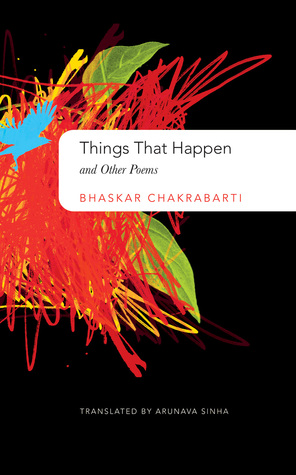
Things That Happen and Other Poems is the first cross-career selection of his poetry to be published in English. Translated by Arunava Sinha and published by Seagull Books, this volume offers the world an opportunity to become acquainted with this profound, melancholic poet. The recent inclusion of this title on the poetry longlist of the 2018 Best Translated Book Award will hopefully draw even more to discover his work.

Chakrabarti came to prominence in the late 1960s and 70s. It must have been, for him, a time of creative energy and excitement, as his nostalgia for these years, for lost friends and loves, resurfaces frequently in his later poems. However, it was also a period of political and economic upheaval. His earlier poetry often expresses a dramatic, angst-ridden intensity:

Night after night, for countless years, I’ve wanted to slice myself
open for self-examination
I have swallowed alcohol with ashes in it
I have gone up to fallen women to tell them, ‘I love you.’
Not all of this was a game.
My blood and sweat are mingled with black and white days,
brothers mine
I have forgotten nothing, none of it
The blows and the humiliation and the tears
Look—it’s so late tonight as well—still I cannot sleep.

—from “Brothers Mine (1/107)”

In his later poems a certain concern about the state of the world continue to re-emerge, in the form of anxieties about the what he observes in his community, and on the planet. His verse tackles the transformations of modern life, ventures into outer space, and frets within the confines of his room. But in general, as he struggles with his health following a cancer diagnosis, death becomes an ever more present companion, one he seems to entertain as much as he wishes it away and admonishes his audience to live well.

Cut off this thing that has bothered you all your life.

You are alive because of one simple reason, that you’re inhaling and exhaling. Keep this task up.

—from “Come, Let’s Talk of Some Things”

Along with this sense of mortality, a deep, abiding loneliness settles into his words, trails his footsteps, becomes the heart of his careworn song. The predominant mood of these poems is quiet, sad.

The one thing that is clearly evident  in all of Chakrabarti’s poetry is that he was a poet through to the very core of his being. It is the essence of his life’s work, all he ever wanted to do and he talks about his art with eloquence and passion. As he declares in the essay that opens this collection:

All the world is made of poetry. On some days the doors and windows within are flung open. All that I see and hear, all that I get a sudden smell of, turns to something new in a moment. My body feels light. I have had glimpses of the astonishing world of poetry, and I have been astounded every time. So many wilting conversations, fragrances, glances and dreams are happily tacked up on its walls.

How wonderful! He goes on to admit that his love of poetry never abandoned him, even if it did interfere with his ability to worry too much about employment or a steady job, likely to the dismay of some of those around him. And although he came of age in a time of upheaval, he is content to be a poet of the small, the simple, and the everyday. “I am a poetryist.” he writes, “I love ordinariness. Rejected, pedestrian conversations and scenes, days and nights left behind are all things that move me.”

True to this poetic spirit, many of his poems address the act of writing. He writes into silence and frustration with persistence:

I stay here in Baranagar, in Calcutta
Everyone here wants their fortune read
They want to know what life holds for them
They want to know when they’ll come into money

And I, an ancient ghost
Keep struggling with imagery, symbol and resonance
To hell with day before yesterday’s poems
All women with large breasts are better than them

Conjuring up thoughts about Panskura is better
Even writing four or five ordinary lines
About tender blades of grass is better

—from “Panskura”

Chakrabarti’s poetry is, on first encounter, simple. Calm, measured, pensive. His work is personal, mentioning places, addressing people directly, while speaking to emotions—attraction, loss, and loneliness—in tones that are intimate and human. But his poems invite the reader to fall into them, again and again. To read the verses aloud. And here is the junction where the magic of the translation comes into play. Without knowing the original language, vision and meaning must be trusted, but in listening to Chakrabarti reading from his work in Bengali, the cadences of his speech are clearly echoed in the way this poetry sounds and feels in the English.

And that is a remarkable achievement, and an endorsement for this evocative collection, this celebration of Calcutta in its uniqueness and its universality.

Echo has no compass: Footnotes in the Order of Disappearance by Fady Joudah

Echo has no compass: we trace each other’s dermatomes

No ecstasy without betrayal: not all who live in flames are saints

Great art needs no nation: in memory country size is one

Great nations need great art: soliloquy a mother tongue

— from “Footnotes to a Song”

It was not until I sat down to write this review—in so much as I yet feel myself capable of calling my scribbled thoughts about poetry a review—that I realized I’m following a piece about Ghassan Zaqtan’s latest novella, Where the Bird Disappeared, with a look at the latest collection of poetry by Fady Joudah, Footnotes in the Order of Disappearance. I came to Joudah first as a translator of Zaqtan’s poetry so I was not unaware of the concurrence. But I am typically reading at least two books of poetry and two books of prose at any given time, so the crossover is never so obviously bound, thus it is only now that I’ve become aware that the titles of both books include a form of the verb to disappear. A timely happenstance. However, although it is impossible to underestimate the importance Ghassan Zaqtan’s influence on an entire generation of Arab poets, Joudah included, the experience offered by the latter’s work is distinctly his own.

Fady Joudah is a Palestinian-American poet, translator and physician living in Houston, Texas. If I was conscious of the fact that he is a doctor, I don’t think it really registered or made its presence known in scattered poems I’ve encountered in the past. But his medical profession and scientific curiosity comes through in his work, along with a love of art, literature and nature. So does the legacy of war, destruction and conflict in the Middle East, and the varieties of experience of exile. His poetic territory is wide; his passage through it is intimate and acutely observed. As poet Mary Szybist contends in her praise for this “intensely vulnerable book,” Joudah is:

forging a lyric that works at the crosscurrents of reportage, myth, and dream where false imagined boundaries—of gender, nation, family—fray and unfold, and there are possibilities other than ‘to go mad among the mad / or go it alone’. . . (his) gifts for articulating the intersections of bewilderment, tenderness, rage, and grief are fully alive here.

The physician’s attention is very much evident in the early poems in Footnotes. “Progress Notes,” for instance, opens with the poet’s assessment of his own asymmetrical visage:

My left eye is smaller than my right,
my big mouth shows my nice teeth perfectly
aligned like Muslims in prayer.
My lips an accordion. Each sneeze
a facial thumbprint. One corner
of my mouth hangs downward when I want
to hold a guffaw hostage. Bell’s palsy perhaps
or what Mark Twain said about steamboat piloting
that a doctor’s unable to look upon the blush
in a young beauty’s face without thinking
it could be a fever, a malar rash,
a butterfly announcing a wolf.

before moving on to find a future echo in noted in one of the cadavers in his anatomy classroom:

But the colonel on table nineteen
with an accessory spleen had put a bullet through
his temple, a final prayer. Not in entry or exit
were there skull cracks to condemn the house
of death, no shattered glass in the brain,
only a smooth tunnel of deep violet that bloomed
in concentric circles. The weekends were lonely.
He had the most beautiful muscles
of all 32 bodies that were neatly arranged,
zipped up as if a mass grave had been disinterred.
Or when unzipped and facing the ceiling
had cloth over their eyes as if they’d just been executed.
Gray silver hair, chiseled countenance,
he was sixty-seven, a veteran of more than one war.
I had come across that which will end me, ex-
tend me, at least once, without knowing it.

Medical and medicinal imagery continues to resurface routinely throughout the collection, woven into both the political and the personal (which are never mutually exclusive here) infusing both with an intimate humanity:

The hour of the grackle, and a mother
not menopausal, solitary with endgame lung

tumor in a foreign country
and what makes one foreign:

she hasn’t seen her son for three or five
exilic or immigrant years,

citizen or national stints, a keyword
a thrombus dislodges

in heart or head
for infarction’s infraction

—from “The Hour of the Grackle”

Although much of Footnotes reflects the poet’s specific experience in America (“Palestine, Texas” is a telling, gently ironic send-up of the tendency of the same place names to occur so ubiquitously across the American landscape that they lose resonance with any original roots), his concerns reach far beyond national boundaries. This is rendered most explicitly in the central section of Footnotes, “Sagittal Views” which is the result of a collaboration between Joudah and his friend, Syrian Kurdish poet and translator, Golan Haji, who now lives in Paris. Drawing on their meetings, phone and email communications, all conducted in Arabic, Joudah translated and formed their words into chilling evocations of loss, sorrow, and resignation:

Over dinner we spoke of the game of recurrence dissolving into an old dog’s tail, loquacious desire far from the borders of the body, yet is the body’s. What’s inside and doesn’t come out to skin or what’s outside and doesn’t touch us. Victims, we told ourselves, will inherit the future one day, but souls will linger distant from redemption. Don’t follow the signage and keep your eyes on the phrase. News of the explosion will hang around. The hell of pictures on the web. Faces of the dead on Facebook will wait for your walk home. A woman who awakened your first lust when you were a kid was killed in the morning while talking to her sister on the phone. First a blast then stillness. You were late to dinner. You had lost your way to the restaurant. You couldn’t have known she had just died, and what you thought were Klee’s paintings in the gallery clawing your afternoon nerves was her calling your name one last time.

—from “After Wine”

Poetry, at its best, invites re-engagement. Demands it, even. I was so enamoured with the anatomy of Joudah’s wordplay that, on my first passage through Footnotes in the Order of Disappearance, I was so intrigued to see where his wonderings would lead that I did not linger as I might have on another initial journey. I read this book with an unexpected urgency. But as I returned to it with an eye to sorting out my responses, I encountered new depths, new heights of emotion. And at times in the seemingly simplest passages. For me, the prose poems—“Horses,” “An Algebra Come Home,” and “Alignment” to name a few—hold a particular power, but the entire collection is so strong, so varied, that there are boundless rewards to be found in the generosity of Fady Joudah’s pained and passionate poetics.

Footnotes in the Order of Disappearance is published by Milkweed Editions.