
The past is so long ago. A lot is certain and clear—there are documents. But I was only a few years old at the time, so it’s difficult: I only know what I experienced physically. That I do know. But the paths, the detours we followed, even the ones I was there for, those I have to imagine.
Heinz Fritz grows up haunted by a past filled with mystery, secrets, ghosts. He is the son of a Norwegian woman who fell in love with a wounded Austrian soldier she was caring for during the Nazi occupation of Norway. When she discovered she was pregnant, she was forced to leave. As the daughter of the mayor of the northern town of Kirkenes, her circumstances made it impossible for her to stay. It seems that her soldier accompanied her to Oslo, and from there she travelled alone to his hometown of Hohenems, where she was to live with his family. But somehow the plan goes awry. Something happened in Berlin, something which remains unexplained, and although she reaches her destination, soon after Heinz is born in late 1942, she falls ill and he is taken away from her. He ends up fostered out to a farmer and his wife near Lustenau until his mother suddenly arrives to claim him four years later. Mother and son then live together, happily if precariously, for several years until she meets and marries a man named Fritz with whom she will have two more children. But Heinz’s stepfather is cruel and his mother emotionally fragile, prone to frequent epileptic fits, leaving him uncertain where he belongs, if anywhere. It doesn’t help that his mother regularly questions whether he really is her Heinz, or whether he’d somehow been mixed up with another as an infant.
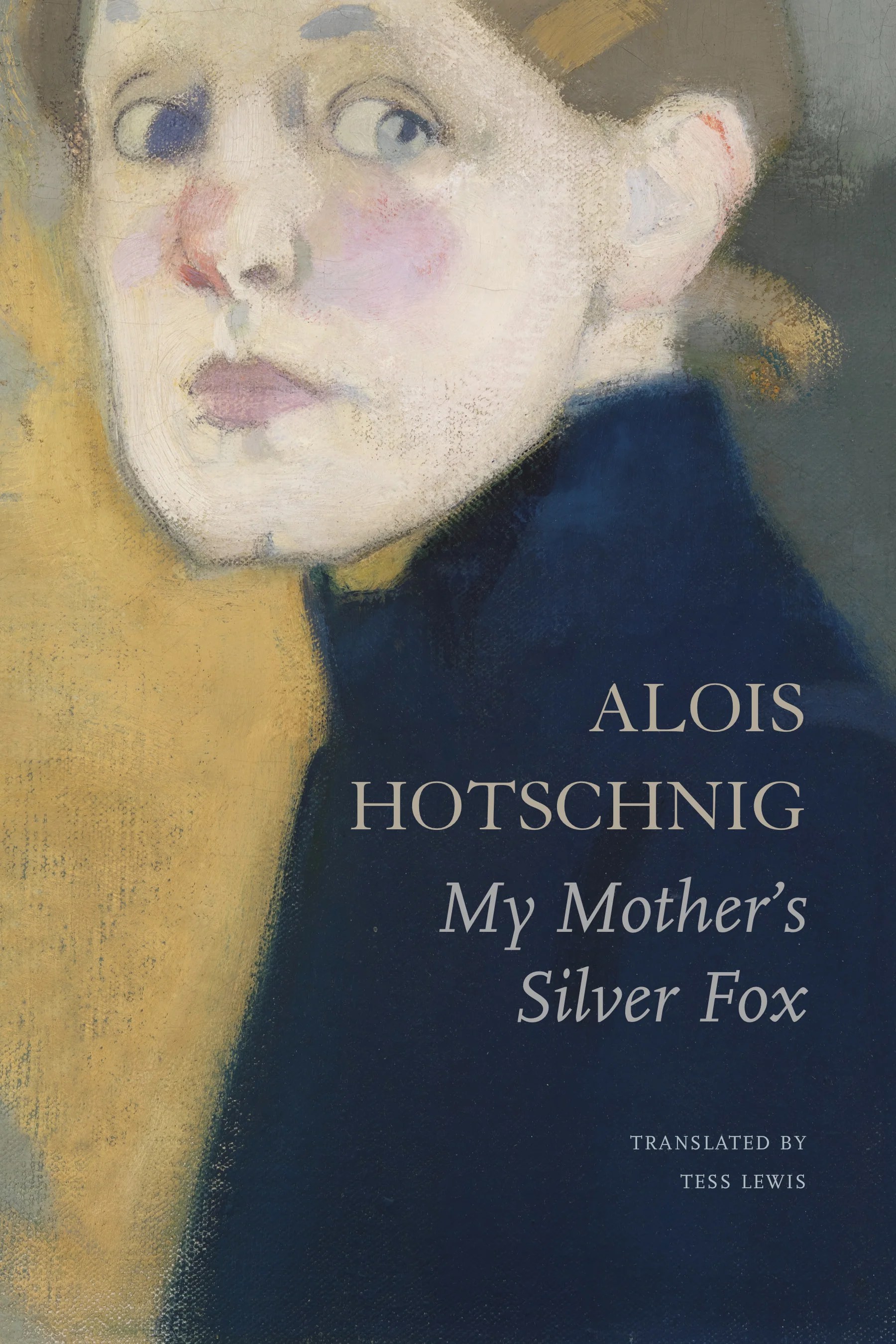 An unsettling and inspiring meditation on memory, identity, and the power of love and resilience, My Mother’s Silver Fox, by Austrian writer Alois Hotschnig, is the story of one man’s attempt to untangle the truth of his own history as he looks back over almost eighty years of life. Heinz longs to understand his origins, but he has surprisingly little to go on at first. Whenever he asks his mother about her past or his real father, she inevitably falls into a seizure, so he stops asking. The bits and pieces of information he manages to gather over time, whether close to home or when he finally visits Norway with his mother, contradict one another. The only seemingly solid documentation he possesses is an itinerary charting his mother’s journey from Oslo to Hohenems, apparently under the auspices of the Lebensborn, the secret SS initiative designed to promote racial purity and build an Aryan race.
If marrying Fritz is his mother’s attempt to find stability, eight year-old Heinz finds that settling down offers him no sense of security. His stepfather seems most intent on teaching him to slaughter animals, so he copes by what he describes as relocating internally. He discovers that it is possible to hide inside his own imagination. His earliest realization that such a possibility exists comes when his mother reads to him from her cherished copy of Peer Gynt. Although the text is in Norwegian, he understands it because each time she reads it she becomes Peer Gynt’s mother, dramatically performing her death for him. It is a performance she repeats as his mother too, so often in fact that he finds it hard to tell when she is acting and when she is actually having a seizure. Each time she is there, but not there:
No one knew where her journey took her. But I wanted to get away from there too, ideally with her, and so I tried to go on the journey the same way she did and practiced falling down and falling over. I portrayed what went on before my eyes, I re-enacted it, actually, as I re-enacted everything that scared me in order to get hold of it. No matter how often I witnessed them, her episodes shocked me every time. And they attracted me. Everything that frightened me also attracted me and in the way that my mother enacted Åse’s ascension to heaven, I tried to accompany her on her journeys. I wanted to understand and I wanted to feel the strength she had in those moments when she was unconscious.
So, Heinz learns from his mother that he can find refuge in acting; by performing he can be protected from that which threatens and frightens him, through private fantasies and later on a makeshift stage in his backyard. But, soon he becomes hungry for more inspiration than the tattered magazines his family subscribes to and when a friend lends him a copy of his first proper book—Bram Stoker’s Dracula—he is completely consumed by the main character, terrified and obsessed. “I almost didn’t survive my first book,” he tells us, “but I let it happen because without this book I certainly would not have survived, I sensed that, too.” From that point on, he cannot help but surrender to the heroes of books he reads or films he sees, and eventually, every role he takes on in the theatre as a professional actor.
But the road to the theatre is a long one. Heinz’s childhood and adolescent years are difficult. By the age of fifteen, after only seven years of schooling, he is working full-time in an embroidery factory to help support his family. His stepfather is dying, his mother is often hospitalized, and he has two younger siblings. As close as he is to his mother, she remains a mystery, one that deepens as her illness progresses. When he does find out who his real father is and where to find him, he is not welcomed, or even acknowledged. In his absence, he longs for a true father figure of some kind, someone lasting, but instead he finds a series of men who pass through his life, each making some important contribution. They can’t, however, fill in the missing past. When, at the age of sixty, Heinz finally does meet his real father, there are some answers, but are they even true?
There is a haunting, almost diaphanous quality to this circuitous first person narrative, so thoughtfully translated by Tess Lewis who has also translated two of Hotschnig’s earlier works. The tone is cautious, the style halting, with italics used generously for emphasis and to indicate uncertainty. It is as if Heinz is sorting his story out as he tries to tell it. He is an actor, after all, so he is inclined to perform his life, as he once staged recitals in his childhood backyard, relying as much on his imagination as on the scattered facts he knows, or thinks he knows, for sure. Ultimately, the unfilled and conflicting elements of his account reflect so many of the secrets that persisted in the wake of WWII, and even more powerfully so because Heinz Fritz’s life echoes (with permission, Hotschnig notes) the real life story of Austrian actor Heinz Fitz. The final result is mesmerizing.
My Mother’s Silver Fox by Alois Hotschnig is translated from the German by Tess Lewis and published by Seagull Books.

