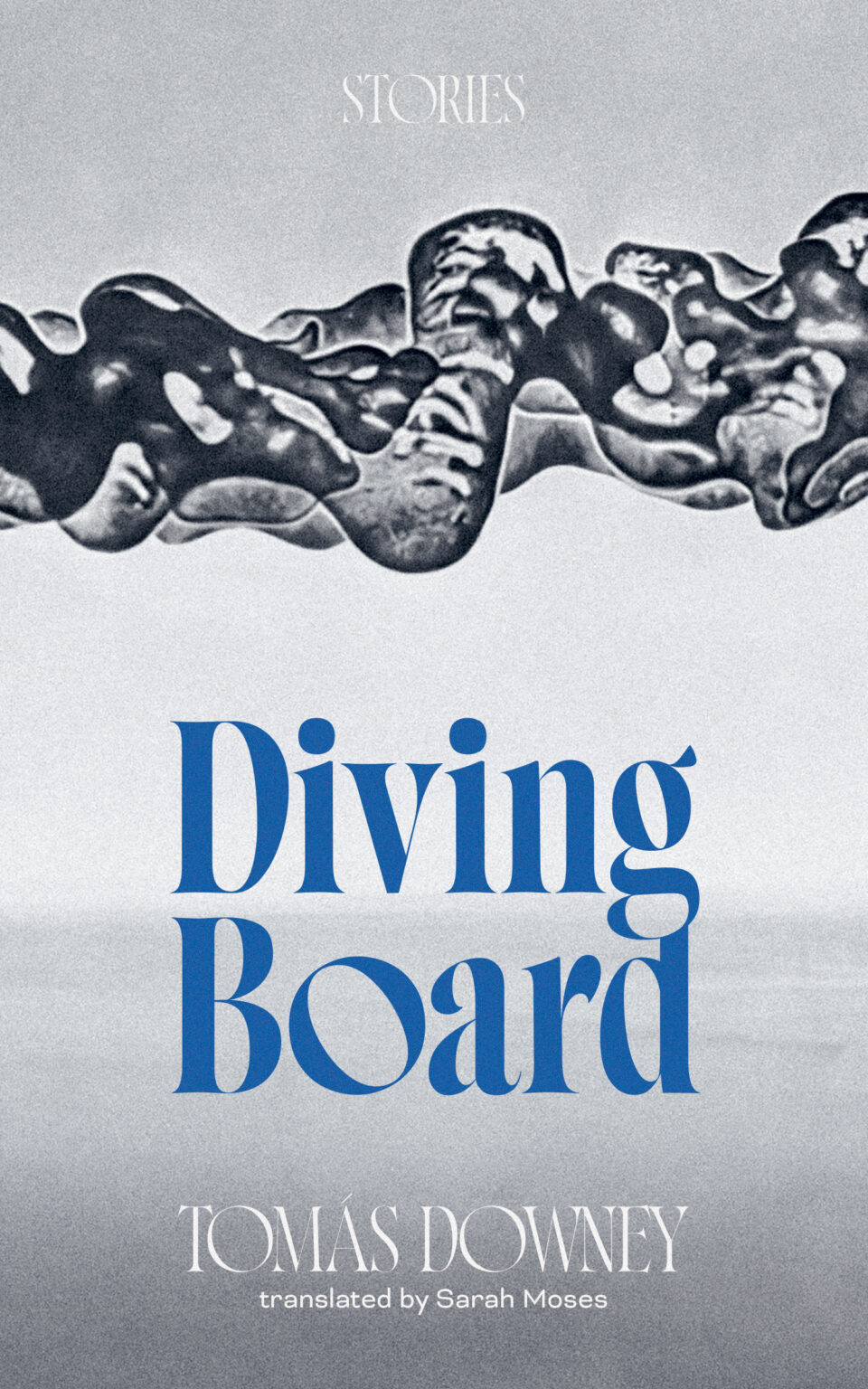
Slipping into the twilight zone: Diving Board by Tomás Downey

The first thing I think to write is this: what’s happening to me is incredible. But immediately, I stop—I’m suspicious of everything. I think about it, reread the sentence, and the pen slips through my fingers and falls to the floor. It bounces and flips in the air, does some involuntary acrobatics. Describing what’s concrete is easier.
(from “Astronaut”)

If there’s a common feature uniting the nineteen stories gathered together in Diving Board, Argentinian writer Tomás Downey’s first collection in English translation, it’s the uncomfortably close focus he places on the experiences of his narrators or protagonists. His lens is so tight that the edges of the world around them becomes  increasingly distorted, leaving them emotionally isolated and alone. Consider “The Astronaut” quoted above, for instance. The narrator is a man who has inexplicably found himself freed from the restraints of gravity, a condition that has literally turned his world upside down. Only at ease resting on the ceiling, every time he returns, even briefly, to the floor he is struck by waves of dizziness and nausea. There is no magic in this altered reality; everyone else, his wife included, remains grounded, unreachable. He decides there is only one means of escape—an open window.
Born in Buenos Aires in 1984, Downey is one of Argentina’s foremost short story writers, a master of a strangely unsettling terrain that his fellow Argentinian writer Mariana Enriquez refers to as bizarro fiction, not a genre but: “a disturbing variant that hides a vague threat, that leaves the reader feeling something between awe and unease.” As such, his stories vary from harsh realism to fantasy to horror to speculative fiction, but regardless of form, he tends to minimize set-up and avoid resolution altogether, intensifying the tension. In most instances, his settings lack excessive detail which allows circumstances, personalities, and interrelationships to take centre stage. As a result, even stories that take place in rural settings have a certain pervasive claustrophobia.

Short story collections, especially those that contain so many titles, can run the risk of falling into either unevenness or sameness. With Diving Board however, even if many of the tales involve either couples or families, no two stories are alike. Each treads a distinct terrain. In “The Cloud,” a thick, damp fog settles on a community, driving everyone indoors as the temperature rises and snails and slugs seem to multiply rapidly. A family tries to wait it out as this strange, heavy, wet plague spreads. In “Horce,” a man buys a seed that grows into a horse, a creature he hopes will offer him an excuse to reach out to the woman he loves, but instead the vegetal animal only increases his isolation. And, in the title story, a divorced father takes his daughter to a swimming pool, but when he finally agrees to allow her to jump off the diving board, she disappears into thin air:

Josefina leans over again, gauging the distance. She walks back to get a running start. She runs, jumps. He closes his eyes for a second, they’re irritated by the sun and the bleach. He hears a scream or a laugh. When he opens his eyes, Josefina should be in the air, about to fall, but she’s not. He hasn’t heard a splash either.

While many of Downey’s stories exist on the edge of the uncanny, reminiscent of Rod Serling’s Twilight Zone and its iterations, others lean straight into horror with characters who harbour cruel and twisted intentions. The action often stops just as things fall apart or in some vague aftermath. No explanations or reasons are ever offered. But sometimes there seems to be a deeper, more serious message. Such is the case with my favourite piece, “The Men Go to War.” Although it is not tied to any specific conflict, Argentina and other Latin American countries have seen their share of uprisings, coups, and warfare, but in truth this tale could take place anywhere, any time. The setting here lies in the shadow of a brutal war. Jose’s husband Manuel is a soldier. Every day she sits at home, refusing invitations to go out or welcome visitors. She is angry at her husband’s willingness to get involved. Then two officers appear at the door with the grim news that Manuel has been killed. They tell her that the incident occurred in a critical battle. They assure her they are winning:

Jose nods, possibly without listening. She’s used to condolences and accepts them with the hint of a smile, trying to downplay their importance, and always responds with a look that’s melancholic and resigned. She waits for the moment to pass, for nothing further to be said on the subject. Whatever it takes, she needs to believe that Manuel’s death is one fact among many, that it’s not of great importance. Thousands have died, all the women are widows, all the children orphans, winter is almost over, and the roofs of the houses need to be repaired. This week there were bananas at the market. When was the last time there were bananas at the market?

Jose’s measured response only cracks briefly when she is given all that remains of her husband, a knife with a mahogany handle and leather sleeve that had once belonged to his father. But when the men have left, she places it in a drawer. Then, as the days pass and winter begins to give way to spring, the official visits continue repeating the same script. Jose seems to be trapped in some kind of time loop, a repetition she responds to with the same questions, the same acceptance, the same self-control. This is yet another story that dissolves into its mysteries rather than revealing them.

Downey’s haunting, weird tales tend to linger, leaving a discomposing sensation in their wake. But they leave one wanting to move on and find out where his imagination will wander next. His stories have appeared in a number of English language publications, but now with this collection, translated in clear, clean prose by Sarah Moses, a broader introduction to the eerie landscape his characters inhabit is available in one volume.

Diving Board by Tomás Downey is translated from the Spanish by Sarah Moses and published by Invisible Publishing.

With a restless curiosity: A Question of Belonging: Crónicas by Hebe Uhart

To experience the world through the words of the esteemed Argentinian writer Hebe Urhart is to be offered a uniquely calm and compassionate view of ordinary places and people that effortlessly makes them seem anything but ordinary. A Question of Belonging, a newly translated collection of her crónicas—short, informal, observational writings, often published in newspapers or magazines—pulls together a selection of texts composed over five decades, and offers a fine introduction to the distinctive voice she brought to this form, one that became increasingly important to her over the course of her literary life (she also published two novels and collections of short fiction).

In her fascinating introduction, Mariana Enríquez reports that Uhart always considered herself a “writer of the outskirts.” She was born in Morena, a town on the edge of greater Buenos Aires, and experienced many family tragedies in her early life. As a young adult, she took on a position a rural school teacher in an impoverished region and cites that experience as one which not only helped her mature, but taught her to guard against self-centredness. Yet, she was also restless and loved to travel, devoting much of her writing to chronicling her excursions. Enríquez describes her friend as:

so unlike most people I have met in my life: she was brave, curious, carefree, sure of herself. Yet, as a traveler, she didn’t like going to big cities – they unsettled her (despite having visited many, of course). She preferred small towns. Places that were easy to get to know. Because what she loved was talking to people. These trips, day trips, in general (she referred to herself as a “domestic” chronicler) were a search for different ways of expression, a search that would take on the contours of the place itself.

The early pieces in A Question of Belonging, with the exception of a description of train trip to La Paz taken when she was twenty, tend to be brief musings, sometimes personal, but also more general observations about topics like the way pets seem to resemble their owners or how families commonly inherit a style in keeping with their political leanings, even if the politics themselves are not always passed down. Her writings are peppered with examples of her characteristic subtle humour, something is that sustained even as her work becomes more serious and more political throughout her career. “Inheritance,” reproduced on the Paris Review blog offers a perfect taste of her wit and style.

Once the travel bug sets in, her trips become a key subject for her chronicles. Her excursions would take her to cities, towns and communities throughout Latin America, but time and costs often kept her closer to home. In “Irazusta” she describes how:

Once, when I did not have the money to go on vacation, I saw a TV ad for Irazusta, a town of a thousand residents. The reporter explained that the town was near Gualeguaychú and then asked some women cooking what kind of tourist attractions it had to offer. One of them said, “The handcar on the railroad and the otters bathing in the lagoon.”

Not extraordinary attractions per se, but the women seemed optimistic about summoning a visitor. And so I went.

When she arrives, she discovers there are no accommodations. Residents simply open their homes to this novel phenomenon—a tourist. In fact, the TV ad lures twenty tourists and the town is beside itself with excitement. Undeterred by the ad hoc way interactions and opportunities that arise in this otherwise ignored community, Uhart manages to find, amid the pigs running around freely, an interesting assortment of intelligent people to engage with.

No matter where she goes, Uhart’s approach is one of open curiosity; she displays an honest interest without judgement, in the lives and customs of others. Socially conscious, she is keen to learn more about Indigenous peoples and, in her typically unobtrusive way, call attention to the layers of discrimination existing in Latin American societies—typically allowing the people she engages with to express their concerns in their own words. And, more than once, she finds herself up against people who do not wish to entertain her questions, or even her attempts to be cordial. But, she never lets that upset her. She figures they must have their reasons and, if she senses her presence is truly unwanted, she simply remains silent or, if possible, leaves.

A lifelong teacher, she frequently seeks out local historians or anthropologists to interview, and visits libraries and schools. She is especially interested in language and colloquial expressions—finding in them clues to the diverse ways that different peoples view and understand the world. But she also likes to take time to herself, to observe. One of her favourite means of exploration is to simply walk through neighbourhoods, look at the homes and gardens, visit local markets, and then find a comfortable café where she can sit and watch people pass by.

Uhart’s crónicas paint vivid portraits through relatively spare accounts. She tends to be well prepared when she ventures into a community, and draws on what she has read to guide her interactions, but the intention is to ignite her reader’s interest and awareness, rather than to overwhelm them. But she can be energetic in her descriptions, as in “Río is a State of Mind,” her rollicking take on Río de Janeiro during Carnival:

Río bares it all: its gardens, its past, its beggars, its beauty, its ugliness. An obese man with two bellies, one on top of the other, is eating at the restaurant. His shirt isn’t long enough, but he doesn’t mind. Beggars move around the street without fear for themselves or others: one of them was ranting with a very long iron bar in hand – nobody seemed to be frightened. A man with dyed blond hair was dipping a piece of bread inside a can of Coke and offering it to anybody who walked by. Another beggar, a woman this time, was wearing an underskirt that hung behind her like the train of an evening gown. She sat down at a bar next to some middle-class women and drank like any other customer.

During her time in the Brazilian city, she also takes an opportunity to explore another of her favourite resources—the programs available on the television set in her hotel room. Unlike many fellow writers and academics, Uhart loved TV. As a source of information and as entertainment.

Although she does not discuss finances, her excursions are generally modest, either day trips from her home in Buenos Aires (even visits to areas within the city limits), or longer trips by bus, train, car, small plane or some combination thereof. In addition to Argentina and Brazil, the crónicas in A Question of Belonging see her visiting Paraguay, Colombia, Bolivia, and Peru. Later in life, when her literary fame led to invitations to attend festivals in major centres, she would go, but tended to find the crowds, the disorienting hotels, the vast festival grounds, and the general businessiness overwhelming. She is inclined to try to get away, to explore and see what the location has to offer outside the closed festival environment. In the longest text here, “Off to Mexico,” she details a visit to Guadalajara and Mexico City in 2014, when she was already in her late seventies. It’s an account rich with humour, scenic descriptions, and historical and literary references. No trip can ever be wasted. Since she’s in the country, she hopes to come to understand something of Mexico’s history, society, and culture.

Rarely does Uhart write directly about her own life in these dispatches, the exceptions in this collection include the first piece, “A Memory from my Personal Life” in which she recalls an alcoholic boyfriend from her past, a brief account of her varied experiences with therapy, and the final crónica, “My Bed Away from Home,” published just days after her death in 2018, at the age of eighty-one. Here, with remarkable humour and sensitivity, she writes about a stay in the hospital when she already very ill. She starts in ICU and eventually gets “promoted” to Intermediate Care where she is delighted to discover her bed is close enough to the bathroom that she go on her own. She details her frustration with some of the staff and the humiliation of having her diapers changed in full view of others, but as ever, she is careful to keep in mind that so many of her fellow patients are in much more compromised and unfortunate circumstances than she is; she never wishes to be overly self-centred. Humble and grateful to the end.

A Question of Belonging: Crónicas by Hebe Urhart is translated from the Spanish by Anna Vilner and published by Archipelago Books.

Things that will come to pass and cannot be stopped: January by Sara Gallardo

What is a day? What is the world when everything inside you shudders? The sky darkens, houses swell, merge, topple, voices rise in unison to become a single sound. Enough! Who is that shouting? Her soul is black, a soul like the fields in a storm, without a single ray of light, silent as a corpse in the ground.

Sixteen year-old Nefer has a secret. A secret growing inside her body that is pushing her away from her family and deeper into herself. Desperate to resist the abrupt transition to womanhood that has been thrust upon her, her predicament is the central focus of Argentinian writer Sara Gallardo’s January. Originally published in 1958, when Gallardo was only twenty-seven, this unsparing novella about rape, pregnancy and abortion in a world where a woman’s body and being was strictly defined by church and convention, has come to be regarded as required reading in her native country. It has now been released in Frances Riddle and Maureen Shaughnessy’s English translation.

This brief novella simmers with stark intensity as it follows Nefer’s conflicted and tumultuous emotions as she struggles to cope with her unfortunate circumstances alone in a deeply religious rural community in mid-twentieth century Argentina. The youngest of three daughters, her life on her family’s farm is one filled with hard work and constant expectations. She admires her disabled father’s quiet dignity, resents her sister’s fulsome beauty and fears her mother’s large, threatening presence. And, in spite of her condition, she nurses a hopelessly passionate crush on her handsome neighbour, Negro. In her mind, in fact, it is he who is responsible for her pregnancy although the child is not his. She had invested so much time and desire into the design and creation of a dress for her eldest sister’s wedding imagining it might magically catch his eye and, had she not been so intent on making an impression, she believes she would not have inadvertently attracted the attention of the older man who forced himself that day.

Playing out against a landscape defined by blistering heat, vast open spaces, sparse shade and clouds of dust, Nefer’s experience of her surroundings is highly charged and fragmented. She swings from rage to fear to jealousy to waves of crushing guilt. Unable to escape the stain of her strict Catholic upbringing, the sorry state of her soul is a constant concern. Anxiety eats away at her. She cannot help but think back to a time when she was carefree, when the world still held promise. But she remains determined to face her fate on her own terms, no matter where it takes her. Gallardo brings us right into the heart of her effort to assert control over her mind, her body and her life, as in this scene where she slips out during siesta to sneak into town in search of a possible medicinal intervention:

She kicks and takes off at a gallop, steering toward the thick grass that will absorb the footfalls. She doesn’t want to think about the end of her journey, about the old lady she’s never seen but with whom all her hope now lies. Her eyes pick out objects one at a time, attributing an exaggerated importance to each. Thistle, she thinks, thistle partridge, dung, anthill, heat; and then she hears – one, two, three, four, one, two, three, four – as the hooves hit the ground. Slowly, sweat begins to appear behind the horse’s ears and runs in dark strands down his neck where the reins chafe against his coat, churning up dirty foam. Little voices, little voices speak to Nefer, but she continues her journey indifferent to them. Cow, she thinks, a Holstein, and another and another. That one’s overheated. Lapwings. Two lapwings and their chick. Those piercing shrieks!

In less than 120 pages, January offers a vivid, internalized account of a young woman facing impossible odds. Gallardo was born in 1931 to a wealthy Buenos Aires family with broad agricultural interests and this, her first book, shows a clear sensitivity to the social dynamics impacting disadvantaged rural communities and the suffocating influence of the Catholic mission churches. But beyond the constraints of her time, it is Nefer’s private horror, as reflected in her relationship to other people and to the natural environment, that makes this such a compelling—and timeless—read.

January by Sara Gallardo is translated from the Spanish by Frances Riddle and Maureen Shaughnessy and published by Archipelago Books.

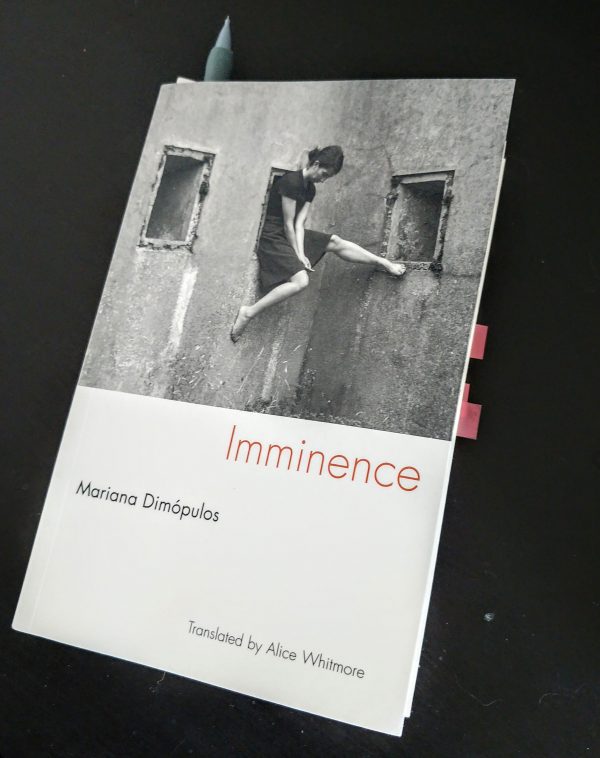
A second-hand melancholy: Imminence by Mariana Dimópulos

At the beginning of Argentinian writer Mariana Dimópulos’ unsettling novel Imminence, it is immediately evident that there is something oddly off-balance here—a softly-hued disconnect that instantly sets the tone for one of the most finely realized representations of what it feels like to be oddly out of step with the world around you. The narrator, alone for the first time with her infant son awkwardly reaches out to touch him. She strokes a foot and waits for something to stir inside her chest as she had been assured it would. Nothing. Her partner Ivan comes into the room and, for the moment, rescues her from any further responsibility. Relief.

She was, we soon learn, hospitalized for a month with a serious infection following the baby’s birth, so young Isaac has been attended to by Ivan, her sister, and the nurses up until this point when she is deemed well enough to venture home. She does not even know her child has been named until that first night in the apartment.  His Russian father has chosen his own grandfather’s name, an appellation sadly devoid of Spanish musicality. But that’s okay.

The story that unfolds—or to be more precise, unwinds—belongs to that first evening home from the hospital, and to another evening with strong and increasingly ominous echoes—the last with her pervious lover, Pedro. Woven in and out of her careful accounts of those two evenings, are a flow of memories tied to her past and a number of key people in her life. There is Celeste, the relative she comes to stay with when she moves into Buenos Aires from the smaller rural community of Los Flores in her teens, and her friends, Mara the actress, and Ludmilla who was tragically killed young. These are the women she tries to measure her own insecure sense of womanhood against. And then there are the men: Ivan and Pedro, of course, and the Cousin, a mysterious distant relative with whom she has an occasional sexual relationship—a manipulative, distasteful character with an uncanny sense of timing.

Her account is not chronological, she foreshadows and repeats herself as if slowly filling in a fluid, watery tapestry. There is a dreamlike quality to her stories that bounce off one another, gradually taking on greater shape and form. Her observations are strange, often almost mechanical as if existing in the world is not something that comes naturally. She tries to take her cues from others. Mara and Ludmilla are especially important as early role models:

They were masters of subtlety, and both possessed a scathing wit. And as the stars of the night I would feel a great admiration for the two of them, and I would swear alongside them the sacred oaths of their master plan: I would never get married; I would never cry a single tear over a man who didn’t deserve it; I would never have children, nor would I attend to any other such calls of nature, if indeed nature were ever to call.

As her story is gradually fleshed out, her differences become more explicit, and more intriguing. Socially she struggles. She is, it appears, truly unable to interact with reality, if there is such a thing, with the same ease others seem to demonstrate. Aware of this shortcoming, she has learned, as she puts it, to disappear “inside the parenthesis”. She cannot even recall when it first happened—as a child or as an adult in response to loss perhaps—but either way she has found a refuge, first in the comfort of numbers and if that fails, in a private ritual:

In order to pull off the trick, all I had to do was imagine a beautiful derivative. If that didn’t work, I would make a little ball out of a stocking or a scarf and place it where I imagined my stomach to be, then spin around on the floor or the bed and wait for a few seconds, and soon enough it would start working, and any feeling remotely like an emotion was swiftly eliminated.

This ability to push emotion aside, one that could well be deeply embedded in the narrator’s personality, is a double-edged sword. If it eased the trauma of Ludmilla’s death, or Celeste’s difficult final years; it impairs her resistance to the Cousin’s inappropriate attentions, and undoes her relationship with Pedro, an academic who had visions of a future she could not share. In close proximity to others, her capacity to “perform herself” tends to fall apart and she becomes the architect and the audience of her own misfortune, watching from the impassive default position she continues to fall back into.

But when Ivan unexpectedly comes into her life, the ground suddenly shits beneath her feet. She feels. Unprepared, she is secretly pleased at this thing stirring inside. However, he is a doctor, called back to Minsk at least temporarily, and she has to act fast on this rising tide:

I was triumphant: I made promises, I sent signals, I invested all my energy into calculating what Ivan was really trying to tell me, rummaging for the hidden meaning beneath every sentence, in a feverish kind of hermeneutics, trying to enthrall him, letting myself become enthralled.

Ivan does return, their relationship blossoms, and ultimately they are sitting over soup on this first night together as a family while their child sleeps in his cot. She and Pedro likewise had had soup for dinner on the night their relationship ended. Is the stage set for another repetition, like the many coincidental duplications our number-obsessed narrator has previously noted? As the trajectories of the two accounts at the core of this tale threaten to converge, the tone becomes increasingly measured, disturbed. Tensions rise.

Imminence is an exceptionally well crafted novel. The narrative winds forward and back in time, but never loses its focus. The compelling voice of the narrator is the key, the magic that pulls this work together. Translator Alice Whitmore allows the full beauty and the strangeness of her reminisces and reflections to come through. Lyrical, but odd, the narrative strikies a tone somewhere between that of  Fleur Jaeggy’s SS Prolterka and Max Frisch’s Homo Faber. Some may find her detachment difficult to forgive, but she herself is aware of a lack, a disconnect—a something that sets her apart from other people, especially women. She will frequently assert that she is not a woman, but this is not an indication of an inherent gender insecurity, so much as a failure to play by the normal rules of human engagement which, because she is female, she assumes are those of a woman. Yet, with less of a record to set straight than Jaeggy or Frisch’s protagonists, her story is one with many more undefined edges. This is not just a confession, but a sombre self-examination, a mess of complicated emotions muted, repressed and viewed through a haze of time and physical fatigue. And it is a narrative that holds you in its spell until the very end.

Imminence by Mariana Dimópulos is translated from the Spanish by Alice Whitmore, is published by Giramondo.

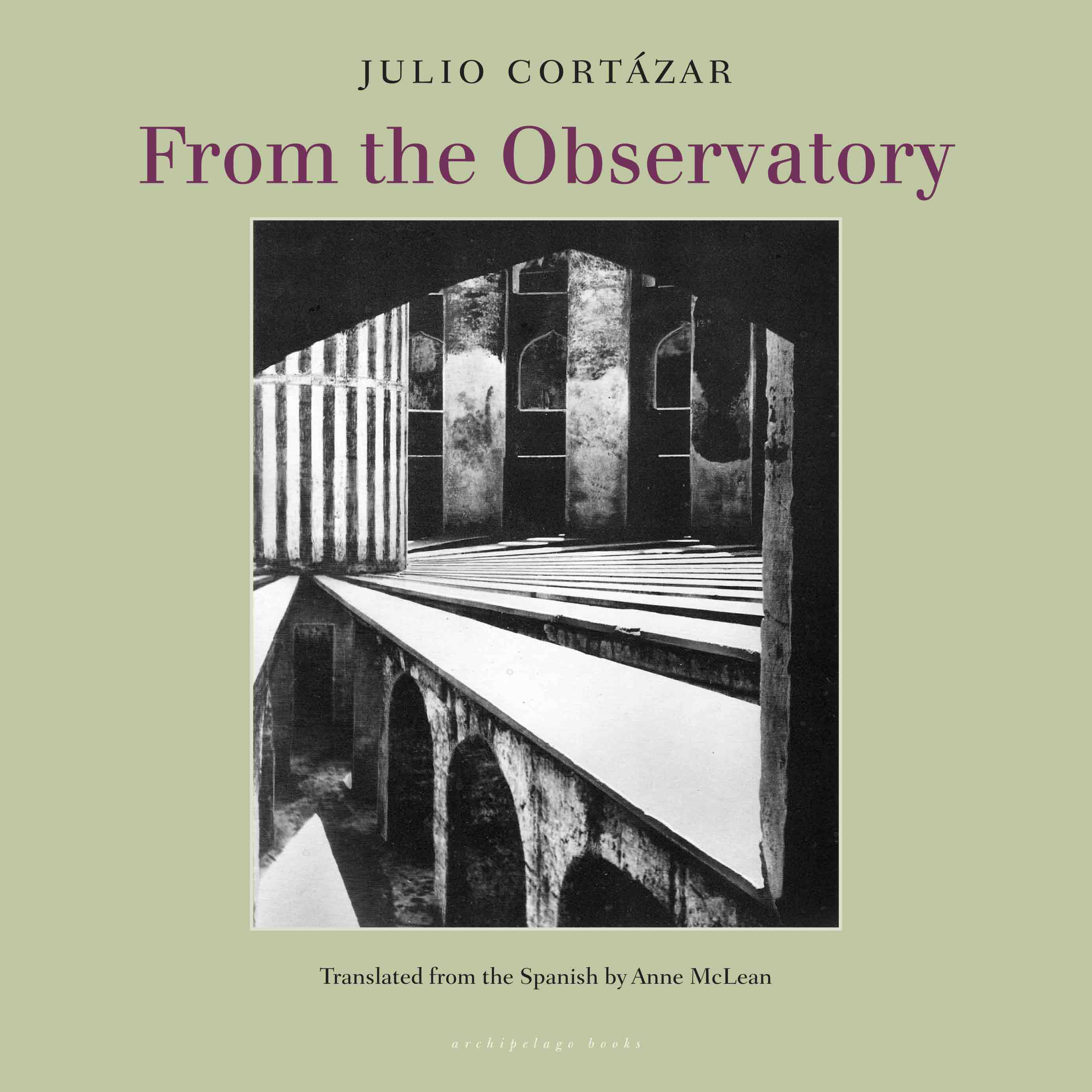
Into the redheaded night: From the Observatory by Julio Cortázar

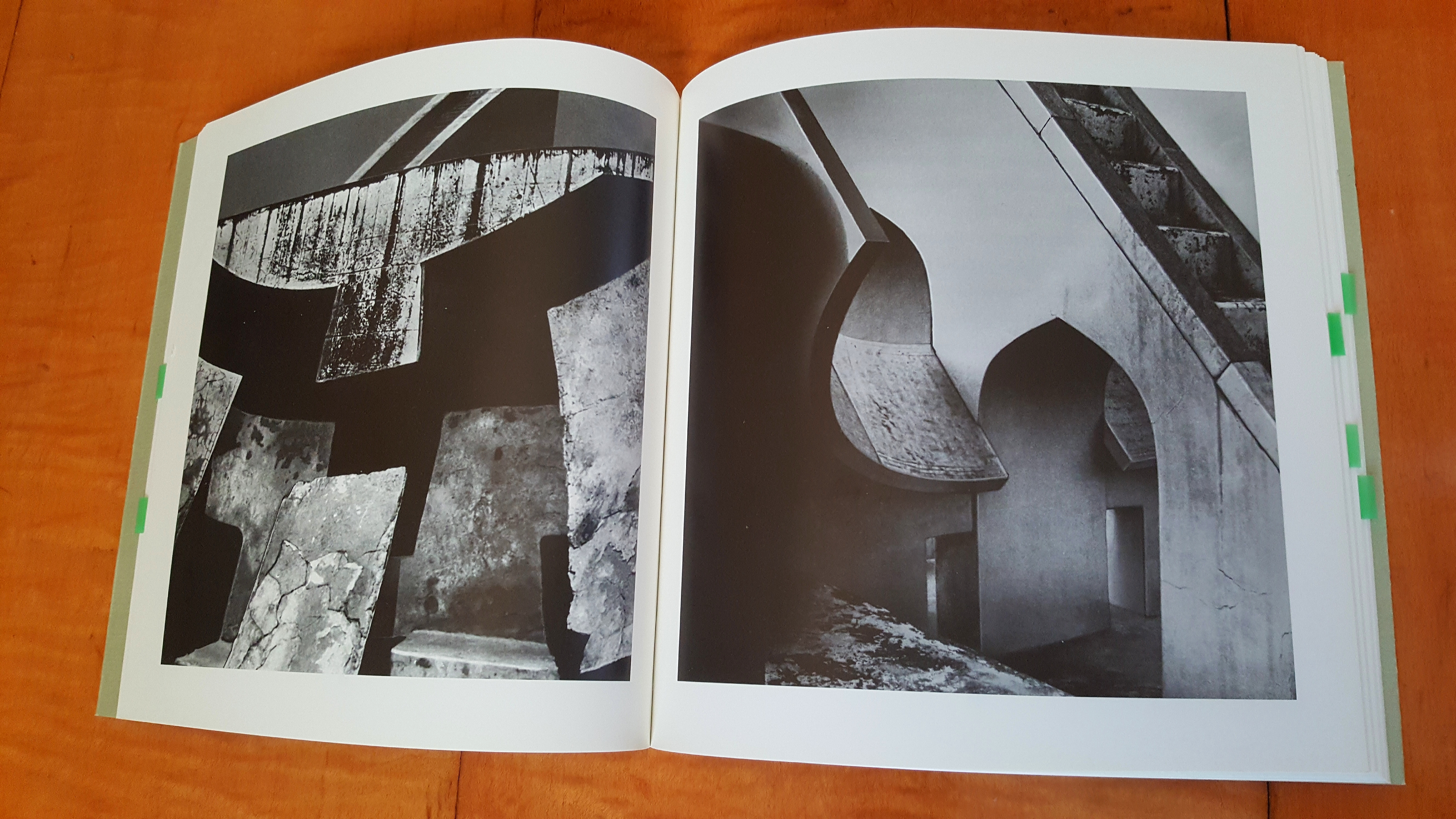
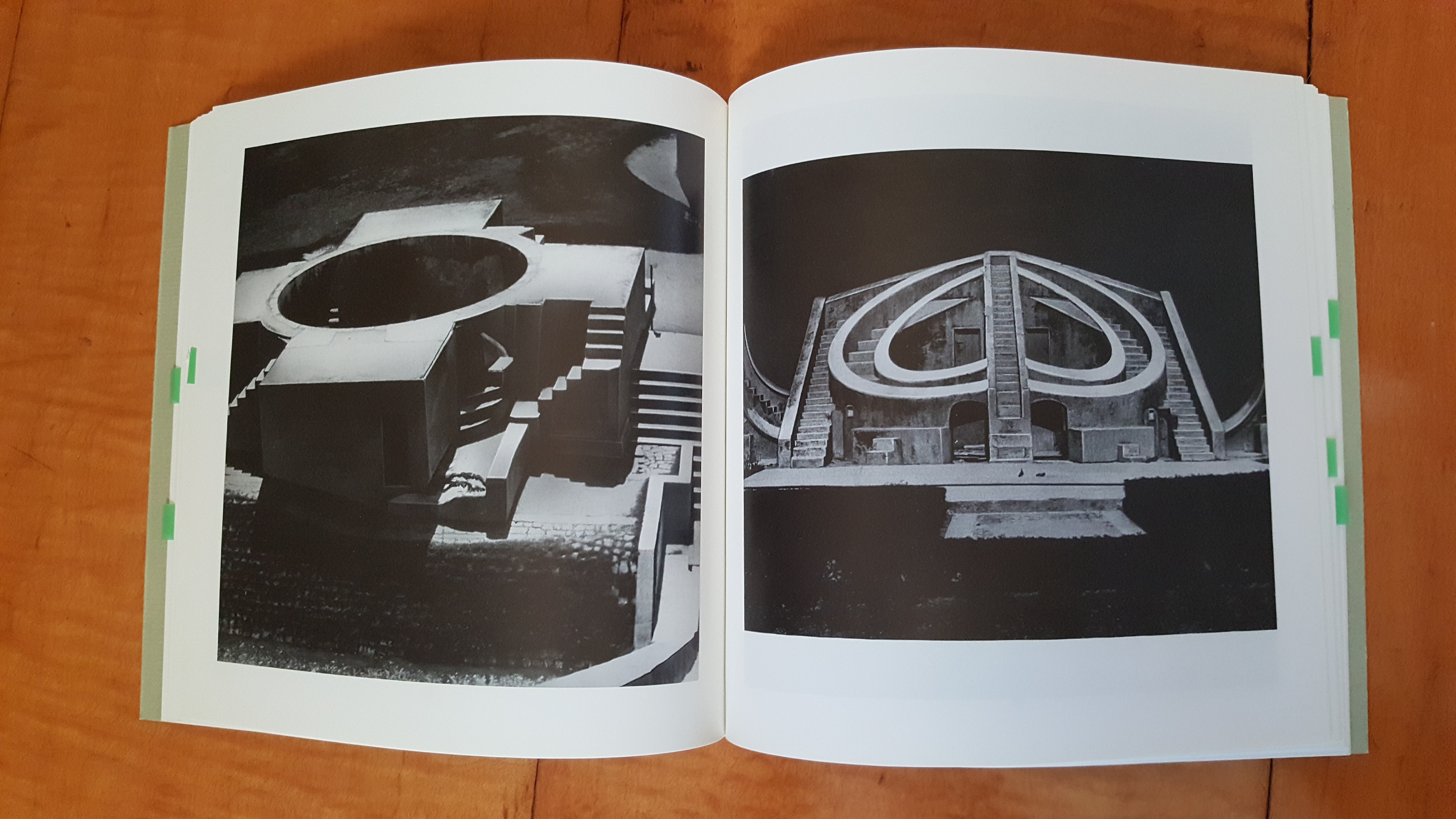
Serendipity is one of the joys of bookstore browsing. Case in point, my discovery of From the Observatory, a book I’d never heard of, discovered amid a selection of Archipelago Books in a local indie bookshop. There was something in the confluence of text and images that instantly captured my imagination. I had to take it home.

Billed as perhaps the “most unconventional work” of Argentinean author Julio Cortázar, an author who was not exactly known for sticking to conventions, this slender volume is essentially a meandering essay that moves between poetic contemplation of the life cycle of the European eel and reveries inspired by the precise angles and arches of the observatories constructed by Sawai Jai Singh, in Jaipur and Dehli, during the 18th century. If that sounds like an unlikely basis for a meditative discourse, the relentless flow of dream-like imagery pulls one into a space reflected in the silvery passage of migrating eels through dark waters and in the movement of stars across the night sky—a space that opens to an exploration of the nature of humanity, morality and society. One simply has to be willing to let go and follow the unspooling sentences:

Lovely is the science, sweet the words that follow the course of the elvers [eels at this stage of their life cycle] and tell us their saga, lovely and sweet and hypnotic like the silvery terraces of Jaipur where an astronomer in his day wielded a vocabulary just as lovely and sweet to conjure the unnameable and pour it onto soothing parchments, inheritance for the species, school lesson, barbiturate for essential insomniacs, and comes the day when the elvers have entered into the deepest depths of their hydrographic copulation, planetary spermatozoa already inside the egg of the high pools, in the ponds where the rivers settle down and dream, and the winding phalluses of the vital night calm down, bed down, the black columns lose their lithe erection advancing and probing, the individuals are born of themselves, separate off from the common serpent, feel their own way and at their own risk along the dangerous edges of ponds, of life; the time begins, no one can know when, of the yellow eel, the youth of the species in its conquered territory, the finally friendly water compliantly encircling the bodies at rest there.

Punctuating this mesmerizing text is a series of photographs taken by Cortázar himself at the observatories, and converted with the assistance of Antonio Gálvez into coarse, grainy black and white images. They provide a stark, antiquated contrast to the winding, lyrical prose.

There is an inherent sensuality to the language throughout—from the detailed descriptions of the eel’s extended journey, to the imagined sentiments of an Indian prince viewing the night sky, to the predicament of man seeking to make sense of life:

Nevertheless there Lady Science and her cohorts, morality, the city, society position themselves for ambush again: barely has one reached the skin, the beautiful surface of the face and the breasts and the thighs, the revolution is a sea of wheat in the wind, a pole vault over history bought and sold, but the man who steps out in the open begins to suspect the old in the new, bumps into those who’re still seeing the ends in the means, he realizes that in this blind spot of the human bull’s eye lurks a false definition of the species, that idols persist beneath other identities, work and discipline, fervor and obedience, legislated love, education for A, B and C, free and compulsory; beneath, within, in the womb of the redheaded night, another revolution must bide its time like the eels beneath the sargassum.

We move back and forth from Jai Singh’s observatories, constructed with mathematical precision as a response to the tyranny of the stars which for centuries had dictated the fate of his lineage, declining as he measured the skies; to the masses of eels, subject to the tyranny of genetic forces, irresistibly drawn through a long fresh water migration to ultimately return, mate and die, in the waters of the ocean. Within its two primary threads, From the Observatory, invites questions about the destiny of humanity, caught between passion and logic, nature and science, dream and reality.

Thoughtful and refreshing, this short book—barely 80 pages, roughly half given over to images—is the perfect accompaniment to a hot summer afternoon.

From the Observatory is translated from the Spanish by Anne McLean, and published by Archipelago Books.