
from here ways parted
breathing was growingin the collapse, something sweet
a hollow of timeall the eyes that I have opened
are the branches I have lost.
Ever since I started reading Italian poet Franca Mancinelli’s latest collection, recently released in a beautiful dual language edition, I have been haunted by the couplet from which the title was born—all the eyes that I have opened / are the branches I have lost. I have been more aware than ever of the eyes of the aspen meeting me on my daily walk, watching over me as in some sense I have always known them to, but now I was seeing my own journey reflected in their stare… the branches I have lost, and the growth that I have gained over the years.
 I’ve always loved aspen, widespread as they are throughout North America. I found an adolescent refuge in the hidden depths of an expanse of aspen that spread across a wide, open field near my childhood home and, now, every day I look out at the clusters of aspen that mark the edges of the forest of Douglas firs I live above. Ever since I learned that they are typically colonial, that a growth of aspen are a single organism, I love them even more. An extended family in nature to balance my fragmented human one.
All the Eyes that I have Opened is a mature collection from a poet whose work I have read since her first English translation, The Little Book of Passage, arrived at my door courtesy of our mutual friend, her long-time translator John Taylor. A few months later, our paths would fortuitously crossed in Calcutta, so I can’t help but hear her voice when I read her words, even as her poetic voice continues to expand beyond the strictly personal to encompass an ever wider range of experiences and circumstances. The enigmatic title of this latest collection came to Mancinelli, as she explains in “An Act of Inner Self-Surgery,” a piece in her essay collection The Butterfly Cemetery, during a time of “inner devastation” when, walking through the woods she came upon a tree with a heavily scarred trunk. Despite many cuts and amputations the tree had healed and transformed itself, reaching ever upwards to the light:
I continued to walk with this voice that had been articulated in me, and one clear image: there are losses that you can weep over with all your tears, fight with every effort, yet they are necessary. We would give our life so that they won’t happen, yet they are guiding our sap toward the shape and the place that belongs to it.
This understanding is expressed most explicitly in an early sequence, “Master Trees,” which like many of the others in this book blends verse and prose poetry. The poet speaks of branches and pruning and seeing “the eyes of the trees,” of opening herself up “according to the light.” But growth is uneven:
the air was inert, traversed by trembling and quivering. It needed to withdraw, to set life aside, to push it towards areas where pockets of quietness opened. I thus grew in this maimed form. You can see in me how the nearby street burns.
Her ensuing engagement in the woods with the very bark of the trees is existential in nature. She emerges with her gaze freed. The following sequence, “All the Eyes that I Have Opened,” turns to experiences that have caused pain, abstracted in natural imagery that is often brutal yet from which new strength and determination seems to arise in the speaker. As ever, Mancinelli distills emotion, memory and experience into crystalline elements, moving from the intimate to the universal in rarely more than a handful of finely wrought lines. Drawing her metaphors from nature and the land, with eyes, sight, branches, darkness and light as recurring images throughout this book, she focuses her attention on a world—internal, external, and interpersonal—in which the dynamic tensions are always shifting, always in flux, and aims to capture its essence.
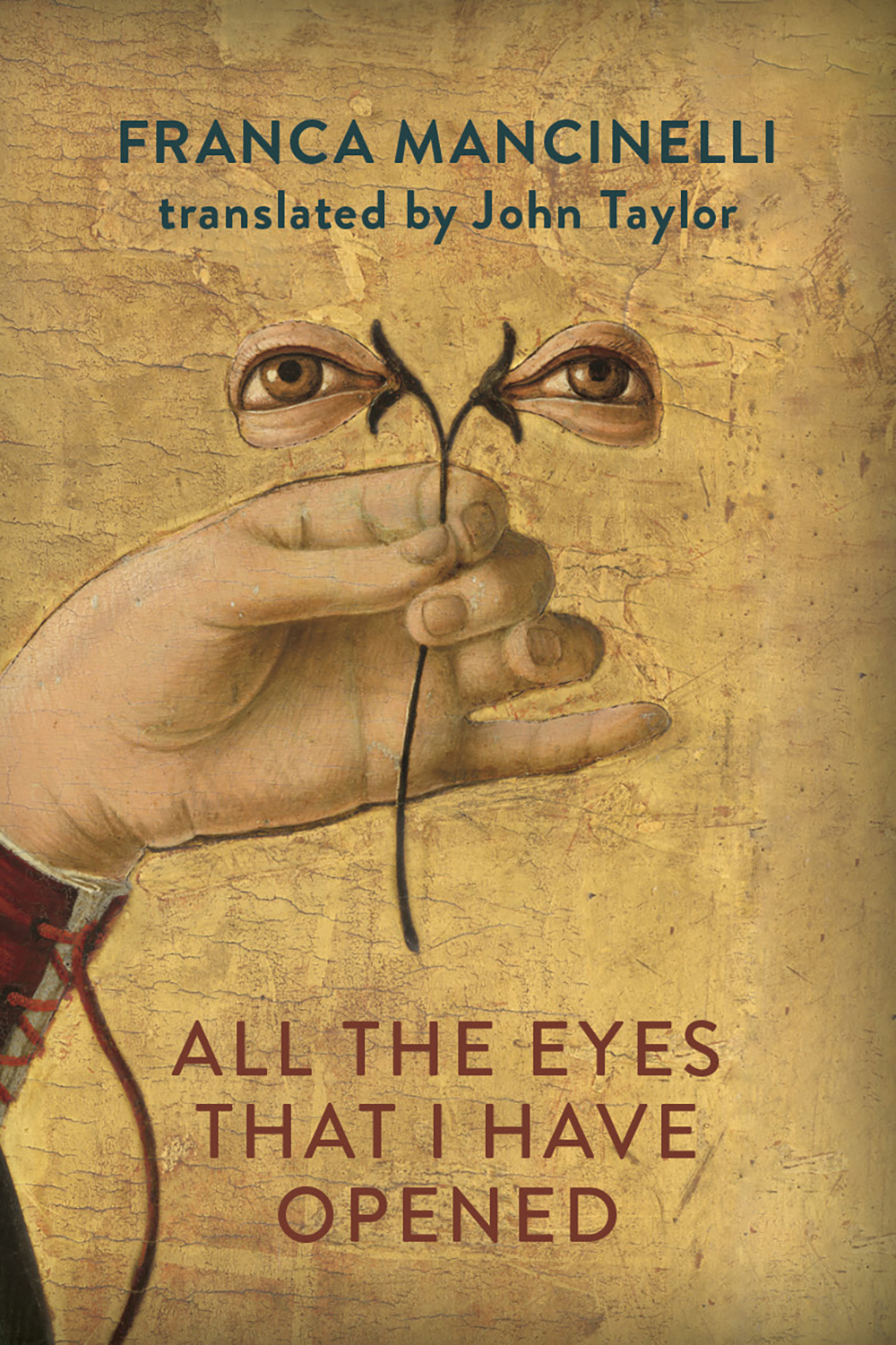 This collection, as Taylor points out in his introduction, sees an expansion of Mancinelli’s poetic universe, as she brings ancient and traditional sources into her work for the first time, including Saint Lucy (Lucia), the patron saint of the blind, often depicted with her eyes on a plate, whose own sight was restored by God. All the Eyes that I Have Opened also begins and ends with sequences in which the poet endeavours to give voice to the plight of migrants seeking a better life in Europe, meeting danger, cold, and closed borders along the way.
My body has an open texture from which hangs a thread. Someone at the other end, without even noticing, pulls it, and slowly I grow thin. The absence beckons me. I approach the spirits of the cold, that white wordless nucleus which governs this earth. I close my eyes as if pervaded by a flat colorless sea. (from “Diary of Passage”)
These works stem from an interdisciplinary project she took part in which she and other artists traced a route through Croatia often used by refugees.
This is but a brief and rather personal response to this rich new collection. Every time I open it I find something else that catches my attention. I will be turning to it again and again, and thinking of these poems as I encounter the eyes of the aspen each day.
All the Eyes that I Have Opened by Franca Mancinelli is translated from the Italian by John Taylor and published by Black Square Editions.
 roughghosts