
I want to tell how sorrow makes a shape that is familiar. And how that familiar thing can be difficult to both name and to narrate. (Note 83)
For the past week or so I have been sitting in the presence of this singular text. I have been ill, so it has had a little extra time to spin through my fevered brain. And yet, it is not easy to articulate my response.
Ordinary Notes is a text one must come to openhearted and openminded. Over the course of 248 numbered “Notes,” writer and professor Christina Sharpe examines, interrogates and honours the reality of ordinary Black existence. This collection of reflections and observations, some as brief as a single sentence, others extending for several pages, supplemented at times with photographs, documents, and artworks, may appear fragmented yet there is form and direction as Sharpe moves through a series of themes or inquiries, with careful focus and lyrical intensity. The result is a dynamic response to the many horrors and losses faced by Black communities, in the face of white supremacy, historically and recently, but, at the same time, it is a deeply personal work—a memoir, an acknowledgement of the writers and artists who have inspired her, and, above all, a love letter to her mother.
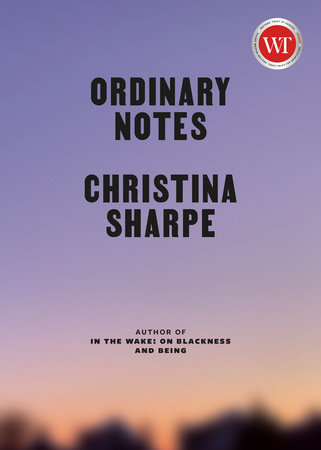 Although a wealth of thinkers, writers and historical figures are referenced in Ordinary Notes, Ida Wright Sharpe is the central inspirational figure in this project. In a number of the earliest notes, Sharpe reflects on the resolve of some of the earliest Black individuals to challenge the colour divide in middle class America: Elizabeth Eckford daring to attend an all-white high school in Little Rock, Arkansas, in 1957, or a Black family moving into an all-white Pennsylvania neighbourhood in the early 1960s. She recognizes an echo of her own experience years later as the only Black student at an all-white Catholic elementary school and then as one of a small number of Black students in a public junior high where it seemed she had made good friends.
Sharpe describes how her mother, recognizing that these friendships her daughter had made were destined to shift with the onset of adolescence, wanted to ensure that she had the necessary knowledge to make her own life choices moving forward—choices she might not have even known she had:
This telling set into motion a series of events that fundamentally changed me.
My mother wanted me to build a life that was nourishing and Black.
My mother wanted me to live in spaces where I would be reflected back to myself without particular distortions.
She spare me tremendous pain.
This Black note changed the course of my life. (from Note 10)
Later Sharpe will explore the lives of her mother and her grandmother, whom she did not know, and the nurturing atmosphere within which she was raised. In a world where Black people are still subjugated in so many areas of ordinary life and society, her mother was determined to ensure that she and her siblings were exposed to literature and arts in which they could see themselves as valued and strong.
As one makes one’s way through this volume, it is perhaps best to take time to stop and process what is being presented, take advantage of the generous footnotes as needed, pay attention to the images. Many of the impressions of anti-Black brutality may be historical, others very recent and widely covered. Slavery, lynching, police violence. Museum visits commemorating historical injustices are described. A multitude of Black voices are welcomed into a conversation with the past and present, the voices of Toni Morrison, Dionne Brand, Audre Lorde, bell hooks and many more. As the Notes accumulate, the observations, reflections, and memories naturally and gradually gather into an examination—a questioning—of the way art, beauty, and literature can form a positive understanding of the meaning of Black experience.
The primary audience Sharpe is addressing and speaking with in Ordinary Notes is a Black one. But a white reader open to listening will find much to both challenge and expand understanding and, as with any intentional engagement with literature, where one comes from and one’s own experiences will inform the reading. Sharpe makes some telling observations about the expectations the often-white reader or reviewer, by virtue of colonialism, brings to a book by a Black writer, fostering a view that “all of that book’s explorations, its meanings, and its ambitions lodge in a place called identity.” They may then praise the writer that “‘bravely’ eschews identity” or does not centre their work strictly in “Black life” as if this is to be commended:
These readers and reviewers are stuck on something they call identity and not something called life or genre or craft or intertextuality or invention or literary tradition.
These readers continually misread the note. They decant all complexity, all invention into that thing they name identity that they imagine is both not complex and not relevant to them. (from Note 97)
This comment strikes me as applicable to the way much literature is presently reduced to identity, whatever that “identity” is perceived to be, when seen as something distinct from a reader or reviewer’s own experience, disregarding that we are all much more complicated—and ordinary—than any arbitrary designation of identity.
Some things I remember but they no longer live on the surface of my days. (Note 198)
Ordinary Notes has been my companion throughout this Black History Month. It has stimulated much reflection, especially on the legacy of anti-Black racism that is still with us and growing, along with other elements of racism and intolerance, as we don’t have to look too far to see. It challenges me to think more deeply about these issues and explore some of the authors and artists she highlights with whom I should become better acquainted.
Ordinary Notes by Christina Sharpe is published by Knopf Canada, Farrar, Straus & Giroux in the US, and Daunt Books in the UK.



 roughghosts