I have been staring at Barrie Cooke’s pencil sketch for a month, sucked into the mesh of scribbled lines whirling between two figures in a boat, hauling in a curved fish in a net.
They are a man and a boy to my eyes—an older boy, 17 or so—straining under the weight of the pike.
This may not be the case.
My mind’s eye may have made father and son of them, cleaved in both senses of the contranym by the tangle of pencil lines.
This sketch, Pike Fishing, Self and Ted Hughes (you will want to look it up), becomes a central point of reference for Irish poet Ellen Dillon in her captivating hybrid lyric-essay How complete + final the feeling as I lift its curve in the net. She breathes life into it, re-imagining a father-son relationship between the two abstracted figures depicted, and returns to it, addresses it, and holds it as a guiding image as she moves through an exploration of landscape, water, language, poetry, and translation. Barrie Cooke, the English-born Irish impressionist painter, friend of Ted Hughes and Seamus Heaney, was not only a devoted fisherman, but a passionate defender of rivers and waterways. It is no accident, then, that echoes of both Hughes and Sylvia Plath arise in the early pages of her poetic text. But, that is only the beginning.
Moving between poetry, personal observation and reflection, to an exquisite act of transcreation, the voices of many poets and writers swim through her texts and verses, their words set apart in italics and referenced at the end, but there are three who are essential, who whisper to her from the future and the past: Scottish poet callie gardener whose hybrid debut, naturally it is not offers inspiration and an echoing refrain (“hold your temper loosely, or like a fish”); Irish poet Seán O’Ríordáin whose native language presents the beauty and challenge of translating; and American poet Fanny Howe whose words are invited to converse with O’Ríordáin’s. Throughout this innovative meditation, Dillon remains in tune with the natural world around her—the waterways, the birdsong, the wind—for that is where meaning and understanding lie. They must be listened to, as one can hear in an excerpt from a cento that channels gardener, John Ashbery, and Herman Melville:
Babbling upstream like an echo, fragment utterance
calls you out of the wind, finds you
at last a cave of sound too flimsy for a home
but to dwell in it is deeply refreshing
so invigorating you have learned to overlook
the many discomforts and minor threats to life.
an oily calmness floats out from the east
gathers power, pours through you, floods your cells
with a spacious sense of well-being.
Slowly and smoothly Dillon carries us from her early meditation on two figures in a boat to an Englishman fishing on a lake—that is, to the question of bringing that Englishman into the English language out of his existence in O’Ríordáin’s Irish, in his poem “Oileán agus Oileán Eile,” An Island and Another Island. The echoing island within islands, real or imagined, begins an extended examination that is the beating heart of this enterprise, at least for anyone fascinated by language and by the challenge of translating poetry.
Dillon tells us that she is no translator. “My Irish isn’t good enough, for starters. Words that should shimmer with a wealth of implications remain closed and lumpen in my schoolroom lexicon.” She moves into an exploration of translations, sensitively, feeling her way, guided by O’Ríordáin own poems, her familiarity with his personal geography, and tuned into her muses, including and especially, Fanny Howe. However, her efforts make her conscious of her limitations as she seeks to untangle the mess of charcoal lines that a poem can seem to become on its journey from one language to another. Something essential in the sound-weave of O’Ríordáin’s poetry seems to be escaping her grasp. Is there another route?
Anne Carson writes of translating the same poem over and over again, using the wrong words and it makes me feel I’ve been on the wrong track, one of many wrong tracks, with Seán. I’ve been so affronted by the razzle-dazzle of rockstar poets patching ‘concupiscence’ into his hard-won soundwaves as if he was a home-spun Wallace Stevens, that his poems have grown skeletal, marrowless, in my cold hands.
Perhaps straight translation, destined to lose many of the nuanced textures of the original is not the answer. Maybe a little experimentation is. Enter Fanny Howe. Doubt meets doubt as two writers speak across the years and distance and tongue in a collage of a translation of a section of “Oileán agus Oileán Eile” with lines from Howe’s Gone.
A poet whispers. A poet interrogates what it means to be a poet, to interact deeply with the poems of others, and in the process finds many questions and answers. As it should be.
Dillon’s poetic voice is vibrant, her spirit endlessly curious, and her willingness to engage with nature, art, and the wisdom and words of writers she admires makes for a multi-layered, richly intertextual experience. For a sense of the magic of this lovely lyrical book, you can find an excerpt at Minor Literature[s].
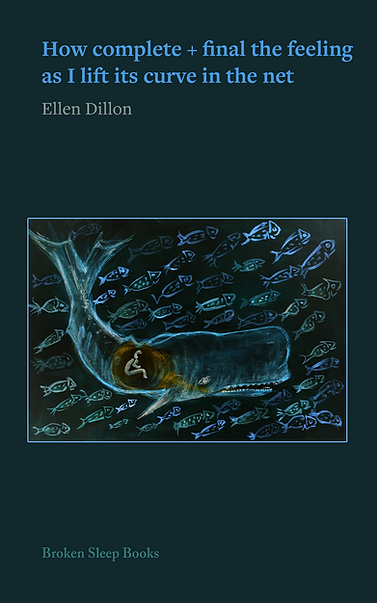
How complete+ final the feeling as I lift its curve in the net by Ellen Dillon is published by Broken Sleep Books.

