“We laugh, and I truly believe that we genuinely like each other.”: Jérôme Lindon by Jean Echenoz

Jean Echenoz opens his tribute to his longtime editor and publisher, with an account that many other hopeful, and perhaps naïve, would-be authors might know well.  It is 1979, he has just turned thirty-one, and he has finished writing a novel—his first:

I don’t know if it’s my first; I don’t know if I’ll write another. All I know is that I’ve written one, and if I could find a publisher for it, that would be good. If that publisher could be Jérôme Lindon of Éditions de Minuit, it would of course be even better, but let’s not get greedy. Too serious a house, too austere and rigorous, the epitome of literary virtue, too good for me, not even worth trying. I therefore mail the manuscript to several publishers, all of whom send it back.

He continues to send his prospective novel out until he amasses a “near-exhaustive collection of rejection letters” and if for no other reason than to complete the set he takes a copy to the offices of the illustrious Éditions de Minuit, home to writers like Samuel Beckett, Marguerite Duras, and Alain Robbe-Grillet. He expects nothing, so he is stunned when, on the way to a job interview, he learns that Jéróme Lindon has called his house and wants him to return the call as soon as possible. He phones the publishing house to explain that he has an interview and is invited to come by as soon as he is finished.
That initial meeting ends with a signed contract  and marks the beginning of a productive working relationship, if not exactly a firm friendship, that will continue until Lindon’s death in 2001 (and beyond that, of course, with his successor, his daughter Irène Lindon). The present text, Jérôme Lindon, is a slender volume written shortly after Lindon’s death in which Echenoz reflects on his own growth as an author under the guidance and encouragement—or when he was not impressed a glaring absence of either—of this legendary publisher. It is a warm, funny, and often gently self-deprecating reflection on both a singular man of vision, and a world of book publishing that sadly belongs to another era.

Jérôme Lindon was born into a Jewish family in Paris in 1925. During the war he went into hiding outside the city, and joined the Combat resistance as a teenager. In 1946 he went to work at Éditions de Minuit and two years later with support from his family he took over as director at the age of twenty-three, a position he would hold for over fifty years. If the early post-war years were difficult for the small publishing house, things began to turn around in 1951 when he accepted a novel rejected by other publisher—Samuel Beckett’s Molloy. Lindon would go to publish the central figures of the Nouveau Roman, expand Éditions de Minuit’s catalogue to include important French Philosophers and social theorists, and, from the 1970s to the mid- 80s, take on a number of fresh young French writers, of which Echenoz was one. He was, as Echenoz demonstrates in his affection tribute, a man with a keen, and typically immediate sense of what he liked without any reservation about making it equally clear when he felt a manuscript fell short of the mark. During their twenty year association, Echenoz experienced his effusive warmth and enthusiasm when he impressed his publisher, punctuated by lengthy stretches of icy distance when he did not.

Echenoz’s debut novel, in spite of Lindon’s eager embrace, failed to sell, something the novice author hadn’t even taken into account, being thrilled just to know it was out in the world. Then, one day, he receives a call informing him that he has won the Fénéon Prize. Still, the book does not sell, but Echenoz is unphased, reasoning: “I have a publisher and it’s Jérôme Lindon. The rest is unimportant.” And so, a year or two later, he delivers a second novel. It’s a disaster. Lindon is not impressed. In fact, he is at pains to describe in detail exactly what is bad about the book. They will not see each other for two and a half years.

But his next effort, awkwardly delivered, is met with unexpected enthusiasm and they’re back in business again. As time goes on, more books will be published, more prizes will be awarded, and Echenoz will learn to ride the waves of his publisher’s responses to what he writes and, as he becomes a more publicly known and admired writer, his engagements the wider literary world. Lindon has strong views about how his authors should conduct certain aspects of their careers, but as an editor, if he likes a work, he exercises a very light hand. Nonetheless, Echenoz recalls debates over book titles and long, surprisingly fun-filled, sessions spent haggling over commas.

Only 59 pages long, Jérôme Lindon, is a spare meditation on a  special working relationship that is infused with fondness for its subject, amid Echenoz’s humorous confessions of his own, often stumbling, growth as an author—his shyness, his missteps, and his inability to say no. And he shows a genuine appreciation of his  brilliant, if mercurial, publisher’s nature:

 Still, you shouldn’t think that the man is cold, brusque, authoritarian, unemotional, and who knows what else—quite the contrary. In fact, he’s passionate, he can be moved, he laughs, he lights up, he rejoices just as easily as he gets indignant or up in arms. Nor should you conclude that he’s unfriendly, that’s not the issue: he can be utterly pleasant. The issue is that he has other things on his mind than being likeable; likeability is not his concern. And besides, there’s also the fact that he simply has no time to waste, and he can be vigorously up-front about that. One day when I call him about who knows what, first apologizing if I’m disturbing him: Yes, he cuts me off, you are very definitely disturbing me—before hanging up without another word.

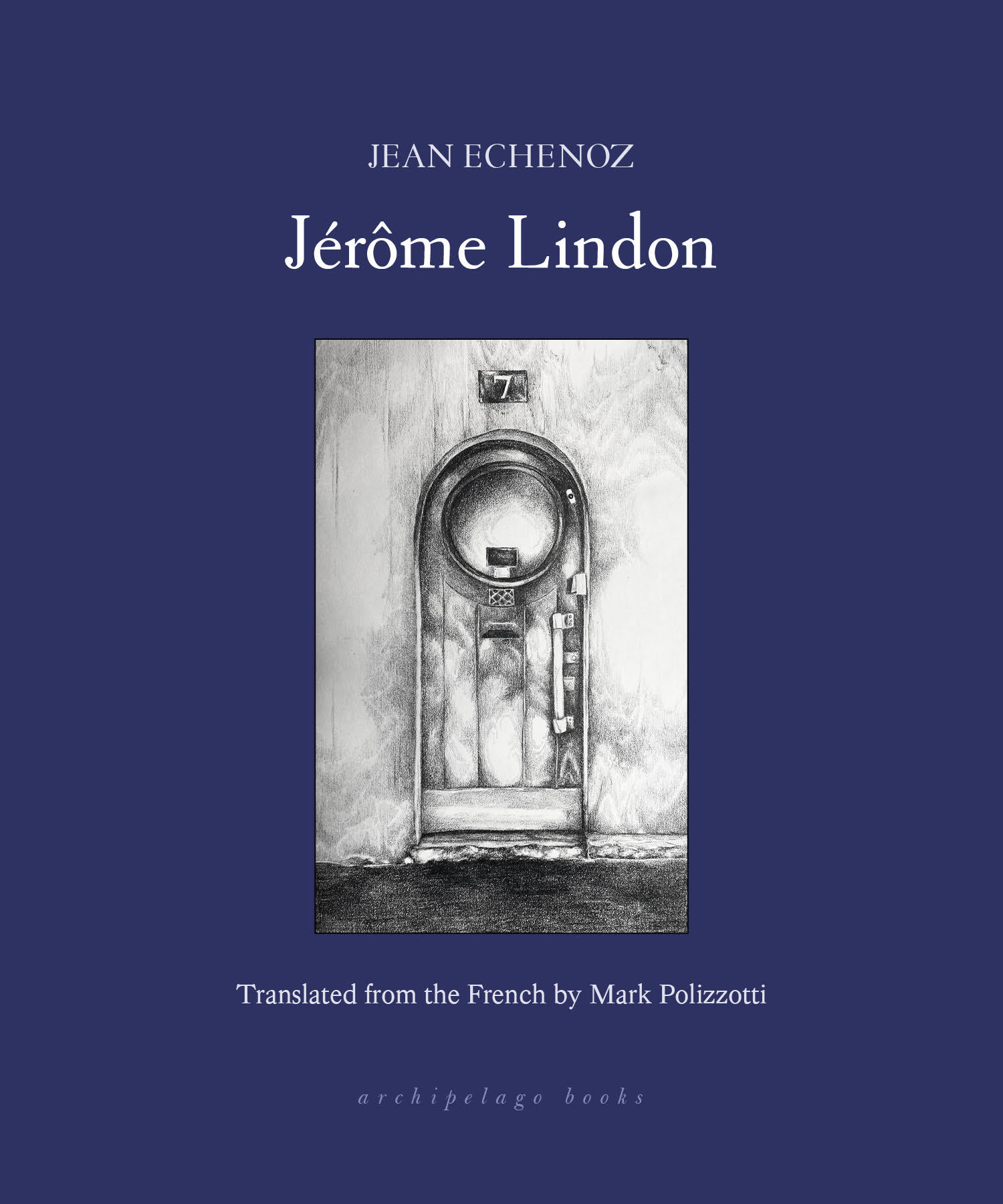
Beautifully presented with Echenoz’s own handwritten notes lining the inside of the covers and running across the centre spread, this touching little memorial work is an honest and unvarnished a portrait of an important figure in the world of post-war twentieth century French literature. It strikes just the right note and is guaranteed to make you smile, maybe even laugh out loud.

Jérôme Lindon by Jean Echenoz is translated from the French by Mark Polizzotti and published by Archipelago Books.
Who holds the truth? Sister Deborah by Scholastique Mukasonga

The latest work from Rwandan writer Scholastique Mukasonga, to be released in English translation, is a novella that takes us back to 1930s Rwanda when the small, landlocked east African country was under the administrative control of Belgian authorities and the religious influence of the Catholic church. With the arrival of a group of black American evangelists, life in a small community faces unprecedented challenges to both the externally enforced regulations and the traditional norms of social conduct. When the local chief grants them permission to establish their mission on a hillside long associated with pagan rituals of the past, rumours spread and curiosity is aroused by their seemingly strange services and the enigmatic prophetess who dances, babbles in strange tongues, and appears to have miraculous healing powers. Women, in particular, are drawn to her, while the village men tend to regard her and her odd companions with distrust.

Meanwhile, the narrator of this tale, Ikirezi, is a sickly young girl mysteriously prone to endless maladies. Suspicious of the white man’s medicine, her mother applies all of the home remedies she can think—all to no avail. Ikirezi’s illnesses only grow worse. There is, she decides, but one solution:

“Tomorrow we’ll go to see Sister Deborah, she’ll be able to cure you. Tomorrow we’ll go to Niyabikenke, to the mission of the black padri.” If my father noticed our travel preparations, he exploded in fury. “You are not going to that devil’s mission. I forbid it! Didn’t you hear what our real padri said about it? They’re sorcerers from a land called America, a country that might not even exist because it’s the land of the dead, the land of the damned. They have not been baptized with good holy water. And they are black—all the real padri are white. I forbid you to drag my daughter there and offer her to the demon hiding in the head and belly of that witch you call Deborah. You can go to the devil if you like but spare my daughter.”

Ikirezi, we will later learn, is not only strengthened physically and intellectually as result of her encounters with the foreign faith healer, but she goes on to study abroad and become an anthropologist. This accounts, perhaps, for the  tone of the of the extended first section of Sister Deborah which  often relies on varying details, reports, and speculation about what might or might not have happened, resembling at times a sort of gathering and integration of field data. The narrative extends beyond that of a child’s experience, describing the conditions surrounding the settlement of the American missionaries, the black pastor’s talk of the impending return of the Savior to this very location in the heart of Africa, and Sister Deborah’s particular appeal to the womenfolk, some of whom come to understand her to be implying that the Savior will likely be a black woman who will descend from the clouds bearing a special seed that will grow and flourish to feed their families without back breaking labour, thus releasing them from the constraints imposed on them by their husbands and economic traditions. Needless to say, the men of the community, the church, and the administrative powers are unsettled by the disruptions and feminine empowerment that arises in the wake of Sister Deborah’s influence. A series of events that lead to the expulsion of the Americans and the disappearance, or possible death of the prophetess are shrouded in confusion and conflicting accounts.

A brief second part considers the possible fate of Sister Deborah and allows Ikirezi to explain how she came to be a professor based in Washington, DC, dedicated to the study of her people but oddly aware of the hands of Sister Deborah somehow guiding her. She senses she has to follow a path laid out for her. Research leads her to a shantytown in Nairobi where she finds the faith healer, now known as Mama Nganga, and turns the narrative over to her. Now, the woman at the heart of this tale, has an opportunity to tell, on her own terms, the story of her life, reaching back into her own childhood in America and forward, through the formation of the missionary project, the long journey to Rwanda, her mystical awakening, and beyond the turmoil in Niyabikenke, to the life and identity she has created for herself in Kenya.

Her own spiritual evolution, as she describes it, was filled with mystery, even as she reflects on it years later. Early on, for example, when the  mission pastor suggests that the otherworldly sounds she makes when she falls into a trance may come from an African dialect, to be understood as a sign that all the black peoples will be liberated and saved from the coming  biblical Apocalypse, she has her private interpretation:

As for me, I was prey to a strange thought that I didn’t dare confess to Reverend Marcus. It seemed to me that the spirit speaking through my mouth was not the Holy Spirit of the pastors, who was always trailing behind the Father and Son. For one thing, it spoke neither Hebrew nor Greek nor Latin, but perhaps indeed, as Marcus believed, an African tongue. The spirit that had chosen me as medium could only be an African spirit, perhaps the spirit of the black woman who had visited me during my trance. I made prayers to her; I diverted toward her the worship that the pastor celebrated for the Savior. I preciously guarded that secret in the deepest recesses of my heart.

Sister Deborah Nganga’s account is ultimately one without clear resolution. Forces run through it that neither she nor the narrator, who also feels their presence, can fully articulate. Ikirezi’s later return to Nairobi to follow up on the fate of the former faith healer is again, like the opening section, guided by rumour, informants, and speculation. This is a book that continually asks questions about truth and memory, in the context of oral history, recorded biography, and academic research. There are no firm answers: Mukasonga allows uncertainty to linger in this story that explores the challenges and varying fates experienced by African women in times of shifting social and political conditions, yet keeps the spirit—or spirits—alive.

Sister Deborah by Scholastique Mukasonga is translated from the French by Mark Polizzotti and published by Archipelago Books.