
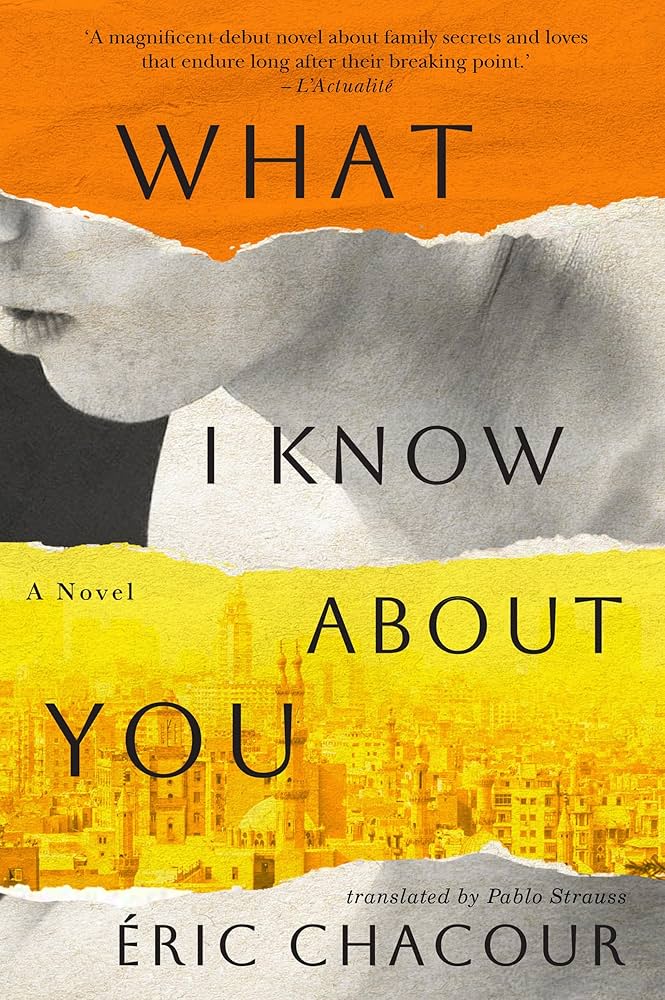
Stories of queer love—hidden, unrequited, or impossible—tend to take on a special dimension when the temporal or cultural setting is one that outright forbids the expression of same sex attraction (and often even discourages public displays of opposite sex affection). A further challenge when bringing such a stories to life though, is the question of approach: can this tale be told in a manner that sets it apart from the burgeoning LGBTQ romance genre? Narrative is key, a metafictional twist perhaps, a less than reliable narrator, or an indirect angle through a spouse who never reveals what he or she knows. What I Know About You, by Québécois writer Éric Chacour, employs an inventive and surprisingly effective method to expose a story that spans forty years, from 1961 to 2001, and moves between Egypt and Montreal.
 The novel opens in Cairo, or rather the narrative begins there, when the protagonist, Tarek Seidah, is twelve years old. He is out in the city with his father and his younger sister Nesrine. Their playful banter reveals that a certain order reigns. Even at this point, Tarek already senses that his life is set to follow an inevitable course laid out by fate and circumstance. As a member of a respected Levantine Christian family, there could be little debate. His father was doctor. He would be one too. In time he would marry and have a family, continue the family lineage, and the family practice.
It’s not hard to imagine that something or someone will threaten the ideal realization of this destiny, but what immediately sets this account apart is the perspective. It is a second person narrative, directed to Tarek, by a narrator whose identity will not be revealed until midway through the book, and at that point only to the reader, as the now-first person narration continues to be addressed to Tarek who has no idea it is even taking shape. It is a story—his own—that he wants to believe he has put far behind him.
As expected, Tarek does become a doctor and, by the age of twenty-five, he has taken over the family clinic after his father’s sudden death. The responsibilities to his legacy, his patients, and his mother weigh heavily, but he has his own project on the side that gives his life and career personal value away from home. He has established a weekly clinic in Cairo’s Mokattam slum area where he brings care attention to those who have little. It provides him with a great deal of satisfaction, but it also where Ali comes into his life.
By the time he meets the young man, Tarek is in his early thirties and has been married to Mira for less than a year. At first Ali approaches the doctor to ask if he will come see his mother who is ill but refuses to come to the clinic. These “house calls” soon become a regular practice, and, in time, Tarek invites Ali to come assist him on clinic days. For someone with little formal education, the boy is quick to learn and becomes a reliable assistant. As to how he earns money otherwise, Tarek does not ask, but there are insinuations that it is less than reputable employment. By the time he finds out, he has already started to become aware of his own feelings—attractions that defy the norms of age, sex and class. Their affair will threaten to destroy everything and everyone he cares for. His solution will be to escape, to emigrate to Canada, and leave his family behind. Even if it might have been possible to salvage his marriage:
What did you have to offer her in return? No real apology or explanation. A collection of monosyllables, I don’t knows and What can I says. You had long ago relinquished your duties as a husband. She wanted to know where you stood – as if the two of you were plotting geographical coordinates. Did you even know where you stood? Were there even answers to these questions? You observed her pain without trying to meet it halfway; your suffering and hers had grown so far apart they would never again meet. She didn’t mention Ali’s name, perhaps hoping you might broach the subject. The subject was never broached.
Once he is settled in Montreal, after retraining to meet Canadian standards, Tarek’s life continues with quiet dedication to medicine, alone and with little contact with his Egyptian past. Until it comes to confront him.
The second person narrative of the first section “You,” affords a certain spareness to the account of Tarek’s life in Cairo, events move swiftly and, at moments, possible details are surmised where the narrator does not dare to guess what might have done or felt. In fact, there is little direct insight into Tarek’s thoughts throughout the entire text. This is someone else’s version of the story, sometimes empathetic, sometimes tinged with bitterness. There’s also a peculiar sentimental note that slips in here and there, the echo of a piece of cliched wisdom perhaps. All of this will begin to make sense in the section, “Me,” wherein the narrator reveals their connection and motivation for the story they are telling. This is where the tension starts to build, as the long term implications of an attempt to bury the past are explored. Of course, given the clever way it unfolds, this is a book best not spoiled with too much advance detail.
Chacour was born in Montreal to parents who emigrated from Egypt, his family background likely allowing him to recreate the social and political mood of Cairo in the 60s, 70s and early 80s so seamlessly. This debut novel has won or was shortlisted for a large number of French language prizes, and now, in Pablo Strauss’s attentive English translation, it is again garnering attention. But, like many other queer novels that have ventured to entertain the possibilities for love when all the cards are stacked against it, a sadness and loneliness lingers.
What I Know About You by Éric Chacour is translated from the French by Pablo Strauss and published by Coach House Books.

 roughghosts