The stamps on the envelope were still moist. I noticed they were foreign. As I got to the window I realized that I was, in fact, in another country, somewhere unfamiliar. I didn’t know where. To confirm or dispel my sense of foreboding, I went into the bathroom. A stranger’s face looked at me from the mirror.
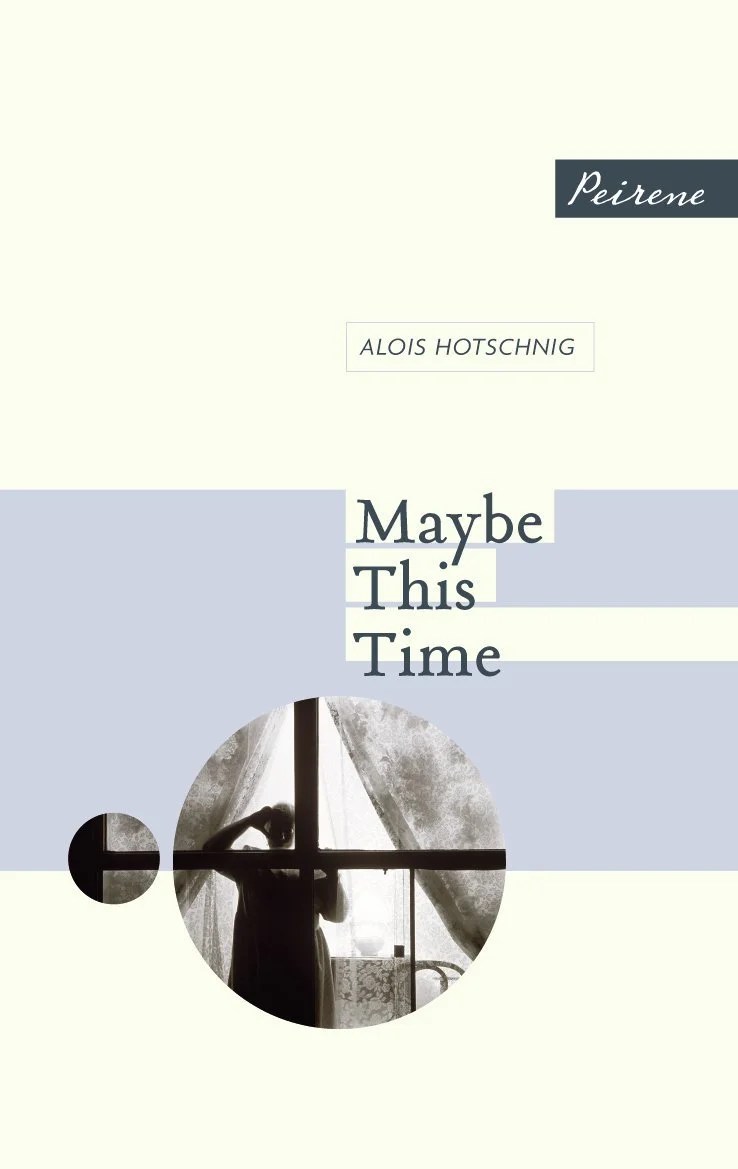
An uncertain, shifting sense of identity haunts Maybe This Time, a collection of nine short stories by Alois Hotschnig originally published in German in 2006,and in Tess Lewis’s English translation in 2011. Eerie and unsettling, his tales often begin and end in a strange, not-quite-alternate reality where it can be difficult to tell if the oddness lies with his characters or narrators, their surroundings, or both. Sometimes things seem a little more grounded, but the angle of observation is unusual, unexpected. At other times, an obsessive anxiety builds until all sense of logic and meaning is distorted. And rarely is the situation explained or resolved. The publisher’s description suggests comparisons to Bernhard (well, they are both Austrian) and Kafka (the standard comparison for themes of alienation), but one might well describe their otherwordliness, mood wise, as akin to classic The Twilight Zone epsiodes. Or perhaps, simply consider it “Hotschnigesque.” (Interestingly, his more recent and more much sophisticated novel My Mother’s Silver Fox, inspired by a true story, still leans into a strong atmosphere of ambiguity and troubling questions of identity.)
The narrators and protagonists of Hotschnig’s stories tend to find themselves in strange situations, drawn into circumstances that defy rational explanation, trapped in distorted dreams, and waking in places they do not recognize. Perhaps even more unnerving, they frequently allow themselves to fall into a cycle that they recognize as destructive. The opening story, “The Same Silence, the Same Noise,” is the account of a man who becomes obsessed with the neighbours of a property he has rented. He observes the couple sitting out on their jetty, day after day, rain or shine, seemingly oblivious to all around them. He keeps trying to convince himself that their indifference means nothing to him, but he simply cannot let it go. Their daily routine, if oddly consistent, may not be as uncanny as the narrator makes it out to be, it is difficult to tell where he is losing perspective. That is, of course, what makes the story so strangely engaging:
My attitude clearly had to change. But I didn’t know how to get away from these two. I simply didn’t exist for them, and that is how they hooked me. They refused contact, yet they willingly exposed themselves to me. I had caught the scent of their lives, which obviously had reached some premature end. I had fed on them, devoured them, and now I wanted more. I couldn’t resist absorbing their most fleeting emotions as my own, and so I carried them inside me and lived out their disquiet, which was also my disquiet.
Later on, in the story from which the title of the collection is derived, “Maybe This Time, Maybe Now,” another narrator seems to be aware that the odd obsession that has cast a spell on his family makes no sense, but again no one is willing to face reality even if the circumstances are, on the surface, far less mysterious. Or are they? Here, an entire family regularly gathers for holidays and special occasions, but one member never joins them. No one knows why he doesn’t show up, he’s not far away and they do sometimes see his wife and family, but he has been conspicuous in his absence for so many years that every gathering becomes solely focused on talking about Walter. Within the subtle absurdity of the situation, is something uncomfortably familiar to anyone with an extended family. . .
Still other stories push the creepiness factor way up. One particularly disturbing example is “Then a Door Swings Open and Swings Shut” wherein a man is lured into an old woman’s home when he is on his way to visit her neighbours. When he enters her house she greets him as if she has long awaited him, and he finds himself in a room filled with dolls of all conditions and ages. Her children. She then introduces him to a special doll, one with his name that he notices bears a striking resemblance to him. She tells him that she had always promised Karl the doll, that he—that is, the other Karl—would come back.
He’s not a bad kid, she said. Peculiar, yes, but you already knew that and, let’s face it, you’re all he’s got. And he’s been waiting ever since you abandoned him. That’s when he came to me. He can’t talk to you about it, at least not yet. But things will work out now you’ve finally come back. And now I’ll leave the two of you alone, she said, and stood up and left the room.
Needless to say, things are about to get really weird for our confused, but oddly enthralled protagonist.
And so it goes. Each of the stories in this slender volume opens a new, unexpected doorway into the life and mind of its characters (one of which is an insect), offering an entertaining little journey into the dream-like world of Alois Hotschnig.
Maybe This Time by Alois Hotschnig is translated from the German by Tess Lewis and published by Peirene Press.