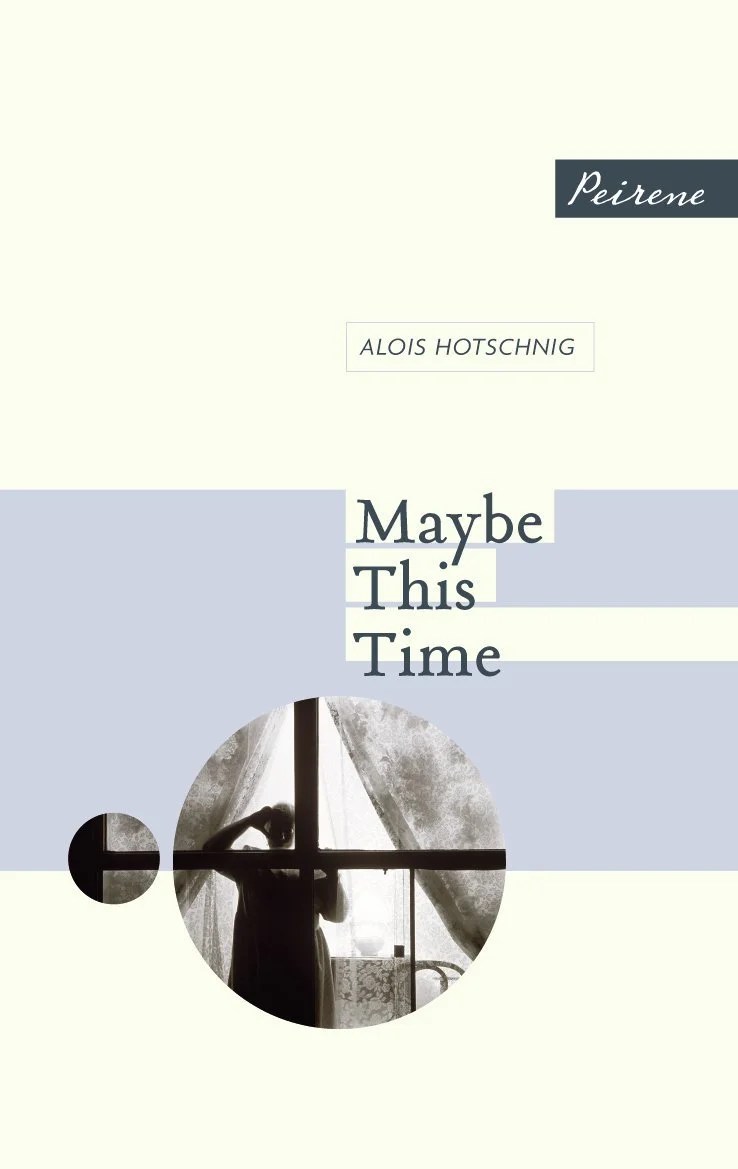
That strange face in the mirror: Maybe This Time by Alois Hotschnig

The stamps on the envelope were still moist. I noticed they were foreign. As I got to the window I realized that I was, in fact, in another country, somewhere unfamiliar. I didn’t know where. To confirm or dispel my sense of foreboding, I went into the bathroom. A stranger’s face looked at me from the mirror.

An uncertain, shifting sense of identity haunts Maybe This Time, a collection of nine short stories by Alois Hotschnig originally published in German in 2006,and in Tess Lewis’s English translation in 2011. Eerie and unsettling, his tales often begin and end in a strange, not-quite-alternate reality where it can be difficult to tell if the oddness lies with his characters or narrators, their surroundings, or both. Sometimes things seem a little more grounded, but the angle of observation is unusual, unexpected. At other times, an obsessive anxiety builds until all sense of logic and meaning is distorted. And rarely is the situation explained or resolved. The publisher’s description suggests comparisons to Bernhard (well, they are both Austrian) and Kafka (the standard comparison for themes of alienation), but one might well describe their otherwordliness, mood wise, as akin to classic The Twilight Zone epsiodes. Or perhaps, simply consider it “Hotschnigesque.” (Interestingly, his more recent and more much sophisticated novel My Mother’s Silver Fox, inspired by a true story, still leans into a strong atmosphere of ambiguity and troubling questions of identity.)
The narrators and protagonists of Hotschnig’s stories tend to find themselves in strange situations, drawn into circumstances that defy rational explanation, trapped in distorted dreams, and waking in places they do not recognize. Perhaps even more unnerving, they frequently allow themselves to fall into a cycle that they recognize as destructive. The opening story, “The Same Silence, the Same Noise,” is the account of a man who becomes obsessed with the neighbours of a property he has rented. He observes the couple sitting out on their jetty, day after day, rain or shine, seemingly oblivious to all around them. He keeps trying to convince himself that their indifference means nothing to him, but he simply cannot let it go. Their daily routine, if oddly consistent, may not be as uncanny as the narrator makes it out to be, it is difficult to tell where he is losing perspective. That is, of course, what makes the story so strangely engaging:

My attitude clearly had to change. But I didn’t know how to get away from these two. I simply didn’t exist for them, and that is how they hooked me. They refused contact, yet they willingly exposed themselves to me. I had caught the scent of their lives, which obviously had reached some premature end. I had fed on them, devoured them, and now I wanted more. I couldn’t resist absorbing their most fleeting emotions as my own, and so I carried them inside me and lived out their disquiet, which was also my disquiet.

Later on, in the story from which the title of the collection is derived, “Maybe This Time, Maybe Now,” another narrator seems to be aware that the odd obsession that has cast a spell on his family makes no sense, but again no one is willing to face reality even if the circumstances are, on the surface, far less mysterious. Or are they? Here, an entire family regularly gathers for holidays and special occasions, but one member never joins them. No one knows why he doesn’t show up, he’s not far away and they do sometimes see his wife and family, but he has been conspicuous in his absence for so many years that every gathering becomes solely focused on talking about Walter. Within the subtle absurdity of the situation, is something uncomfortably familiar to anyone with an extended family. . .

Still other stories push the creepiness factor way up. One particularly disturbing example is “Then a Door Swings Open and Swings Shut” wherein a man is lured into an old woman’s home when he is on his way to visit her neighbours. When he enters her house she greets him as if she has long awaited him, and he finds himself in a room filled with dolls of all conditions and ages. Her children. She then introduces him to a special doll, one with his name that he notices bears a striking resemblance to him. She tells him that she had always promised Karl the doll, that he—that is, the other Karl—would come back.

He’s not a bad kid, she said. Peculiar, yes, but you already knew that and, let’s face it, you’re all he’s got. And he’s been waiting ever since you abandoned him. That’s when he came to me. He can’t talk to you about it, at least not yet. But things will work out now you’ve finally come back. And now I’ll leave the two of you alone, she said, and stood up and left the room.

Needless to say, things are about to get really weird for our confused, but oddly enthralled protagonist.

And so it goes. Each of the stories in this slender volume opens a new, unexpected doorway into the life and mind of its characters (one of which is an insect), offering an entertaining little journey into the dream-like world of Alois Hotschnig.

Maybe This Time by Alois Hotschnig is translated from the German by Tess Lewis and published by Peirene Press.
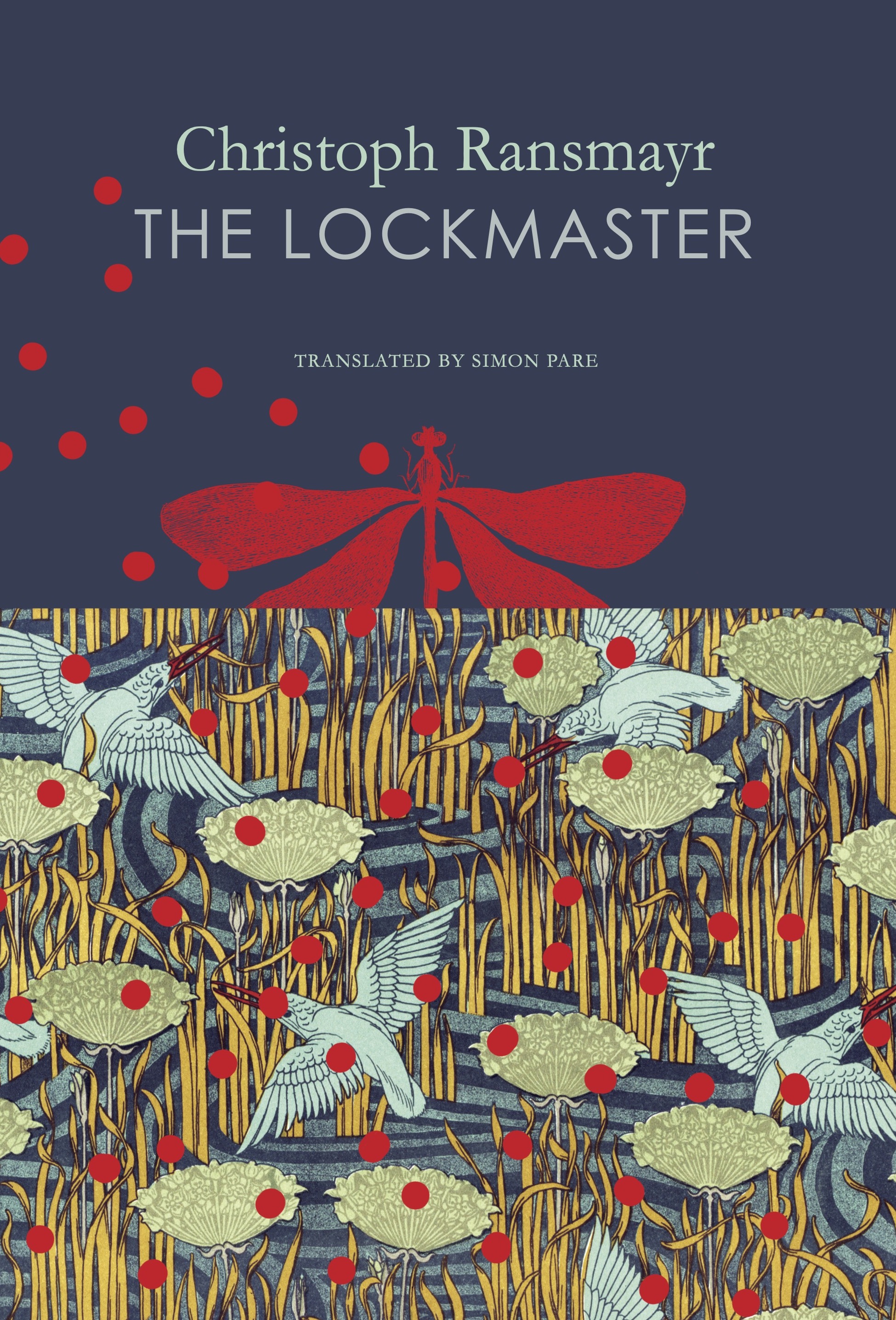
The reversal of the currents: The Lockmaster by Christoph Ransmayr

Five dead. That is the fact the opens and haunts The Lockmaster: A Short Story of Killing by Austrian author Christoph Ransmayr. Five people are killed when a longboat carrying twelve capsized above the Great Falls of the White River when the sluice gates suddenly opened releasing a torrent of water that caused the vessel to lose control and shoot downstream, all while a crowd of festival goers watched from the sidelines. The lockmaster, who had for thirty years, proudly guided boats safely around the falls through a series of locks, made a valiant effort to manually close the gate, and was locally regarded as a hero. But when his son, a hydraulic engineer working on a project in Brazil, receives word of the event, he is not so sure it is an accident.

Set in some indeterminate future time, when sea levels are rising and inland regions are drying out, this novella depicts a world in which water is a precious resource to be defended by force. In many places the tensions over resources have ignited tribal wars or enabled the rise of brutal dictatorships while in Europe the political landscape has been shattered into a vast number of warring microstates each with their own flags, languages, cultures and long list of enemies. The narrator and his sister Mira, as the children of the lockmaster and his foreign wife, grow up in a socially isolated home situated above the falls. The waterways are their playground, but all of their education is conducted over screens, so they rarely engage with other young people. As a result, they develop an intimate relationship, something that is no longer taboo but nonetheless unsettling to imagine, especially because the narrator is still so thoroughly obsessed with Mira who has a rare condition that makes her bones exceptionally fragile.

One year after the incident at the festival, the lockmaster himself disappears. When an angler reports having seen a man in a boat dragged over the crest of the Great Falls, although no remains are found, he assumed to have drowned. At this point, the narrator is still in Brazil, the very tight, globally controlled restrictions surrounding major water projects forbid his departure even for a family emergency. His sister is left to tidy up their father’s affairs (their foreign mother had long since been deported from the small central European microstate in which they lived) and by the time he finally gets home, even his beloved Mira is gone, having married a dyke reeve and moved with him to the rapidly eroding shoreline of the Elbe estuary. Already questioning his father’s innocence in the collapse of the festival longboat, when the narrator reaches his next assignment on the Mekong River, he is certain that his father is both a heartless killer and still alive.

Five or seven or twelve cannot have made any difference to him—after all, the precise number of their victims did not bother the bomb planters and well poisoners who were, in those times, bent on drawing attention to themselves and their grand ideas in countries, tribal areas and microstates. Deaths meant fear; and fear meant open ears and open eyes. No one could fail to hear; no one could fail to see what a murderer did, even if he denied his deed.

With this crime, my father clearly wanted to defy the course of time and take himself back to overweening dreams where a lockmaster had been more, much more and more influential than the curator of an open-air museum on the White River could ever be.

The world of conflict, armies, mercenaries, and rebels within which the narrator moves in his work which has taken him to so many of the earth’s great rivers, colours his understanding of the tragic event at the Great Falls and his father’s presumed role in it. He vows to hunt him down and kill him.

This is a more focused effort than Ransmayr’s more sweeping work like Atlas of an Anxious Man, but it does highlight his broad global perspective and ability to evoke a vivid natural—or unnatural—atmosphere as his protagonist navigates the world of his present and remembered past. But the narrator is not a readily sympathetic character. He continually refers to his father as a “man of the past,” but his own refusal to accept that his fragile sister has had the audacity to marry someone else and not sit at the Great Falls waiting for him while he travelled the world, demonstrates that he too is caught in his own self-centred and, to be honest, somewhat disturbing incestuous longings. This is, of course, a fable. A dark speculative folktale. Neither the characters nor the political and environmental dimensions are fully fleshed out—but in such a fractured and volatile world, the protagonist’s insularity would be an expected coping mechanism. As such, the oddly discomfiting narrator is not only plausible, but he adds a suitably unnerving tone to the gloomy undercurrents already driving his story. And Ransmayr’s trademark spare, poetic prose adds a further chilled quality to the work.

The Lockmaster: A Short Story of Killing by Christoph Ransmayr is translated from the German by Simon Pare and published by Seagull Books.

Thoughts on Among the Bieresch by Klaus Hoffer

Sometimes, when I am reading a book that I know I will want to write about, my thoughts about the work at hand take form in the process of reading in a manner that will later inform and direct my review. Other times, the route from reading to writing is more circuitous. I tend to take copious notes, underline and engage with my books, but, having said that, there is always the risk of failing to see the forest for the trees (or more explicitly, failing to appreciate the text for the words). Then, when I sit down to write, no matter how much I may love the work at hand, I look back over my notebook and face too many words to sift through.

BiereschAmong the Bieresch, the long-standing German cult classic by Austrian writer Klaus Hoffer is a book that threatened to undermine me, as a reviewer, with its words – words that are supercharged with meaning and reference to a broadly expanding literary and socio-economic landscape. The beauty of this book is that it works on so many levels and now, with its recent release from Seagull Books, in an animated translation by Isabel Fargo Cole, an English language audience has the opportunity to meet and explore the singular world of the Bieresch.

My review of Among the Bieresch has been published by 3:AM Magazine. I am most grateful to Tristan Foster for his wise and patient editorial guidance as I floundered, at times, in my own words.