When noted Albanian author Lekë Cukali arrives in Sarajevo for a writer’s residency, he is met by an elegant but odd woman, his programme contact, who accompanies him to the flat where he is to stay for the next month. It is a little dated, but serviceable if they can find him a proper desk and chair. However, when he wakes up the next morning he discovers that there is no heat, no hot water, and no wi-fi. And although it is April, 2024, spring has not yet made itself known. Not exactly an auspicious start to his brief sojourn in the city.
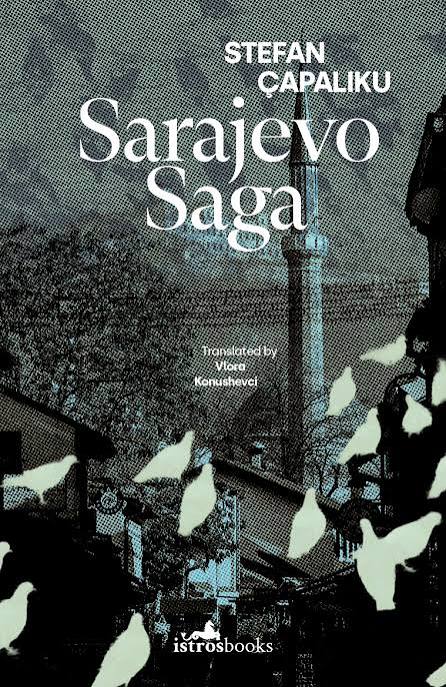
Sarajevo Saga by Stefan Çapaliku, the third Albanian translation to be published by Istros Books, is a clever, briskly-paced story that combines mystery and history with just enough unresolved danger to make for a thoroughly entertaining adventure. Capaliku, a versatile writer known especially as a playwright and theatre director, draws on his dramatic skills to craft a tale that makes the most of its 133 pages to trace a fascinating line of connection between two Balkan countries that stretches back over a century.
While Lekë waits for his hosts to sort out the necessities of a comfortable and functional space in which to live and work, it occurs to him that he really has no idea what he hopes to accomplish with his time in Sarajevo:
I have in fact come here to write, though even if I did not write no one would reproach me for it. But I do want to write. I cannot trample on this opportunity, which lifts me out of my daily routine. I am at an age when I can no longer afford to squander my days, moments, least of all occasions such as this.
In other residencies I have always arrived with clear ideas in my head. I do not know why, this time, I have allowed myself to drift into free fall.
But if his professional ambitions are less clear, he does have a personal mission—to see if he can find any trace of members of his family, distant cousins, a widowed woman who, with her four children, left Albania presumably with the retreating Austrian army following the end of WWI. These relatives, captured in an old photograph in a family book back home in Shkodër, had fascinated him as a child, but little was known of their fate beyond the fact that they had ended up in Sarajevo. Contact had long been lost, and during the long years of communist rule, such matters were better left forgotten. However, when Lekë’s ninety-one year-old father learned that his son would be going to Sarajevo, he insisted that he see what he might find out.
Meanwhile, within the first few chapters of the book, a second thread born of Lekë’s childhood imagination—or so it seems—takes us back to late October, 1918, as Mikel Cukali begins his account of the events leading up to his sudden departure from Shkodër with his mother, older sister and twin brothers. This second historical thread detailing the family’s journey to Sarajevo, their arrival, and the life they settled into there, will continue to alternate with Lekë’s present day story. This twinned narrative advances swiftly, in short, 3-page chapters that nod back and forth one another. The continual switching creates a tension which builds and crosses between the threads.
As he explores the city, acquainting himself with its sights and coffee shops, Lekë is inclined to inquire whenever the opportunity arises, if anyone remembers or knows of someone with the surname Cukali. At first his search leads nowhere. And then, one day at his favoured café, the curiously named Amarcord—evoking thoughts of Fellini’s film and the notion of nostalgic remembrances, in name if not décor—his inquiry seems to raise the ire of the establishment’s owner. It’s the first clue that will ultimately lead to a connection with a possible descendant of his distant relatives. But the more he learns, the more he risks putting his own life in danger.
For a novella with two distinct threads separated by the better part of a century (or are they?), Çapaliku manages to weave a fair amount of societal, cultural, and historical detail into both. The language is unadorned, the accounts necessarily spare, and though one spans thirty years and the other just a few weeks, there is a nice balance between the interwar environment of the imagined historical thread and the very contemporary, technology-dependent atmosphere of the present day strand. The two narrative voices complement one another well but, at the end of the day, it is the conversational-styled account of the rather neurotic writer-in-residence who in his efforts to connect with the past inadvertently stumbles upon ghosts better left undisturbed, that makes this sojourn in Sarajevo most memorable.
Sarajevo Saga by Stefan Çapliku is translated from Albanian by Vlora Konushevci and published by Istros Books.

