There are very few things that man needs: to love, to be happy, to eat; and then he dies. Yet there are over six thousand languages spoken in the world — why do there need to be so many in order to make such simple desires understood? And why do we manage it so rarely, why does the light in words fade as soon as we write them down? One touch can say more than all the world’s words, that’s true, but the touch fades with the years and then we need words again, they’re our weapons against time, death, forgetfulness, unhappiness.
It has been a long, cold winter marked by hardship and loss, and now that the snow has finally melted and a reluctant spring settles in, it is the season when, as they say, a young man’s fancy turns to love. But in The Heart of Man, the third and final installment of Jón Kalman Stefánsson’s Trilogy About the Boy, his unnamed protagonist is not alone in his longings and desires. Romance, be it passionate or practical, is in the air, infecting more than a few lonesome souls and leading to some unlikely couplings amid tragedy, conflict, and confusion.
 In each of the first two volumes, Heaven and Hell and The Sorrow of Angels, the most intense drama lies in the battle against the unforgiving elements of ice and snow during a winter that has held fast to a corner of Iceland well in to May. In the first novel, after witnessing the death of his only friend aboard a fishing boat, the sensitive nineteen year-old referred to simply as “the boy” makes his way to the Village to return a borrowed copy of Paradise Lost and finds himself taken into the home of Geirþrúður, a scandalously independent woman, and her companions Helga and the old, blind sea captain, Kolbeinn. Here he becomes part of a makeshift family, one where books and literature are appreciated. The second part follows the boy and the postman Jens as they cross a sparsely populated stretch of land to deliver mail to a community on the north shore. As storms rage, their struggle with the forces of nature hits a fever pitch, concluding with a terrifying accident.
When The Heart of Man opens, the boy is slowly regaining conscious awareness in a strange room. Jens is sleeping in the next bed. It seems that they had the good fortune to crash into the side of the doctor’s house when they lost control on their icy descent to the village of Sléttueyri, the intended destination of their trek across the frozen Icelandic landscape with a heavy mail bag and a most unusual parcel they picked up along the way. If he is surprised to have survived, the boy is even more surprised by Álfheiður who appears at his bedside with her short red hair and deep green eyes. He is smitten. But also confused, because back home he believed he had already lost his heart to Ragnheiður, the privileged daughter of an important local merchant and broker, even if she may never see him as a serious prospect. When he returns to the Village, she continues to tease and seduce him against her father’s explicit warnings, but the red-haired young woman on the northern shore still haunts the boy’s dreams. And then he receives a letter that asks: “Is your heart still beating? If so how?”
It’s beating like that of a drowning man, a wingless bird, how the hell should he answer this? Of course it’s important to receive a letter, to have a person consider it worthwhile to sit down and assemble words and have you in mind the entire time it takes to write the letter, to receive a letter indicates that you exist, that you’re closer to being light than darkness. Admittedly, not all letters are good, and some should perhaps never have been sent, never have been opened, read, some are full of hatred, accusations, they’re poison that will deprive you of your strength, they bring darkness and disappointment.
In this third volume of the trilogy, the terrain to be navigated is that of the human heart, and the boy is not the only one on such a journey. As a result the world of the Village expands and deepens as we come to know the townsfolk better. We witness the troubled power dynamics that exist between social classes, and between the sexes. One might also suggest that divisions between misfits and the accepted members of society are exposed, but to be fair, the environment and challenging living conditions of this part of the world attract and reward those who have their own distinct idiosyncrasies. There are many such characters here, each one with his or her dreams and disappointments, joys and despair. Yet, even with its multiple crisscrossing storylines, the tale never drags over its 400 pages thanks to the rhythmic force of the chorus of drowned ghosts at the helm. These timeless storytellers, fueled by longing, tend toward the melodramatic, lending an operatic quality to the narrative, but in turn allow the characters’ thoughts and actions to unfold with a degree of distance. They are relaying an account from the past, but action unfolds in the present. Dialogue is relatively succinct, woven into longer paragraphs or set aside in a scripted format, while repeated refrains reinforce the flow.
Stefánsson writes with the soul of an Icelandic epic poet, his grand romantic spirit and poetic prose is rooted in the sagas of the past but directed at a contemporary audience. His ghostly narrators, in telling the boy’s story, are reaching through a wound in existence to grasp at what they miss the most:
Yet no story can ever be told completely, or, how shall we say it; we inhale in the nineteenth century and exhale in the twenty-first. Time is an illusion; the only useable unit of measurement is life. People never change, regardless of the passage of time, what we call the years; fashions change, not mankind. But what pains us most is that we no longer exist, except in these words; they’re as close to life as we can come.
To read this tale, then, is to surrender to the music of the language, because the real question at its heart is: what is the worth of poetry and knowledge? The boy, orphaned after the death of his parents, has known years of hard labour on farms and fishing boats, but it did not come naturally. He was clumsy and prone to daydreaming. So, although his strength and endurance have been recently tested in his journey overland with the postman, it is the fact that he has been welcomed into a home filled with books and given a chance to learn, that truly gives him a sense of value. But will that be sufficient to resolve his internal conflicts and secure his future happiness? Is that even possible for anyone?
The Trilogy About the Boy does come to a dramatic conclusion at the end of The Heart of Man, but it is one that is not without ambiguity. Of all of the volumes in this trilogy, this is perhaps the one that reads best as a standalone work, but again, the pieces that fall together will have a stronger impact if the earlier books are read first. And, on what is turning out to be a very hot summer across the Northern Hemisphere, it might be just the right time to escape to a colder climate for a while.
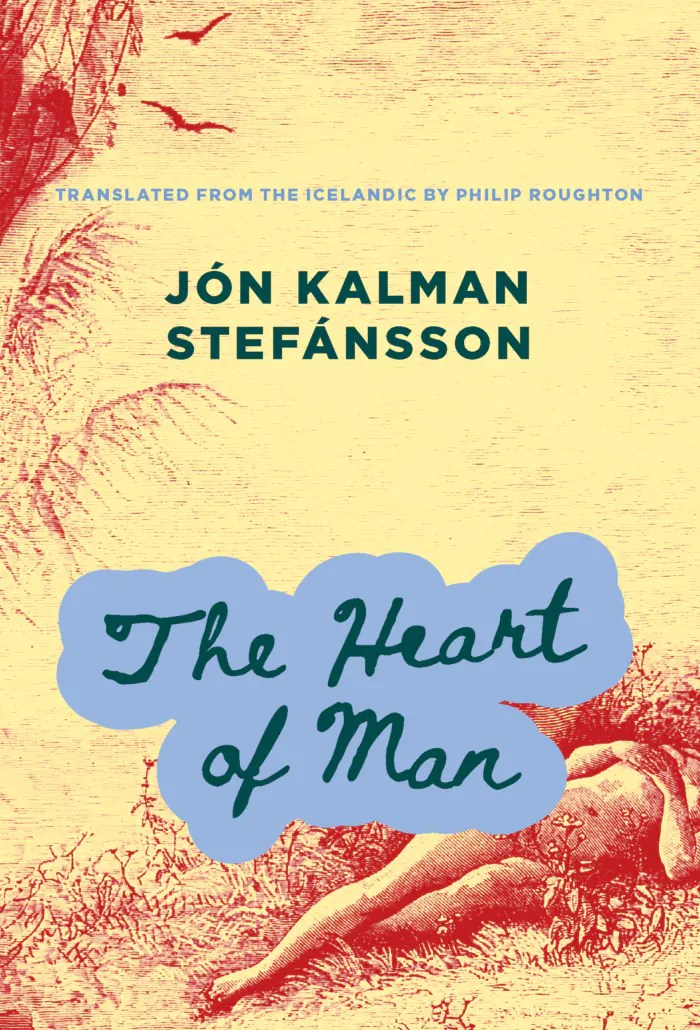
The Heart of Man by Jón Kalman Stefánsson is translated from the Icelandic by Philip Roughton and published by Biblioasis.

