“I live dangerously; I stand in front of the microwave and watch food revolving.” SPRAWL by Danielle Dutton

I dramatize small moments of my life on the phone or in a public restroom. I am all sorts of things in themselves: I am in character, I am in mint condition, I am in my head, I am in luck, I am in need, I am in vogue, I am in the red, I am in deep, I am in tune, I am in trouble, I am in control, I am in the way.

It feels oddly fortuitous or serendipitous to come to this book (truth be told, it came to me, but so be it) at a time when a healthy amount of literary oxygen is being consumed by an enormous novel which, depending on how you wish to slice it, consists of one sentence unfolding over 1000 pages. The narrator of Lucy Ellman’s ambitious Ducks, Newburyport is a housewife who stands, according to reviews, and thinks—about the mundane details, matters of political curiosity, family affairs and, apparently, Little House on the Prairie though I’m not certain if it’s the television series or the books on which it was based. I haven’t read it and likely won’t for the simple reason that 1000 pages, no matter how compelling, no matter how many sentences it is divided into, is a good 750 more than my typical comfort zone. 500 if I really feel inclined to tackle the length. But, it does serve as a fitting counterpoint to Danielle Dutton’s SPRAWL, a tidy 115-page single-paragraph narrative also centred around a suburban housewife.

However, Dutton’s unnamed narrator exists in a strangely self-contained universe. In an unbroken monologue her observations, desires, interactions, and actions—often broken down to distinct poses or placements of her body in relation to space or other objects—spill across the page. But we know little about who she really is beyond what we can glean from some childhood memories and odd comments about her marriage. She is an abstracted everywoman, existing in a series of tableaus, described with precision like a still life painting, in a community of (preferably) identical lawns, tedious backyard get togethers, nameless kids, and collections of objects on tables or countertops. Imagine flipping through copies of Oprah and Woman’s Day and piecing together fragments of an idealized suburban reality and trying to step into it. The absurdity of the two dimensional American dream subverted into a wonderfully surreal, almost otherworldly narrative. One that is disturbingly recognizable if not especially desirable: “While it’s been proposed that we are more interesting than characters on television, one day soon we will be characters on television.”

SPRAWL’s narrator is invested in a kind of performative domesticity, a search for a certain model of feminine perfection measured against the other women in her neighbourhood (with their pies, casseroles and perfect flower arrangements), and executed with the assistance of her husband Haywood who seems equally adrift in this world of prefabricated products, crumpled paper napkins, passionless sex acts and strange stilted allusions to conversation. Like real-life distorted through a glass of water. Fragmented and elongated at once.

In one sense, the town in which the narrative (can it really be called a story?) is set, is understood in historical and geological terms. It was not always there. And what presently exists has moved farther and farther from what might have been the natural state of the land.  The strata of geological time is mirrored in the (perfectly iced) layers of a cake as the inexecrable pressure of conformity takes hold. It’s a world of gossip and prejudices and peculiar notions of social cohesion and natural preservation. At the same time, there is a sense that chronological time is at once stretched out and bunched together, as if this town, all of America perhaps, is perched on the edge of a black hole. Dutton’s narrator, in her suburban technicolour irreality knows that feeling well and delights in these exaggerated bubbles of time. Her days are compressed, distorted and often very lonely:

We identify with metaphors about need and space. It is central to our values, which range from sexual depravity to temperance to melodrama. Then, in the middle of the afternoon, someone sends a rake against the asphalt. I grab my hat, full of enthusiasm, and head outside seeking kinship with others, but the street is deserted. Instead, I continue to function alone in the house. I am essentially productive and genuine and important. I bake banana bread and paint the ceiling. On the TV is an interview with a young woman saying loudly “Could I? Could I?” Later, a little boy in a driveway tells me he has three superpowers: eating yogurt with his eyes closed, reading upside down, and breathing warm air. A smaller boy drops a plastic gun and runs over to say: “Even my superpower is jumping on one foot.” But anyone can do that. So I jump on one foot for fifteen years, and he jumps too, and the other boy watches blandly from the seat of his bike, and no one walks down the sidewalk or drives down the street at all. I might as well think of this as the period of jumping.

Because there is an intentional feedback loop quality to the days that unspool and blur into one another in this most unusual novel, this Walden for an increasingly sterile modern age, it may be easy to wonder what it is like to read. With its compendium of lists and descriptive vignettes, the real or imaginary letters the narrator composes to various neighbours—generally to gently express her concerns about their behaviour—and her own endless efforts to coordinate herself, like any another object, with her environment, SPRAWL is enchanting, uncanny and unsettling. And, of course, it’s also very funny.

As the end nears, the narrative grows increasingly abstract and existential, cracks start to appear in the domestic veneer, but Dutton’s hand is so steady, her language so endlessly surprising that one is, as Renee Gladman notes in her Afterword, reluctant to leave this bright and brilliantly realized world behind. It is akin to living, for a time, in a painting—a still life at once realist and surreal—that contains within its frame, a sharp and insightful commentary on contemporary suburban life in America.

SPRAWL by Dorothy Dutton is published by Wave Books.

Too old to write? Indulging in a little writerly insecurity.

From time to time I’ll see a flurry of comments cross my social media pathways, complaining and commiserating about rejections and the frustration that comes from having one’s literary labours unappreciated routinely. I have also received a few rejections myself of course, but the more unfortunate reality is that I have rarely written and completed anything worth submitting unsolicited to any publication—and certainly nothing that would come close to resembling a manuscript to set loose in the world in search of a publisher. For critical work I always pitch first, but even then my rate of production has dwindled to exactly two reviews last year and one this year which has yet to see the light. Add a few small somewhat poetic efforts and a commissioned essay for a book that is supposed to come out sometime next year and that’s about the sum extent of my writing outside this space.

So, while I have submitted and pitched little, I have certainly written a lot of rejection letters since joining 3:AM Magazine almost two years ago. At certain times of the year, and this is one, I shudder every time Gmail pings on my iPad because the submissions and pitches roll in at a steady rate. I debate acceptances and agonize over rejections. I do enjoy editing, and I think I am a good and respectful editor, but because I edit for a publication that defines its own rules by essentially refusing to have any hard and fast guidelines, I have often opted to take on ambitious younger writers with what I think is a cool and original idea—maybe one they’d be hard pressed to sell elsewhere—even if it means that a lot of time may need to go into making that idea come to life. If I worked on a clock it would be reckless to allow accept such projects. But I’m not, so what is costing?

Quite honestly, I’m afraid it’s beginning to cost any pretensions to a writing life I my have ever entertained. I’ve never seen writing as a way to make a living, all the more power to those who need to, but at this point in my life it’s about trying to tell a story. My own.

However, I am beginning to wonder for whom and for what.

In early March I came home from a wonderful month in India with a notebook full of essay ideas. I felt I had turned an important corner in my own journey of self-acceptance. I carried a renewed sense of personal value. Within weeks a crisis erupted at 3:AM which was not only a very stressful lesson in the speed at which intolerance—in multiple directions—can spiral out of control and the damage it causes. I stayed on but with a greatly increased workload. Add to that, a difficult spring spiralling through grief, revisited traumas, family stress, and mental health challenges, and, at this point, all of those essay ideas sit exactly as I left them. Unexplored.

The one thing I am pleased with is this blog (or literary site as I call it when I want to sound serious). I’m not super prolific and my reading rate has been dismally slow, but I have written a couple of longer essayish meditations and, although I no longer review everything I read, I tend to treat the reviews a do write with more critical attention—equivalent to what I might seek to publish elsewhere. I am aware that I have a significant readership and that many of these reviews, especially if publishers pick them up and link to them, attract traffic and readership as well, if not better, than many lit sites. I am extraordinarily selective when I do accept a book for review and I feel no obligation to finish or write about a book that’s not working for me on some level—which is not to say one has to love a book to engage with it on a critical level, but there must be something of interest to talk about in a meaningful way. However, that’s another debate altogether. It’s my space, here I set the rules.

I can even engage in a little self-indulgent navel gazing like this when I need to.

Thing is, to go back to where I started, I not only see writers measuring their lives in accumulated rejections, I also see writers within my little network publishing. Books, maybe, which I don’t begrudge anyone, but also on literary sites and journals—and sometimes at a regular pace. Which leads me to think other writers have a collection of finished, or nearly finished, stories, essays, and poems sitting in file folders, virtual or otherwise, or being tossed to the vagaries of unpredictable editors like myself at all times. Or they write constantly.

This past June I started a daily writing practice with the encouragement of a dear friend and mentor, Naveen Kishore of Seagull Books. The first night I write a few prosaic words to myself about goals. The second night I emptied a couple of pages of anger and frustration until I nearly made myself physically ill. I’ve written about grief and loss, rehearsed a number of blog posts and essay fragments (like this one you are reading now), and at times I have used it as a journal to record my thoughts, activities, and goals. When all inspiration fails I have switched to the Devanagari keyboard and sputtered away in my rudimentary Hindi. I have revisited my entries several times, retracing my way through the accumulated pages, gathering words and ideas for use elsewhere; reminding myself how far I have travelled emotionally these past few months.

But still I am left with the questions: Why am I writing? Who am I writing for? What am I writing towards?

I can’t help but wonder if I am simply too old to start anything significant. Have I missed this train? Or rather is there just too much baggage now packed into nearly six decades and two gendered lives to unpack and make sense of? What if I do unpack it and find barely a story worth telling? Or worse, a story I cannot tell because I don’t know where it lies anymore. I am increasingly aware, as our world becomes ever more polarized on every axis—as we hunker down in our little glass houses with a pile of stones at the ready—that I look like a middle-aged white man (and I’ll admit it’s a handy façade on occasion) even if the actual truth of my being is so much more complicated and even ticks a few of the popular diversity boxes quite readily, should I want to define myself in such terms.  But, in the end, all the labels I could wear are simply part of complex real life lived.

Just like anyone else’s.

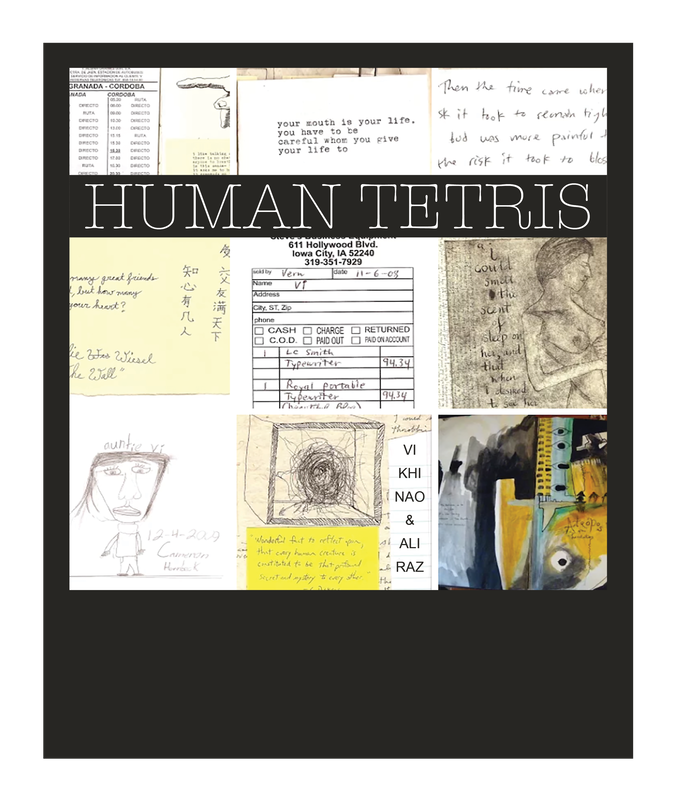
Poetry as personal ad? Human Tetris by Vi Khi Nao and Ali Raz

If dating in the era of online personals and dating sites intimidates you, especially if you lack the necessary surface appeal to ensure that your desired target will be inclined to swipe right, a space that will allow you to describe succinctly a lover with the exact shape to match your own twisted shape, you might wish a network like Human Tetris really existed. If you’re sexually squeamish, you might not. But in the way that old-fashioned newspaper-printed personals provided plenty of entertainment even if you were not on the hunt, shall we say, this playful poetic collaboration that boldly satirizes aberrant desire is great fun.

Within the pages of this game-shaped book with a stubbornly neck-twisting layout, unspoken (primarily) queer longings are given voice with a healthy measure of “no boundaries” internet exhibitionism. (I’ll tell you what I want, what I really really want—and exactly what I expect you to do to realize my exceptional expectations.) Gleefully playful or painfully doleful this uncensored imaginary/imaginative collaboration between the incomparable Vi Khi Nao and the amazing Ali Raz injects a double-barrelled dose of estrogen into the—to date—male dominated catalogue of one of the most promising innovative publishing projects to arise in the past few years, 11:11 Press.

This tag team creative duo has dreamed up a collection of sometimes delightful, sometimes disturbing personal ads suffused with the hopeful desperation of a world in which we are simultaneously more connected and more isolated than ever.

Be My Beehive, Be My Boner & Clyde:

I need someone sexy to blame
for all the great things
that are happening in my awesome life.
Or, you could be ugly & and this is how it will roll: Do you want vacation
days or do want my Sundays? Do you want happiness or do you want décor
What if I offer both?
I’m beautiful and I’m happy.
I need a soulmate who aren’t either.
@hitmebabyhitthisdamnbabyrightaway

ALABAMA (where else?)

Mutated pop-culture pleasures, kinky quirks, and a plethora of identities (which honestly should almost come with a glossary—subject to change without notice, of course) rise in these poetic pleas that run down, rather than across each page. But don’t fear. It’s not all unexpected terrain. There is @papabear, a beach-loving “30-something hardworking exec” seeking his cute and totally together beach bunny for some shared mind exploring and world expanding interaction. Would a collection of personals be complete without at least one of these missives of implied perfection?

Most, however, veer off the well-trod path:

Looking for My Panadol:

curl up with me like a leaf. be my wellness dog. i’m always sick (but don’t let that scare you!)

who isn’t sick in these days of anomie? indeed, if you are perennially well—I don’t trust you.
be sick with me, let’s be sick machines.
@stickfiguresex

Soeul, South Korea

Every poem exists as an integrated unit. The content of the romantic (or unromantic) call for companionship plays against the title, avatar name, and location; the elements of each poem bounce off each other like, well, the tiles in a game of Tetris. A complete picture depends on the interaction of all these pieces.

But where do I stand? I haven’t been on a date in forty years. Since that time, as a marriage ended, there was another relationship, one that started in the time honoured fashion—introduced by a mutual acquaintance  albeit at a distance. Today I’m as uncertain about my identity as a potential partner as I am about what that imagined “other” might look like. And if years of being single accomplishes anything, it raises your standards to the point that a forty-page questionnaire might just barely suffice to guide my search.

I could write an entire book of poems myself and just crack the surface. So maybe I’ll adapt this one (substituting the cheeseburger for something vegetarian and the bar for a coffee shop).

Partner Wanted for One Date:

It’s been raining all day where I am.
It’s romantic; the rain, cool wind, winter.
I want to go for a long drive with the top down.
We’d stop at a restaurant (your choice) and have a coffee and cheeseburger each.
Then we’d watch a movie (my choice). We cuddle a little. On the way back,
before I drop you home, we stop by a bar for a single drink each.
You pay for my drink, I pay for yours. I drive you home. We never see each other again.
@hamster

Detroit, MI

Ah well, Human Tetris is a quirky jaunt over what is, in the end, a familiar space—the longing for love, and the desire to be seen, validated, and known. Open this collection with a  confident queerness and find inspiration for your next conquest; peek between the covers with a history of unrequited love and perpetual unmatchablity and discover, amid the puns and pathos of passion-starved misfits, that you are not alone.

Human Tetris by Vi Khi Nao and Ali Raz is published by 11:11 Press.

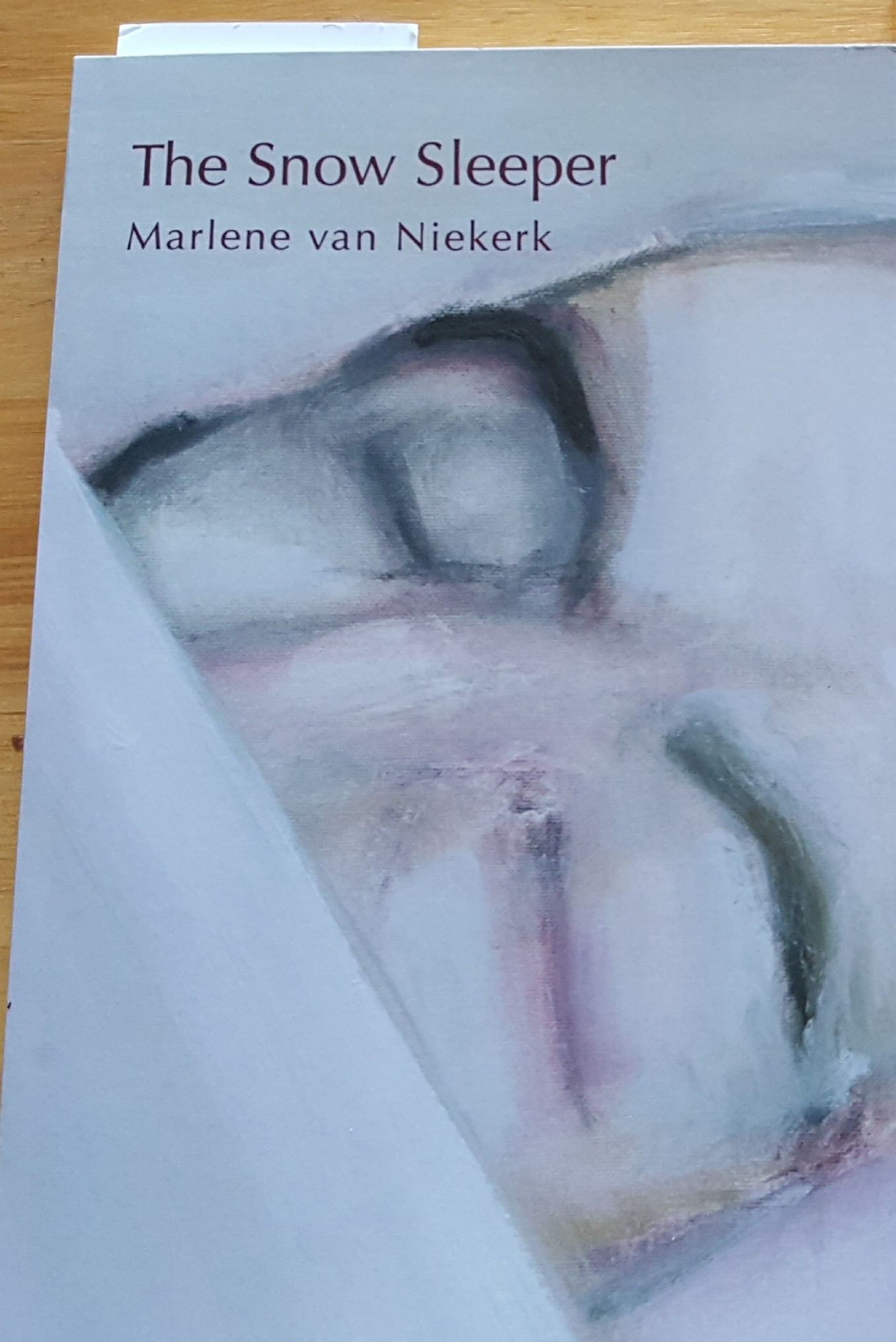
Tales within tales: The Snow Sleeper by Marlene van Niekerk

Oh, she serenades me so lovingly in the crepuscule of the park, the last lark. Does she really want to fraternise with this fluorescent shade? You are from the social services, Mevrouw? What? Come closer chincherinchee, I’m hard of hearing. You’re from the service that does the annual census of rough sleepers? She looks at me! Oh what an expert gaze rests upon me! Diva of the indolents in the catacombs of Krijtberg, sleep-counter of the stone-broke in the Heiligeweg!

At the end of July I shared a few thoughts about translation, arguing that a translated text need not be cleansed of all the linguistic flavour of the source language, especially slang, vernacular or wordplay woven into the original narrative. It may not always be possible or desirable to maintain certain elements, and sometimes transferring the rhythm and feel of an idiosyncratic expression may require the creation of a new word or the unconventional use of English, but it’s a balancing act. Strip away too much and, unbeknownst to the reader, the smooth sounding rendition they hold in their hands may have come at the cost of much of the energy and charm of the original. It might arrive prechewed, if you like, as if to make it more digestible. And unless you know the source material and language, who’s the wiser?

With Marlene van Niekerk’s The Snow Sleeper, you will have no doubt that you are dipping into the slippery terrain between languages. Originally published in Afrikaans, and translated into Dutch and English, it almost feels as if more than one language is meant to interact on the page at times. As a collection of four longer short stories—two set in Amsterdam, and two in South Africa but with a significant connection to the Dutch capital—there is room for a little playful linguistic overlap. And English language translator Marius Swart is quite comfortable allowing that to happen, when appropriate.

Of course, this approach is entirely in keeping with the text at hand. This set of loosely intertwined tales is concerned with storytelling—with language, translation, sound, and images. With what can be told and what cannot. With what should be said—that is, the storyteller’s social obligation—and what should not. And with how to open oneself up to what is being shared.

The opening story “The Swan Whisperer” will be familiar to anyone who chanced to read it in a slightly different form in The Cahier Series edition which featured the striking images of William Kentridge. Rereading it again I was as captivated as ever. Presented in the form of a lecture by a South African teacher of Creative Writing who shares the author’s name; it is an account of Kasper, a misfit student who unexpectedly sends her a long missive from Amsterdam where she had secured him a writing bursary. He is in the hospital, but wishes to explain why he is dropping out of his degree, and recount the most unusual and transformative occurrences which he has experienced. She is not impressed. No, she is even a bit angered. Reads a little and tucks his letter away. When a second package arrives, this one filled with cassette tapes and a so-called Log Book of a Swan Whisperer, she retrieves the letter, reads further and learns about her student’s infatuation with a drifter who appears to be able to communicate with swans. Reluctantly she finds herself drawn into the strange and compelling mystery her former student represents, and caught up in the project captured on his tapes—one where translation leads beyond the structure of ordinary language, grammar and meaning.

The second tale, set in Amsterdam, takes the form of a lengthy, rambling eulogy for Willem,  a writer of some renown. Jacob, his best and perhaps only friend, is a clockmaker who sets out to describe the last day of Willem’s life, one they spent together. The writer had been seeking feedback on his latest story, “The Percussionist,” and now Jacob has brought the unfinished manuscript along. It forms the unlikely backbone to his address to the gathered mourners. He reads from it, imploring the restless assemblage to help him complete the tale. As with all of Willem’s stories it was inspired by someone he had become fixated on and studied through his binoculars:

I would always know when he was having a crush on someone new, and that he’d write it up as soon as it was over, and that I’d once again be called as his witness. Not to witness the infatuation, but to attest to the fantasy. Because nothing meaningful ever came from these so-called great loves of Willem’s. The stories were all he retained. He held on to them for dear life. They were his real lovers, I only realise this now.

Their final day together ended in a riotous, childlike trashing of Willem’s apartment, as if he somehow sensed it was his last, but his friend, left to gather up all the pieces is the one who now has nothing to hold on to. Even as much as he resists it, the funeral also has to come to end and he must go home in his aloneness.

The title story “The Snow Sleeper” is the point at which the threads that tie the stories together intersect, though, the way they actually connect, or the extent to which the narratives and characters can be trusted, is not entirely certain. Here Willem’s younger sister Mevrouw, with both her father and her brother dead, is engaged in a study of Amsterdam’s homeless for her thesis. She finds herself under the spell of a “radiant vagrant,” an enigmatic and articulate jester holding court on a bench in a city park. Unfolding as a series of transcriptions from her interview with him, interspersed with memos that record her reaction to her curious subject along with memories of her own father who had similarly wandered in his later years, lost and restless until he was contained in a nursing home. She is, in guilt and grief, vulnerable to the strange charm of an eccentric drifter determined to tell her a story about a snow sleeper while she is intent on recording responses to the questions on her questionnaire.

Where I’m from, that’s what you want to know Mevrouw? Don’t they teach the art of the diplomatic approach any more, there in your lieweherehogerschool? “Where” is a vagrant “from”, did you hear that, dear listeners? Where from!

Fromness is for someone with a bed in one place, dear lady, but I sleep outside, I come from a cucumber and blow where I will, I know all the spots, the summer houses and the short stays, this park bench is my Xanadu, but I’m actually a man of snow, I drink my own thirst, with a horseradish for a nose and three chestnut buttons on my stomach, a cruel infestations of imaginings in my breast.

Among the tales he spins for his interviewer, is one of a doleful young man whom he tricked into believing he had the power to call swans, and a photographer for whom he performs the construction of a winter bed of cardboard and plastic. He has been, he implies, the ultimate jack of all trades—reciting poetry for a few coins in the park, seducing the lonely souls out of their own security and onto the streets. And for Mevrouw? He haunts and disturbs her thoughts as they share that park bench and day fades to evening:

If you’re going to split your fire for me, I wanted to tell the drifter, if that’s what your story is about, about how you consume people by whom you feel threatened, then I will burn like the wood of a plum tree, you will see all your language burn, soaked into my fibres, you will hear the echo of your impossible tale, a suitcase full of popping coals.

The interview ends when her tapes run out, but she is altered. Not even certain how. His stories nested within her own memos is a searching for answers.

The closing story, “The Friend,” returns to South Africa. The narrator is again named van Niekerk, caustic like the first one, but different in nature. She tells of a friend from school to whom she was unnecessarily cool when she was a young politically engaged activist and he was an awkward character with a stutter and an interest in photography. She encourages him to turn his lens to the injustices of the day at their country’s critical turning point. And he does, becoming a famous documentarian—then going a step too far. Does he perchance end up in Amsterdam one winter? Paths cross, but this is a softly tragic tale about a different kind of storytelling. One with images instead of words. One that ends, like the first, beyond words altogether.

Marlene van Niekerk, known for large novels like Triomf and the monumental Agaat, is equally mesmerizing in a smaller format. The stories in this collection are dense with emotion, ideas, and textual cross references, yet each one feels like magic—sad and wonderful at once.

The Snow Sleeper by Marlene van Niekerk is translated by Marius Swart and published by Human & Rousseau. It is my final Women in Translation Month read for 2019.