
This book arrived unannounced. An author unfamiliar to me, but on the very first page ten previous titles are listed, complete with translator and publisher. Then, on the title page, a personalized salutation from the author himself and the explanation of how this lovely little book found its way to me—the name of the translator: John Taylor. Over the years, through John’s translations, I have come to know of a number of writers and poets who have quickly become indispensable additions to my library. And now, another.
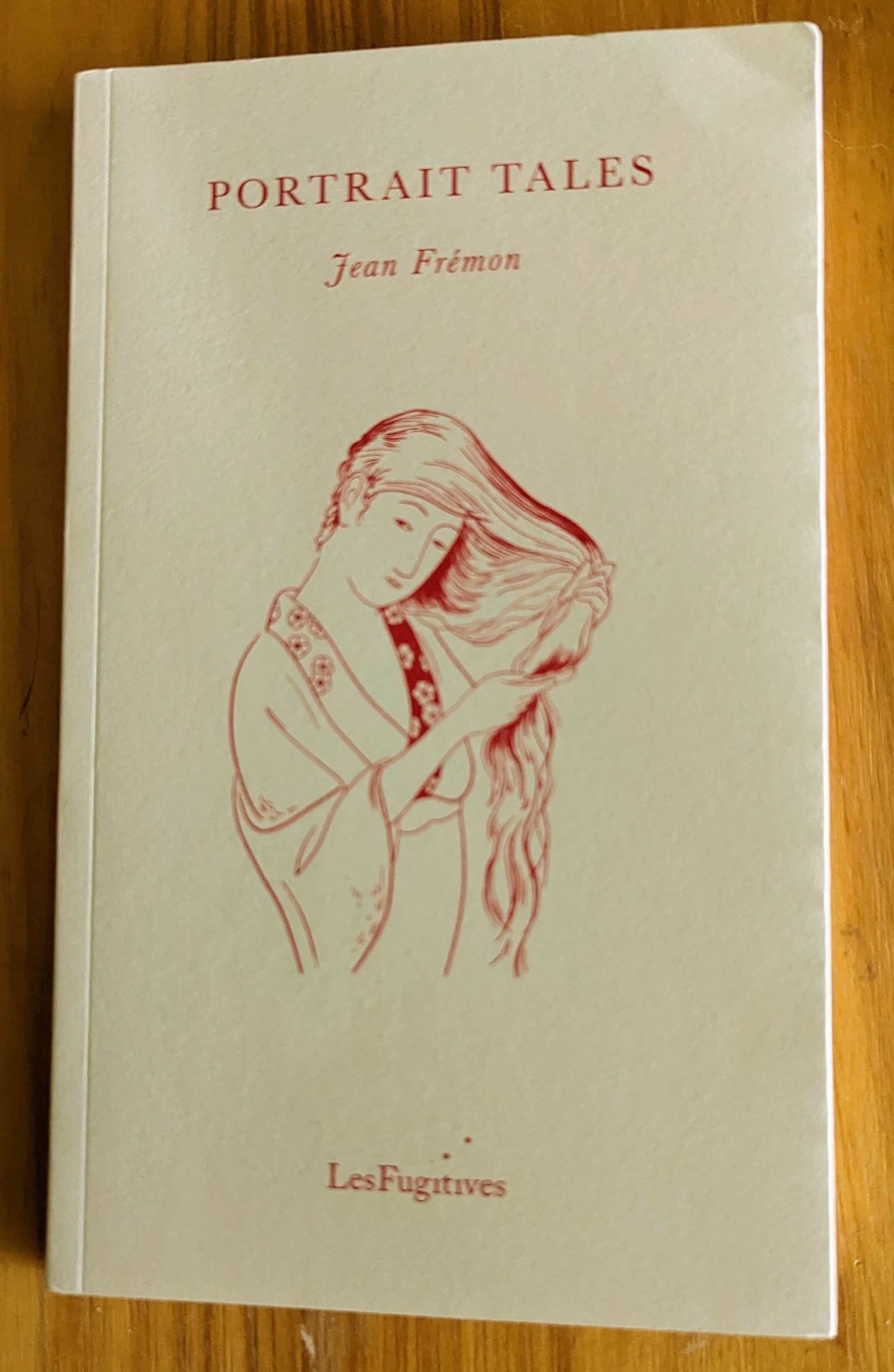 Jean Frémon is French author who, in the words of the publisher of this volume, Les Fugitives, “has been contributing to a trans-genre tendency in contemporary French letters since 1969.” By day, he is the president of Galerie Lelong, by night a prolific writer of poetry, fiction and essays on art, or, quite often, work that blends all three forms. He has published over twenty books in France and the present text, Portrait Tales is a selection of narratives on portraiture originally published in his 2020 book Le miroir magique. His tales explore well-known and little-known works and artists alike, and demonstrate Frémon’s extensive knowledge and deep appreciation of art whether he is playfully fictionalizing his subject or examining artistic techniques or revealing the historical consequences faced by those who allowed their likenesses to be captured against religious or cultural mores.
These short narratives cover a wide range of subjects. He begins with Lucian Freud’s singular, and less than flattering, portrait of Queen Elizabeth II, travels back in time and across the world to close with a remembered conversation with Louise Bourgeois, the only artist to appear twice and someone he worked closely with as a gallerist. In between—although reading the pieces in order is not prescribed, freedom of movement as in an actual gallery is encouraged—we are invited to learn about an Indian ambassador who paid the ultimate price for allowing Élisabeth Vigée-Lebrun to paint his portrait in defiance of Koranic law and entertain a meditation on the legendary impossibility of rendering a likeness of a young Jewish prophet named Jesus.
We travel back to Imperial China and Japan, to trace changes to ideas and styles of portraiture and conventions about what can or cannot be captured. Meanwhile in Europe, a number of factual or elaborated tales unfold. Frémon details, for example, the obsessiveness of Maurice Quentin de la Tour who worried his pastel portraits into being and the revenge of a young sculptor who becomes enamoured with the woman he is commissioned to portray. One of the shortest and most charming essays, is a sketch of the life and remarkable art of seventeenth-century Italian painter Sofonisba Anguissola:
Having withdrawn to Palermo, Sofonisba continued to paint. There is a self-portrait of her at age seventy-five. She is sitting in an armchair, in a three-quarter profile, her arms on the armrests. A large white ruff surrounds her oval face, which she has not tried to make look younger; her cheeks are hollow, her lips thin and tight; two large folds surround her mouth; but the pose is dignified and her bearing is not without nobility.
Ever confident in her ability to capture life in her many noble subjects and in herself, Frémon closes his sketch with an account of her submission to another artist’s pencil, the young Van Dyk, when he visits her at the age of eighty-nine. Her only instruction to him: “Ask the light to be clement.” It almost feels like each of the artists, or artistic moments Frémon considers here, is presented in a clement light. It is an intrinsic element of his tone.
Varied in spirit and style, every piece in this slim volume is a gem, enlightening and entertaining. As I was reading, I frequently found myself stopping to search the internet to find the portrait or artist in question, if such a record was available. That is a compliment, of course, not a criticism. A sign of a good book is, for me, one that sends a reader down the odd rabbit hole or two, expanding the experience of reading beyond the pages of the text.
Portrait Tales by Jean Frémon is translated from the French by John Taylor and published by Les Fugitives.

 roughghosts
I do like the sound of this.
I’ve hunted around for it, in either French or English, print or kindle but it’s either not available in Australia or it’s absurdly expensive. And (why am I not surprised?) not in my library either.
Still, just as well, I really shouldn’t be adding more to my TBR!
LikeLiked by 1 person
Les Fugitives is a UK publisher, but fortunately not too difficult to get here. They publish some excellent books.
LikeLike
I haven’t given up yet, but what I’d really like is to read it in French. Because each one is self-contained, it makes it an easier task.
LikeLiked by 1 person
I tried to press “Like”, Joe, but it didn’t work, so I’ll just leave my pleasure here. A beautiful way to begin the morning…
LikeLike