
Toronto consists of enclaves. All right, and parks. Enclaves are areas inhabited by minorities. There are a hundred and five minorities in Toronto, and new ones are being created all the time. Surrounded by invisible lines, walls and wires of separation and by a very visible medley of customs and languages, these minorities are becoming the majority. The little territory left over, in the centre, belongs to the majority that is slowly being transformed into a minority. And in similar circumstances, historically known to us, such a reduced majority may come to regret it.
Daša Drndić’s observations of Toronto in the mid-1990s, informed by history, much of it painfully recent for the new immigrant, is characteristically measured and insightful. And today, thirty years later, the tensions she predicts have found full expression in the anti-immigrant sentiments that have laid bare the multinational myth that we, as Canadians, have long held to. Fresh from the Croatian War of Independence, she had crossed an ocean as a refugee, only to find herself left to fashion some kind of home in a Greek-Chinese-Indian enclave in a sprawling metropolis in the so-called “New World.”
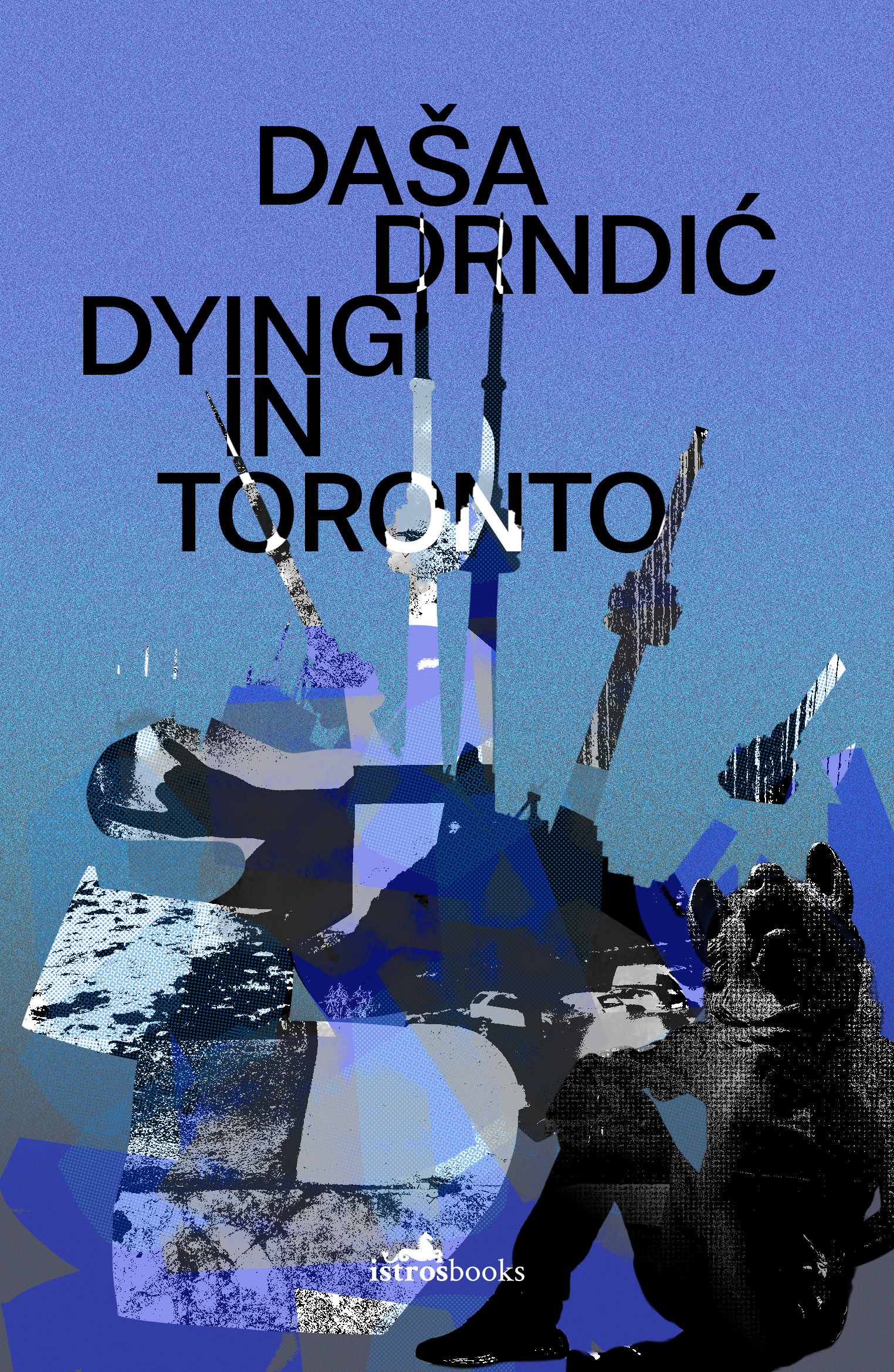 Dying in Toronto, subtitled Or Our Lady of Czestochowa is still shedding tears, originally published in Croatian in 1997, is an extended essay (or series of essays, if you prefer) chronicling her experiences as an immigrant living in Toronto from the summer of 1995 and into 1996. It may be considered as the non-fiction counterpart to 1998’s Canzone di Guerra which was released in English by Istros Books in 2022 (and as Battle Songs by New Directions in 2023). Both books are translated by Celia Hawkesworth, and feature narratives woven with factual commentaries and detailed footnotes, but Canzone has a fictionalized storyline, and a somewhat more experimental feel, especially with the regular asides about pigs. With Dying in Toronto, Drndić does not take on an alter ego for herself and her thirteen year-old daughter. Her focus is more directly on the machinery and indignity of the government system newcomers must navigate, and the adaptations (and sacrifices) they are forced to make. It is a sobering, yet often wry, account.
For her first months in Toronto, Drndić is keen to maintain, in this foreign urban landscape, a current and updated link with life back home. She discovers that an Istrian Croatian newspaper, Glas Istre (The Voice of Istria) can be obtained if she is patient enough to make a long trek across town to buy it. She maps a route, but then thinks better of it. She decides to stop nostalgizing, and try to integrate amid the visible minorities and the white majority. She visits the library and goes to the cinema, for although her finances are limited, she requires creative stimulation (a luxury to be hidden from her case worker). Likewise, social and cultural contacts are important, so she reaches out to other Croatian and Slavic immigrants most of whom are also living diminished lives, at least relative to their pasts and professional credentials. As for her daughter Maša, she indulges her with a string of small, short-lived, mostly rodent-related pets. As a single mother, Drndić and her daughter are naturally very close; together they struggle to adapt to the realities of their new existence:
The dichotomy of our life here is interesting. On the one hand a pathetic attempt at getting close to intellectual circles, on the other – identification with socially marginalised groups, partly out of curiosity and the masochistic satisfaction of reducing everyday life to the elementary and partly because of objective material poverty.
Yet, for Maša there is also a distinct kind of adolescent loneliness. She is at a sensitive age to be uprooted, though, with the war, she really has not known any kind of normal settled life since she was a young child. Her mother hopes to make up for this while still ensuring she has a connection to her homeland. It’s a difficult balance.
The portrait Drndić paints of Toronto, and more broadly of Canadians, is sharp, even cutting, but not without a dry sense of humour. To anyone familiar with the city, the history she describes will be familiar, as will its more garish landmarks—the legendary, now closed, Honest Ed’s discount department store and the oddly eccentric Casa Loma. But her diversions extend beyond Toronto, north to the Inuit in the Arctic, and back in time to trace the surprisingly long record of Croatian migration to Canada. As a Canadian reading this book, it is easy to nod with a smile as she points out our idiosyncrasies, because her tone is light. However, when it comes to the immigration and refugee “system” itself, and the perils of those who get caught trying to make their way through it, one can hear a bitter sarcasm come through. And even more unsettling is her response to the 1995 Quebec separation referendum—although it fails by the slimmest of margins, she is certain the province will ultimately secede one day. She also sees clearly the racist forces at play and the disregard of First Nations and Inuit rights. Little has changed. Today we are looking at separatist movements and talk of referenda again, but now it is not only in Quebec. In the west, in Alberta, the province where I live, we will soon go to the polls to decide whether we want to stay in Canada or make plans to vote to leave.
Clear-eyed and ever wise, Dying in Toronto is a work of astute social criticism with a deeply personal element, that not only speaks to a certain era in time, but provides undeniable evidence that the forces that divide us today are not new, nor are they unique to those long standing trouble spots like the Balkans or the Middle East; they were already taking root decades ago, even in a place that still imagines itself peaceful, welcoming. Like Canada. It is good to have this valuable work finally available in English.
Dying in Toronto by Daša Drndić is translated from the Croatian by Celia Hawkesworth and published by Istros Books.


I enjoyed reading this although it tells of a time passed – but, as you say, the origins of some of the issues which blight us now can be seen.
LikeLiked by 2 people
Yes, our memories are short. Drndić’s clear vision is always enlightening and as a Canadian it is interesting to be seen through her eyes.
LikeLiked by 1 person
I’ve had Belladonna on my TBR for at least 5 years! I had no idea she lived in Canada.
LikeLiked by 1 person
I’m not sure how long she lived here, but she arrived in 1995. Even if that was 30 years ago, as a Canadian her observations about our country(and TO) are very interesting and at times quite funny.
LikeLike
I like the passages you’ve quoted; it seems she has a satisfying balance of clear, direct prose with some gently lyrical bits.
LikeLike
She was a very interesting writer. I’ve only read what would be considered her minor works, but this one still resonates given the anti-immigrant sentiments gaining strength in Canada.
LikeLike