Grandmother’s heart is a vast forest with thick underbrush, towering trees and squat ones, along with many shrubs. You can go for a walk in it or go astray.
It has clearings, too, that open up like a surprise. A single step and the child is suddenly standing in the light, the sky overhead filled with soft pillows of cloud and the sun. There, Grandmother is an angel who grants every wish.
The forest of Tamangur—Il god da Tamangur in the local Romansch language—is the highest extended forest of stone pines in Europe. At altitudes of up to 2400 meters above sea level, this protected realm of long-lived trees stretches along the slopes of the Engadin Valley in the eastern Swiss Alps. In Tamangur, the novella by Swiss poet Leta Semadeni, the forest takes on mythical qualities, watching over the villagers who dwell in its shadows, and welcoming them home when their souls are ready to rest in its heavenly counterpart.
Born in 1944 in Scuol, Engadin, Switzerland, Semadeni studied Languages at the University of Zurich and worked as a teacher in Zurich and Engadin. Writers residencies have since taken her to Latin America, Paris, Berlin, and New York. She did not publish her first work, a bilingual Romansch and German collection of poetry, until 2001 when she was in her fifties. She continued to write poetry in both languages, sometimes even translating between the two, before turning her attention to fiction. Tamangur, her debut novel, was published in German in 2015 and released in Tess Lewis’s nuanced English translation in 2025.
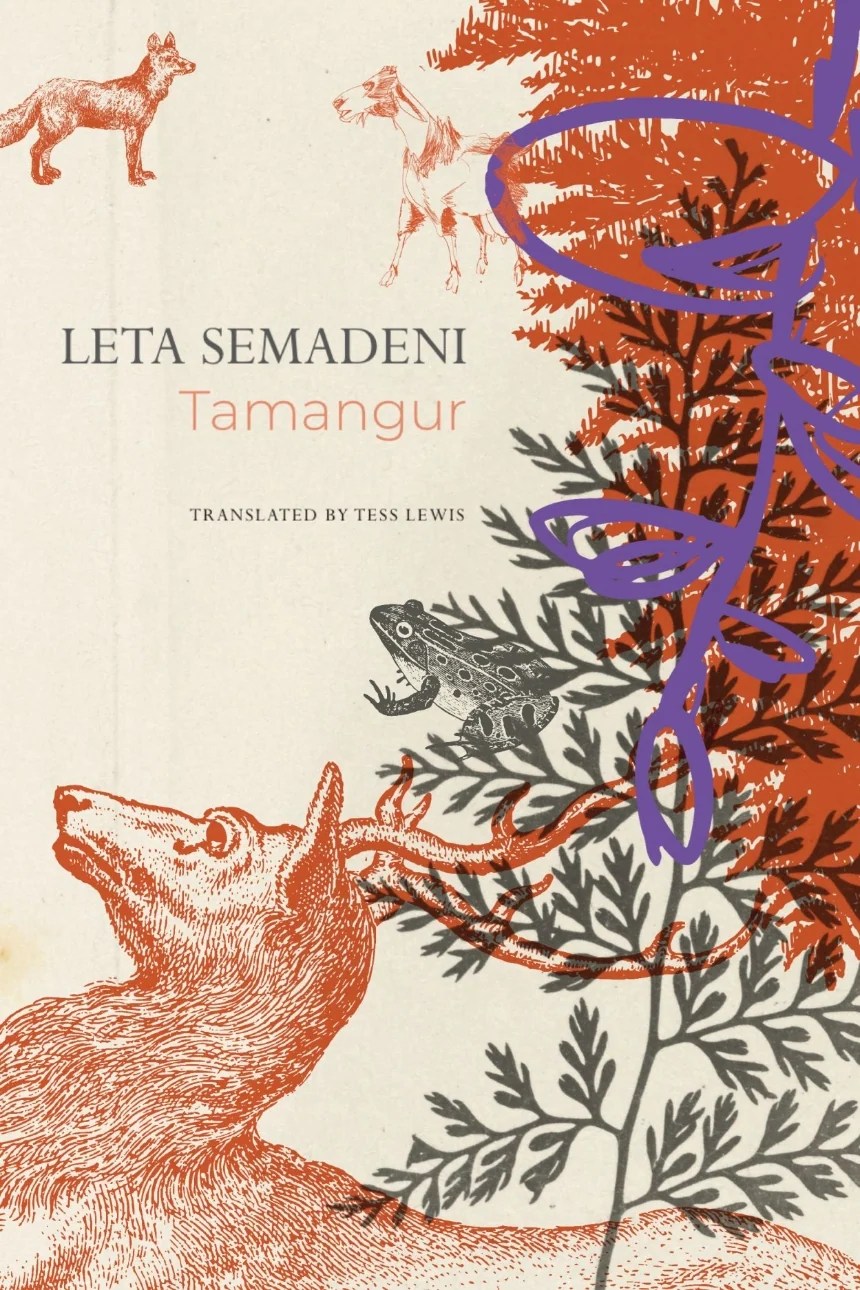
Stitched together like a patchwork quilt, Tamangur unfurls over eighty-four vignettes that, through interlinked scenes and memories, tells the story of a young girl who lives with her pragmatic grandmother in a tiny Alpine village surrounded by a cast of eccentric characters. The circumstances that led to this living arrangement are never fully fleshed out but appear to have arisen following the accidental death of the girl’s younger brother. In the present time her grandfather has also died—gone to Tamangur, as they say—and both she and her grandmother grieve his absence in their own ways. Yet none of the central figures are named, rather known simply as “the child,” “Grandmother,” and “Grandfather.” In an interview conducted during a residency at New York University’s Deutsches Haus at the time of the novel’s original release, Semadeni explained her reasoning for this approach:
It wasn’t a conscious decision. It was more of a gut decision, which, in retrospect, was the right one. The omission of a personal name gives the main characters a universal meaning. In my opinion, a personal name would trivialize them.
It seems she is quite right in her instincts, as this choice enhances the folktale-like quality of the narrative and its inherent timelessness.
The spare prose is poetic, tracing scenes observed and remembered from a spare third person narrative filtered through the imagination of the child. Even Grandmother’s actions, comments, and idiosyncrasies are interpreted from this angle. As a result, the child observes things and hears expressions she can’t fully understand, her innocent perspective serving as a subtle channel for much of the unspoken “adult” sorrow and humour running beneath the surface of the narrative.
The village is home to an assortment of “oddballs” as Grandmother calls them. To her mind, they add friction and interest to the social fabric of the community. There is the seamstress who steals memories, the chimney sweep who crosses the border to meet up with men behind his wife’s back while other menfolk make the same trip to visit “cathouses,” and Luzia the maid from the Alpine Rose restaurant and guest house who, being three years older than the child, introduces her to many more mature notions and pleasures (like stealing plums from the tree in the priest’s yard) than she might have otherwise encountered living alone with an old woman.
But the most charming oddball is Elsa who lives in the yellow house with her imaginary boyfriend Elvis. Grandmother is especially fond of her, so she visits often. When, on their first Christmas without Grandfather, faced with a carp too big for just an old woman, a child and a dog, it only seems right to invite Elsa to join them.
The doorbell rings at seven on the dot. Elsa steps into the room like an angel in fur. She has woven tinsel into her grey braids and fastened them on top of her head with paperclips. The child is a little afraid of Elsa, but Grandmother finds her refreshing. With most people, you already know what they’re going to say, it’s deadly dull and only bearable if you put on a friendly face and nod off inside, Grandmother says. Elsa, on the other hand, is full of surprises. She’s a good girl, you just have to listen to her. Elsa can take the most disparate things and tie them up into a neat package. That said, I’m all for biodiversity, I just don’t have the equanimity it takes to enjoy the company of boring people. At my age, I haven’t got the time either. As a surprise, Elsa has brought Elvis. Naturally he’s wearing his stupid jumpsuit, she says, the white one with glittery sequins because it’s Christmas and at Christmas everything glitters and shines.
Elsa is in fact filled with many wonderfully strange observations about life, gravity, and time. Her unabashed oddness is a counterbalance Grandmother’s tendency to express strong opinions and hold to regular routines and preferred ways of doing things. She can be harsh at times in her comments and directives to her granddaughter, but the child has an intuitive empathy with her grandmother, even if at times she hates her. It’s okay to feel that way she knows, because Grandmother also knows hatred, insisting that it “sharpens the senses, gets the blood flowing and simply does one good.” As long as it’s reserved for important people and things, mind you. Of course, Grandmother is also filled with wise observations about nature, wistful stories about the many exotic places she travelled to over the years, and deep physical longing for her beloved lost husband.
As the eclectic narrative advances, piece by piece, the portrait that emerges is one of a relationship of complicated affection between two people, a young girl and an old woman, who have been left behind, each dependent on the other on her own terms. The girl’s parents moved away after her brother’s tragic drowning, leaving her with her grandparents and she cannot shake the fear that it is because they hold her responsible. Now, more recently, Grandfather—hunter and fisherman, husband and magical storyteller—is gone and his memory weighs so heavily on Grandmother that the child sometimes has to tread carefully. A pervasive sense of loss is never far away. But with Semadeni’s light poetic touch their tale becomes one with just the right balance of sorrow and absurdity to allow the beauty of life and love to shine through the shadows.
Tamangur by Leta Semadeni is translated from the German by Tess Lewis and published by Seagull Books.


First, I don’t think I’ve taken note of “stone pines” before, so that was an interesting “discovery”. But beyond that, this just sounds like a perfect match for me. This might well be my first offish Blackwell’s leap (too bad about the U.S. for so many reasons, not least of which is not being able to enjoy Seagull’s distribution through Chicago). Andrea Tompa’s Omerta is also in stock at Blackwell’s… /ponders
LikeLike