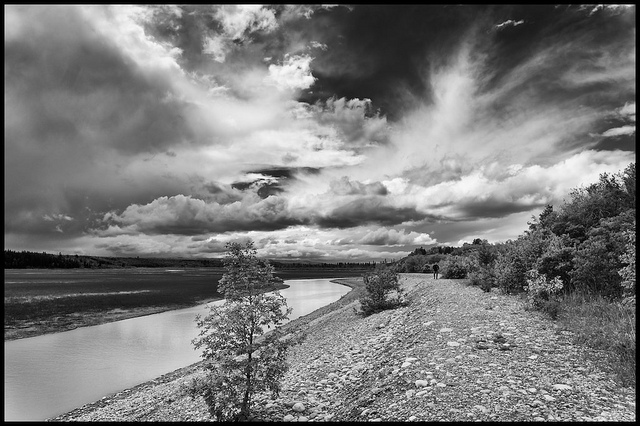
Maybe it’s the unusually early snow. Tree branches still rich with green foliage weighted to the breaking point under heavy wet snow are decidedly out of place so early in September. If it warms up we may squeeze a little fall out of the year after all. If we get a killing frost the leaves will turn leathery and cling to the trees until spring.
Copyright JM Schreiber 2014 (yes these shots were taken today)
An omen perhaps?
Is it late summer or early winter?
Like trying to define the weather, it can be difficult for me to clearly pin a label on my emotional state. A stable, well medicated state is actually one of relative distance from what I really feel. Blunted at either end of the normal ups and downs. I am not certain if that is a natural or artificial state. It is probably more realistic to call it functional.
Manic? Well, manic is really only recognizable as it recedes. Think of the way that you can become accustomed to a certain level of physical pain and not realize just how severe it is until the painkiller kicks in. But there is no instant relief for a significant manic episode. Manic gradually disappears in the rear view mirror as I creep along and then, just as the road ahead seems to become clear, I hit depression. Or this anxious emptiness that I feel lately.
Copyright JM Schreiber 2014
Like today.
The streets are littered with branches that could not handle the weight of the snow. The power has been off across the western side of the city for hours. As crews manage to restore power to one section, melting snow frees branches that bounce back and knock the wires out all over again. The silence and reduced light has left me alone with my thoughts for much of the day.
There is, however, an important lesson in unexpected situations like this. You have no choice but to ride it out, stay safe and wait until the storm has passed. Only then can you assess the damage, clean up and move forward. After all, we are supposed to be back up to summer temperatures by the weekend.
My own spirits might not lift quite so quickly, but I know from past experience that they will.
I started this blog in a fit of manic energy not realizing how very close I was to running over the edge into full blown madness. And now I find myself writing in and around the experience as best I can, unpacking and worrying myself into the future with a level of anxiety that seems to greet me refreshed every morning before I even crawl out of bed.
Taken in the aftermath of major flooding last year this looks like how I feel sometimes… Copyright JM Schreiber 2013
With my original diagnosis I read all the available materials and although it was pre-internet (imagine!) I spent a lot of time at the library. This time around I find myself in world where so many fellow travelers on the road in and out of sanity are busy scribbling their way along. I have been and will always be selective in what I chose to share about myself with others. Great for maintaining privacy, not so great for making new friends. So I struggle every day with how or what to add to the dialogue.
I think I am personally drawn to creative expressions… photography, poetry and writing but am not sure where to start. I suspect madness, sanity and that huge area in between is best met sideways. So no memoirs for me. Photography is good outlet but I lack the discipline to take it to the next level. I would like to capture that moment when reality and one’s experience of reality begin to part ways. It is such a subtle process with manic depression the way I experience it and I imagine I am not alone in this regard. To those outside, unless they are highly attuned to changes in your patterns of behaviour, the transition can be unnoticed for a time.
And then before you know it you are picking up the pieces or retreating from the world or both.
To date, the finest literary account of slowly growing madness, that I have read, is William Golding’s The Spire. This novel imagines the construction of a 404 foot spire atop a medieval cathedral (inspired by Salisbury Cathedral in England) and is narrated from within the mind of Dean Jocelin. The dean is a man who has attained his position by curious family connection rather than earning it on a solid foundation of faith. As he envisions and directs the construction of the spire, tuberculosis in his spine advances to the point of driving him into a psychotic state. At first he interprets the sensation caused by his infection as angels at his back, sure evidence of God’s blessings. However as his pain and madness grows he becomes increasingly erratic, unstable and irrational. It drives him to conflicts with the master builder, sexual obsessions with a woman, paranoia, jealousy and possibly murder.
Reading with an online reading group added to the richness of the experience of this novel, but for me personally it captured so vividly the sensation of gradually and fully losing grip on reality that I had during my first severe manic episode. By the final moments before the ambulance arrived to whisk me away I was no longer able to distinguish between what I had interpreted as a mental breakdown that I could handle and the creeping fear that the Devil was tormenting me. It was a horrifying moment.
For poor Dean Jocelin because he is not only mad but dying of tuberculosis, his last days and hours are vivid mental and physical torment. It is up to the reader to decide if his soul finds any peace at the end.
Luckily my more recent manic episode did not end with as much drama as the first because someone finally commented on how fast I was talking and I had the shocking realization that I was sick. But the damage was already done all the same. I just wish I could help those who experienced my behaviour understand but I am not certain they wish to listen. And honestly, can I be a more reliable narrator of my own manic experiences than The Spire‘s mad dean?
Yesterday I took a small road trip with my son out to visit my parents. It’s about a two hour drive each way and this is the first time I felt that I had sufficient stamina and concentration to manage it since my breakdown in June. The countryside is beautiful but the journey did not really offer me more than time to sit and fret behind the steering wheel. I thought about how I used to need a road map to navigate the back highways when my 86 year-old father’s ongoing retreat from civilization first drew them out there a few years back. I no longer need a map and know the route well.
Copyright JM Schreiber 2013
I could, however, use a personal map or trail of bread crumbs to follow back to make sense of the past year or two of my life. A mood disorder can wreak havoc on one’s internal compass. In the hazy debris of an extended period of hypomanic energy sliding into manic, I am finding it impossible to make sense of where I was or where I go from here.
At a deeper, more fundamental sense I have lost faith in myself. Or rather my ability to make sense of my self.
It is likely that this is the affect of depression. It’s hard for me to know because I have rarely ever experienced the sort of black dog depression that many others describe. I tend toward anxiety and a bone weariness that weighs me down, but I do not crawl into bed and pull the covers up. I don’t sleep well, in fact I tend to insomnia. But I don’t recall experiencing the all pervasive lack of physical energy that haunts me now. I find it hard to remember how I ever managed to accomplish all of the projects, personal and professional, that I tackled during the many years of relative stability I experienced over the past ten to fifteen years.
At the moment, the fact that’s really eating away at me is that the last impression I left at work was of a manager who was increasingly high strung and finally quite stressed and obnoxiously concerned that he alone had the skills and perspective to resolve the challenges facing the agency. The manic Mr Hyde side. But how long was he showing his face? And now that I am living with a shy, anxious shadow of my Dr Jekyll self (assuming I even have one) I wish I had GPS system of some kind to help me retrace my steps.
A good therapist would help, and I do have one, but at $180/hour I won’t be seeing her much and if I am going to spend that much I would rather wait until I have figured out where I have been so she can help me figure out where I go from here.
Or maybe it’s better to accept what cannot be changed and look forward instead…
Shame: A painful emotion caused by a strong sense of guilt, embarrassment, unworthiness, or disgrace.Copyright JM Schreiber 2014
A severe manic episode leaves a residue of shame that no magic formula can resolve or wash away. Your behaviour, actions, words and deeds – no matter how out of character – are remembered by others while you, yourself, have only the foggiest sense of a hellish few days or weeks.
As the weeks pass I find myself unable to shake thoughts of my workplace, the environment in which my manic drama played out. I don’t think about returning to work and I know that at this point I could not even mentally or emotionally entertain that notion even if they would accept me. I realized today that it is the unbearable shame I feel for actions and words I could not control and can never properly apologize for that is eating me up inside.
A post on a blog I follow inadvertently put me in mind of a poem I discovered in the wreckage of my first manic psychosis many years ago. The poem, “Deceptions”, by Philip Larkin was inspired by an account from Henry Mayhew’s London Labour and the London Poor of a young girl who was drugged and raped by her master.
The poem is exacting in its depiction of her grief and the poet admits, unapologetically, that there is no consolation he can give her; recognizing that both victim and perpetrator were deceived in the violent act. I think it is this very measured recognition that there is nothing that he can offer to absolve grief and shame in the sufferer whether the event is recent or buried by the sands of time that gives the poem its power. The following lines struck me when I first encountered them and this time around, perhaps because my manic episode was a much more public event, they clearly articulate the feelings with which I am currently trying to come to terms.
… light, unanswerable and tall and wide, Forbids the scar to heal, and drives Shame out of hiding. All the unhurried day, Your mind lay open like a drawer of knives.
This too shall pass, I know, and I will ease the drawer closed and the emotional scars will fade with time.
Absolution is not the issue. Mental illness is not a sin.
Every morning I wake up in the middle of a dream about work. The dreams are surreal and disturbing.
I was at the height of a full manic psychosis at the point of last contact about two months ago. That is not an impression one wants to leave. It has taken a long time to slow down enough to appreciate just how agitated I have been. One can no more pull oneself out of depression than one can throw the breaks on a train running at full manic speed. And my memories of those last few weeks are hazy at best.
Technically I still have the potential of returning to work. I was a senior manager and I worked at this small not for profit agency for nine years without incident until a series of circumstances contrived to create an increasingly dysfunctional, toxic environment. And, well, long story short, the pressures took a devastating toll on my mental health. After a decade and a half of relative stability, I became ill. And as a bipolar person with a strong swing to the manic, I left in a spectacular flourish. So I have no real idea what remains for me there.
In all fairness I was paid out generous sick time and vacation pay and I do have access to a short term disability benefit that should see me through the next few months. The approval process has proceeded with typical government efficiency. But today I finally received confirmation of my application and that is a tremendous relief.
Copyright JM Schreiber 2014
I just hope the dreams about work fade for while.
And I can spend some time reading and reflecting about where I go from here.
There is a question tends to haunt those of us who live with mood disorders, especially in the early months of adjusting to a diagnosis or in the aftermath of breakdown:
Who Am I?
There is this persistent fear that, if the highs and lows of this “disorder” should ever hit equilibrium, what will be left?
And will that stable “me” be the real me or a medicated artifact?
Copyright JM Schreiber 2013
The theory is that mood disorders are typically associated with “normal” periods but as most of us know, mania and depression can simmer under the surface, felt rather than observed for a long time. When symptoms burst through resulting in “abnormal” thoughts, actions and behaviours, those around us rarely understand that these are beyond our control. And because insight is impaired, when we are at our most unstable we are often the last to know just how far off the rails we have run. All this is further complicated when a mood disorder exists in conjunction with addictions or trauma or other chronic conditions.
Having a mood disorder is like living with ghosts.
But we own those ghosts. They are us. Everyone has them.
Ours just like to try to steal the stage, set the agenda, write the script and direct the show.
Maybe that is why I am drawn to so much fantastic literature lately… allowing the ghosts of others to distract me from my own.
We have all heard this expression, probably said it ourselves if we are parents. Somehow, today, as we continue to simmer in the aftermath of the news of Robin William’s tragic suicide on Monday, this is the thought that keeps coming back to my mind. For those of us who live with the very harsh reality of a mood disorder his death holds a special poignancy. So does the inevitable, endless discussion that only unexpected celebrity death seems to be able to generate.
I am presently on sick leave after a severe manic episode and although I feel the worst of my own suicidal ideation has passed, the extreme mixed state I passed into as medical resources were amassed to put the brakes on my mania was the worst I have known to date. I relied heavily on the local Distress Centre at all hours of the day and night and as much as practical on my elderly mother and young adult children. Otherwise I was intentionally and completely ostracized by my employer and they have yet to follow up on my well being. Still I feel fortunate. Robin Williams and countless others are not so lucky.
In the wake of his death, everyone seems to be turning in to look at the darkness haunting so many seemingly outgoing, humorous, entertaining and outgoing individuals. It seems to me like the attention is so keenly focused on depression and addiction. But when he was working all out, brimming with manic energy the danger signals were just as evident. But we were too busy laughing, crying, and being entertained to be concerned. It’s all fun and games…
Another public media post mortem comment that disturbs me is the observation some people have made that he seemed to hide behind his characters, whether in his improvised comedy or the countless powerful and engaging individuals he portrayed on screen. From this they extrapolate that it is as if he was hollow inside. As if only an individual so empty and devoid of being could ever be driven to take his or her own life! I am no expert on Robin Williams, I never met him, but I would not be surprised to learn that he was a deep and intensely private man. Probably shy and insecure too.
For many people who grow up with an inclination to conditions on the mood/anxiety disorder spectrum, there is often a lot of social isolation. I know from my own experience and that of my son, social interaction does not come naturally to some of us. The need to compensate can drive such people to the creative arts – drama, music, literature for example. Likewise such individuals can be drawn to academic pursuits where energy and intellectual drive can lead to striking success. After all, there can be long periods of essentially “normal” function, especially if one avoids the trap of alcohol or drugs as a means to cope.
From my own recent experience, it seems to me that our western society, rewards the mildly manic. Over the past nine years I worked at a small agency where I routinely held the largest and most complex caseloads and took on any extra assignments placed on my desk. I developed programs, trained staff. I was rarely sick and frequently had to struggle to squeeze my allotted vacation time in before year end. I loved my job.
At home I was a single parent with two teenagers, each with their own special needs. There was whole full time round of responsibilities that fell into play outside the office. Then about a year ago things at work got crazy. The Director was exhibiting signs of significant cognitive decline and it was left to myself and a junior staff to monitor and report on the increasingly toxic state at the office while the Board of Directors tried to decide what to do.
As senior management I took the brunt of the responsibility, workload and, ultimately, abuse. I became irritable, overwhelmed and distressed – big time manic. Although I had always been open about my bipolar diagnosis no one recognized the warning signs until a chance comment about how fast I was talking hit me like a ton of bricks. I immediately pulled myself out but by then it was too late. And it is all still seen as entirely my fault, my failure to control my behaviour.
I wasn’t funny, no one was laughing and I am the only one who lost an eye, figuratively speaking of course.
In the early weeks of my sick leave I remember thinking that if I took my life, maybe my employers would realize how truly sick I had become. Of course it would have only reinforced my madness and saved them the complication that as a disabled person I have human rights protection.
Loveable madness is remembered fondly. Margot Kidder digging garbage out of an alley is not. On a more horrific level, the nice ordinary person who seems to suddenly snap and takes the lives of family or strangers is not. However mental illness is a critical subject that we cannot afford to ignore.
After all, it’s all fun and games until somebody loses a life.
There is a dish which has become ubiquitous in Canada – fries smothered with gravy and cheese curds – the French Canadian artery clogging delight called poutine. Many years ago when I lived in Ottawa it was a treat to cross into Québec, follow some back road instructions to a truck, seemingly parked in the middle of nowhere and order the authentic dish complete with cardboard container and plastic fork. Personally my tastes have changed in 30 years, so while some version resembling poutine can be found at most of your favourite fast food haunts, but I will leave you to it. My kids, on the other hand, love gravy – with or without the cheese curds.
Today my wish for my son is gravy. At 24 he has been struggling with an addiction to alcohol for several years. He is aware that underlying the addiction is the mood disorder that knits so much of our family together. Yet his experiences in anything resembling conventional mental health care have been quite horrific for an intelligent, gifted child. As far as he is concerned, alcohol is preferable to medication or therapy. I can appreciate where he is coming from but I chose to take my risks with the prescribed meds and I have been spared the temptation to turn to alcohol that has marked many other family members over the years. Not that it has prevented me from falling ill again but life has no guarantees.
Living with mental illness is not easy. Addiction adds to the burden. But I love my son unconditionally and understand that, in the end, his life is his own and he is the only one who can really come to terms with his own blessings and curses.
Lately we have been fooling ourselves with the idea that he can maintain a minimal alcohol intake and get by. However, this morning after a night of heavier drinking and the inevitable conflict such situations evoke, he finally admitted that he cannot live without alcohol and that it is interfering with everything he wants in life. He poured out every remaining drop and gathered all the empty cans and bottles to return.
Will it hold? It is a critical start, as close to bottom as I have seen him reach to date. So I want to offer him gravy. Poets, artists, musicians and writers who nursed their muse with alcohol or drugs are well known and a tragic number paid a steep price. But I want to offer my son Gravy, a poem composed by the incomparable Raymond Carver after a diagnosis of cancer. Although illness took him early it was not for alcohol – that was a battle he won and was rewarded with the time to create a body of poems and short stories that have inspired and moved so many. And that is a victory he celebrated as, of all things, gravy:
No other word will do. For that’s what it was.
Gravy.
Gravy, these past ten years.
Alive, sober, working, loving, and
being loved by a good woman. Eleven years
ago he was told he had six months to live
at the rate he was going. And he was going
nowhere but down. So he changed his ways
somehow. He quit drinking! And the rest?
After that it was all gravy, every minute
of it…
Excerpt from Gravy by Raymond Carver, All of Us: The Collected Poems, edited by Tess Gallagher, Vintage (1996)
During the past year, I was haunted by an overwhelming pressure that I needed to be able to slow down, take stock of my feelings. I was becoming aware of a wall coming down between myself and my emotional grounding.
At work a toxic environment was brewing as our director became increasingly paranoid and unstable. My daughter was trying to impress an unreasonable employer at her own workplace while, at home, my son who has long struggled with his own mental health and addiction issues was going through an especially difficult, potentially violent series of conflicts with friends. Just to keep my head above water I was going through the paces. A familiar process. Single parents tend to develop this coping skill.
It is strange how life gives you time to reflect when you need it the most.
Although I have lived with the ups and downs of a mood disorder for most of my life, a full manic break and diagnosis did not come until I was in my mid 30s. Until that time I felt like I was lost at sea, battling waves I could not put a name to, but hanging on and, as much as possible, faking my way through the years. After all, unless you know better, you figure that everyone else is essentially doing the same thing.
With the diagnosis and other critical underlying issues that subsequently came to light, my life started to make sense. I felt I had some answers, some sense of a guideline. It was not an easy prescription and there were costs, including the end of a long marriage, but I prided myself that I had persevered, that I had survived. Although I was late to the game I was able to build a career that allowed me to support my children, buy home and start to put away some money for the future.
Now the reality of the diagnosis has cruelly returned to confront me leaving me unable to know if returning to the job I had is either possible or even desirable. I find myself re-evaluating what I want for myself.
Something that haunts me this go round is the notion that people with mental illnesses, bipolar in particular, have a shorter life expectancy. Although the reasons, methods of study and populations under consideration is not clear this is not a factor I ever considered before. Funny thing, we are bombarded with the message that we have to be prepared to support ourselves financially for longer than previously expected and yet we see people die prematurely – of natural or unnatural causes – all the time.
Fact is, life offers no guarantees.
Read. Travel. Write.
Either everything has meaning or nothing has meaning.
The aftermath of madness leaves its own measure of grief. Because the manic end of the bipolar experience is by nature expansive, the episode is rarely one that occurs in isolation. At the very least, strange, anxious and pressured calls are made. Sometimes to strangers. Sometimes to those you know. Friends and families may observe the cracks as they start to spread. The first tremors may be intermittent. They can look like occasional or periodic moments of stress – the bad days anyone can have. When things start to spiral out of control I suspect it is already too late. For the person inside the experience, the pressure, the racing thoughts, the inability to sleep or find relief from the escalating crisis becomes a space in which all perspective is lost.
And generally there is damage.
At the most severe there can be serious physical harm, violence toward the self or others. More typically major manic episodes impact relationships, bank accounts or jobs, sometimes beyond repair. Yet in the middle of it all is a person who is very ill, who will need time to recover physically and emotionally for whom there is frequently very little understanding or sympathy. Especially when they are isolated.
As I struggle to cope with the rotating cycles of sadness, embarrassment, anger and fear following my recent breakdown I am aware that because no one from my workplace has contacted me, no one has any idea how severely ill I have been. They just remember the last days of fractured functioning before I was finally able to get away from the office. Four weeks later I am exhausted, still unable to regulate my sleep and uncomfortable driving beyond my immediate neighbourhood. When I am deemed well enough to return to work my employers will be able to imagine this “illness” was all a convenient ruse and I have reason to believe it will be held against me. The nine years I worked there and the senior management position I held under increasingly toxic work conditions will mean nothing because it was always an environment in which your work was never acknowledged or appreciated. My mistake was to care enough to stay because I believed in the work we were doing.
The emotional roller coaster is the worst. It is interfering with the comfort and enjoyment I have always found in reading and photography. It finds me moaning and wallowing in self pity when I’m not trying to push grief and anger behind me. And my young adult kids and 80 year-old mother deserve a break from having to listen to it all.
And I would much rather be blogging about books and ideas, not the black heartache of depression.







 roughghosts