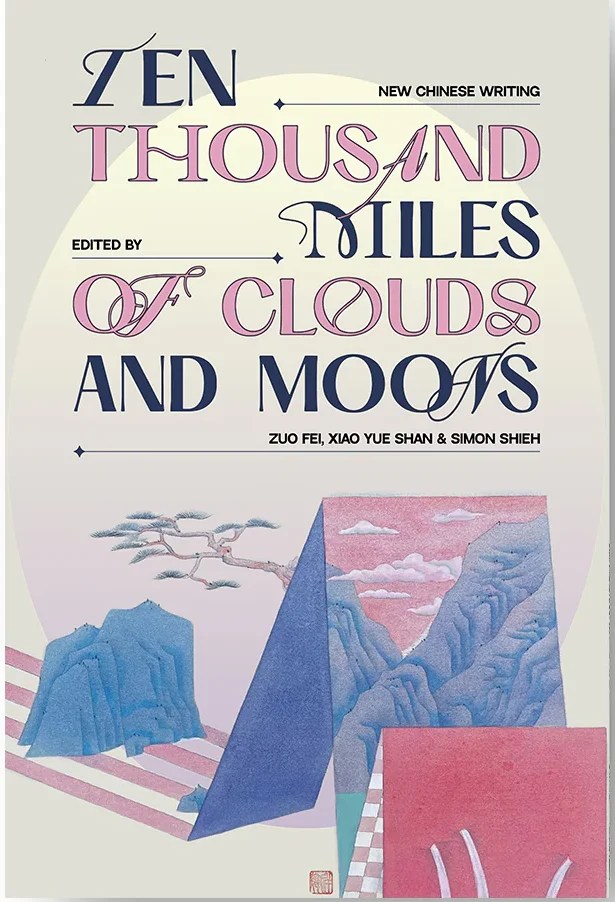
To go where the language goes: Ten Thousand Miles of Clouds and Moons – New Chinese Writing, edited by Zuo Fei, Xiao Yue Shan and Simon Shieh

Grey cloud grasping light,
unrolling the softness of another world
towards the wobbling plane wing; its folds ripple,
someone has scattered seeds in each furrow.

Who’s thinking, underneath the clouds,
how hard it is to restore the life of a flower,
when rain never coincides with favorable winds.

But we have a shred of light.
Today, passing through a mid-gate
as if remembering.

(from “Introspection on a Cloud” by Du Lulu, translated by Dave Haysom)

What exactly does it mean to enter into another world, to open oneself to a landscape at once familiar and strange? That is, one might suggest, one of the functions of literature. But if the map that grants access to that other world with its many artistic and cultural riches is in another language, translation is the key. For the editors of Ten Thousand Miles of Clouds and Moons, a collaboration between Beijing-based Spittoon Literary Magazine, a dual-language journal of contemporary Chinese literature, and Honford Star, the guiding inspiration for this first anthology project is, in keeping with that of the magazine, to seek out and bring into English translation, some of the most original, exquisite, and daring voices—new and established—contributing to the present literary landscape in China.
The introduction lays out the vision that guided their selection of pieces

The work had to be excellent; the writer had to have a point of view that is under-explored in the Anglosphere; there had to be a balance of genders; and the language had to be so special that it has the potential to torture translators. This final aspect came only from our love for the Chinese language—which, like all languages, has a singular soul, a force drawn from its age and its malleability throughout time. The more a writer is able to tap into that soul, the more difficult the piece would inevitably be to translate.

Thus sixteen contributors—eight writers of fiction, six poets, and two essayists—were paired with eighteen translators, to offer readers a journey that covers a wide literary terrain. You will find yourself in a world with a long rich cultural history and traditions, and you will find stories that depict a modern society that Western, English language readers will instantly recognize, with influences drawn from an international well of literary sources. You will find work that pays homage to the China’s past and tales that turn on distinctly futuristic, apocalyptic visions. And surreal, experimental tones alongside traditional Chinese poetic form.

The opening story in the compilation sets the mood perfectly. A piece of dystopian science fiction that  revolves around the fate of the 18th century work considered the greatest of all Chinese novels, “Mass in Dream of the Red Chamber” by Chen Chuncheng (translated by Xiao Yue Shan) is set in the far future—the 4800s—at a time when this great work of literature is not only lost, but any effort to retrieve its contents or storyline are strictly forbidden. There is, at this time, a belief that the text was completed at the peak of the universe’s development, and that all had begun to decline and dissipate since that time. The narrative follows the recorded account of a prisoner, a man born in 1982, who fell into a deep coma for several thousand years, only to miraculously awake and find himself as a specimen in a museum exhibit. He becomes a kind of missing link to the lost masterpiece for a clandestine organization desperate to recreate, as much as possible, the original; its preservation being essential to the continued existence of the universe itself. But that also makes him, and those who come to hear him access his memories of the text, the target of murderous government forces. It is a wonderful meeting of the glory of past achievements and the horrors of a post-apocalyptic totalitarian future, connected with an out-of-time protagonist’s personal recollections of life in the 1990s and 2000s.

The settings of the tales that follow vary, from a contemporary urban environment where bored youth hang out and make trouble, to the account of family history, to a mystical encounter on a mountainside. The energy shifts from story to story, often turning to the unexpected, cracking the fragile veneer of reality. Particularly delightful is the excerpt from Lu Yuan’s novella The Large Moon and Other Affairs (translated by Ana Padilla Fornieles), a piece of weird fiction that reflects, perhaps, in its magical strangeness, the influence of Bruno Schulz whose work the author has translated. As the moon, being pulled toward the earth, grows larger and larger in the sky, the eccentric Mr. Lu struggles with insomnia and troubled dreams. One night, having taken a concoction to aid his sleep, he finds himself carried off on a nocturnal adventure through the skies:

Mr. Lu rose from the valley of dreams and rowed out the window, picturing himself an unthinking mycoplankton or a sea cow, heading back to the Amazon River Delta. Riding upon the clouds and the wind with neither a northeastern wife nor a Vietnamese mistress at his side, the invoices seeking his death yet to arrive, and the murderous plots working their shapeless, invisible night shifts had been temporarily put on hold. There were no cold, mechanical alarms, no greasy company breakfasts, and definitely no covetous relatives, neighbours, acquaintances, or colleagues. The naked Mr. Lu, wearing only a heavy pair of  plastic slippers, flew over the sparse suburban streetlights, bounding towards the corridors of stars spiraling in a snail-shell pattern along the horizon’s towers. A thin sheet of air gently caressed his bulging beer belly, and the city was as far away as a firefly, succumbing to the hallucinatory bird’s eye view of inebriated men.

The two nonfiction pieces add a welcome new dimension to the collection. Hei Tao’s “Three Essays” (translated by Simon Shieh and Irene Chen) paint delicate portraits of southern China, and a lifestyle that is gradually disappearing, while Mao Jian’s “No One Sees the Grasses Growing” is a relatable, and humorous, memoir of her years as a student at East China Normal University in Shanghai in the 1980s and 90s. She recalls a time when students paid less attention to their studies than might have been wise. They were young and in love with a certain literary coolness. Her first degree was in Foreign Languages, but she found it hard to resist the allure of another course of study:

The truth is, in the eighties, it was impossible to resist the passions of the Chinese Department. The notice boards were plastered with adverts promoting literary lectures, and all sorts of clubs and societies adopted the grandiose affectations of belles-lettres, prancing about the center of campus. If someone were to ask you about going corporate after graduation, you’d have to self-reflect on the unrefined impression you must have been giving off. Those years were the golden age of Casanovas, who made names for themselves by proclaiming their undying love for poetry, and any girl who could be moved by Rilke would inevitably enter into a spontaneous fling with one of these campus poets.

It was an era of living away from home, first trips to KFC, young love, and inspiring and unconventional professors. But looking back decades later, now a professor herself at the same institution, she realizes that that time is past, in so many different ways.

Spread out among the prose pieces, are the contributions of the poets, three poems each. This arrangement works very well, offering a change of pace and granting each poet the space to have their unique voice heard. As with the fiction and nonfiction, there is both variety and, of course, precise, evocative imagery that is at once modern, yet with an echo of the long-standing traditions of Chinese verse.

Anthologies can be uneven projects, but this selection of new Chinese writing is strong, varied, and continually fresh and surprising from beginning to end. The contributors range in age, with the youngest in his mid-twenties, the oldest in his mid-sixties. Their work is consistently fresh and vibrant, and the translators all appear to have produced results that feel effortless. It should also be noted that this volume is beautifully presented, with a simple, yet elegant design. This is an endlessly engaging collection for anyone with an interest in contemporary Chinese literature, especially if you are seeking work that challenges expectations.

Ten Thousand Miles of Clouds and Moons: New Chinese Writing is edited by Zuo Fei, Xiao Yue Shan and Simon Shieh, and published by Spittoon Literary Magazine in collaboration with Honford Star

A compilation of shadows: Ninth Building by Zou Jingzhi

From childhood till now, I’ve spoken many bold words. Publicly or in private, I’ve proclaimed the kind of person I wanted to be, though it never happened in the end. I feel like someone has somehow taken my place, leaving me to become the person I am now.

When I’m around too many people, I lose myself. In an unfamiliar city, among crowds of strangers, I keep having to stand still—not to ask directions, but to find myself. Even when I’ve done that, I’m still lonely, so I head back to my hotel and listen to the sound of rain.

These lines, drawn from the melancholy and poetic Introduction to Ninth Building by acclaimed Chinese writer, poet and playwright Zou Jingzhi, speak to a fragmented sense of self, a “compilation of shadows,” that has long accompanied him, appearing unbidden on the street or haunting quiet nights. This book, originally published in Chinese in 2010 and now available in Jeremy Tiang’s excellent English translation, is an attempt to give these shadows some of the depth, context and meaning distorted by the experience of growing up during the years of the Cultural Revolution. As Jingzhi says in an interview on the site of the 2023 International Booker Prize for which his book has been nominated:

 In the early 1990s, my childhood felt like it had been a gust of wind behind the trees. I used to spend my days being lost: What should I write? Whatever I wrote was wrong. It was impossible to get rid of my childhood back then. So I just wrote like that. I wrote for myself. I wrote to let go of my childhood.

Ninth Building is a cohesive work with a common narrator, but it is presented as a series of vignettes or very short stories, set between 1966 and 1977, arranged in a roughly but not strictly chronological order. Time, in its experiencing and remembering, has a somewhat fractured quality. After all, the Cultural Revolution was an unnatural period of disruption and upheaval and, as Jingzhi’s stories so clearly demonstrate, many hours of unstructured tedium. The first section “Ninth Building,” takes its name from the housing complex in Beijing where Zou is living with his family when the Revolution begins. He is about thirteen or fourteen at the time. The first story “Eight Days” is a diary format tale set in November 1966 that describes the eagerness and concern with which a group of boys set out to obtain Red Guard armbands. It is not clear that they understand just what they signify, only that they don’t want to be seen without one. Many of the pieces in this part demonstrate the haphazard way that the adolescents try to make sense the objectives of this movement sweeping the country, rejoicing in the death or humiliation of old women labelled part of the “landlord class,” unaware that many of their own families would soon be suspect. Yet amid the increasing levels of violence among their classmates and peers, there is a lot of idle time to be filled with a variety of friends and neighbours. Boredom had company.

There is a lot of humour in the first part of Ninth Building, some of it rather black, even disturbing, but much also reliant on the innocence of the protagonist and his young buddies (it is the 1960s after all). A wonderful early vignette (“Capturing the Spoon”) describes a night patrol during which the intrepid and enthusiastic guards observe, through a lighted window, a naked couple thrashing around in a bed. Alarmed, they rush to report this obvious, if strange, infraction, but the grown-ups from their compound’s “Attack with Words, Defend with Force” Unit are unmoved by this important information:

Nothing came of our waiting. We’d imagined they’d jump up immediately to stop whatever incorrect action was taking place. This was at the height of the Revolution, and the train we were on had switched to another track. What we’d seem didn’t fit the scenery on this route; red armbands and nakedness didn’t go together. The five of us had three flashlights between us, and for more than half a month now we’d stayed awake night after night, fully alert, wishing something would actually happen. Now something had, but the adults didn’t feel about it the same way we did.

The second and slightly longer part of Ninth Building, “Grains of Sand in the Wind,” opens in 1969 when is Zou sixteen and sent to the Great Northern Waste for “re-education through poverty.” He is one of the millions of “educated youth” sent to work in rural areas and learn from the peasant population. He will not return to the city until after the Revolution comes to an end in 1976. These are years filled with long days of back-breaking labour under harsh conditions, yet no more immune to extended periods of boredom than he knew in Beijing. But here the distractions, apart from the required performances of patriotic operas, were limited to gambling, drinking and practical jokes. Innocence is gone; the underlying tone is now one of resignation. Zou and his peers have come of age in a time when their lives and dreams of the future are suspended:

Youth is a concept whose meaning isn’t easy to grasp. You might as well try to wrap your mind around every era, every event. The word doesn’t really evoke any special memories for me. Perhaps I’ll have to wait till the age when every other sentence begins with “back then” before I truly understand it.

The vignettes set against the vast rural landscape are harsher, with more tragic elements. They are not devoid of humour or eccentric characters, but illness, injury and death feature regularly. Life is cheap. However, poetry and increasingly astute observations are woven into Jingzhi’s anecdotes and tales. As his narrator matures and grows more cynical, he also begins to recognize the seeds of his future as a writer that have been sown during these long years.

The Cultural Revolution was a period of great turmoil during which the power of radicalized youth was harnessed against the Communist Party hierarchy, but as illustrated by Ninth Building, the impact on many young people during this time was marked not by heroism or the glory of conflict, but by years of boredom, dislocation and numbly tedious labour. With its brisk pace and refusal to succumb to despair in spite of the countless temptations, this collection of brief vignettes makes for an entertaining and powerful read.

Ninth Building by Zou Jingzhi is translated from the Chinese by Jeremy Tiang and published by Open Letter in North America and Honford Star in the UK.

An island to hold in the palm of your hand: Purple Perilla by Can Xue

Imagine. Islands of words, small self-contained worlds of ideas, stories, exploration. Points of reference in a sea that is increasingly uneasy, uncertain to navigate. This is the vision of isolarii, a project designed to revive the notion of “island books”—collections of literature and art united on a singular idea and bound into a single volume—that first appeared during the Renaissance, but was lost as other literary forms began to take precedence. Now, under a bimonthly subscription model, the tradition has been reborn in miniature.

Purple Perilla by Chinese experimental writer Can Xue is the third offering in this series. Beautifully presented, complete with a translucent dust jacket, this tiny book is about the size of a deck of cards and contains, in just under 150 pages, three delightful short stories: “An Affair,” “Mountain Ants,” and “Purple Perilla.” Xue offers these tales, which move from an urban to a wild setting, as a lyrical reaction to our contemporary condition. Her trademark measure of unreality permeates each piece.

For those unfamiliar with her work, Can Xue is a very idiosyncratic writer. She allows her fiction to spill forth in what will be its finished state—she writes, one hour a day, without rereading or edits. As a result, her stories and novels have a wandering quality, with a real, yet unreal atmosphere. Much like a dream. The best way to approach such work is to read as Xue writes, one word at a time. This is against an attentive reader’s natural instincts, but looking for patterns and clues will not help. However, this is not to say there is no form, no direction, no meaning—only that one is forced to be patient, to listen and see where the story takes you, not worrying if it seems to tumble along freely at times. Reader and author are essentially on a journey together. As Can Xue says:

Reading my fiction requires a certain creativity. This particular way of reading has to be more than just gazing at the accepted meanings of the text on a literal level, because you are reading messages sent out by the soul, and your reading is awakening your soul into communication with the author’s.

“An Affair” tells the story of Fay, a thirty-six year old teacher, living in a city, who receives a most unusual love letter from a man who claims he has seen her on the bus. He neither reveals his name nor provides a return address, admitting he does not expect she would want to write back. This odd, enigmatic correspondence haunts Fay, leading her to wonder what kind of hold this mysterious man has on her imagination. Eventually she sets out to find him, or find out more about him, by travelling to the far end of the city where he told her he works at a cigarette factory. What she discovers on her strange, convoluted mission seems to tell her more about herself than any mysterious suitor.

The second tale, “Mountain Ants,” is set in a small city surrounded by mountains. Lin Mai lives with his parents in a mansion which is oddly isolated despite being surrounded by buildings. Visitors are rare. The boy spends much of his free time interacting with a large nest of ants in his yard. One day an old man appears at his gate. He tells Lin Mai that he lives in the mountains and has followed the ants to his home. This man, who is called Grandpa Wu, shares some knowledge about the ants and promises that one day he will take Lin Mai up a mountain. As this magical story unfolds, Lin Mai learns some curious information about his parents, the beggar known as Grandpa Wu, and the importance of tending to his own and several other mountain ant colonies in the city.

The final story “Purple Perilla,” the most dreamlike and magical of the three, ultimately carries the narrator into the wilderness, where a friend and his grandma have gone to live among the wolves. To young Chickadee this friend, a boy he has long admired, has uncanny qualities:

Unwittingly, I followed Nigu. He was so profound that he wasn’t like a child, but like … what was he like?

“I’m my grandfather’s grandfather.” Nigu turned around and spoke to me. I was stunned—he actually knew what I was thinking!

“I’m really like my grandfather’s grandfather. I think I am. Chickadee, don’t be afraid of me; I won’t hurt anyone…”

Read as a cycle, these short stories walk headfirst into the unknown. Here, questions are transformative in themselves—it’s less a matter of securing answers than of finding comfort in mystery. Bound together in this portable format, they offer a direct engagement with the magic and vision of one of China’s most inventive writers.

Each volume in the isolarii series is accompanied by several forewords. Presently, Scholastique Mukasonga’s prose riffing in response to a sentence or two from each of Can Xue’s stories is available online. It can be found here. Reading this small volume is a uniquely pleasurable experience. And, it’s worth noting that although the book is small in size, the font is not nor do the stories feel compressed or compromised in any way. It has been a while since I last wandered in Can Xue’s world and my first encounter with her short fiction, but I am now keen to return, before long, to her dreamscapes in a longer work or collection.

Purple Perilla by Can Xue is translated by Karen Gernant and Chen Zeping. It is the third volume in the isolarii series published by Common Era Inc.

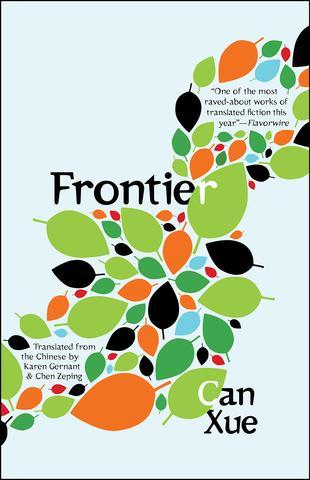
Initial thoughts on Can Xue and a link to my review of Frontier at Numéro Cinq

In the month or so since I wrote the following review, I have been thinking about Can Xue, about what it is that sets her work apart—that makes it so difficult and so addictive. There is nothing intrinsically complex about her language. Her characters are intriguing, interesting. But one can easily feel unmoored within the scope of her imagination. Borders shift; the signposts we look for as readers are missing or misleading.

But once one accepts this condition, the possibilities are endless and exciting.

After reading Can Xue, I went on to read João Gilberto Noll and Michel Leiris. In the light of this subsequent reading there is more I would like to explore with respect to the dream-like narrative/anti-narrative, but that will have to wait until after my next Numéro Cinq review.

In the meantime, here’s a taste of my review of Can Xue’s Frontier, please click through the link at the end to read the rest. A second link leads to an excerpt:

Life In a Northern Town | Review of Frontier by Can Xue — Joseph Schreiber

It can be said that Chinese experimental writer, Can Xue, inhabits a strange and elusive territory in contemporary literature. With an idiosyncratic approach to writing, she has created an impressive body of work that effectively explores a geography of the spirit—mapping, if you like, the space where the real and the surreal, the personal and the political, and the magical and the mundane meet. Her 2008 novel Frontier, newly released from Open Letter Books in a crystal clear translation by Karen Gernant and Chen Zeping, has been eagerly anticipated by her admirers. Yet, for intrigued newcomers, it may well offer an excellent introduction the dazzling, and baffling, world of Can Xue.

Born in 1953, in Changsha City, Hunan Province, South China; Can Xue is the pseudonym of Deng Xiaohua, who took her intentionally gender-neutral penname from a Chinese expression that refers to both the dirty snow that refuses to melt and the pure snow remaining at the top of a high mountain. This inherent duality is very fitting. In the years leading up to the Cultural Revolution, both of her parents came under suspicion for their journalistic activities and were sentenced to hard labour. Consequently, their daughter was unable to continue her education beyond elementary school. Despite the brutal hardships her family experienced and her own ill health, Can Xue showed great resilience. With her schooling cut short, she turned to reading. Largely self-taught, she read fiction, poetry, and discovered the joys of classical Western and Russian literature, eventually going on to study and read in English. At the same time, she married, started a family, and worked as a tailor before publishing her first work in the mid-1980s.

Continue reading here:

Read an excerpt here: