The boundary between the psychiatric ward and the real world: Hospital by Sanya Rushdi

But why have we turned to the right? That’s where the psychiatric ward is. Of course, there must be examples in history of those who, in an effort to protect their non-mainstream alternative thinking, pretended to be who they were not in order to shield themselves from politics. This may be a similar arrangement. Even as I’m wondering about this, a wheelchair emerges from somewhere and I am told to sit in it. I refuse, saying I’d rather walk. They say if I don’t sit in it on my own, they will make me. So I sit.

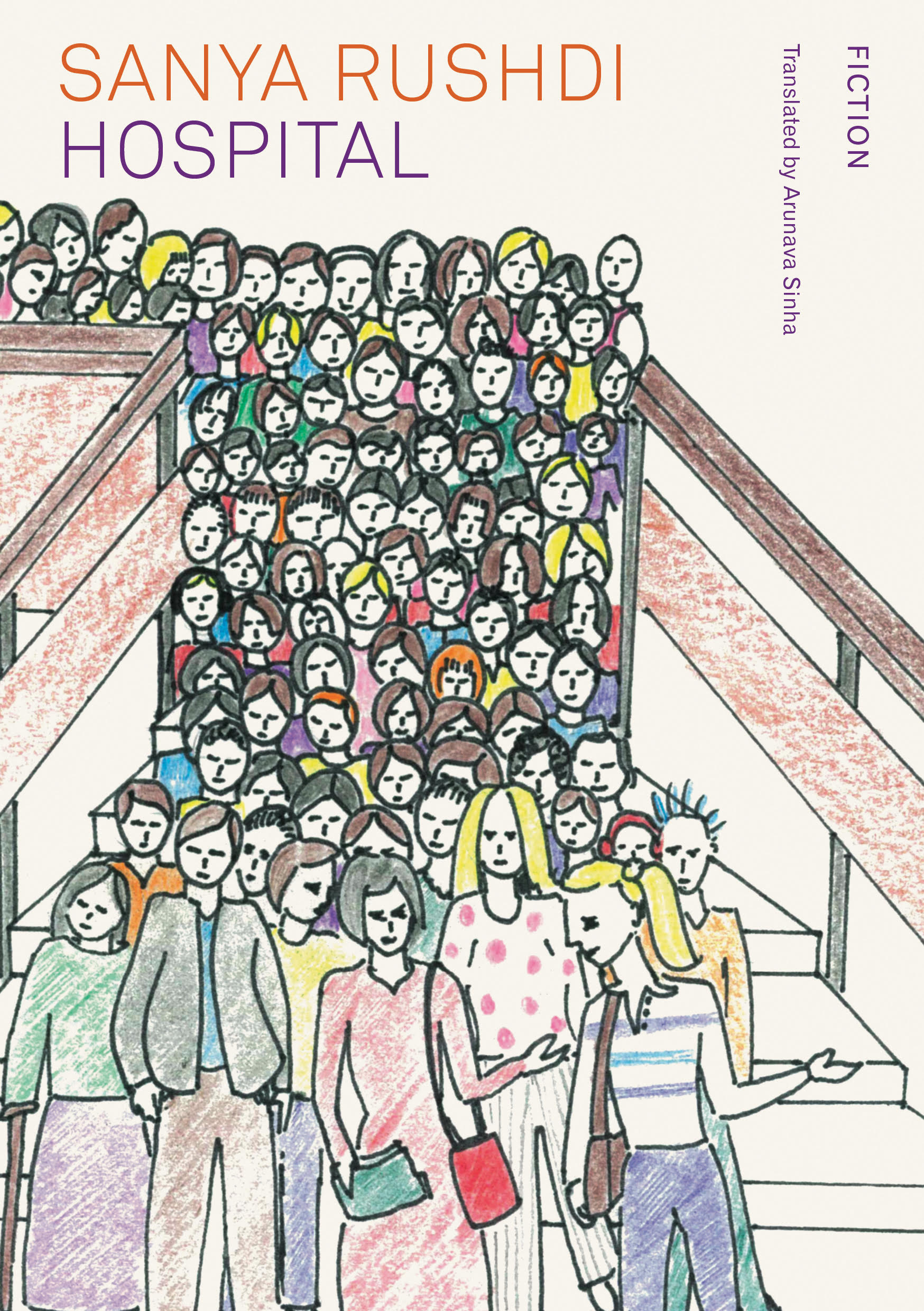
Books and movies about mental illness and psychiatric wards frequently play to either the horror or mystique of madness, while language related to psychiatric conditions—bipolar, psychotic, schizophrenic—is often applied carelessly to describe a range of circumstances that have nothing to do with actual diagnoses. Around the world, the stigma of mental illness is difficult to shake. A heart attack will bring friends and family to your hospital bedside; a serious breakdown can leave you isolated and alone, at home or if you are sick enough, confined to a psychiatric unit. From the outside, a worse fate cannot be imagined but, in reality, once the shock of finding oneself hospitalized subsides, the world behind the locked doors tends to contain a community, at once strange and familiar, within which one can recover. Days pass with a certain routine that gradually returns structure to a life that has been temporarily, or periodically, upended, distorted, weighed down or wired up. Hospital, by Bangladeshi-Australian author Sanya Rushdi, takes you into that environment as seen through the eyes of a patient experiencing psychosis.

Based on real-life events, this debut novel is set in Melbourne, originally written in Bangla and translated by Arunava Sinha. Rushdi’s protagonist, is, like the author, a Muslim woman named Sanya. Years earlier, psychosis interrupted her PhD studies in Psychology. Now, with her third episode pointing to a diagnosis of schizophrenia, she finds herself at odds with her family, a community mental health team, and everyone who seems to be conspiring to force her to comply with the medical model of treatment that she distrusts. She acknowledges her past psychosis, but is unable understand that the curious coincidences, obsessive behaviour, and lurking paranoia might signal that she is sick again. That is the cruel nature of serious mental illness—what one experiences from the inside is increasingly at odds with what others observe from the outside. As her psychosis progresses, the world is simultaneously terrifying and brilliant, but Sanya resists all efforts to encourage her to access care willingly, so ultimately she arrives at the hospital under police escort.

Sanya’s narrative is restrained and oddly lacking in affect, even when she describes her tears and outbursts. She is continually trying to observe herself and logically reason her way through whatever arises. However, her reasoning is often disjointed and confused. She is constantly seeking symbols of significance, spends a lot of time trying to figure out the secrets behind the thoughts and actions of others, questions why certain song lyrics keep coming to mind, and fitfully attempts to draw strength from her faith. Rushdi’s ability to present this state of fractured association and allow her protagonist’s processing to slowly become more coherent as the story progresses is very impressive. Madness has a logic of its own as anyone who has experienced depression, mania or psychosis knows well.
Rushdi captures this shifting state of awareness by combining Sanya’s internal monologue, readings, and diary entries with the use of a dramatic format to capture external dialogue. This allows a record of what is said apart from what Sanya hears or wants to hear. It is also especially effective for reflecting the banter between the residents on the ward. On her first day in the hospital, one of the patients, an older man that Sanya describes as “so handsome,” exposes himself to her as she passes his room. Her self-appointed tour guides try to explain:

Michael: Please don’t be upset. He does these crazy things, but he has a beautiful heart. Give him a day or two and you’ll see what a lovely person he is.

Me: I’ve seen it already.

Glen and Michael laugh.

Glen: Yes, many of the girls are crazy about him.

Me: They need a reason to be here, after all.

Glen and Michael laugh again.

Initially, most of the men Sanya meets seem exceptionally attractive to her—a charged energy between the sexes is not uncommon on the unit. She becomes obsessed with a few of the male patients during her early weeks in the hospital, while other women barely register unless she senses that there might be something between one of them and a man she fancies. At such moments, jealous and conspiratorial thoughts immediately engulf her. At one point, when a doctor suggests she seems to be spending too much time following the male patients around, she becomes defensive. She will leave that session with another drug, lithium, added to her regime as a mood stabilizer and eventually these persistent passions will start to subside.

With her education in psychology and her prior experience with psychosis, Sanya feels she is in a good position to determine whether or not she is sick this time. She blames her family for sending her to the hospital and is resistant to drugs.  She argues that a particular type of language-focused talk therapy would be preferable, but, if she wants to be released, she knows that medication is part of the game. Convinced of the value of language, she pours her thoughts into her diary, filling pages with arguments that are, at the height of her psychosis, bound by incoherent and tenuous  connections. Reasoning and recognition are slow to return.

I read this book very slowly, although it is neither long nor difficult. But as someone who has been hospitalized for manic psychosis, I was impressed and sometimes shaken by Rushdi’s ability to draw on her own experience to craft such an uncanny portrait of psychosis from the inside. Her protagonist appears very logical and rational, and within her own inner construct she is, but from the outside, it is clear to her family and the medical personnel that she is unaware or unwilling to believe that she is ill. She lacks insight. It is almost like being separated from the rest of the world by a one way mirror. On her side, are her fellow patients who form among themselves a community, an island.  She remains convinced that language is the answer to her survival and recovery. And perhaps she has a point there, as Rushdi has demonstrated through her own use of language to create a work that is masterful, moving and tightly controlled.

Hospital by Sanya Rushdi is translated from the Bangla by Aruava Sinha and published by Seagull Books. In Australia, Hospital is published by Giramondo.


The memory remains: My Kind of Girl by Buddhadeva Bose

Sometimes, the simplest premise is all you need. Like this one. The setting is Tundla Station near Agra in north India on a frigid December night. In the first-class waiting room four middle-aged men sit, bundled up in their winter coats, as long, bitterly cold hours stretch before them. A derailment on the rail line ahead has forced this unanticipated stopover and now all they can do is wait. This is the unfortunate predicament that sets the stage for a warm-hearted take on the Decameron in Bengali writer Buddhadeva Bose’s 1951 novel My Kind of Girl.

 The four delayed travellers include an exceptionally large-framed contractor leisurely making his way back from a business trip, an established bureaucrat from Delhi with an urgent and important schedule to hold to, a well-known doctor from Calcutta on his way home from a conference and a man on holiday who described himself as writer, if, the others might have wondered, writing could even be considered a profession. As they prepare themselves for an unwelcome and uncomfortable sojourn, the doors to the room slide open, briefly revealing a young man and woman, clearly newlyweds, looking for a private place to settle. This moment changes everything:

That couple, who had only given them a glimpse of themselves at the door before disappearing, had left something behind; it was as though the bird of youth had shed a few feathers as it flew by: some sign, some warmth, some pleasure, some sorrow or tremor that refused to dissipate, something with which these four individuals – even if they did not speak, if they only thought about it silently – would be able to survive this terrible night.

First love—that joy, so fleeting, but never forgotten. As if they have been awakened to memories long assigned to the past, the men decide to pass the time by sharing, in turn, stories of their own first loves. As each man slips into his own youthful reminisces, the story he offers emerges with a distinct setting, character and voice. The contractor goes first, refusing to own the account he shares, saying it is only one that he heard of, but the young man he describes as burly and powerful, but admittedly a little thick-witted, seems to be only a faint effort to camouflage himself. Perhaps the sadness is hard to acknowledge; it is the tale of a family that builds a successful manufacturing empire right through the worst of the Japanese attacks on Calcutta during the war and the enterprising son whose mother is endlessly obsessed with securing for him the hand of the daughter of the neighbouring professor, all for envy of their library no less. But money, it turns out, cannot buy everything.

The Delhi bureaucrat’s story carries him back to his adolescence in rural Bengal and his first intimations of love, barely spoken, with Pakhi, a girl he secretly adored. Over the years, as life leads them both in different directions, to different cities, they chance to meet from time to time, and her actions lead him to wonder if she might have once cared for him in return. His tale asks if the embers of love can still burn even if busy lives, marriages and families separate the two people who may have shared that early spark. He thinks back to a night long ago when they had walked home from town together, ahead of their families. Pakhi says:

“I was thinking – I was thinking, this walk is lovely, but it’s because we’re walking on it that the road will end.”

Back then, I found this funny. But now it seems that fourteen-year-old girl had, without knowing it, spoken wisely. Our existence is like that: living eats into our life, all the roads we walk end because we take them.

The doctor, when his turn comes, takes the subject in yet another direction. He promises a happy story, one in which his first love becomes his wife, but the route by which that end is reached is a strange and convoluted one. Suffice to say, when he meets the woman he will eventually marry, her focus is on someone else altogether. Finally, the writer, almost reluctantly, takes over. His poetic, tragic tale is one in which he and his two best friends are all completely besotted with the same girl, collaborating with and competing against one another to win her favour in sickness and health.

This gentle, affecting novel is a thoroughly entertaining read, always feeling fresh as it moves from speaker to speaker. Each man reaches deep into his own memories to share youthful passions and vulnerabilities that, by the light of day and in any other circumstances, would have remained half-buried in the mists of time. Everyone marvels at how their emotions have been stirred in this unexpected interlude—until daybreak returns each traveller to the road he was on the day before.

Buddhadeva Bose (1908–1974) was one of the most accomplished and versatile Bengali writers of the twentieth century. He was also celebrated for translating Baudelaire, Hölderlin and Rilke into Bengali. My Kind of Girl by Buddhadeva Bose is translated from the Bengali by Arunava Sinha and published by Archipelago Books.

“All the world is made of poetry”: Things That Happened and Other Poems by Bhaskar Chakrabarti

Each of us is a bird of disbelief
Flapping our wings beneath the tired water
We shall be born, we shall be born, a new life
Tomorrow or the day after—maybe even this evening

—“The Window”

An important voice in the rise of modern Bengali poetry, Bhaskar Chakrabarti was so intimately bound to the streets, alleys, and rooms of Baranagar in northern Calcutta that he was, until recently, little known beyond West Bengal. Born in 1945, his life spanned an era of tremendous turmoil and change in India and in his native state, yet his poetry touches universals of experience that transcend time and place. To spend time with his verse is to feel that one is in the company of the man himself, in the urban spaces he inhabited.

Things That Happen and Other Poems is the first cross-career selection of his poetry to be published in English. Translated by Arunava Sinha and published by Seagull Books, this volume offers the world an opportunity to become acquainted with this profound, melancholic poet. The recent inclusion of this title on the poetry longlist of the 2018 Best Translated Book Award will hopefully draw even more to discover his work.

Chakrabarti came to prominence in the late 1960s and 70s. It must have been, for him, a time of creative energy and excitement, as his nostalgia for these years, for lost friends and loves, resurfaces frequently in his later poems. However, it was also a period of political and economic upheaval. His earlier poetry often expresses a dramatic, angst-ridden intensity:

Night after night, for countless years, I’ve wanted to slice myself
open for self-examination
I have swallowed alcohol with ashes in it
I have gone up to fallen women to tell them, ‘I love you.’
Not all of this was a game.
My blood and sweat are mingled with black and white days,
brothers mine
I have forgotten nothing, none of it
The blows and the humiliation and the tears
Look—it’s so late tonight as well—still I cannot sleep.

—from “Brothers Mine (1/107)”

In his later poems a certain concern about the state of the world continue to re-emerge, in the form of anxieties about the what he observes in his community, and on the planet. His verse tackles the transformations of modern life, ventures into outer space, and frets within the confines of his room. But in general, as he struggles with his health following a cancer diagnosis, death becomes an ever more present companion, one he seems to entertain as much as he wishes it away and admonishes his audience to live well.

Cut off this thing that has bothered you all your life.

You are alive because of one simple reason, that you’re inhaling and exhaling. Keep this task up.

—from “Come, Let’s Talk of Some Things”

Along with this sense of mortality, a deep, abiding loneliness settles into his words, trails his footsteps, becomes the heart of his careworn song. The predominant mood of these poems is quiet, sad.

The one thing that is clearly evident  in all of Chakrabarti’s poetry is that he was a poet through to the very core of his being. It is the essence of his life’s work, all he ever wanted to do and he talks about his art with eloquence and passion. As he declares in the essay that opens this collection:

All the world is made of poetry. On some days the doors and windows within are flung open. All that I see and hear, all that I get a sudden smell of, turns to something new in a moment. My body feels light. I have had glimpses of the astonishing world of poetry, and I have been astounded every time. So many wilting conversations, fragrances, glances and dreams are happily tacked up on its walls.

How wonderful! He goes on to admit that his love of poetry never abandoned him, even if it did interfere with his ability to worry too much about employment or a steady job, likely to the dismay of some of those around him. And although he came of age in a time of upheaval, he is content to be a poet of the small, the simple, and the everyday. “I am a poetryist.” he writes, “I love ordinariness. Rejected, pedestrian conversations and scenes, days and nights left behind are all things that move me.”

True to this poetic spirit, many of his poems address the act of writing. He writes into silence and frustration with persistence:

I stay here in Baranagar, in Calcutta
Everyone here wants their fortune read
They want to know what life holds for them
They want to know when they’ll come into money

And I, an ancient ghost
Keep struggling with imagery, symbol and resonance
To hell with day before yesterday’s poems
All women with large breasts are better than them

Conjuring up thoughts about Panskura is better
Even writing four or five ordinary lines
About tender blades of grass is better

—from “Panskura”

Chakrabarti’s poetry is, on first encounter, simple. Calm, measured, pensive. His work is personal, mentioning places, addressing people directly, while speaking to emotions—attraction, loss, and loneliness—in tones that are intimate and human. But his poems invite the reader to fall into them, again and again. To read the verses aloud. And here is the junction where the magic of the translation comes into play. Without knowing the original language, vision and meaning must be trusted, but in listening to Chakrabarti reading from his work in Bengali, the cadences of his speech are clearly echoed in the way this poetry sounds and feels in the English.

And that is a remarkable achievement, and an endorsement for this evocative collection, this celebration of Calcutta in its uniqueness and its universality.