
As for me, I didn’t exist until I was six months old, because up to then no one wanted to be bothered with such a case. Just my luck, I was not an official being, since there was no trace in the records of my coming into the world. Born by the side of the road like a natural disaster incarnate, I had not known the holy oil of baptism, and no one thought to scrawl my name on a government document or anything resembling it, nor even to take an ink print of my tiny foot for a hospital data sheet, even if it was as cute as a tiny goblet. In short, no one dared to believe in me even if I was born bottoms up, like everyone else.
Such is the misfortune of Hugues, abandoned in a shopping cart in a bog of bulrushes by the side of the road, only to be rescued and adopted by Céline Francoeur and her new husband Claude, granting them an instant family, or as he describes it, “they could have all of that indescribable joy, minus nausea or miscarriages, as long as no one went to claim me from the lost property counter.” Despite his unfamiliar appearance, his crossed, slightly almond-shaped eyes, it is not until he overhears his “adaptive” parents arguing over whether he should be told the truth, that the reality of Hugues’ origin story becomes known to him, forever shifting his perspective. Céline and Claude become his semi-parents, his brother and sister his semi-siblings, and his entire existence, in his heart, is rendered incomplete.
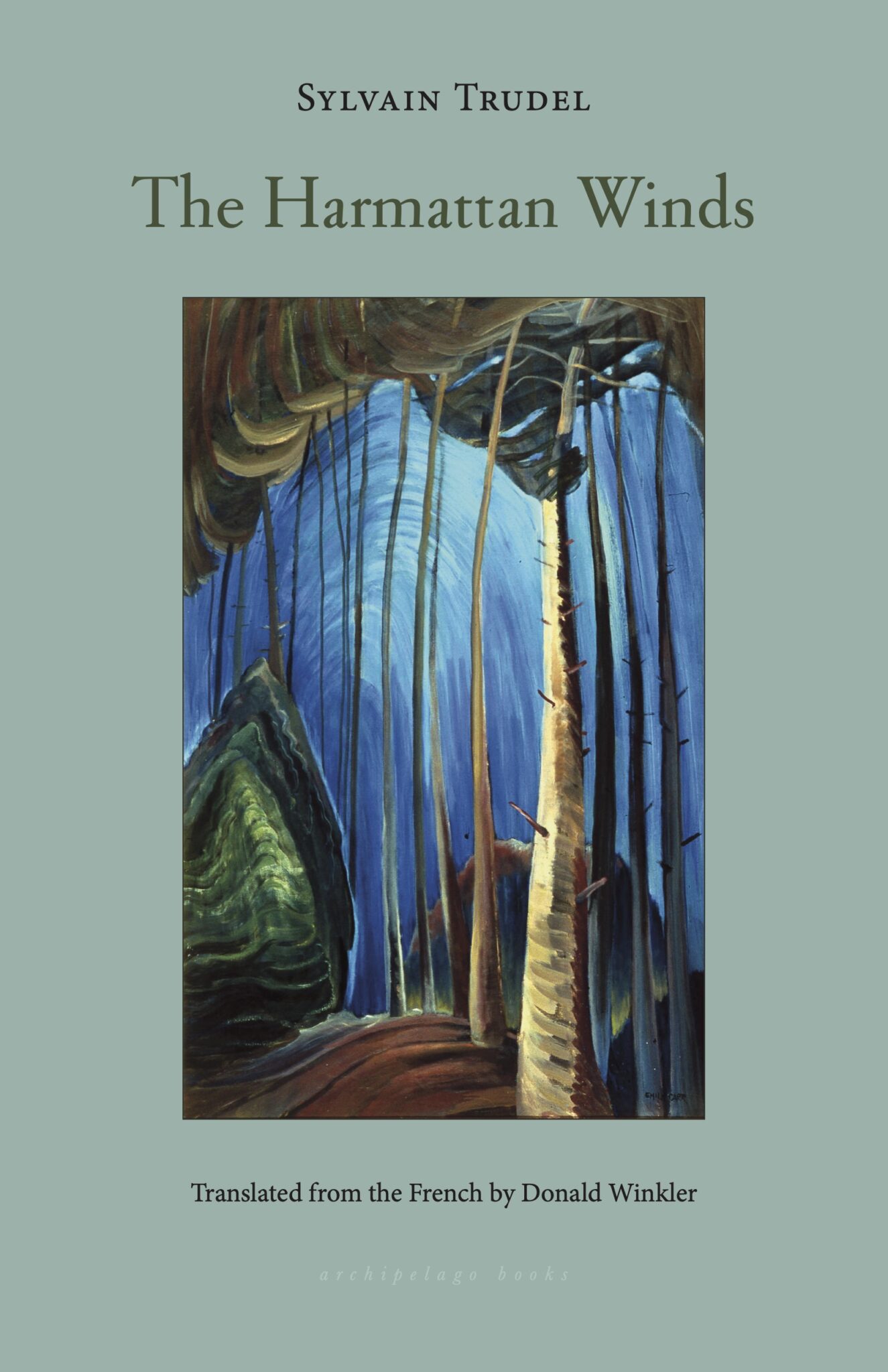 The Harmattan Winds, by French-Canadian writer Sylvain Trudel, originally published in French in 1986, is the dramatic, youthful account of a boy who does not know where he really comes from. However, there are two unlikely companions who give meaning and purpose to what might have otherwise been a lonely life in an isolated town in 1970s Quebec. One is a well-worn collection of poetry by the fictional Gustave Désuet, a flea market find that Hugues carries with him everywhere, reading from it like a guidebook, memorizing the florid and overwrought verses which he admits he doesn’t always understand. He turns to it for comfort and enlightenment—and one also suspects much of his exuberant sense of drama, tragedy and romance are inspired by the poet’s example, even if his misunderstandings and misspelling lend his often enigmatic narrative an internal logic entirely its own. Hugues believes that Désuet, long dead by his own hand (and a rope), helped him to live his life.
He was sort of a paper tiger who one day took up his pen as you would arm to do evil, and poison dripped from his nib. A real viper, that tiger. He said that we, the rich of America and Europe, we’re living in the Accident, curled up in our accidental countries, and the Bible’s Apocalypse is a great idiocy because it has already begun and no one sees it, it’s ongoing right under our eyes that choose to run and hide behind their lids, but it’s there, and, in fact it’s us, yes, the Apocalypse, it’s ourselves, we are the cataclysm of the poor, seeing that we kill them with one hand hidden behind our backs in the convenient darkness of our heads, so as to stay rich at their expense.
This accidental (that is, occidental) guilt inspired in our hero by his beloved poet, no doubt prepares him to embrace the second companion who suddenly comes into his life. When Habéké, an Ethiopian boy orphaned by famine and adopted by a couple from Montreal, arrives in town, Hugues is naturally drawn to him. They are the same age, and both are potential social outcasts amid the vagaries of early adolescence and the latent racism of the local community, but even though Habéké has already learned the essentials of his new life—to speak French, sing O Canada, and ride a bicycle—he carries within him the dark mysteries of a world beyond the Accident. An irresistible attraction.
I remember that I loved talking with him about Africa, and that is why I know some things today, for example that Africa is a stew of languages and that Habéké’s is full of burgeoning vowels or that in Africa men’s problems, due to their galloping demography, are both acute and grave, high-pitched and low, therefore circumflex, making Africa a kind of quotient, for it is, according to Habéké, the product of divisions between peoples, and over there that’s all there is, peoples. . . . There exist, however, little hooded hats made of soft rubber to rein in the ardor of the peoples, not well attuned to the circumflex dilemmas of Muslims or animists. And then those rubbers look like the moltings of snakes or little caimans, and I’m wondering what a man of this ilk would do with such a device, he who revers the companionship of sacred pythons and crocodiles.
But there is more. Habéké’s exotic wisdom, along with his distinctive appearance, set him apart from the world in which fate had landed him so far from his native land, and in this Hugues finds an echo of his own mysterious dislocatedness. He sees in him a brother in arms and confesses his own truth: “I told him about my calamity in the bulrushes, my botched birth, my lost invoice, my semi-family, my other man’s eyes, and all and all.” An unbreakable bond is formed—one that sees them through all manner of adventure, outrageous schemes, and some incredibly close calls.
With the spirit of a fairy tale, yet at the same time grounded in small town Quebec (or Canada generally) in an age before video games, computers or many available television channels, this novella surges with energy. Hugues’ willingness to follow Habéké’s increasing desire to connect with his traditional heritage, arising from myth as much as memory, and bound to their mutual desire to escape, not only lands them in more than a few risky situations, but also ends up threatening the safety of two teenage girls they befriend.
Youthful narrators can be hit or miss, but the magic of this coming of age tale rests firmly on the imagination, determination, and entirely idiosyncratic worldview of Hugues and Habéké. The endless forests, rivers, and railway lines that surround them become the African landscape they dream of exploring, and the island of exile they imagine escaping to to live out their naïve utopian dreams. Fast paced and original, it is wonderful to finally have access to The Harmattan Winds in Donald Winkler’s lively English translation.
The Harmattan Winds by Sylvain Trudel is translated from the French by Donald Winkler and published by Archipelago Books.




 roughghosts