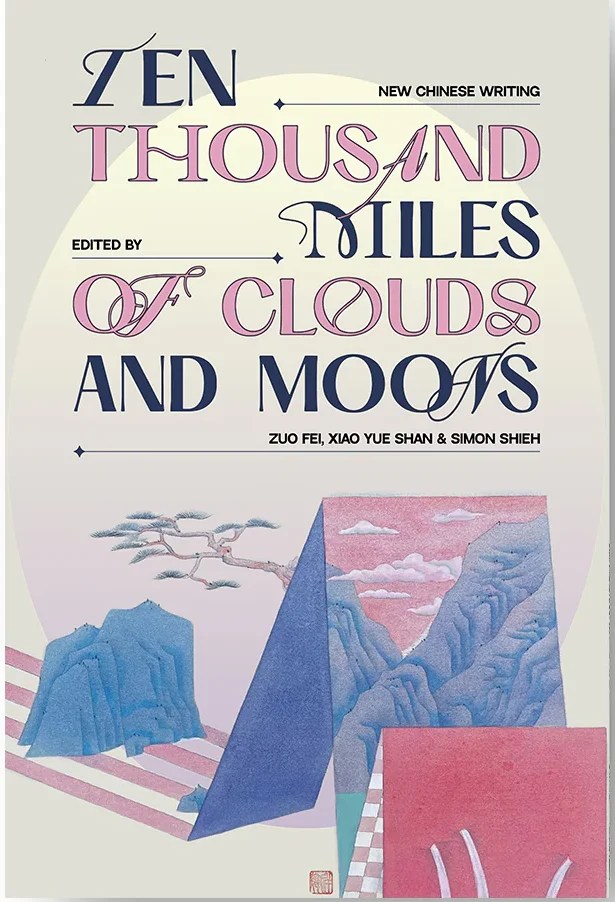
To go where the language goes: Ten Thousand Miles of Clouds and Moons – New Chinese Writing, edited by Zuo Fei, Xiao Yue Shan and Simon Shieh

Grey cloud grasping light,
unrolling the softness of another world
towards the wobbling plane wing; its folds ripple,
someone has scattered seeds in each furrow.

Who’s thinking, underneath the clouds,
how hard it is to restore the life of a flower,
when rain never coincides with favorable winds.

But we have a shred of light.
Today, passing through a mid-gate
as if remembering.

(from “Introspection on a Cloud” by Du Lulu, translated by Dave Haysom)

What exactly does it mean to enter into another world, to open oneself to a landscape at once familiar and strange? That is, one might suggest, one of the functions of literature. But if the map that grants access to that other world with its many artistic and cultural riches is in another language, translation is the key. For the editors of Ten Thousand Miles of Clouds and Moons, a collaboration between Beijing-based Spittoon Literary Magazine, a dual-language journal of contemporary Chinese literature, and Honford Star, the guiding inspiration for this first anthology project is, in keeping with that of the magazine, to seek out and bring into English translation, some of the most original, exquisite, and daring voices—new and established—contributing to the present literary landscape in China.
The introduction lays out the vision that guided their selection of pieces

The work had to be excellent; the writer had to have a point of view that is under-explored in the Anglosphere; there had to be a balance of genders; and the language had to be so special that it has the potential to torture translators. This final aspect came only from our love for the Chinese language—which, like all languages, has a singular soul, a force drawn from its age and its malleability throughout time. The more a writer is able to tap into that soul, the more difficult the piece would inevitably be to translate.

Thus sixteen contributors—eight writers of fiction, six poets, and two essayists—were paired with eighteen translators, to offer readers a journey that covers a wide literary terrain. You will find yourself in a world with a long rich cultural history and traditions, and you will find stories that depict a modern society that Western, English language readers will instantly recognize, with influences drawn from an international well of literary sources. You will find work that pays homage to the China’s past and tales that turn on distinctly futuristic, apocalyptic visions. And surreal, experimental tones alongside traditional Chinese poetic form.

The opening story in the compilation sets the mood perfectly. A piece of dystopian science fiction that  revolves around the fate of the 18th century work considered the greatest of all Chinese novels, “Mass in Dream of the Red Chamber” by Chen Chuncheng (translated by Xiao Yue Shan) is set in the far future—the 4800s—at a time when this great work of literature is not only lost, but any effort to retrieve its contents or storyline are strictly forbidden. There is, at this time, a belief that the text was completed at the peak of the universe’s development, and that all had begun to decline and dissipate since that time. The narrative follows the recorded account of a prisoner, a man born in 1982, who fell into a deep coma for several thousand years, only to miraculously awake and find himself as a specimen in a museum exhibit. He becomes a kind of missing link to the lost masterpiece for a clandestine organization desperate to recreate, as much as possible, the original; its preservation being essential to the continued existence of the universe itself. But that also makes him, and those who come to hear him access his memories of the text, the target of murderous government forces. It is a wonderful meeting of the glory of past achievements and the horrors of a post-apocalyptic totalitarian future, connected with an out-of-time protagonist’s personal recollections of life in the 1990s and 2000s.

The settings of the tales that follow vary, from a contemporary urban environment where bored youth hang out and make trouble, to the account of family history, to a mystical encounter on a mountainside. The energy shifts from story to story, often turning to the unexpected, cracking the fragile veneer of reality. Particularly delightful is the excerpt from Lu Yuan’s novella The Large Moon and Other Affairs (translated by Ana Padilla Fornieles), a piece of weird fiction that reflects, perhaps, in its magical strangeness, the influence of Bruno Schulz whose work the author has translated. As the moon, being pulled toward the earth, grows larger and larger in the sky, the eccentric Mr. Lu struggles with insomnia and troubled dreams. One night, having taken a concoction to aid his sleep, he finds himself carried off on a nocturnal adventure through the skies:

Mr. Lu rose from the valley of dreams and rowed out the window, picturing himself an unthinking mycoplankton or a sea cow, heading back to the Amazon River Delta. Riding upon the clouds and the wind with neither a northeastern wife nor a Vietnamese mistress at his side, the invoices seeking his death yet to arrive, and the murderous plots working their shapeless, invisible night shifts had been temporarily put on hold. There were no cold, mechanical alarms, no greasy company breakfasts, and definitely no covetous relatives, neighbours, acquaintances, or colleagues. The naked Mr. Lu, wearing only a heavy pair of  plastic slippers, flew over the sparse suburban streetlights, bounding towards the corridors of stars spiraling in a snail-shell pattern along the horizon’s towers. A thin sheet of air gently caressed his bulging beer belly, and the city was as far away as a firefly, succumbing to the hallucinatory bird’s eye view of inebriated men.

The two nonfiction pieces add a welcome new dimension to the collection. Hei Tao’s “Three Essays” (translated by Simon Shieh and Irene Chen) paint delicate portraits of southern China, and a lifestyle that is gradually disappearing, while Mao Jian’s “No One Sees the Grasses Growing” is a relatable, and humorous, memoir of her years as a student at East China Normal University in Shanghai in the 1980s and 90s. She recalls a time when students paid less attention to their studies than might have been wise. They were young and in love with a certain literary coolness. Her first degree was in Foreign Languages, but she found it hard to resist the allure of another course of study:

The truth is, in the eighties, it was impossible to resist the passions of the Chinese Department. The notice boards were plastered with adverts promoting literary lectures, and all sorts of clubs and societies adopted the grandiose affectations of belles-lettres, prancing about the center of campus. If someone were to ask you about going corporate after graduation, you’d have to self-reflect on the unrefined impression you must have been giving off. Those years were the golden age of Casanovas, who made names for themselves by proclaiming their undying love for poetry, and any girl who could be moved by Rilke would inevitably enter into a spontaneous fling with one of these campus poets.

It was an era of living away from home, first trips to KFC, young love, and inspiring and unconventional professors. But looking back decades later, now a professor herself at the same institution, she realizes that that time is past, in so many different ways.

Spread out among the prose pieces, are the contributions of the poets, three poems each. This arrangement works very well, offering a change of pace and granting each poet the space to have their unique voice heard. As with the fiction and nonfiction, there is both variety and, of course, precise, evocative imagery that is at once modern, yet with an echo of the long-standing traditions of Chinese verse.

Anthologies can be uneven projects, but this selection of new Chinese writing is strong, varied, and continually fresh and surprising from beginning to end. The contributors range in age, with the youngest in his mid-twenties, the oldest in his mid-sixties. Their work is consistently fresh and vibrant, and the translators all appear to have produced results that feel effortless. It should also be noted that this volume is beautifully presented, with a simple, yet elegant design. This is an endlessly engaging collection for anyone with an interest in contemporary Chinese literature, especially if you are seeking work that challenges expectations.

Ten Thousand Miles of Clouds and Moons: New Chinese Writing is edited by Zuo Fei, Xiao Yue Shan and Simon Shieh, and published by Spittoon Literary Magazine in collaboration with Honford Star

An island to hold in the palm of your hand: Purple Perilla by Can Xue

Imagine. Islands of words, small self-contained worlds of ideas, stories, exploration. Points of reference in a sea that is increasingly uneasy, uncertain to navigate. This is the vision of isolarii, a project designed to revive the notion of “island books”—collections of literature and art united on a singular idea and bound into a single volume—that first appeared during the Renaissance, but was lost as other literary forms began to take precedence. Now, under a bimonthly subscription model, the tradition has been reborn in miniature.

Purple Perilla by Chinese experimental writer Can Xue is the third offering in this series. Beautifully presented, complete with a translucent dust jacket, this tiny book is about the size of a deck of cards and contains, in just under 150 pages, three delightful short stories: “An Affair,” “Mountain Ants,” and “Purple Perilla.” Xue offers these tales, which move from an urban to a wild setting, as a lyrical reaction to our contemporary condition. Her trademark measure of unreality permeates each piece.

For those unfamiliar with her work, Can Xue is a very idiosyncratic writer. She allows her fiction to spill forth in what will be its finished state—she writes, one hour a day, without rereading or edits. As a result, her stories and novels have a wandering quality, with a real, yet unreal atmosphere. Much like a dream. The best way to approach such work is to read as Xue writes, one word at a time. This is against an attentive reader’s natural instincts, but looking for patterns and clues will not help. However, this is not to say there is no form, no direction, no meaning—only that one is forced to be patient, to listen and see where the story takes you, not worrying if it seems to tumble along freely at times. Reader and author are essentially on a journey together. As Can Xue says:

Reading my fiction requires a certain creativity. This particular way of reading has to be more than just gazing at the accepted meanings of the text on a literal level, because you are reading messages sent out by the soul, and your reading is awakening your soul into communication with the author’s.

“An Affair” tells the story of Fay, a thirty-six year old teacher, living in a city, who receives a most unusual love letter from a man who claims he has seen her on the bus. He neither reveals his name nor provides a return address, admitting he does not expect she would want to write back. This odd, enigmatic correspondence haunts Fay, leading her to wonder what kind of hold this mysterious man has on her imagination. Eventually she sets out to find him, or find out more about him, by travelling to the far end of the city where he told her he works at a cigarette factory. What she discovers on her strange, convoluted mission seems to tell her more about herself than any mysterious suitor.

The second tale, “Mountain Ants,” is set in a small city surrounded by mountains. Lin Mai lives with his parents in a mansion which is oddly isolated despite being surrounded by buildings. Visitors are rare. The boy spends much of his free time interacting with a large nest of ants in his yard. One day an old man appears at his gate. He tells Lin Mai that he lives in the mountains and has followed the ants to his home. This man, who is called Grandpa Wu, shares some knowledge about the ants and promises that one day he will take Lin Mai up a mountain. As this magical story unfolds, Lin Mai learns some curious information about his parents, the beggar known as Grandpa Wu, and the importance of tending to his own and several other mountain ant colonies in the city.

The final story “Purple Perilla,” the most dreamlike and magical of the three, ultimately carries the narrator into the wilderness, where a friend and his grandma have gone to live among the wolves. To young Chickadee this friend, a boy he has long admired, has uncanny qualities:

Unwittingly, I followed Nigu. He was so profound that he wasn’t like a child, but like … what was he like?

“I’m my grandfather’s grandfather.” Nigu turned around and spoke to me. I was stunned—he actually knew what I was thinking!

“I’m really like my grandfather’s grandfather. I think I am. Chickadee, don’t be afraid of me; I won’t hurt anyone…”

Read as a cycle, these short stories walk headfirst into the unknown. Here, questions are transformative in themselves—it’s less a matter of securing answers than of finding comfort in mystery. Bound together in this portable format, they offer a direct engagement with the magic and vision of one of China’s most inventive writers.

Each volume in the isolarii series is accompanied by several forewords. Presently, Scholastique Mukasonga’s prose riffing in response to a sentence or two from each of Can Xue’s stories is available online. It can be found here. Reading this small volume is a uniquely pleasurable experience. And, it’s worth noting that although the book is small in size, the font is not nor do the stories feel compressed or compromised in any way. It has been a while since I last wandered in Can Xue’s world and my first encounter with her short fiction, but I am now keen to return, before long, to her dreamscapes in a longer work or collection.

Purple Perilla by Can Xue is translated by Karen Gernant and Chen Zeping. It is the third volume in the isolarii series published by Common Era Inc.

Initial thoughts on Can Xue and a link to my review of Frontier at Numéro Cinq

In the month or so since I wrote the following review, I have been thinking about Can Xue, about what it is that sets her work apart—that makes it so difficult and so addictive. There is nothing intrinsically complex about her language. Her characters are intriguing, interesting. But one can easily feel unmoored within the scope of her imagination. Borders shift; the signposts we look for as readers are missing or misleading.

But once one accepts this condition, the possibilities are endless and exciting.

After reading Can Xue, I went on to read João Gilberto Noll and Michel Leiris. In the light of this subsequent reading there is more I would like to explore with respect to the dream-like narrative/anti-narrative, but that will have to wait until after my next Numéro Cinq review.

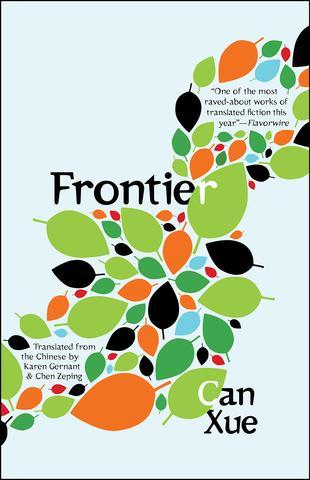
In the meantime, here’s a taste of my review of Can Xue’s Frontier, please click through the link at the end to read the rest. A second link leads to an excerpt:

Life In a Northern Town | Review of Frontier by Can Xue — Joseph Schreiber

It can be said that Chinese experimental writer, Can Xue, inhabits a strange and elusive territory in contemporary literature. With an idiosyncratic approach to writing, she has created an impressive body of work that effectively explores a geography of the spirit—mapping, if you like, the space where the real and the surreal, the personal and the political, and the magical and the mundane meet. Her 2008 novel Frontier, newly released from Open Letter Books in a crystal clear translation by Karen Gernant and Chen Zeping, has been eagerly anticipated by her admirers. Yet, for intrigued newcomers, it may well offer an excellent introduction the dazzling, and baffling, world of Can Xue.

Born in 1953, in Changsha City, Hunan Province, South China; Can Xue is the pseudonym of Deng Xiaohua, who took her intentionally gender-neutral penname from a Chinese expression that refers to both the dirty snow that refuses to melt and the pure snow remaining at the top of a high mountain. This inherent duality is very fitting. In the years leading up to the Cultural Revolution, both of her parents came under suspicion for their journalistic activities and were sentenced to hard labour. Consequently, their daughter was unable to continue her education beyond elementary school. Despite the brutal hardships her family experienced and her own ill health, Can Xue showed great resilience. With her schooling cut short, she turned to reading. Largely self-taught, she read fiction, poetry, and discovered the joys of classical Western and Russian literature, eventually going on to study and read in English. At the same time, she married, started a family, and worked as a tailor before publishing her first work in the mid-1980s.

Continue reading here:

Read an excerpt here:

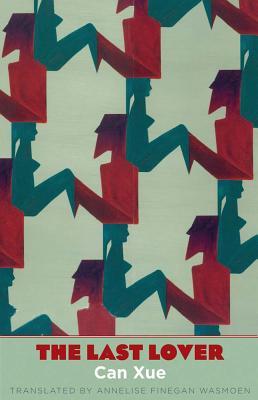
There are no roads here: The Last Lover by Can Xue

To enter into the pages of The Last Lover by Chinese author Can Xue, is to surrender yourself to a shimmering, surreal dream world – a space where human souls cross paths with animal spirits, experience love and loss, and embark on journeys that intersect with some measure of a real world then cross back into magical landscapes. There are no clear parameters to follow, once you feel you are beginning to make sense of things, the floor falls away beneath you or you find yourself trapped in a labyrinth, or both at once. Nothing is what it seems, and the main characters are equally confused, conflicted, uncertain about whom to trust or what is happening to them.

Does it all come together at the end? Brilliantly yes. Perhaps. And I’m not entirely certain.

lastTo attempt to outline the plot of The Last Lover would be fruitless. Essentially the novel revolves around several key couples living in an unnamed ostensibly western country. The central figure, if it is possible to see him as such, is Joe. He is an avid reader, capable of losing himself in books, forever weaving a story of his own from the threads of the stories he reads. His wife Maria is a housewife who weaves images into tapestries and seems to have a capacity to channel mystical energies. Daniel is their teenaged son who drops out of school to take up his passion for gardening full-time. The dynamic between the three family members shifts – close on some levels but following separate trajectories on others.

Vincent is Joe’s employer, the owner of a successful clothing company. He seems distracted and at odds from the onset, while his intense wife Lisa is convinced he is having an affair. Apparently he also appears to be able to be in two places at once, a remarkably common occurrence in the world of The Last Lover. Vincent and Lisa are deeply in love but wrestling with the demons of their own peculiar mid-life crises.

Reagan, a client of Vincent’s Rose Clothing Company, is the 50 year-old bachelor and owner of a rubber plantation south of the city where the others live. He is drawn to Ida, a young woman of obscure Asian origin, who is working on his farm. Theirs is probably the most overtly surreal of all the relationships, but that is not imply that any couple has anything approaching a routine domestic existence. The overlapping and entwined connections between the six key characters forms a strong thread that pulls the reader into and through this anfractuous tale.

Winding in and out of the lives of the key figures is an ambiguous cast of other entities – mysterious Asian and/or Middle Eastern women, odd servants and drivers, eccentric loners, beautiful street cleaners with curious doppelgängers and a host of cats, snakes, birds, mice, insects and other creatures. Earthquakes rumble throughout the novel, shaking some characters to the core while passing unnoticed by others. Fires rage, floods wash mountainsides away, roses exert magnetic energies, and dream worlds collide – not just with assumed reality, but between dreamers. Sexual desire arises frequently – at times characters are surprised by the intensity of the arousal, the unexpected gender of their object of attraction and the insubstantiality of most ensuing encounters.

As the story unfolds, moving through of layers of unreality, the tendency is to try look for clues, to assign meaning and value. My thought is that meaning is a slippery concept here, amorphous and shifting. Can Xue herself has advised that modernist literature requires the reader to turn inward to seek the structure of time and space within one’s soul, to be able to grasp the structure of the work. But structure is one thing, meaning is something else entirely. I would argue that this a work that will open itself up to the receptive reader, and be met by each reader on his or her own terms with what they bring to the experience.

I took pages and pages of notes, delighting in tracing connections, amazed by the depth of reading possible. In the end I was most keenly aware of themes of migration, the sense of a lost connection with a home left behind, the loneliness of love, the ambiguity of remembering and forgetting, and the increasingly virtual quality of our connections with others in our modern world. But those are my perceptions at this moment. Can Xue, (her real name is Deng Xiaohua, her pseudonym meaning “dirty snow that refuses to melt”) is a self taught writer. The Cultural Revolution abruptly ended her education after elementary school, so she took to educating herself, reading poetry and fiction and steeping herself in the classical Western canon and Russian literature. She has cited Kafka, Borges, Cervantes and Dante as influences. Echoes of Calvino are strong and I could not help but think of contemporary writers like Ben Okri and Sjón among others.

This is actually my first encounter with contemporary Chinese literature. This morning it was announced as a contender for the Best Translated Book Award (BTBA), making it the one title to appear on both major annual translated fiction award longlists. Annelise Finegan Wasmoen’s translation is clear, spare and lyrical. She maintains a steady pace and brings to life the sounds that reverberate throughout the text – the su su rustling of pages, si si hissing of snakes, the cha cha whisper of snow – preserving what one imagines might approach the sensory experience of reading The Last Lover in the original Chinese.

Independent Foreign Fiction Prize 2015 / Best Translated Book Award 2015: A demanding read that defeated a few members of our IFFP shadow jury, this was a highly rewarding reading experience for me. I will definitely seek out more of Can Xue’s work. A taste of her short stories, some of which can be found on line and this insightful feature from Music & Literature were helpful, though I avoided reading other interpretations closely before finishing the book. I would encourage a reader interested in a challenge to persevere, open to the riches that this type of literature can offer.

Update: The Last Lover has been awarded the 2015 BTBA Award. Of the six of the ten shortlisted BTBA titles I read it was my favourite all along. Congratulations to Can Xue and Annelise Finegan Wasmoen!