
Father Luis Cordoba was a large man, and his heart even larger—too large, in fact. When, after attempts to treat his condition with a pacemaker, diet, and exercise proved insufficient to ease his poor organ’s further decline, it became apparent that he would require a transplant. But while waiting for a suitable donor to die, he would have to rest quietly and refrain from strenuous activity, like climbing stairs. So, at the beginning of Colombian writer Héctor Abad’s Aside From My Heart, All is Well, he moves from the home he has shared for twenty years with fellow priest and longtime friend, Aurelio Sánchez, also known as Lelo, into a house occupied by two women and three children. This book is, on one level, an account of his final months of life, as recorded by Aurelio, looking back from a vantage point another two decades on. However, once our narrator began to gather his memories of his friend, it became a much broader exercise, evolving into a tribute, a personal memoir, and a meditation on the costs a commitment to the priesthood exacts.
 Neither Luis, who was known to most of his friends as el Gordo, nor Aurelio have what might be considered a traditional approach to their vocations. They both might have intended to follow the norm more closely when they met in seminary and embarked on their earliest placements, in Europe and then back home in Colombia, but when Luis was given the opportunity to take up residence in his family home in Medelin, the two proposed that they might live together, take in other priests, seminarians, or missionaries as need be, and pursue their own ministries, in their own ways. Their order was skeptical at first, as the two had already demonstrated their eccentricities, but permission was granted—as long as they promised to be “prudent, modest, and restrained.” So the two men became roommates. Aurelio said Mass every morning for a nearby congregation followed by bible classes at the university, but an attraction to men tested—and often defeated—his commitment to celibacy. El Gordo had other temptations which he would ultimately adapt into his own form of ministry:
Like all of us, Luis had taken vows of obedience to his superiors when he was ordained; also vows of chastity, renouncing the possibility of having a wife and children, and – as far as possible – the libido and carnal relations, as if he were a eunuch. Under those conditions he had been a priest in a rural parish near Munich and in an urban parish in Manizales. The same vows committed him to devote himself to the service of others and his objectives in life must not aspire to lucre or any personal benefits. But after these sacrifices and abdications, and after thinking it through carefully, Córdoba had resolved not to deprive himself of his other three remaining passions, two of them almost spiritual and the third – the one he had the most trouble confessing – carnal: classical music (especially opera), cinema, and fine dining. Had not Jesus multiplied loaves and fishes? Had he not turned water into wine? Had he not bid farewell with a last supper? Well, exactly.
Over time, Luis became a respected film critic and students flocked to his lectures on classical music and cinema. His typical priestly duties were limited, many had no idea about his official profession, but, unlike his best friend he held fast to his vows. That is, until his fragile heart forces him to move in with Theresa, whose husband had left her and their two young children, and her Black maid Darlis and her daughter. Being in the presence of two beautiful women and a house filled with the laughter of three children begins to lead the priest to question what he has given up. He begins to imagine how, at the age of fifty, a new heart could potentially mean a new life.
Aside From My Heart, All is Well is a gently meandering novel guided by warmth and subtle humour. Aurelio balances his account of Luis’ life before and after he had to leave their shared home, with the story of his own upbringing and experiences in Catholic boys schools, and the challenges he and his fellow clergymen had within a Church hierarchy that could be less than forgiving, in a country that could be violent and lawless. Given Luis’ great fondness for opera, favoured arias are referred to throughout the narrative, when relevant, linked with QR codes so one can listen while reading—nice touch that is handled well. But the subtle thread that holds it all together is that of the heart itself, that essential yet fickle organ, in both its physical and emotional connotations. It seems that Aurelio originally launched his mission to honour his friend at the behest of Joaquín who, it turns out, is Theresa’s former husband:
Sometimes I wonder why and for whom I am writing these notes, if they are for Joaquín or for me. If I’m writing this for myself or just for the pleasure of pleasing him. The more I write, the more I grow fond of the exercise of remembering or reconstructing everything I know about my friend Córdoba, all that he told me. I’m supposed to be doing it so Joaquín can discover details about Córdoba’s life. But he’s not very clear, and his idea has changed over time. At first, he was talking about a novel, and then he began to say it would be better to write a well-documented biography of Luis Córdoba, an intellectual biography. I don’t know what to believe anymore. The last thing he told me was that his only real interest was to establish a contrast that would serve as a parable of Colombian life.
Joaquín had long been a friend of both priests, so he is able to provide important insight into Luis’ final months in his ex-wife’s house and offer relevant research to further the project he instigated taking it even farther afield. But when he finds himself facing the same heart condition that Luis had, he also becomes obsessed with understanding his own possible fate from a medical perspective.
As for Luis, he is portrayed as a humble and optimistic man, well loved by so many for his dedication to music and cinema, but whereas Aurelio long struggled with his carnal urges, the recognition of his own unfulfilled desires comes too late. This is, then, a story about mid-life longing and regret. Of the three men at its heart, Luis, Aurelio, and Joaquín, one realizes too late that he wishes he had married and had a family, one is denied that possibility by his sexuality (not to mention his vows), and one walked away from a marriage and family for a much younger woman and the illusion of glamour. But, as we do, each man finds his own way to make things work, Luis perhaps most successfully by having a heart large enough to accommodate his first passions—opera, film, and fine dining—and still find room to welcome the possibility of even more love right to the very end.
In his closing comments, Abad notes that his novel is “based freely on the life of Luis Alberto Álvarez, an extraordinary priest who was a friend of mine” and an important figure in Colombian cultural circles. He draws on many sources, including his own heart condition, to create a vibrant fictional Luis in a rich environment that is beautifully reflected in Anne McLean’s warm English translation.
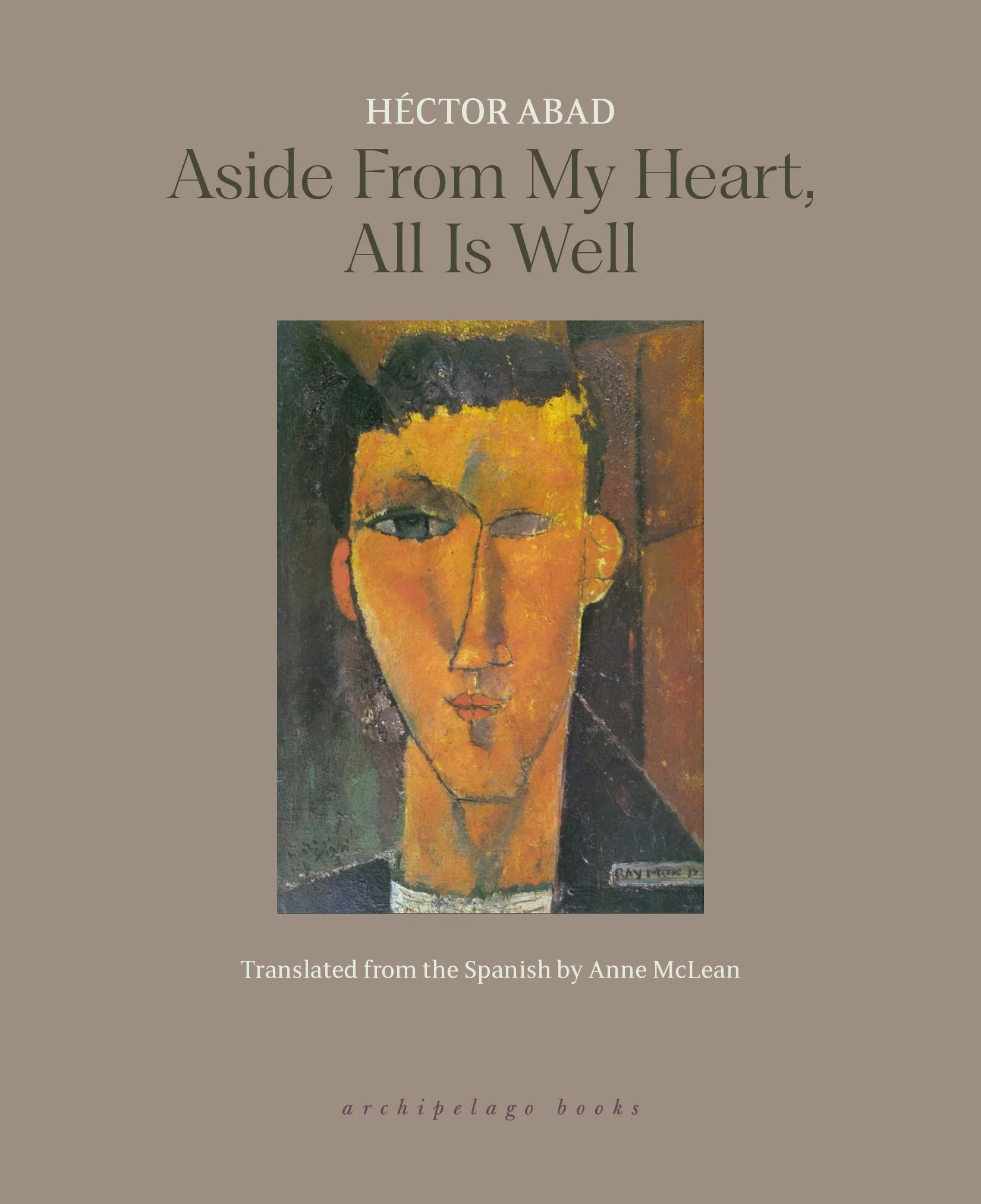
Aside from My Heart, All is Well by Héctor Abad is translated from the Spanish by Anne McLean and published by Archipelago Books.

