2025 Wrap Up: Reading and other stuff


I don’t know what I expected when this year began. Ever since 2020 it seems we have greeted each year with some measure of optimism—I mean how could it be worse than the one that just passed? And somehow, each year has managed to be worse in some new, unanticipated way. 2025 saw the continuation of conflict, famine, destruction, climate catastrophes.  We also witnessed the further escalation of intolerance, racism, sexism, anti-trans sentiment, religious fundamentalism, and autocratic politics. Where I am in western Canada we have witnessed all of this, not just from our neighbours to the south, or distant nations, but right here close to home. It is hard not to lose hope, but giving up is not an option and so, 2026, here we come, preparing for the worst but dreaming of the best.

Personally, I struggled a bit this year. Family stuff, some depression, and, in late November, a car accident that has left me with stiffness and pain that is slow to subside. But, on the bright(er) side, my focus and concentration has returned, and replacing my damaged car proved easier than it might have been. My old Honda Fit had more value than I expected, and I happened to see a (newer) used vehicle that fit my needs for a very good price and was fortunately in the position to buy it. If the police manage to find the impaired driver who hit me (assuming she was insured) I will even get my deductible back. But, quite honestly, I’ll be happy to be able to look over my left shoulder again!

As for reading/reviewing, 2025 was a mixed year. I had a few off times when I struggled to finish books (or gave up altogether), and a number of mediocre reads passed without public mention. At the same time, I read some excellent poetry in English, but could not find the words to write coherent reviews. For some reason, I feel I lack the knowledge and vocabulary to say the “right” thing about poetry in my own language—I feel more comfortable responding to translations. And I did read a lot of poetry in translation this year.

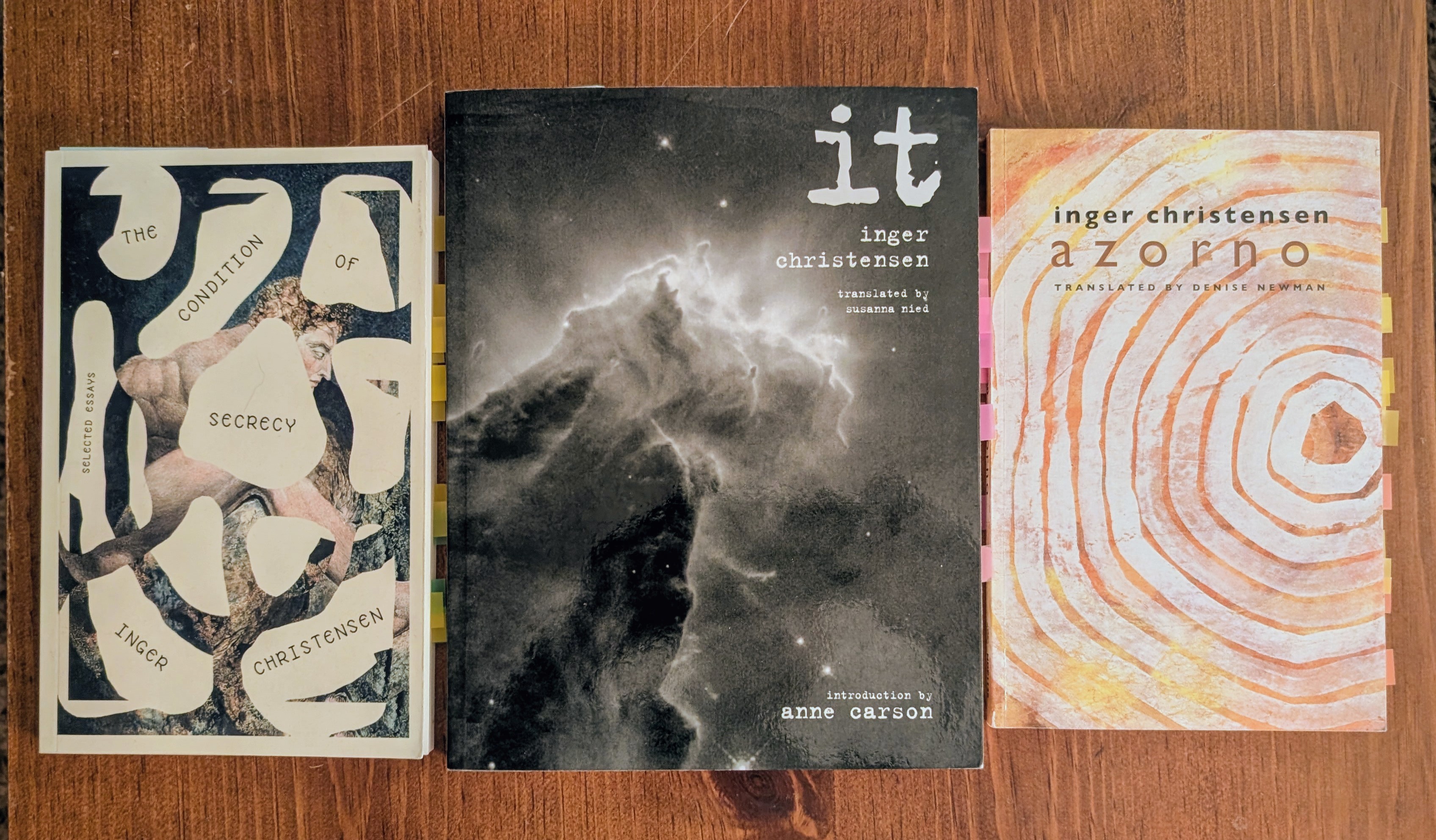
Looking back over 2025, the singular defining force for me was the work of Danish experimental poet and writer Inger Christensen (1935–2009). In January I read her essay collection  The Condition of Secrecy, and I was immediately entranced by her love of language and her view of the world as informed by science, nature, music, and mathematics. I knew I wanted to read all of her poetry and fiction and, throughout the year, that is exactly what I did. I read eight of her translated works and only have one left to obtain although I have a dual language edition of one of the sequences in that volume (“Butterfly Valley”). Along the way I also decided I wanted to learn to read Danish as there are elements of her work that simply cannot be reproduced in translation (mathematical constraints in particular).

And so, I am learning Danish, or, should I say, jeg lærer dansk.

Although I enjoyed all of her books, my favourite piece of fiction was the crazy word play mystery Azorno (1967) and my favourite work of poetry was her monumental it/det (1969), both earlier works. Of course, the wonderful book length poem alphabet (1981) is also amazing. Her poetry and essays are translated by Susanna Nied, her fiction by Denise Newman.
Some thoughts about a few of my other favourite reads from the past year:

 Prose:

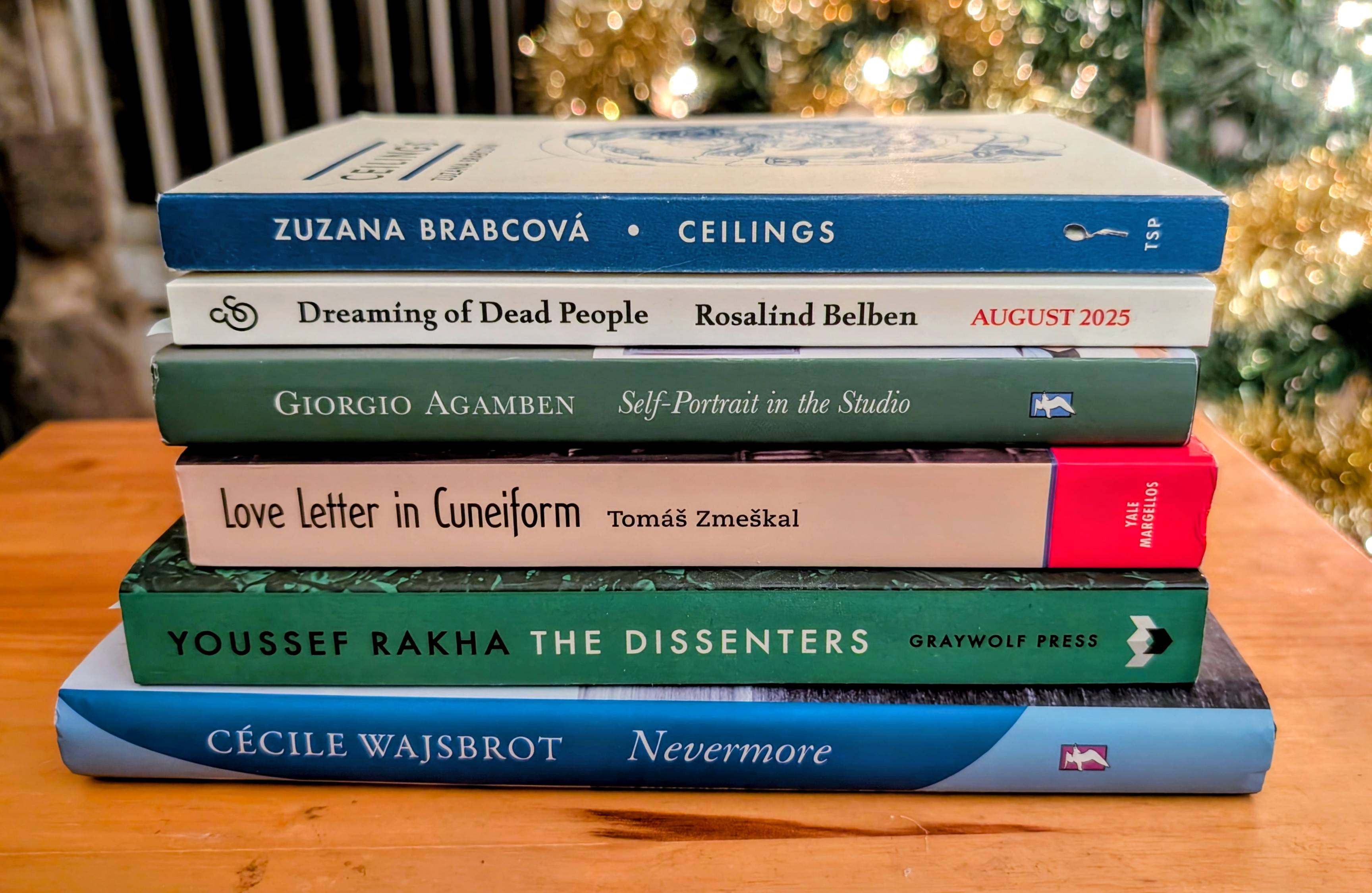
Ceilings – Zuzana Brabcová (translated from the Czech by Tereza Veverka Novická)

Set on the detox ward of a psychiatric hospital in Prague, Brabcová captures the institutional environment and the strangeness of psychotic interludes with the skill only personal experience can provide. This wild and delirious ride pulled me out of a reading slump.

Dreaming of Dead People – Rosalind Belben

I read two novels by Rosalind Belben this year, The Limit which was re-issued by NYRB Classics several years ago and this one which was re-issued by And Other Stories this year. Both are strange in a brutal yet beautiful way, but Dreaming is, to me, a more accomplished, in depth novel.

Love Letter in Cuneiform – Tomáš Zmeškal (translated from the Czech by Alex Zucker)

One of those books I’ve been meaning to read for years and when I finally picked it up off the shelf, I was delighted to find out how funny and weird this multi-generational family drama truly is. Zmeškal lends magical realism and historical reality with a cast of eccentric characters to create a memorable tale.

Self-Portrait in the Studio – Giorgio  Agamben (translated from the Italian by Kevin Attell)

Far from a conventional memoir, Agamben invites his reader on a tour of the various studios he has occupied over the years, reflecting on the people, books, and places that come to mind along the way. A surprisingly engaging work.

The Dissenters – Youssef Rakha

The final two novels on my list are both highly inventive in style and form. Egyptian writer Youssef Rakha’s first novel written in English manages to seamlessly incorporate Arabic expressions without explanation, adding to the richness of this original, multi-dimensional story of one remarkable woman set against the events of recent Egyptian history. Endlessly rewarding.

Nevermore – Cécile Wajsbrot (translated from the French by Tess Lewis)

This ambitious novel is a moving evocation of loss and change. A translator has come to Dresden to work on a translation of the central “Time Passes” section of Virginia Woolf’s To the Lighthouse from English into French. Reflections on change and transformation drawn from her own state in life and various historical events accompany the process of translation.
Poetry:

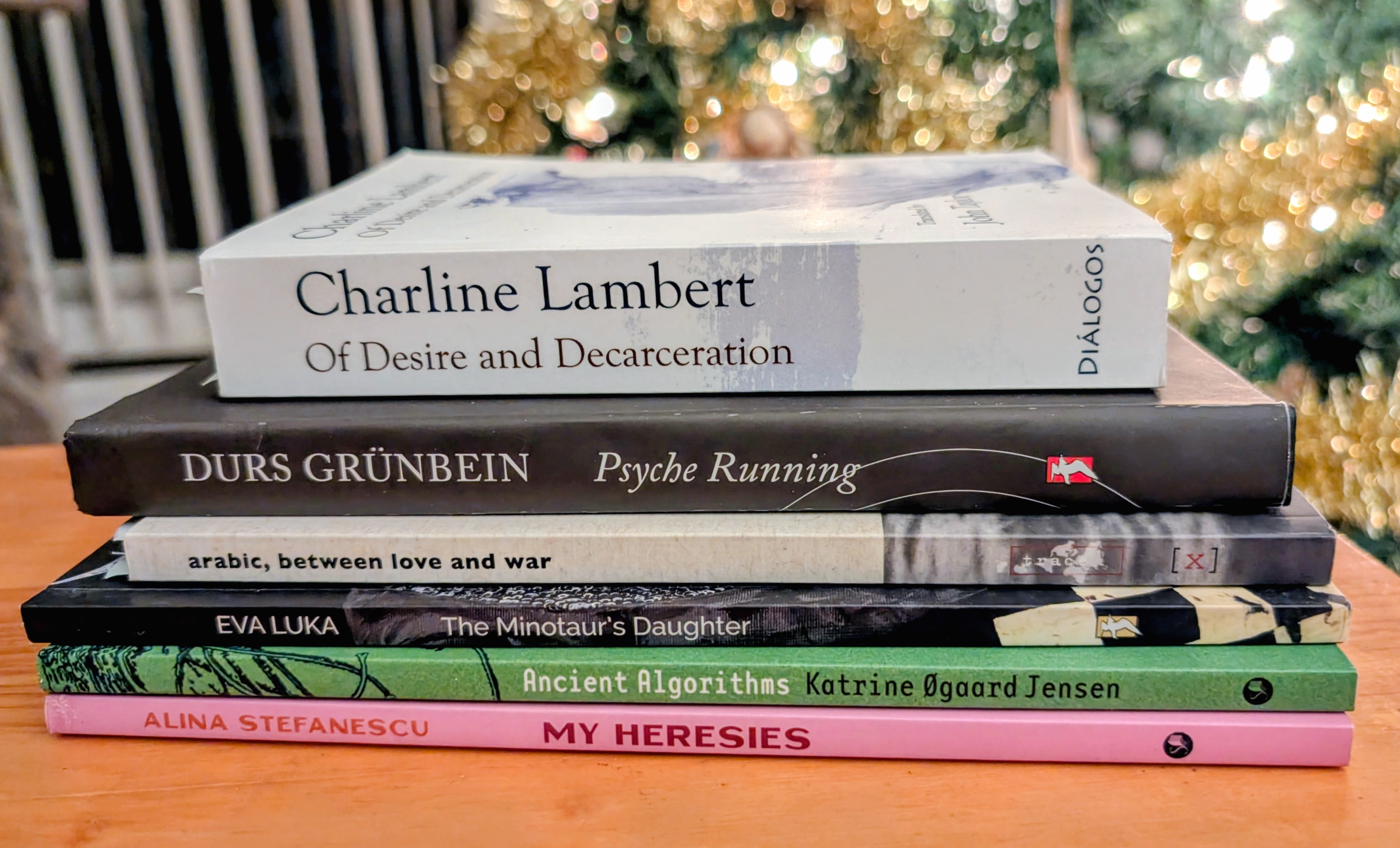
Of Desire and Decarceration – Charline Lambert (translated from the French by John Taylor)

It is most unusual for a poet as young as Lambert (b. 1989) to see her first four volumes of poetry published together so early in her career, but translator John Taylor felt that the Belgian poet’s books show a natural growth best appreciated as a whole. He is not wrong (he is also a translator whose judgement I always trust).

Psyche Running: Selected Poems 2005–2022 – Durs Grünbein (translated from the German by Karen Leeder)

This selection of poetry rightfully won the Griffin Prize this past year. Grünbein’s work tends to draw on his hometown of Dresden and Italy where he now spends much time, and this selection presents a good introduction to the variety of his mid-career work. One can only hope that the attention he has received with this book will lead to full translations of more of his work.

arabic, between love and war – Norah Alkharrashi and Yasmine Haj (eds)

The first of a new translation series by Toronto-based trace press, this selection of original poems with their translations—most written in Arabic, with some written in English and translated into Arabic, exists as a kind of conversation between poets from across the Arabic speaking world and its diaspora. Vital work.

The Minotaur’s Daughter – Eva Luka (translated from the Slovak by James Sutherland-Smith)

This book, a complete surprise tucked into a package from Seagull Books, is a delight. Luka’s world is a strange and quirky one, transgressive and fantastic. Leonora Carrington is a huge influence, with a number of  ekphrastic poems inspired by her paintings but given life from Luka’s own unique angle. Loved it!

Ancient Algorithms – Katrine Øgaard Jensen (with Ursula Andkjær Olsen and others)

This is the book that marked my return to reading post-accident. And how could it not. Jensen’s translations of Olsen’s poetic trilogy are very close to my heart. This unique work begins with poems selected from those books (in the original Danish), followed by Jensen’s translations, which set the stage for a series of collaborative mistranslations guided by rules set by the various poet translators involved. A wonderful celebration of poetry and translation and the necessary bond between the two.

My Heresies – Alina Stefanescu

Finally, one of the English language poetry collections I read and did not review (I did have a great title though). Alina Stefanescu breathes poetry as a matter of course, as is clear to anyone who has had an opportunity to engage with her online. There is an infectious defiance to this collection which straddles Romania and America, conjures angels and demons, and explores the everyday reality of romantic and parental love. I connected most directly with wry observations of motherhood that resonated with my own less than conventional parental existence.
There are, as ever, many other books I read this year that could have made this year end review. You’ll have to check my blog to find them!

Happy new year!
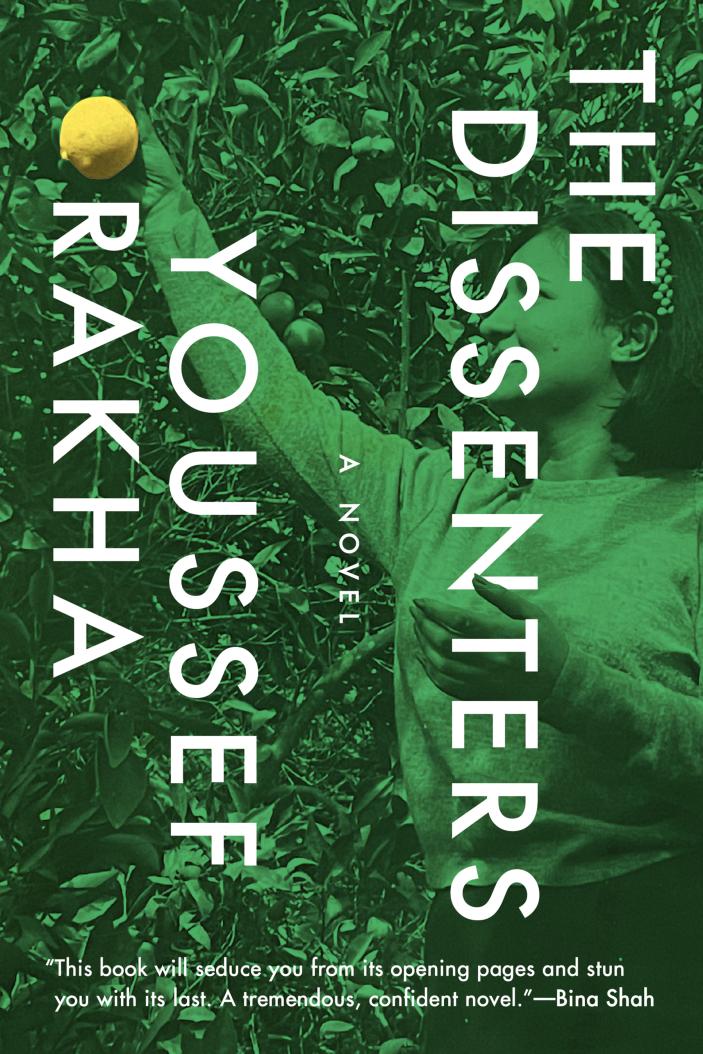
Memories, visions, and grief: The Dissenters by Youssef Rakha

I think I hear the dawn azan much earlier than it is supposed to sound. The world, spaced out, is speeding down some derelict highway in time. And long before my attic visions start, Shimo, I am thinking it is time that happens to people. We talk about having and saving and wasting it as if it is ours to work with, but really it is we who are time’s property. It molds and meddles with us, changes us without our knowing, so that one day we wake up with no idea who we are. And suddenly the life we’ve lived is no longer ours.

Youssef Rakha’s latest novel, his first composed in English, explores the remarkable, multi-dimensional life  of a strong-willed, enigmatic woman, set against the tumultuous years of recent Egyptian history, from the mid-fifties through the January Revolution of 2011 and its aftermath. But to put it like that sounds too simple, too conventional, for the tale that The Dissenters unleashes. Not content to embark on a straightforward narrative (which would not be his style anyhow), Rakha has chosen to tell the story of Amna Hanim Abu Zahra—Nimo to her friends, Mouna to her husband and children—through the memories and hallucinatory visions of her eldest son Nour. In the wake of his mother’s death, his grief-tinged, ecstatic narrative unfolds in a series of letters to his estranged younger sister Shimo in California. He wishes to share with her the understanding of Mouna, their mother, that he has gained through the strange rift in the fabric of time that has allowed him, within the confines of the cramped attic of the their family home, to slip into her earlier existence, living, reliving or closely observing her experiences, even those from long before he was born.

The Dissenters is, then, essentially a one-sided epistolatory novel consisting of three long letters with an interlude stolen from Mouna’s own notebook. Nour engages his sister directly and imagines her responses, but the apparent silence on her end provides no indication whether his dream-inspired insights will manage to heal, as he hopes, the unresolved rupture between mother and daughter that precipitated  Shimo’s unannounced departure from Cairo years earlier. However, it would seem that this is not the only loose end Nour is attempting to tie up. He is a forty-five year-old journalist who returned home to live with his mother after his divorce in 2010, and there is much that he must resolve with respect to his own life and his relationship to his country.

Moving between more recent, post-revolution events to which Nour—and in one section Mouna herself—can speak directly, and the attic revelations that reach back further into the past, Rakha unwinds a tale that works with, and against, temporal framings to create a narrative that slowly builds to reveal a full, multi-dimensional portrait of a singular woman and the shifting political, social, and civic world around her. Nour’s earliest visions take him back to 1956 when his mother, a teenager still known as Amna, is deprived of a chance to take her baccalaureate  exams and forced to marry a forty year-old man her family has selected. The awkward marriage will remain unconsummated and ultimately be dissolved, which allows young Amna the opportunity to finally pursue her dream of going to college.

There she will meet Amin, the young Communist lawyer who steals her heart and gives her the name “Mouna,” but their newfound joy is short-lived, as he is arrested and imprisoned a few short months after they move in together. The years of their separation, Nour tells his sister, see their mother exercising a new confidence and independence as she finishes school and enters the workforce. As a modern, stylish Egyptian woman, her friends and colleagues call her “Nimo.” When Amin is released from jail, a diminished and disillusioned man, she continues to work, even finding herself, for a time, acting as a secret agent. And then, at last, in 1969 Nour is born. By the time her second child, another boy, arrives, Mouna is again transformed. She has remade herself as a pious, middle-class Muslim mother.

The alternate thread of Nour’s correspondence with his sister, who is thirteen years younger than he is, explores more recent family matters including their parent’s comfortable estrangement, their brother Abid’s sadistic tendencies, and the circumstances that seem to have caused Shimo’s relationship with her mother to become strained and then permanently broken. But the primary focus is the dramatic impact that the 2011 revolution had on their mother. It seemed to awaken a long dormant political spirit in Mouna, giving her a new purpose and a new life.  On February 11, the night Mubarak stepped down from power, Nour walks home from Tahrir Square and is distraught to find that she is not there. Immediately his mind goes to all manner of horrors, imagining her lying in a puddle on the sidewalk.  And then, she appears, holding a flag, smartly dressed, her headscarf gone:

—You’re home early Mouna trills, the premillennial warmth of her voice restored.

Now my mother is smiling for real: an expression utterly unlike the baraka she used to project going about her devotional duties. I haven’t seen such peacefulness in her face since before Baba died. She stands waving her flag, then steps over the puddle that no longer shows her dead.

—I couldn’t stay home on a day like this, now, could I, she says. Besides, I just took the Metro to Kast El Ainy and walked to Tahrir. C’était incroyable, ya Nour. Hold your head high, you’re Egyptian, we chanted. But it wasn’t just a chant, you understand. It was real.

Soon, however, Mouna becomes aware of a strange and disturbing phenomenon. Something that others do not seem to register. Suddenly women are jumping off roofs and out of windows. She begins to investigate, finding a few others who also seem to be aware of this unusual trend. She even tries to recruit Nour, encouraging him to report on the situation. He doesn’t know what to make of the Jumpers,  but she sees a truth in their tragedies. These ill-fated women become a mystery, and then an obsession, even a madness, that fuels Mouna’s final years as the promise of the revolution turns again to upheaval and violence.

This ambitious, hypnotic novel tells a story that is very intimate, turning at times erotic or violent, but it is about much more than the life of one woman. For one thing, the conscious incongruity of having a complex woman’s life recounted and, at times experienced, through the vessel of a man sets up an interesting dynamic, speaking as it does to the shifting roles and restrictions that impact women in Egyptian society from an unlikely angle. Of course, The Dissenters also addresses the price paid by anyone who defies political and social conventions, and highlights the challenges of navigating  the forces of power for one’s own safety or (as in the case of Abid who joins the Secret Police) one’s advantage. Thus, Mouna’s story is much much larger than she is. As Nour confides to his sister:

But I’m no longer talking of my mother, am I. I’m talking of the Mother of the World. Surely you know that’s what Egypt is called, dear sister. At moments like this it seems as if Amna Abu Zahra is a fractal of our country, her biography a variation on its history, a version of the same story.

Finally, although Rakha is writing this novel in English—a language Nour and his sister share—his prose carries a strong Egyptian flavour. Many Arabic terms and expressions are woven into the text without comment or glossary (one can always look them up, mind you), and because Mouna was educated in French schools growing up and continued to use the language in her working years, French phrases regularly appear in her speech. This distinctive voice, in conjunction with the rhythmic flow of a narrative structure that blends the fantastical possibility of Nour’s visions with the reality of his own need for understanding and reconciliation, makes for a compelling and exceptionally rewarding read.

The Dissenters by Youssef Rakha is published by Graywolf Press.

Light in form but not impact: Grief is the Thing with Feathers by Max Porter

When God, disgusted with man,
Turned towards heaven,
And man, disgusted with God,
Turned towards Eve,
Things looked like falling apart.

But Crow Crow
Crow nailed them together,
Nailing heaven and earth together-

So man cried, but with God’s voice.
And God bled, but with man’s blood.

Then heaven and earth creaked at the joint
Which became gangrenous and stank-
A horror beyond redemption.

The agony did not diminish.

Man could not be man nor God God.

The agony

Grew.

Crow

Grinned

Crying: “This is my Creation,”

Flying the black flag of himself.

– Ted Hughes, “Crow Blacker than Ever”

I am carrying three griefs—three “conventional” griefs, if there is such a thing. I carry more, I am a walking inventory of grief, but the three “expected” griefs are those that I, and others, anticipate; I lost both of my parents and one of my closest friends within the span of two months last summer. And yet, no two griefs, no two losses are alike. Grief is the Thing with Feathers, Max Porter’s bravely unconventional novel about the impact of a woman’s sudden death on her husband and young sons, is a book that speaks to me—not as a bereaved child, my parents were in their eighties and ailing—but in the loss of my friend Ulla, who ended her life burdened by an unremittent depression and her own private, unresolved griefs.

She would have loved this book. It would not have saved her, but it might have granted her the comfort of wings, even for a moment.

crowTo appreciate the invention and spirit of Feathers, it is useful but not necessary, to have an acquaintance with Ted Hughes and his work Crow: From the Life and Songs of the Crow. These poems, composed primarily in a span of time bookended by the suicides of his wife, Sylvia Plath, and his partner, Assia Wevill, give inspiration to the corvid character, who inserts himself into the lives of the grieving family. The father is a Hughes scholar, fumbling his way through the completion of a manuscript about the poet’s crow poems in the disorienting aftermath of his wife’s death. Guiding him and his young sons as they struggle to make sense of a world and a family missing such a central figure—partner and parent—is a crude, boisterous, grandiose incarnation of Crow in all his mythological glory. Real or imagined, it matters not. This surreal surrogate houseparent has arrived to ease, tease and prod the troubled family toward healing. He will stay for as long as he is required.

This short novel blurs the lines between prose, poetry and drama. It is narrated by three voices. There is Dad, who, aches for the loss of his friend and lover, and in his uncertainty about the nature of his new role in his fractured little family, questions the possible delusional nature of the presence of Crow. But he recognizes the essential value of his feathered wisdom:

There is a fascinating constant exchange between Crow’s natural self and his civilised self, between the scavenger and the philosopher, the goddess of complete being and the black stain, between Crow and his birdness. It seems to me to the be the self-same exchange between mourning and living, then and now. I could learn a lot from him.

The boys, unnamed and ageless, offer contrasting individual reactions, challenging one another as siblings will, while in unison they form a sort of mini Greek chorus. They fill in gaps, and respond to the loss of their mother with their own magical thinking, express deep concern for their father, and exhibit childish delight with the company of the crusty black bird in their midst:

Once upon a time there were two boys who purposefully misremembered things about their father. It made them feel better if they forgot things about their mother.

And Crow, who, in all his trickster enthusiasm, offers folktale wisdom, philosophical asides, and an abiding concern to preserve the spiritual safety of his charges as he ushers them through the initial stages of grief. At his best he is loud and irreverent:

Gormin’ ere worrying horrid. Hello elair, krip krap krip krap who’s that lazurusting beans of my cut-out? Let me buck flap snutch clat tapa one tapa two, motherless children in my trap, in my apse, in separate stocks for boiling, Enunciate it, rolling and turning it, sadget lips and burning it. Ooh pressure! Must rehearse, must cuss less. The nobility of nature, haha krah haha krap haha, better not.

(I do this, perform some unbound crow stuff, for him. I think he thinks he’s a little bit Stonehenge shamanic, hearing the bird spirit. Fine by me, whatever gets him through.)

From the description of this book alone, I was uncertain how well it would work, or more precisely, how accepting I would be of the premise. I have seen reviewers comment that it is clever, but not an accurate depiction of grief. What is an accurate depiction of grief? Loss is personal; grief is unique. Grief, in this instance, is personified as “that thing with feathers.” Mythology and fable meets the urban reality of contemporary life and becomes something other. And that, I would argue, is exactly what the shock of bereavement (whether it is sudden or foreseen) feels like. Grief is jagged, distorted, time-out-of-placeness.

What insures the success of this original approach to a subject so often steeped in unbearable sorrow and self-pity, is not the absence of these emotions—they are present in measure—but rather the careful sifting of language, tone, and spirit in the magical or surreal elements. Porter employs the poetic energy of Hughes’ poetry, ramping it up and making it his own. Yet, Crow’s presence is more than that. He is aware of his role and his origin in the tale:

“Thank you Crow.”

“All part of the service.”

“Really. Thank you, Crow.”

“You’re welcome. But please remember I am your Ted’s song-legend, Crow of the death-chill, please. The God-eating, trash-licking, word-murdering, carcass-desecrating math-bomb motherfucker, and all that.”

“He never called you a motherfucker.”

“Lucky me.”

Hughes is the father’s hero and a project to anchor his recovery. The poet’s own complicated reputation is not ignored, nor is the shadow of Sylvia Plath’s death, yet there is a self-deprecating humour to Dad’s academic and personal obsession, echoed by Crow’s playful interchanges and his sons’ observations. Without these elements the entire set up would seem contrived, forced. With them, the reading experience is both a heartbreak and a delight.

My friend Ulla lost her mother a few short years after healing a bitter and long estrangement. Every morning she took her coffee and cigarette out to stand by the struggling thorn tree planted in her honour. She would pour a little coffee on the ground where her mother’s ashes had been spread—a daily ritual of connection. The spirit of Crow would have delighted her, I am certain. I regret I cannot share this book with her now. She too has turned to ashes, tossed to the sand and waves of the Indian Ocean along her favourite stretch of the South African shoreline.

Now, if you have read Grief is the Thing with Feathers, you will know why, in the end, this is a book that, for me,  speaks to my loss of one of my dearest friends.