There must be a crack in the fabric of the house,
the candle flickers as if it can’t decide,
and the piece of paper on which I’d been
scribbling all day long, trying to find a beginning,
lies on the floor, butter-side down.
But the doors and windows are all tightly closed.
A beginning of what?—from poem #13
When we look back now at those eerie early months of the pandemic, when we all retreated, each to his own quarters, surfacing only with masks and the niceties of prescribed social distancing, it all seems so far behind us. Afterall, even if the virus is still circulating, any hope that humanity would emerge from isolation united has been proven to be extremely naive. But for many creative professionals—artists, musicians, writers—that period offered an unexpected opportunity to turn inward and focus on their art in a newfound, if temporary, silence.
For German writer and poet Michael Krüger, quarantine was especially critical. He had just begun treatment for leukaemia when Covid-19 hit, and was also suffering from shingles, so his immune system was very fragile. He and his wife took refuge in their house in a rural area near the Starnberger See southwest of Munich where he was under strict orders not to leave the garden (advice he tried to abide by). Inspired by the scene unfolding outside his window as spring fitfully made its way towards summer, and by brief excursions out into the immediate surroundings, he crafted a cycle of fifty poetic meditations on nature, existence, aging, and writing. He sent twenty of these poems to the Süddeutsche Zeitung where they were published weekly in 2020, before the complete sequence was released in a single volume, Im Wald, im Holzhaus, in 2021, at a time when the pandemic was still an ever present concern. Now this sequence is available in Karen Leeder’s generous English translation as In a Cabin, in the Woods.
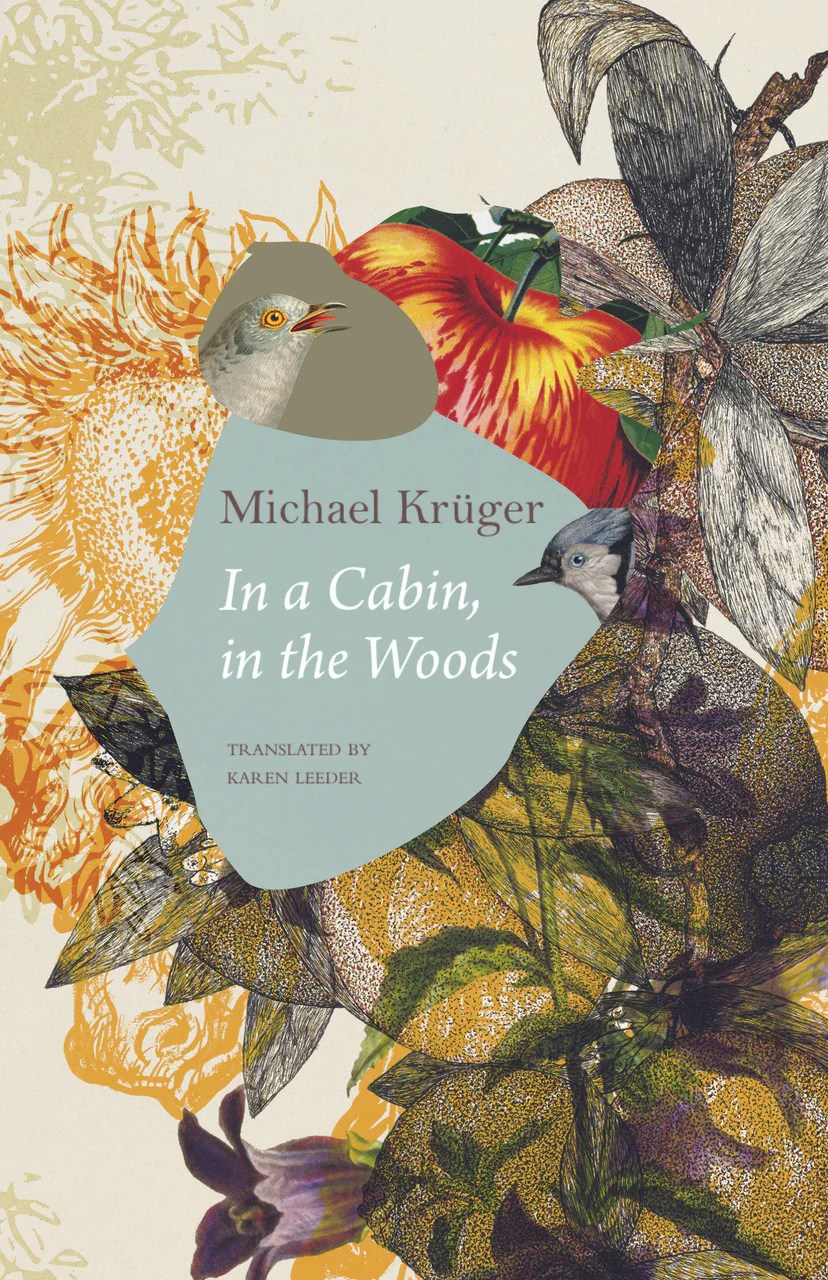 As Krüger closely watches and records the seasonal transformations around him, the activities of birds and other small creatures, he cannot ignore the news that filters in from the outside world, nor can he express his reaction to it all without reference to the writers and composers whose words and music have long been his companions. The tone is contemplative, but not without humour:
The cuckoo is back, the long-haul flier, still a little tired
from its nighttime journey over Spain, France, the Alps,
but I heard it this morning, after the news, as I stood
before the mirror asking myself whether it was still
. worth shaving;
as I greeted Cioran, Canetti and Blumenberg, all of whom
have asked this same question after the news, and the world
has nevertheless squeezed out another spring each year,
even if there’s always something missing that cannot
. be replaced,
maybugs, for instance, that were only put in the world
to serve as supper for the cuckoo.—from poem #10
The poems that comprise this sequence, with their detailed observations of the natural world, tend, in a sense, towards the Romantic. Among the many poets who are summoned along the way, it is Hölderlin who appears most frequently. Krüger even notes with regret that “Corona” has foiled plans for celebrations of the great poet’s anniversary. But then illness, his own and the virus sweeping the globe, has altered so much, suspending so many assumed certainties. The familiar rhythm of the seasons is a comfort, an assurance of continuity, but one that can only go so far. Krüger, tugging at the edges of his enforced confinement and weighed down by all the books of human history he’s consumed, ventures out beyond the garden to connect with life again, only to find himself wanting to retreat once more:
Two dogs approach me, then they stop and growl.
Dogs smell fear, my grandfather had drummed into me,
so I drive them away, shouting loudly, and return proudly
to the community of the fearful, loners and eccentrics,
who are loathe to negotiate with the strong. When the great crisis
becomes a permanent state, the third world war will have
broken out, without us noticing. The pigeons stagger about
like orthodox snobs in grey tailcoats, and two woodpeckers
cross the meadow like men of the world, as if tall grass were
a ludicrous whim of nature. I want to go back to my story
about a man who, with a melancholy gesture, gives up everything
he is and has, in order to be the most confident among all
the disappointed prophets. The sparrows seem like a barrel
. of laughs.—from poem #33 (62)
Yet, even though his specific medical circumstances arise on occasion, as do broader concerns about philosophical and political disruptions, past and present, the overall mood of this sequence is idyllic. The timeless beauty of the natural world is measured against the very real, if only half understood, reality upending the other commercial and political world that suddenly seems so present in the news, but still so far away. As he tells us, “I am one of those who came into the world old. / For me, nature should always be beautiful and terrible, / and a jay in the grass is a turning point in history” (#24). Reading these poems now, only half a dozen years after they were written, makes one almost nostalgic for the thoughtful melancholy of those early months when the everything seemed to grow quieter and the sound of airplanes passing overhead was replaced by birdsong. It is disheartening to see the way our societies and nations have become, in the intervening years, not more united and compassionate, but more divided and, in many places, hostile.
In a Cabin, in the Woods by Michael Krüger is translated from the German by Karen Leeder and published by Seagull Books.

