Everyone’s a monster: Gnome by Robert Lunday

We’re accountable for our boundaries, and for an indeterminate space just beyond—though we share that space with others, also accountable. Society’s a jostling. (“Medusa’s Head”)

In high school I worked, for a while, as a cashier at a sporting goods shop. One evening, in the middle of a busy end-of-season sale, I looked up at the mother and son standing at my till, and saw, where the boy’s face should have been, what I remember as a gaping black hole. Horrified, I completed the transaction without lifting my eyes again. As soon as it was possible I feigned illness and went home. To this day, I have no idea what manner of abnormality might have distorted his visage. I’d always been exceptionally squeamish, with a limited tolerance for the grotesque and gruesome, so there was no question that I would have chanced a second look to, as I imagine was a common reaction, stare at this oddity, even re-evaluate my initial response. Unexpected encounters with damaged or deformed faces still tend to trigger in me an aftershock, a need to find a reassurance in the ordinary:

The only thing more warped than freakishness, however, is the revulsion it engenders in the rest of us. We’re all chance images: faces in crowds, doors, wood grain or fabric bunching, the duck-rabbit or left-old/right-young lady; what if you were nothing but an optical illusion, and not a very amusing one at that? There’s a time-gravity, a pull this way or the other, such that we see only through desire or regret. Everyone’s a monster, made from looming disaster less than the real flaws that spun us into moving objects, searchers for the missing piece: the shadow-line, the peculiar mark, the curving strangeness. A lost knowledge: but beauty, specifically the remembered beauty of the Medusa, lets one inside. (“Cloverleaf”)

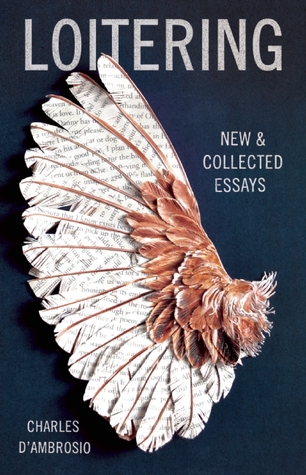
The face is the gateway, the focal point, and the fertile plain of Gnome by American poet Robert Lunday. But what, exactly is Gnome? Drawing on and incorporating literary, philosophical, and biological sources, it is a personal exploration—at once introspective and heuristic—of “face” in its multitude of meanings and implications. An existential physiognomy. Prose poetry pushing into meditative essay and back again.

The first, and to date only, book published by the inimitable Black Sun Lit, Gnome is a collection of intertextual ruminations that incorporate the words and ideas of writers and thinkers as diverse as Max Picard, Laurence Hutton, Elaine Scarry, Rilke, Yeats, Witold Gombrowicz, Kōbō Abe, and many more. Precise and considered, but never forced, the result is a series of reflections that wander from classical Greek history to psychology, from art theory to embryology. The prose shimmers with lyrical immediacy and aphoristic wisdom.

The magic of a work like this, fusing essay and poetry as it does, is the capacity to appeal to readers who might not expect to like either. But we all have faces, exist behind them, and interact with a sea of faces, real and perceived in the world around us. As such it is the ideal fundamentally human substratum through which to consider what it means to be human, to be alive in the world, and remembered in time.

The face is written by glancing phrases into a paragraph, an essay. The phrases are numerous, but much the same, after all. The face doesn’t have much to say except “I am,” “you are,” “it is” when reduced to a stare. And yet, as the world breathes around it, refracts it, ravages it, loves it, a face figures countless versions of itself into the life framed out of the mirror. I gather these figurations, save them, dissect them, arrange them in a grand monument to the fleeting visage they mark. Study the face from every angle, it becomes a cheering crowd, a thousand faces, all inklings of one face: it’s not me but my charioteer, steering one horse upwards, one down. (“The Corinthian Maid”)

Lunday’s project is essentially an open-ended phenomenological exercise, albeit with a strong Platonic edge. His task is to question—to test the instability of the lines we draw between memory and identity, internal and external reality, the embodied and the imagined. He draws on his own personal experience and observation, and builds on and around the thoughts of others, to offer reflections that we intuitively recognize ourselves.

“The atmosphere is of itself adapted to gather up instantaneously and to leave behind it every image and likeness of whatever body it sees.” (Leonardo da Vinci) The face is most often a retrospect: someone new reminds us of someone we knew before, a former friend, a type we’ve discovered in our various travels and meetings. Familiarity gradually unfolds, and the new and old faces form intersections of doubt and trust. (“Gyges’ Ring”)

Endlessly thought provoking, Gnome explores the myriad ways that “face” can be understood, but it is not prescriptive. It invites engagement. As I read it, I not only remembered that long-ago encounter with the “faceless boy;” I also thought about the way my own face—and more critically its role as mediator between myself and society—has changed over the past few decades. And I’m not referring to the inevitable effects of gravity and time. My once-feminine past is only vestigial now in the bald, bearded, unequivocally male face I see in the mirror. But which version is the mask? It depends on how you look at it.

Masks carry the bodies toward and away from one another. Spaces of association border one another; gaze and gawk interpenetrate, and meaning forms from our spontaneous, physical responsiveness to each other. The limit-experiences: insomnia, fatigue, erotic life, birth and death, wisdom.

In my face, my life as a theatre of one.

Ever tried. Ever failed. You know the drill. August 2017, the month that was.

As August draws to a close, and September opens, I have some thoughts about the pressures of prescribed reading and the complicated emotion of loss.

Joseph Schreiber 2017

At the outset of the month I pulled out a selection of potential books to choose from for Women in Translation month. I knew that with several review related reading projects underway I was unlikely to get to more than a few titles. I managed three: one of my must-reads (Carmen Boullosa’s Before), one that was somewhat disappointing (Kjersti A. Skomsvold’s The Faster I Walk, The Smaller I Am), and one late addition (Isabelle Eberhardt’s The Oblivion Seekers). However, I found that many of the books I tried to pick up did not work at all for me— that is, they were not right for right now. Feeling that I ought to try to manage one more before the month was out I found myself frozen, almost unable to read anything… I had to stop and remind myself what such reading projects are all about.

Raising the awareness of the fact that fewer female writers are translated is important, as is celebrating the terrific authors who may not be well known. It never hurts to look at one’s reading habits and challenge one’s self. But it is another thing to get stressed and defensive. And that is what happens when I start to measure my reading by gender. I will admit, more male than female authors line my shelves. I have addressed this fact before in other posts. I also wrote about how for the better part of two decades I read almost exclusively female writers in an essay for Literary Hub last year. For a long time, I hoped that by filling my head with female voices I would find my own. And, of course, I never did. The sense of myself as male was unassailable. Seventeen years ago I set off on a course to realign my presented and internal gender. And here I am.

At this point, I like to think that the gender of the authors I read is secondary, although I will admit to a growing need to connect with gender-queered and gender non-conforming perspectives. Most specifically I am drawn to writing that is challenging, exploring style and form. In recent months, some of those writers have, in fact, been women in translation—Fleur Jaeggy, Can Xue, Marie Ndiaye. Before next August rolls around again I am certain there will be more. And I know for a fact I will be turning to some intriguing experimental female writers writing in English. But, as a person with a differently gendered history, gender is a complicated, messy space of being. Whenever I start to feel the burden of gender pressing on me from the outside, the existential anxiety (and anger) that haunts me is stirred.

So, let me read—as and how I need to read.

But my own self-imposed reading ambitions are not the only pressures that have weighed on me this past month. My brothers and I listed our parents’ house and it sold within one week. With the possession date looming we made several trips to clear the house out and, on the final visit, I found my mother’s nail file. She carried this file with its ivory coloured handle and tattered red plastic sheath for decades. Just looking at it I see her hands. It is perhaps the single most important keepsake I have. More than anything it reminds that she is well and truly gone.

When I first came out to my mother, back when transgender was just beginning to draw some serious public attention, she asked for some time to process what I had shared, but promised that she loved me unconditionally. And she never let me down. She was my advocate, my best friend, the one person I could call for comfort and reassurance, no matter what. I was otherwise alone. There were no local supports, I faced the challenges of being a single male parent of two children with learning disabilities, I experienced a breakdown, the loss of a career, and a life-threatening health crisis. Even though she was unable to travel far near the end, she phoned me every week without fail, and I spent as much time as I could with her and my father in their final months.

When my parents died last year, my mother’s death opened an intangible void.

My parents’ house. Our last day there.

I did, however, still have one faint, yet vital lifeline—a friend in South Africa, the closest queer friend I have ever had. Bookish and bipolar, like me, she was a sort of soul mate even though we only met in person once when I visited her in 2015. But as I was tumbling, she was falling further and farther. One year ago today, September 1, Ulla took her own life. Images of the rugged Indian Ocean shoreline near her home have been seeping into my dreams. As we spread our parents’ ashes before leaving their property for the last time, all I could think of was Ulla’s being spread on the beach. I couldn’t touch the urn. My son spread my share.

Eastern Cape, South Africa

Suddenly I am doubly aware of how alone I am. How alone I have been and how weary I am.

The intersection of Pride Week, rather than providing a distraction, exacerbates the sense of loss. I cannot imagine anything lonelier than a mass of shiny happy people. I did excuse myself from the volunteer commitments I had made and now I am free to avoid the parade as I usually do. I also happened to have a doctor’s appointment so I spoke to him about my recent depressive dips and my frustration with the reality of long-term trans loneliness that nobody talks about, that isn’t fashionable, that doesn’t fit the script.

Sometimes loss feels less like a temporary passage, than a layering, compounded, defining quality of life.

Welcome to my closed space reality:

All of old. Nothing else ever. Ever tried. Ever failed. No matter. Try again. Fail again. Fail better.

And so on.

Note: I should have included a link to the requiem I wrote for my friend. This piece was published at Sultan’s Seal last November, is constructed of salvaged language, and features photographs from my visit to South Africa.

I have no pride: A sombre reflection

I have no pride.

It’s Pride Week here. For me it’s the worst week of the year. An opened wound. I wake with chest pains, panic attacks. Always the same. No. The more I try to get involved the worse I feel.

I have been out for nearly twenty years, but I always feel out of place and alone during Pride.

And each year is more difficult. I have no pride.

I used to believe that it would get better. Then I believed that it didn’t matter. But it hasn’t gotten better. And it does matter.

Things have changed. I have changed.

Yet I’m not sure if the cost has not been too high.

I no longer know where I belong, my body and I.


Remember, Body

Body, remember not just how much you were loved,

not just the beds where you have lain,

but also those longings that so openly

glistened for you in the eyes,

and trembled in the voice—and some

chance obstacle arose and thwarted them.

Now that it’s all finally in the past.

it almost seems as if you gave yourself to

those longings, too—remember how

they glistened, in the eyes that looked at you,

how they trembled in the voice, for you;

            remember, body.

                              –C.P. Cavafy (tr. Daniel Mendelsohn)


A few thoughts about July 27: The days that haunt us

It is, in my time zone, still July 27th, and all day I have debated whether I should call attention to what this date means to me.

For many years, July 27th was, quite simply, my wedding anniversary. Celebrated with affection for years and then, as my marriage became increasingly untenable, barely noted in passing. Since my marriage ended the date typically passed like any other, but every now and then something would occur that caused me to remember the distant significance of the day. Like a fading echo down the years.

Today, my brothers and I accepted an offer on our parents’ house—just shy of one week after it was listed, just over one year after they died. Good news given the poor economy and the less than prosperous state of the village they lived in. But, money and estate matters tend to stir up family tensions. A testy conversation earlier this morning has left me feeling defensive, angry even. And no matter how hopeful it is to be one step further in the process of moving beyond the aftermath of our parents’ unexpected and overlapping deaths, it is not easy.

But the July 27th that I cannot even begin to address involves another encounter with death. My own.

Two years ago today, shortly after midnight, I went into cardiac arrest. I have written very little about this episode because I have no memory of the incident or the days immediately before or after. It has been difficult to process this event, or what it means. The cause was a pulmonary embolism, likely related to travel. I survived because my son happened to hear me, called emergency, and started CPR. But it’s not that simple. Family dynamics again.

Several times I have contemplated writing through the trauma. Try to understand why I survived. What it means.

If this near-death experience had gifted me some magical insight into the preciousness of life, I could write one of those finely crafted inspiring pieces filed under the category: Creative Nonfiction.

I have tried. That’s not my style. I am beginning to understand that my life only makes sense in scraps and fragments, even more now than ever.

I am forever in the process of writing myself into being.

 Time to gather those scraps and fragments.

Image copyright Joseph Schreiber, 2017

One year on, thoughts about loss, and a link to a piece I wrote for my mother.

This afternoon I was out in the yard. My overgrown mess of saskatoon berries and renegade daisies revealed random branches laden with nanking cherries. Last summer, July was a blur—wet, grey, and grim. My mother died on the 9th, she slipped away quite rapidly while my brothers and I were focused on the state of our father who had received critical injuries in a car accident.  A year ago today we were watching him slowly fade. By the 20th he was also gone.


It has taken a full year for the loss to begin to feel real. Their house is now clean, repaired and ready to be listed. None of us, not even their grandchildren are particularly attached to this rural dwelling where they spent the last six years of their lives. Now, more than ever it feels like a shell, hollow.

I grieved my father as I dissembled his library. I had to travel to central Australia to begin to grieve my mother—and that process has only just begun. It started with a dream. She came to me and lingers with me as an absence.  This weekend my first effort to verbalize this absence was published in RIC Journal along with altered images from my time in the red centre.

You can find it here. With thanks to Saudamini Deo.

Last minute solstice check-in: The gift of the outback

With one hour left, in my timezone, to the longest day of the year, I have decided to forego the solstice updates I have written for the past three years. On this day in 2014, I found myself unable to work and facing the fact that I had become very ill under extreme workplace stress. A job I loved was no longer mine and years of living a deeply closeted existence left me without a close friend to turn to.

Three years later, I have a job interview tomorrow morning for a position that, should I be fortunate to get it, would involve outreach and advocacy within and beyond the LGBTQ community.

When I left for Australia in May I carried three personal objectives. One was to challenge myself physically. The second was to open channels to the grief I am carrying. The third was to seriously reflect on my ongoing disconnection from queer community. Each one of these goals was met, albeit in ways I had not anticipated. I returned changed in small but profound ways.

I came back carrying the outback in my soul. There is hardly a day that I wake up without dreaming about being in the red centre. It is in my system and the experience of the place and the people has coloured the way I see and want to live here, back at home.

Today, on summer solstice in the north, winter in the south, that is all I want or need to say. Except that, appropriately, this is also Aboriginal Peoples Day (renamed Indigenous Peoples Day) here in Canada.

Another year of roughghosts has passed, my blog is three years old

“be a ghost gum rising from the waterhole in each heart”
— Rico Craig

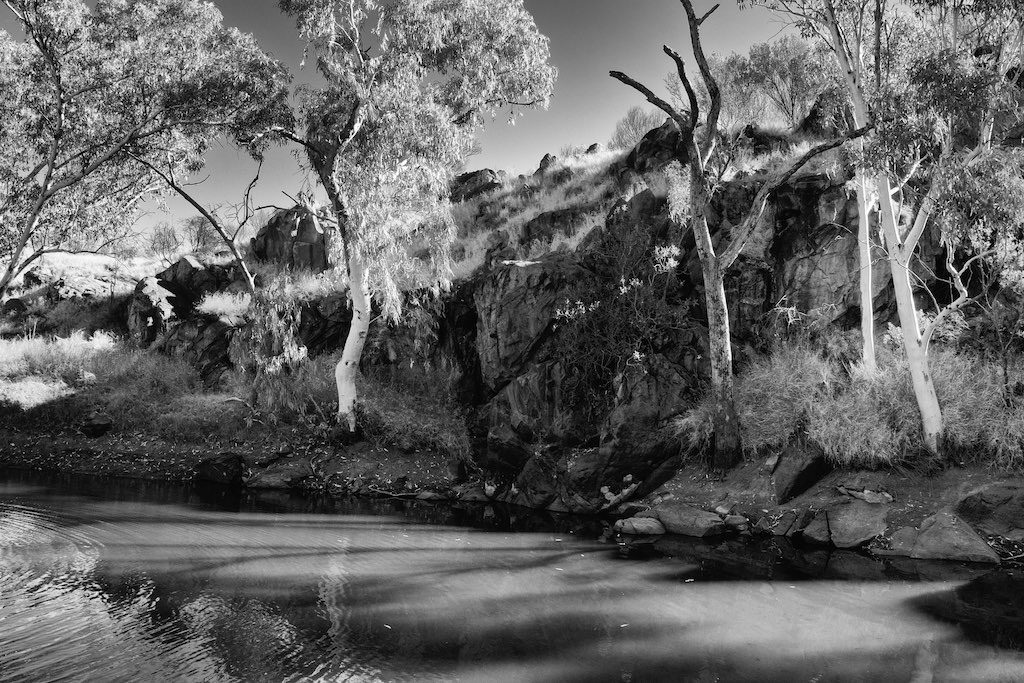
Birthday Waterhole, in the photo above, is perhaps the most stunning and isolated campsite we stayed at along the Larapinta Trail. The line, quoted from Rico Craig’s newly released collection Bone Ink, seems to me to capture so much of the past three weeks—from my own peculiar challenges with walking (or more often, not walking) the trail, through to lunch with the poem’s author on my final full day in Australia. But more about all of that later. The key word at the moment is birthday.

A few days ago, WordPress kindly reminded me that my blog is three years old.

The past three years have been marked by tremendous growth for myself as a writer, amidst loss, trauma, and great adventure. What continues to amaze me is the degree to which the internet, for all its shortcomings, is able to connect people across the miles. Over this past year, many of my casual blogging and Twitter contacts have grown to form a rewarding and productive creative environment that I value very deeply. But it is always a special treat to meet an online friend face to face.

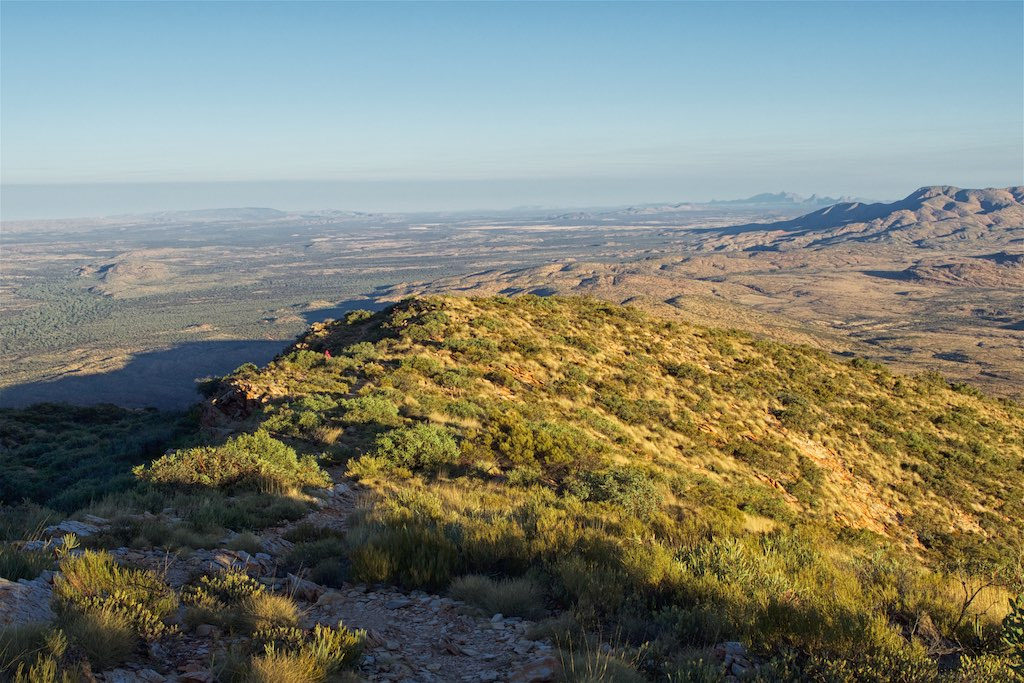
My recent trip to Australia was instigated by an invitation from a fellow book blogger to join his annual “Larapinta Extreme Walk” in support of the NPY Women’s Council in the Northern Territory. Unfortunately, I arrived with what soon developed into a severe head cold that still lingers, tinged once again with jet lag, as I write this. I’m still processing my disappointment at not even being able to know how I might have managed the trail under healthier conditions, but the experience was incredible and invaluable nonetheless, and everyone was so friendly and supportive. I will write about it at greater length in a few weeks time and share more images of the incredible desert landscape.

After two weeks in central Australia I spent a few days in each Melbourne and Sydney. I met with five online contacts during that time, including a long-time friend from the Pentax Forum (a camera as obscure, relatively speaking, as my literary interests tend to be). Every single encounter was wonderful in its own way. Strangely, online banter clears away the space for good solid conversation of the sort one is often at loss to find in the communities we regularly exist in. Naturally, a strong common interest tends to set the course.

So today, as I look back on three years of blogging—and my subsequent forays into Twitter and to a lesser degree, Facebook—I am especially cognizant of how much warmer and richer my world has become. And not only have I been publishing my own original writing beyond this space, but when I suffered a series of losses last year with the deaths of my parents and a dear friend, the outreach of sympathy and support far exceeded anything I received in real life. Which is both heartwarming and sad when you think about it.

I won’t make any predictions or set any goals for roughghosts in the year to come. I don’t want to be reckless or foolhardy in my ambitions. This blog is, first and foremost, a forum where I can call attention to books I read, without necessarily indulging in the rigour I apply to critical reviews for publication elsewhere. It also provides a space to exercise my writing skills and toss out ideas or work through emotions that are troubling me. The beauty of a blog is that you can directly track the response and reaction to your work—you have a sense of the book reviews that draw readers and the musings that resonate with others. That feedback is vital. I imagine that this will remain the primary purpose of this project.

At the moment though, I have four books I’d like to write about here, and a review to prepare for Numéro Cinq. And after months of battling writer’s block, I find that words are starting to flow again, so I am hoping to carve out some time to write and work on ongoing projects of my own.

And that seems as good a way as any to celebrate three years of roughghosts.


* Image copyright Joseph Schreiber, 2017

On my nightstand, a selection of current touchstones in lieu of a personal canon

I have been on Facebook long enough now that I have begun to get those sunny reminders of what I was up to one year ago. Yesterday I discovered that it has been a year since I published my first piece of personal creative writing. The essay, Your Body Will Betray You, remains pinned to my Twitter timeline and continues to generate conversation. Readers have found it informative, inspiring, and, in one important case, a ground for opening a conversation that had been unspoken in that person’s life. And that particular response made baring a piece of my soul like that worth it. A writer may write for him or herself, or to entertain or educate, but to speak to the very core of one reader who needed those words more than anything… that is a gift.

My most recent piece of writing to be published comes deep within the pages of the new issue of The Scofield 2.2: Conrad Aiken & Consciousness. This issue marks my first opportunity to edit the work of other writers—a tremendous honour and thrill, with deep thanks to Tyler Malone and Dustin Illingworth for their faith in me. Putting a publication of this size and scope together is an enormous task and my role is a modest one, but I am proud to be involved. My written contribution is even more modest. I wrote several hundred words about Damon Galgut’s In a Strange Room for the “On Our Nightstand” section (it’s on page 287 if you care to have a look, the issue can be downloaded for free and has a wealth of good reading). In this piece I talk about my evolving relationship to this book by one of my favourite writers. I turned to it as a possible avenue into the task of writing about one’s self—which, for me, after more than a decade of deeply closeted existence and a life lived in two genders, seemed terrifying and overwhelming.  Galgut’s attempt to record three distinct experiences in his own life was so spare, so translucent, that I could not begin to imagine taking an approach like that to my own. In the end he comes to believe that memory necessarily fictionalizes our “truths.” I am, at this point, closer to and yet less troubled by that conviction than I was three years ago when I started to understand that I needed to write. I go back to In A Strange Room often. As I say in my Scofield piece:

This book has become one of my touchstones, an elegant example of the way personal experience can be pared down to its essentials and explored through the lens of time and memory. It remains, for me, some of the most meditative and precise writing about what it means to be grounded, in one’s self and in relation to others; the allure of the road and the ambiguity of home; and most vividly, the way that all truth lived is, in essence, a fiction.

In other words, if I had a personal canon, which I would argue I don’t, this book would be on it. And I do keep it on the shelf inside my nightstand.

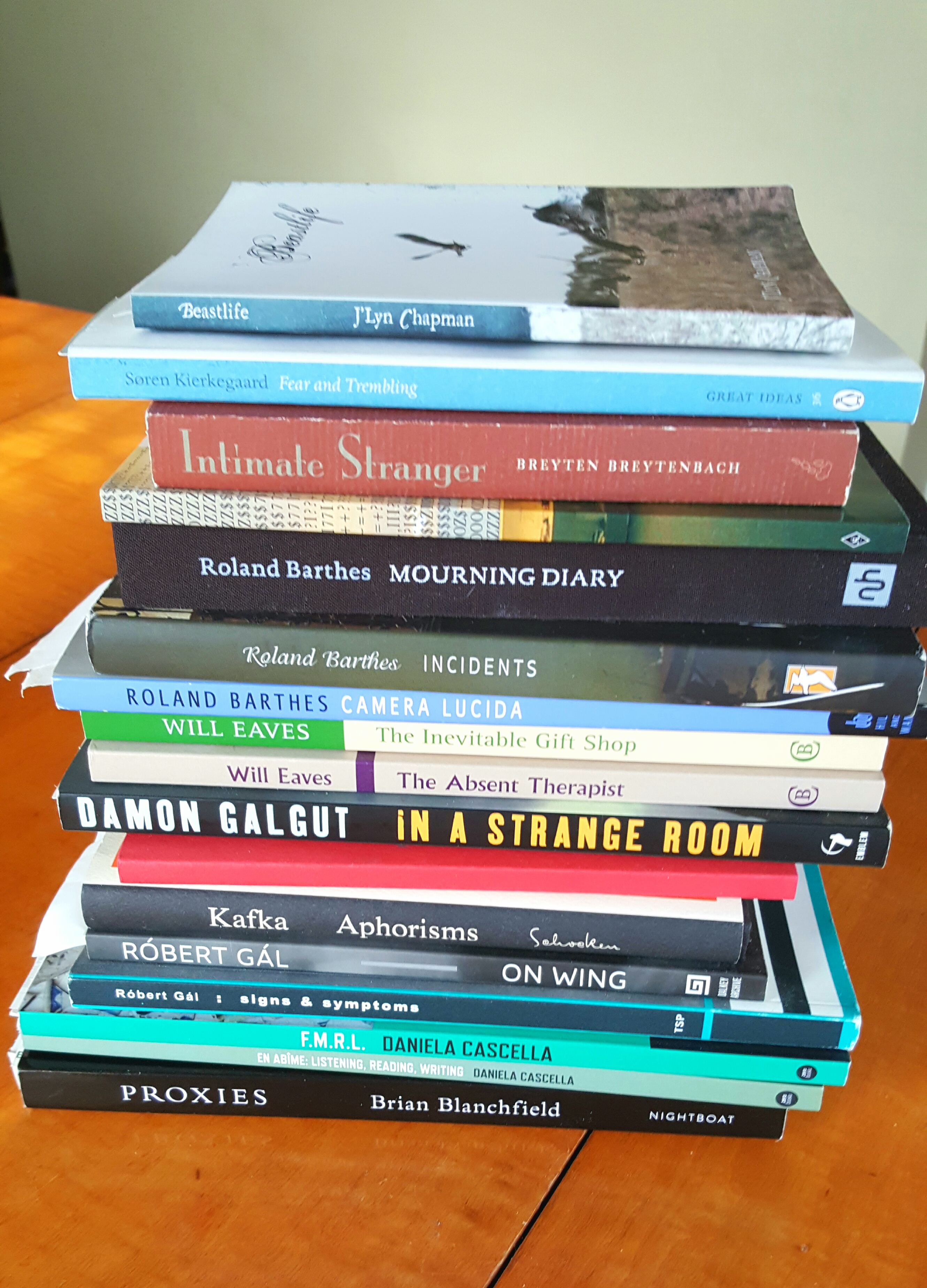
In the past few years, as writing has become more urgent, my reading has become more explicitly targeted. I am especially drawn to smaller, quirky, experimental works and, in many cases, books by people I have been fortunate enough to come to know—writers who have become part of a virtual network people who inspire me and suffer my creative ideas. The majority of those books are literally on (or technically inside) my nightstand. In lieu of a personal canon, here are the books that are currently fueling my literary scribbling. (Links to reviews, if applicable)

Beastlife by J’Lyn Chapman — I am always on the lookout for unique approaches to the personal essay. I have a large selection of books waiting to be read, but this little meditation on life, death and taxidermy is a treat.

Fear and Trembling  by Søren Kiekegaard — Well, just because.

Intimate Stranger by Breyten Breytenbach — This is a collection of essays and poems to a young poet. I ordered it when I came back from South Africa; it arrived when I was in the hospital recovering from cardiac arrest. I’ve mentioned and quoted from this book several times, but the post I’ve linked was written shortly after  I returned from the hospital. It addresses one of the key concerns—loss of a memory—that I am taking with me into the outback this month.  Reconciling one’s own near death is no small matter. I carry it deeply and have not yet found a way to write it out.

Thy Decay Thou Seest by Thy Desire by John Trefry — This little caprice or, as we’re advised, “Meditations for Sedentary Labourers,” is so delightfully eclectic that I found in it inspiration for an experimental project that, in contrast to the deeply personal work I write, will allow me to distance myself from the salvaging of the language I use and, depending on the constraints I set, some of the construction. I am proud to count John among the writer friends the internet has afforded.

Roland Barthes: Mourning Diary, Camera Lucida, and Incidents Three works that intersect for me, at a personal and literary level at this moment. Incidents, may well be one of my very favourite Seagull Books as well.

Will Eaves: The Absent Therapist and The Inevitable Gift Shop. Experimental, insightful, and devoid of pretension. Fragmentary works fascinate me. It seems to be a bit of popular device lately, but in my mind, these books—one fiction, the other essay/memoir—work very well. Eaves has a presence that is immediate and personal, he is good company.

In a Strange Room by Damon Galgut (see above)

The Surrender by Scott Esposito — This is one of those books I watched and waited for. I am cautious about trans themed writing but I knew this one would be different. This book holds infinitely more for me than I included in my review. My reading of this book coincided with the release of my own Minor Literature[s] essay, and the beginning of a valued friendship.

Aphorisms by Franz Kafka. Yes, I also love The Castle — one of the few books I own in multiple translations, but this is the Kafka I need to have close at hand at the moment.

Róbert Gál: Signs & Symptoms and On Wing — When I was first looking for a way to begin to write about my life and experiences, I was looking to fiction. But in defiance of conventional narrative form, I wanted current, accessible, experimental models. I read In A Strange Room and The Absent Therapist in late 2014 but it was almost a year later when I picked up On Wing. It remains a book that I read all the time, it has impacted my thinking in ways I cannot describe (because we ideally absorb and filter the work that drives and inspires our own—it should not be obvious in the final product) and Róbert was one of the first writers to suggest I should write a book. I don’t know where that book is, but it is no accident that a quote from On Wing opens Your Body Will Betray You.

Daniela Cascella: En Abîme and F.M.R.L. It may not be evident, but getting to know Daniela and her work has revolutionized the way I engage with language. Her enthusiastic approach to reading, listening and hearing work into being is wonderful. I find I am so much more attuned to sound when I read now. Maybe it will come through in my own writing one day.

Proxies by Brian Blanchfield. Again, this is another work that asks questions and contains ideas that are important to me. Essays that make me think about writing essays are my favourite kind.

If there was enough room, W.G. Sebald’s The Emigrants and Austerlitz would also count as work of current relevance. (They would probably be in that non-existent canon too, if I had one.)

Looking ahead to adventure, challenge, and healing

As I write this, it is mid-afternoon on Saturday, April 15, and it’s +3C with light snow. I am truly quite finished with this endless, last gasp of winter. In one month’s time I will be in Australia (where it will already be the 16th and, if all goes well, the “extreme walk” into the outback I have traveled to take part in will be well under way). I am excited and a little nervous about the challenge ahead, but above all I am looking forward to being “off the grid” for the better part of two weeks with plenty of time to process some of the internal baggage I’ve been carrying as I undertake this long and demanding journey into a landscape I never imagined I would have the opportunity to experience.

Some of my regular readers may know that two years ago, following a trip to South Africa, I nearly lost my life. I should have known better, but I was sorely ill-prepared for the effects of extended travel on planes and buses. I did everything wrong and failed to recognize the warning signs of impending danger. After surviving this critical event, I found myself afraid of risking extensive physical activity, even after receiving a clean bill of health on all counts. This is, I learned, a not uncommon, if misguided, response.

One of my first longer training sessions.
Better weather earlier this week. Did not last.

Naturally, I ended up hopelessly out of shape. In pushing myself into an enthusiastic training regime earlier this year, I soon found myself with an inflamed bursa and torn meniscus on my right knee. Cue the physiotherapist. My knee has responded very well—I am walking without pain for the first time in months and now, if only the weather would cooperate just a little, I will be as good to go as I am likely to be.

Which will hopefully be good enough.

This little venture is a mere 223 km/11 day hike over mountain ranges. What could possibly go wrong? (Don’t answer that!) If you are interested, I invite you to check out the site—the Larapinta Extreme Walk is a fundraising event created by fellow book blogger Tony Messenger (Messenger’s Booker) in support of a vital Aboriginal women’s initiative. Donations can be made if desired; every little bit helps.

Where I’m heading to. From: http://www.larapintaextremewalk.com.au/

As much as I am looking forward to this experience as an opportunity to reflect, grieve, journal and, with luck, open up the writer’s block that has dogged me these past few months, I am also very excited to have the opportunity for some serious bookish conversation along the way. And before I head home I will have a few days each in Melbourne and Sydney, where I already have tentative plans to catch up with other readers and literary-minded folk, as well as an online photography friend I have known for years but never met.

So wish me well as I continue to train, and as I get the reading, reviews, and writing I’m presently committed to completed in advance of my trip.

Looking back in anger: A personal reflection on World Bipolar Day

You might as well haul up
This wave’s green peak on wire
To prevent fall, or anchor the fluent air
In quartz, as crack your skull to keep
These two most perishable lovers from the touch
That will kindle angels’ envy, scorch and drop
Their fond hearts charred as any match.

Seek no stony camera-eye to fix
The passing dazzle of each face
In black and white, or put on ice
Mouth’s instant flare for future looks;
Stars shoot their petals, and suns run to seed,
However you may sweat to hold such darling wrecks
Hived like honey in your head.

—from Sylvia Plath, “Epitaph for Flower and Fire”

I have known mania, and the imagery in this poem sparks with an intensity that excites and disturbs. When I encounter the words of one of the many poets known (or thought) to share (or have shared) the same affliction, I often find an undercurrent that causes me to flinch for just a second. Not that it diminishes the beauty or power of their words in any way—it is rather an echo in the dark, a faint recognition flashing by.

Image copyright Joseph Schreiber, 2012

It is World Bipolar Day, and this is the first time I have stopped to recognize the fact. I have spoken in, and around, my own bipolar diagnosis, but I have never addressed it formally in my writing. Even now I find myself uncomfortable discussing it. On the one hand, I am fortunate. I respond well to medication. I am, to use that distasteful term, “high-functioning.” But I do harbor a deep anger toward this condition that was part of my life many years before I finally careened through a brutal month of manic psychosis and found myself committed, and ultimately diagnosed, at the age of 36. I was, in classic bipolar fashion, the last person to suspect that I had a mental illness. Even though I, and those around me, knew something was terribly wrong, the stigma and lack of understanding around mood disorders—not to mention the radically impaired insight the sufferer has when they are ill—stands as a barrier to timely intervention. And then there is the matter of actually accessing care. One almost has to crash completely—by which time it can be too late.

Between my first manic episode in 1997 and the second in 2014, I experienced more than sixteen years of stability. I transitioned, became a single male parent, built a career out of nothing, and eventually became the Program Manager at an agency dedicated to working with survivors of acquired brain injury. I loved my job. Looking back, I can now see how the last few years of that period were marked by an increasing tendency toward hypomania. With my psychiatrist’s support I cut my medication back. And then things started to fall apart at work—things beyond my control, but it fell to me to try to pull things together. Then I started to fall apart at work, until I spiraled into full blown mania. Not psychotic, but it matters little. The damage was done.

The agency I worked for, dedicated as they are to supporting clients with disabilities including co-morbid mental illnesses, treated me with distrust bordering on contempt. My only contact with them has been conducted through a workplace advocate and my insurance worker. When return to work was discussed they refused to consider any possibility that I could work there again. Almost three years later with long term disability finally at an end, they still have my personal belongings.

Nine years of employment and dedication to that job now stand as a gaping hole in my life—a life already filled with gaping holes. And that is one of the reasons I hesitate to talk about mental illness (although I have never hidden my diagnosis). What can I say? Bipolar is not my identity any more than transgender is. Both fuck up your life. Leave wounds that do not heal. Find you fumbling through mid-life with little to show for your years but a lot of things you can’t talk about. And periods of time you cannot even remember.

So this is why I find it hard to write about my experience with mental illness. There was a time, following my diagnosis, that I devoured everything I could find, just as, a year later I hunted for books on gender identity. Two pieces of a puzzle I had inhabited—the periodic mood swings and the persistent, life-long feeling that I was not the female person everyone else knew me to be—had finally fallen into place. I had two, if you wish to be specific, explanations that come neatly labelled and defined within the covers of the DSM. It was, for a while, a source of relief.

Today I rarely read any literature that deals with mental illness or gender. But I am aware, more than ever, of being doubly stigmatized. And, most painfully, within the spaces where you would expect acceptance—in the human services profession and within the queer community. Thus the anger.

And what is this anger? Grief. The deep griefs I carry, layered now with more recent bereavements. It has become, for me, an existential bitterness that plagues me, an inauthenticity that defines the way I intersect with the world.

The legacy of mental illness is this: after diagnosis I was advised not to dwell on the disease, not to talk to others with bipolar; I was not deemed “sick” enough to warrant outpatient support or psychiatric follow up. I was left, like so many others, to flounder in the dark. It would take seventeen years and a spectacular career-destroying crash before I was able to access proper psychiatric and psychological support. I am still lucky. I am stabilized. And the forced detour into what may become an early semi-retirement has afforded me a space to write.

Now I need to find a way to write my way through this weight of grief. And begin to heal.

I’ll leave the last word to Sylvia Plath, with the final (fifth) stanza of the poem quoted above:

Dawn snuffs out star’s spent wick,
Even as love’s dear fools cry evergreen,
And a languor of wax congeals the vein
No matter how fiercely lit; staunch contracts break
And recoil in the altering light: the radiant limb
Blows ash in each lover’s eye; the ardent look
Blackens flesh to bone and devours them.

—You can find out more about the International Bipolar Foundation here, and a prose poem I wrote to honour a dear friend who lost her desperate and brave battle to bipolar last year can be found here.