“I wanted to bind up a wound”: The Pastor by Hanne Ørstavik

Who was I? Everywhere I went, something broke or became distorted. What had I thought? That by travelling to somewhere else on the map I would arrive at some new place in myself? A place in me that was good and warm and worthy of love?

Set deep in the endless night of an Arctic winter, The Pastor by Norwegian writer, Hanne Ørstavik, is a novel that pushes into that darkness—on an emotional, spiritual, and historical level—in search of some glimmer of clarity, some sense of meaning in an uncertain, insensible world. Yet, rather than reaching any absolute truths, the internally focused narrative rides on a current of relentless speculation and questioning, becoming a melancholic testament to the inadequacy of language to isolate and contain our thoughts and feelings, and the barriers we often erect that keep us from being able to communicate what cannot be articulated in words. Yet out of this sombre landscape emerges a tale of quiet beauty.
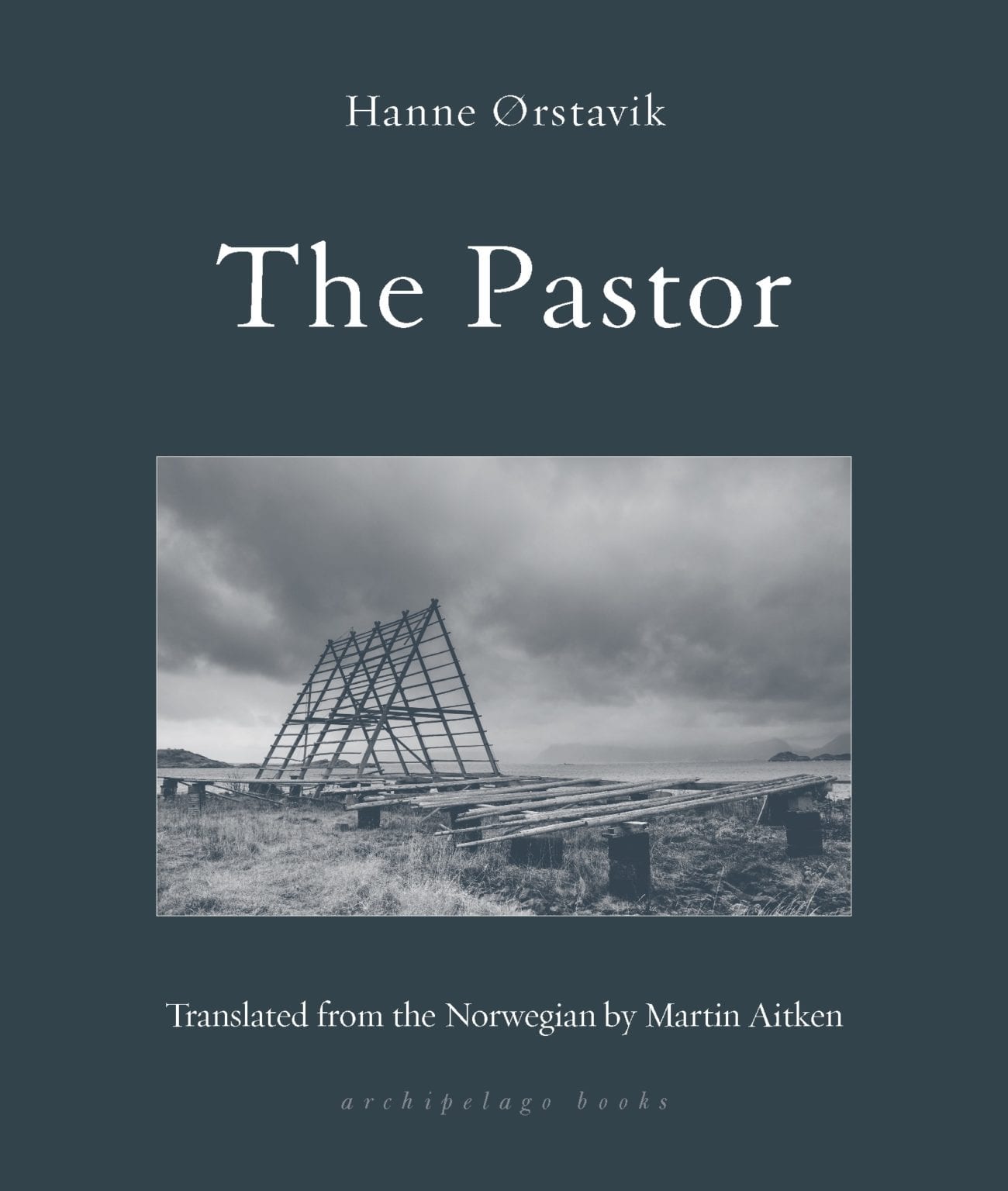
The troubled narrator, Liv, is a theologian who has abruptly abandoned her PhD studies in Germany, following the tragic death of her friend, Kristiane, and accepted the position of adjunct pastor in a small town in the far north region of her native Norway. When we meet her, she has been in this new role for one year. She seems to have achieved a certain state of equilibrium with her skeptical parishioners, and a companionable relationship with the recently widowed woman she has invited to live on the main floor of the parsonage with her two daughters. As well, the relative proximity to the site of the 1852 Kautokeino Rebellion, the Sami uprising against Norwegian settlers, allows her to continue her longstanding academic investigations into the events and the role the understanding of Biblical language might have played in inspiring the Sami’s attack. But it has not been easy. Her brief friendship with Kristiane and the circumstances surrounding her suicide continue to haunt her while she worries that she will always be an outsider, emotionally distant from others and from God.

Unfolding over the course of one week, the novel opens with our unlikely pastor officiating communion. Her thoughts go back to Kristiane, to her decision to move, her hopes for her new home, and the very unfortunate first impression she made in the church. This continual cycling of memories, sometimes shifting from present to past and back in the same paragraph, drive the narrative forward, slowly filling in more of the details, discomforts, and unresolved doubts she carries. An imagining of the Sami rebellion, augmented with historical records, is also woven into the broader tapestry. In the present moment though, it is a call to attend to the parents of a suicide victim, a nineteen year-old girl who has hung herself from a fish drying structure out on a barren piece of land, that triggers Liv’s immediate crisis of identity and faith. By the end of the week, she will have been tested, or rather, will have tested herself against a variety of circumstances that she  struggles to meet.

The challenges Liv faces all revolve around her inability to physically bridge the gap between herself and others—to reach out a hand to a grieving parent, respond to a man to whom she is attracted, recognize signs of depression in someone close to her—a skill she perhaps imagined the priesthood would magically confer upon her. She recognizes what she wants to do or say, imagines it, but fails to follow through. Again and again. Key to understanding her crippling inhibition, she believes, is her brief friendship with Kristiane. At forty-one, seven years her senior, the German woman was a puppeteer with her own workshop and theatre. A definite counterpoint to the serious theologian. Liv saw in Kristiane a lightness of spirit, and an apparent self-confidence that she craved. She seemed at ease in her body and her being, quick to laughter, her crooked teeth flashing—an image Liv cannot forget. They only knew each other for forty days, but Liv is obsessed by the fear that she failed her friend:

Weightless. I was so heavy myself, and all I saw in her was what I needed. Was that it? I didn’t realize that the light in her was turned up too bright, like a film going completely white until the image disappears. Was that the way it was?

If she was aware of an intrinsic “heaviness” before encountering Kristiane, her death untethers her completely. She carries this disconnect with her all the way back to Norway. Recollecting the long drive north she says:

I drove slowly. The flat, open vista seemed to make everything so plain, but still felt like I couldn’t get a hold on anything, as if I was so very far away. The road, stretching out in front of the car, the landscape, the steering wheel I gripped between my hands. My mind was a haze, as if there were no thoughts left to think. It was like I was driving over the back of some great beast that could get to its feet at any moment and shake me off. I wasn’t attached to anything, wasn’t a part of anything.

Liv is wounded. She is ever aware of her failure to connect, feeling outside, separate. She reminds herself that she is a pastor, that people depend on her for comfort, and then wonders again whatever possessed her to choose the ministry as a career when she herself is so uncertain, so ungrounded, so afraid that she will fall and that there will be nothing or none there to catch her. Isn’t that what everyone needs to have? Some kind of faith?

As it moves through the vast, eerily lit northern Norwegian landscape, The Pastor relies on the reader’s ability to connect with a protagonist so estranged from herself. Some might find Liv frustrating, but in its winding, lyrical passage, her narrative contains great depth and mounting tension. As someone who has experienced difficulties with mood regulation, I found Ørstavik’s portrait oddly familiar. I was not surprised to hear in an interview that the author was coming out of a serious depression when she wrote the book almost twenty years ago—she captures the disjointedness of thought so well. And it’s a sensation most people have probably known at some point or another. For example, when Liv is rushing back to town having learned of another tragic incident, this one much closer to home, her thoughts are suspended, frozen: “I tried to think about what I was thinking about. My thoughts wouldn’t think.”

Martin Aitken’s sensitive translation maintains an atmosphere of profound longing for connection and contact, for the touch to fill the unspeakable space, a gesture that can be so hard to give or accept. That is at the core of Liv (and her name means “life”)’s existential discontent. There are many unanswered questions in The Pastor, but small cracks appear and spread slowly, and there is the hope that what one tragedy broke open, a second tragic occurrence a year later might finally begin to heal.

The Pastor by Hanne Ørstavik is translated by Martin Aitken and published by Archipelago Books.

The seasons of love and death: The Year by Tomas Espedal

When something hurts
you shouldn’t avoid it
no
you should meet the worst
with all your weakness
and allow yourself to be destroyed.
You should seek out loneliness
to feel that you are alone
to feel that you are desolate
to feel that you have loved
to feel the love
that can obliterate you entirely.

Norwegian writer Tomas Espedal’s uniquely autobiographical fiction rests close to his own life. From one work to the next, his narrator, ever aging as he does, is restlessly questing, his explorations at once intimate and yet maintaining a certain personal distance, or opaqueness. In his last book, Bergeners, his protagonist, in his early fifties, is seeking to understand the meaning of home as he tries to adjust to both the departure of his adult daughter and the unexpected loss of his girlfriend. He wanders the streets of his hometown and travels abroad, but cannot escape the deep loneliness that settles into his bones. Now, with The Year, his most recent work to be released in English, a few years have passed but Espedal’s fictional Tomas has been unable to let go of his love for his former girlfriend, Janne, and now, wondering if he is destined to spend the rest of his life alone, he seeks advice from another man who loved only one woman, from his first sight of her to the end of his life—Francesco Petrarch.

Thus, The Year begins on a meditative, melancholy note. Our narrator states that he wants to write a book about love, with the initial objective to record the events of each day for an entire year. Ah, but where to start? He decides upon the sixth of April, which is, appropriately, the day in 1327 when Petrarch first set eyes on his beloved Laura, the date in 1348 that she died, and the framework within which he structured the 366 poems that comprise his great Canzonniere—his celebration of his boundless affection for the woman he loved so faithfully, from afar and forever. So, on the sixth of April, seven centuries later, another lovelorn man is making his way by train to Avignon, and then by foot to Fontaine-de-Vaucluse to stay for a time near the house that Petrarch built there. And we are with him, riding along on the flow of his thoughts. Bergeners combined a mix of fragmented poetry and prose, but The Year is a novel written entirely in free verse, a compulsively readable style that very effectively captures the protagonist’s reflective, frequently repetitive and increasingly neurotic consciousness.

Having already spent a year immersing himself in Petrarch’s writing, the narrator is on a sort of pilgrimage. If the Italian poet could love so completely and purely, he must have known something about living with the one he loved. After several weeks living in the area, it is time for him to approach the master directly. On Easter Sunday, an imagined encounter and walk along the river occurs, echoing the Petrarch’s imagined discourse with Saint Augustine recorded in his deeply personal Secretum. They even stop at a café where the narrator’s ghostly companion challenges him, accuses him of being banal, and shares some of the wisdom the saint disclosed to him. Still, the unanswerable question remains: How is it possible that love remains, year after year, even after the one you love has left you and hurt you so deeply? How?

After tracing and retracing Petrarch’s steps and agonizing over his peculiar predicament and the way it has left him emotionally paralyzed, it is time for the protagonist to move on. There’s a writer’s festival to attend in Montpellier where he drinks heavily, has a brief encounter with a woman, and escapes from the hotel the moment she starts to talk about catching up with him once he is back home in Norway. He catches the first southbound train. The atmosphere and mood has shifted.

There’s nothing better than being inebriated
on a fast train at such high speed racing away
from everything you’ve done as a stranger
in a strange city it’s almost
as if you’d never been there I say
aloud and drink some wine
write in my notebook I’m back
to normality writing and drinking
on a journey on the train
the first of May
under way
to or from
it makes no difference
it’s good to be on the move
it’s good to be nobody.

In Barcelona he has arranged to meet his father, for a time panicked that he won’t find him among the mass of tourists arriving, then disappointed to see how old he looks when he does. Together they board a luxury cruise ship, a self-contained city of its own where the days pass, their calendar designations blurring. Our middle-aged narrator seems to view his father with a mix of admiration and contempt. The older man, who has lived by himself since his wife died seventeen years earlier, now clearly shows the weight of his age. This triggers a range of complicated emotions in his son who is secretly fretting about his own life unfolding empty and alone to the end. When, sitting in the ship’s casino, his father says something he knows well—all my life I’ve loved just one woman—the truth suddenly hits home:

He’s always been what I shall become.
All my life I’ve loved just one
woman they’re my father’s words and
they’re Petrarch’s words in a letter
to Boccaccio
and as I’d searched for Petrarch’s history
I had without knowing it
searched for my father’s history
I’d searched for a love story
which I thought was my own.
I’d searched for my father
here he sits
and I hardly see him at all.

I know only too well
why I don’t see him
it’s because I
resemble him.

Father and son, hard-headed, each with a fighter’s instincts and a stubborn inability to let go of love, are an odd, yet endearing pair. The narrator cannot help measuring himself against his father, for better and worse. The dynamics of their relationship plays out while we learn more about the circumstances that led to Janne’s leaving and discover our protagonist is nursing not only an unhealed broken heart but an unresolved grievance. The tension rises as he hatches a plan to resolve it.

The Year is book that, by virtue of its internalized poetic narrative, moves swiftly, swirling around a core set of ideas or, shall we say, obsessions, but shifting and changing shape along the way. In the early pages I took a little time out to glance sideways into Petrarch’s life and writing, but as the narrator’s short pilgrimage draws to a close one soon comes to understand that although he can be meditative and thoughtful, he can also be neurotic, edgy, and a man with a tendency to drink too much. Through this year, spring to autumn, Petrarch continues to surface, as does the initial reflective tone and, amid the ongoing questioning of life, love and death, profound, wide-reaching observations are raised, anchoring Espedal’s work, as ever, in the world in which we all exist.

The Year by Tomas Espedal is translated by James Anderson and published by Seagull Books.

The loneliness of the Norwegian writer: Bergeners by Tomas Espedal

During the day he knows nothing but dreams.

During the day he knows only the lethargy the white, billowing curtain and the humming fan give him as a kind of comfort.

At night he’s wakeful.

At night he knows only the loneliness that lies down beside him in the bed and keeps him awake.

It was not until I finished Bergeners, that I stopped to take a closer look at the biography of its author, Tomas Espedal. I had sensed we were close in age, this introspective Norwegian writer and I. The eponymous narrator of this novel is in his early fifties during the period that frames this wandering meditation which opens in Paris during the dying days of a serious love affair and closes two years later, in Berlin, where he is still carrying  a lingering, immersive heartache and loneliness that won’t abate. So deeply did I connect with the protagonist’s emotional exile, even though my own life and shades of loneliness take on different hues, I could not help but wonder how closely our timelines align. Rather closely, as it turns out, we are only a year apart.

There is, throughout this work, a certain vulnerability that permeates the narrator’s musings. He bemoans his losses; he knows well that he is wallowing. Yet, in contrast to Knausgaard, the friend and fellow countryman whose name is synonymous with intense navel gazing, Espedal’s autobiographical fiction is spectral. He is there and not there. More spare and varied in style, the narrative has an erratic quality, shifting in perspective from first person to second, third and back again, incorporating stories, poetry, fragments and a fair share of modest, self-deprecating humour. And for all the deeply personal emotional moments, the heart of this novel is occupied by Bergen and its residents. The narrator does travel, for work or pleasure, but at this mid-point in his life, suddenly abandoned by both his grown daughter and his girlfriend, he seems intent on staying put, on burrowing himself into the familiar haunts and securites of his family home and community.

Espedal has a sober affection for his native city that comes through in his wonderful observations, character studies, and anecdotes. He argues that the city is difficult to live in, that the persistent rain and dampness enforces a confinement that creates an urban existence conducted almost entirely indoors, or perhaps, in vehicles travelling from place to place. As such, he claims that one could “empty the city of all its inhabitants and fill it up with entirely new people, but the city would remain the same.” However he captures its interior and exterior spaces, and the characters who occupy them, so memorably:

Eerland O. Nødtvedt smokes like an athlete. He’s dressed in a white shirt, a light brown cashmere sweater, the jacket of a green-check suit and light trousers. Good shoes. At night, he plays pieces he’s composed himself on a pump organ which he got from Yngve Pedersen. During the day he writes poetry. In a small one-roomed flat in Lodin Leppsgate, he writes poetry that is bigger than the city he lives in but maybe not as big as the room he inhabits.

The central part of Bergeners reads like a series of entries in a scrapbook—portraits and sketches of a place that contains all that is rooted and central to his existence, except that now, as he walks its streets, plumbing his memories, it is absence rather than nostalgia that weighs on him, pushing him to retreat further into his small house. His narrative, as the book progresses, is freighted with a loneliness no words will write away.

That first evening I sat alone in the living room, both my daughter and my girlfriend had moved out of the house, almost simultaneously, and gone to Oslo, I sat with my head in my hands feeling sorry for myself. I wept, repeating out loud (there was no one who could hear me after all): How could both leave me like this? I, who’ve done my best for you all these years, I said, who’ve given you all my love and nearly all my time, and you just move out  and leave me sitting here all alone like this.

How can you, at the age of almost fifty, adapt to an empty house?

How can you adapt to your own loneliness, what can you fill it with?

On a trip to Albania, Tomas meets a German writer who, at one point, asks him what he writes about. He answers: “Monotony.” That is not quite accurate, but he does have a gift for capturing the ordinary and seeing in it the universal and the exceptional.  His loneliness is not unique, but it is caught in the prism of middle-age. His characters are often eccentric, settled into their habits, their singular lives. However, for our protagonist, the attempt to redefine himself without the two women who meant most to him is an uneasy process. He has lost his anchor and does not know where he belongs. He tries to adapt to his newly defined life, but finds that Bergen, which he knows so intimately, cannot assuage his restlessness. He tries to escape, but finds foreign locales too alien to his own nature:

You can’t anticipate growing old here
age was not formed in you as a child
and now it’s too late
to grow old

Bergeners is my first encounter with Tomas Espedal. There is something very attractive about his autobiographical fiction, a form that can be too claustrophobic at times. The varying perspectives, the passing portraits of people and places, the fragmentary fugues, brief stories and snatches of poetry that are worked into this wandering meditation make for an unusual and absorbing read.

Longlisted for the 2018 Best Translated Book Award, Bergeners is translated by James Anderson and published by Seagull Books.

To be someone: The Faster I Walk, The Smaller I Am by Kjersti A. Skomsvold

It may seem counterintuitive given the immediate obsession with death and a life unlived, but this quirky little book, opens with promise. Mathea Martinsen, the self-deprecating narrator, is an odd character, an elderly woman as afraid of living as she is of dying.  What concerns her most is that she will pass unnoticed, that her existence will not be registered. With an irrational fear of other people, and a preference to stay home watching TV and knitting an inexhaustible supply of ear warmers, she has reached the far side of life and is given to morose reflections on the fact that she has failed to make an impression on the world. Each morning she reads the obituaries, relieved not to find herself listed there. And yet, she reasons, an obituary would be proof that she had been someone, if only a presence noted in passing. She considers writing her own obituary and sending it in to the paper so that it will be on hand when the time comes, assuming that is, that someone notices that she is missing (or registers a smell coming from her apartment).

Cheery? Well, having just witnessed an increase in nuclear posturing between the US and North Korea, riots on the streets of Charlottesville, Virginia, mud slides in Sierra Leone, and carnage on the streets of Barcelona, one could argue that The Faster I Walk, The Smaller I Am by Norwegian writer Kjersti A. Skomsvold is the perfect, light refreshing read—intimations of death notwithstanding. And it is an enjoyable diversion, but strangely unconvincing if one is looking for a meaningful meditation on what it means to be alive.

Serious times welcome distractions. However, is that enough?

Mathea and her husband live in a cooperative where they stick to themselves as they have for decades. High school sweethearts, were brought together after Mathea, a natural loner given to lurking on the edge of the schoolyard, attracted not one, but two bolts of lightning, one after the other. This exceptionally unlikely occurrence caught the attention of a similarly unpopular classmate with a penchant for statistics:

“The chances of being struck by lightning twice in the same spot are less than ε, if ε equals a microscopically small quantity” was the first thing Epsilon said to me. “It’s completely unbelievable.” He didn’t know how truly unbelievable it was, because nothing had ever singled me out. The spun bottle never pointed at me, the neighborhood kids never found me when we played hide-and-seek, and I never found the almond in the pudding at Christmas, one or the other of my parents always found it, which was almost a bit suspicious.

Epsilon works as a statistician, continuing well beyond retirement years, and measures life in statistically accurate probabilities. He is as eccentric as his wife, but at least he gets out of the house and, one suspects, has some semblance of a social existence. His career gives his life meaning—calculable and quantifiable—while his wife, with mortality facing her, has not even begun to figure out how to live.

She walks to the store, sometimes giving the time of day, literally, to a strange man she sees on her way, and buys countless jars of jam, hoping she will chance upon one she can actually open. She buries a time capsule and calls information repeatedly to request her own number, just to register the sense that she is a popular person. She likes to rhyme her thoughts, a strange game that affords for rather clichéd statements which one hopes may be in part an effect of translation. Nonetheless, Mathea comes across as a rather shallow, even irritating character—one can sense Epsilon’s stoic resolve and patience pushed at times to its limits—and she almost appears to recognize her own obstinacy. Yet she is powerless to fight it except in the most strangely counter-productive ways. What is humorous at the outset of this novella, quickly grows strained.

In the end, The Faster I Walk the Smaller I Am is somewhat like the meringues our narrator prides herself on making. Not enough substance to work as an allegory. Not dark enough to turn Mathea and Epsilon’s strangely isolated existence into a mildly gothic tale. A charming read on a week that, in world news, was in sore need of some charm, but, in the end, likely too lightweight to linger.

The Faster I Walk, The Smaller I Am is translated by Kerri A. Pierce and published by Dalkey Archive.

The haunting memory of friendship lost – I Refuse by Per Petterson

April 7, 2016: The post below was composed when I was debating the extent to which I wanted to turn toward reviewing books. As a result it is primarily personal and reflective in nature. Since writing it my reviews rapidly moved to more serious and critical efforts, many of which now appear on other sites.

I recently wrote a piece for the Three Percent blog on why this book should win the Best Translated Book Award for 2016. It offers a more critical view of this work.

23626238The novel opens with the chance meeting of Jim and Tommy, two childhood friends, now in their mid-50’s on a bridge at the break of dawn. More than 30 years have passed since they last saw each other. Jim, the sensitive and more intellectually inclined of the two, has struggled with mental illness and, as we meet him, he has exhausted a year of sick leave after a brief and unsuccessful attempt to return to work. Tommy, who dropped out of school at 16 to work at a mill, has benefited from some shrewd investments and a head for numbers, to find himself in a high level financial position in the city. But his life, with his fancy clothing and new Mercedes, is hollow. Both men have failed marriages behind them and over the course of the day that follows this early morning encounter each one finds himself facing a deep sense of grief and loss over the close friendship they shared growing up in semi-rural Norway.

As spare and luminous as the northern landscape that grounds this exploration of time, friendship, family and dysfunctional parents – themes Petterson has returned to continuously – I Refuse follows a winding chronology and employs a variety of perspectives and characters to frame the peculiar circumstances that helped forge the original bond between Jim and Tommy, and the fractured pathways that each has followed after Jim’s attempted suicide at 18 initiates events that drive them apart. Brought to life through the blistering translation from the Norwegian by Don Bartlett (of Knuasgaard, Loe and Nesbo fame) this is simply Petterson’s broadest, darkest and most complex work to date. If his brilliant Out Stealing Horses has long occupied a space in my top ten all time favourite books, this new work is even more striking and mature.

Or maybe I am simply more mature myself.

At this moment in time, at roughly the same age as the men at the core of this novel, and currently engaged in my own pursuit of disability supports following an unexpected return of a mental health disorder after more than a decade of stability, I could relate to the essential theme of the slowly eroding and distorting impact of the passage of time on our selves and our relationships with friends and family. Apart from a failed marriage and a childhood in a similarly semi-rural setting; my life and circumstances are different than those portrayed here. But the true power of this work lies in the author’s skill and confidence in the reader to leave the space for ambiguity and hint at the possible dynamics that drive the characters without feeling the need to answer all the questions or resolve all the mysteries.

Kind of like the way we have to navigate life itself.