
Ilario watched Anna waiting to die.
For months on end he is forced to sit beside a person whom he loves—very much—whose poor head must be filled with thoughts, and images of death.
Spare and unflinching in its depiction of an unconventional love and a most conventional death, Rosalind Belben’s The Limit presents the story of a middle-aged English woman, prematurely aged and ravaged by cancer, and her much younger Italian seaman husband, as the one gradually loses her ability to function and the other copes with his feelings of growing distaste and deepening love for his ailing wife. It is one of the strangest books I have ever read, but one that, beyond its often coarse, blunt descriptions of both lovemaking and illness—sex and death—lies a portrait of an unlikely love affair grounded in a shared sensibility that defied the many sharp contrasts between them and that will endure beyond the grave.
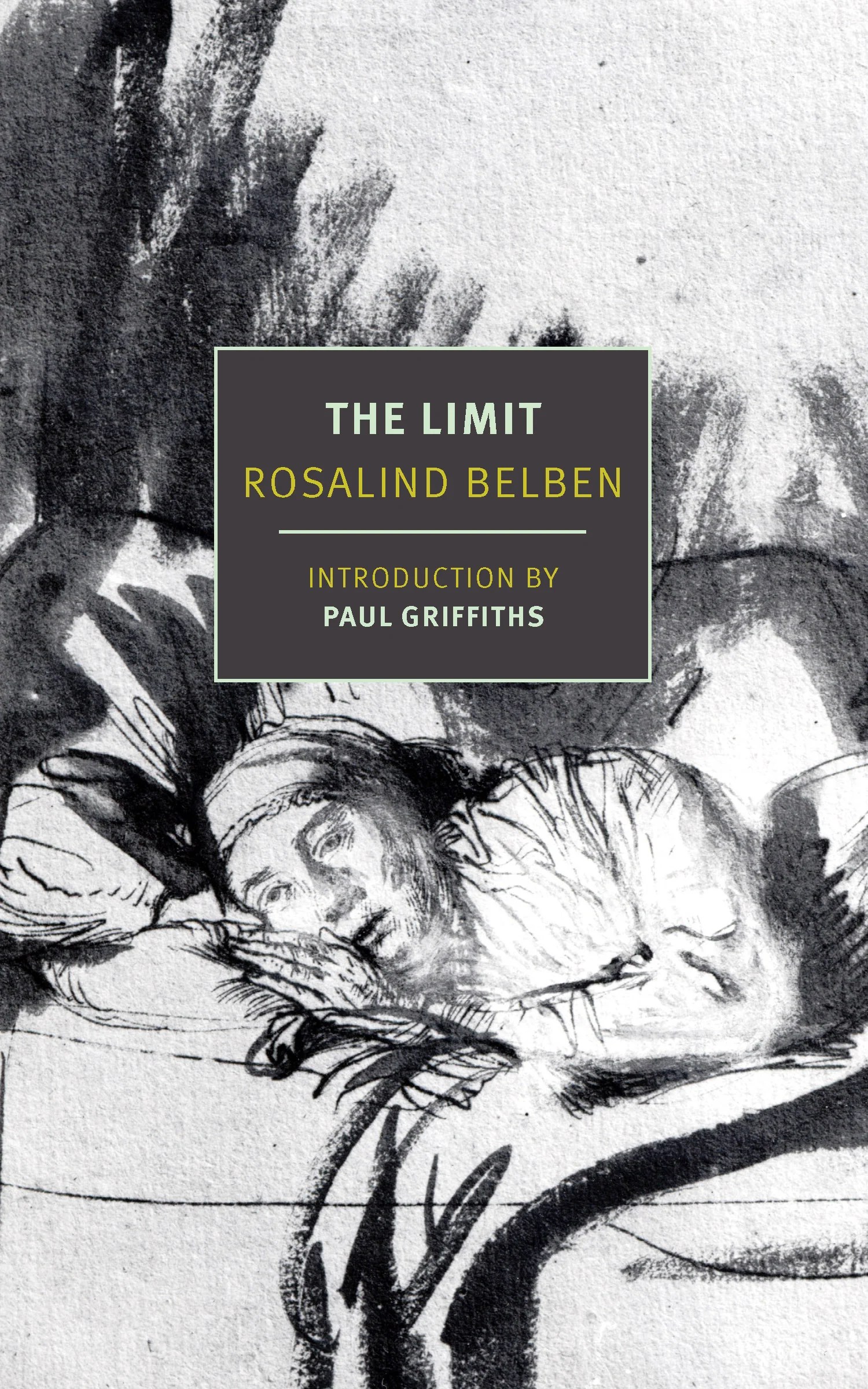 As Paul Griffiths notes in his helpful introduction, The Limit, Belben’s third book, first published in 1974, was a marked departure from her first two. Although other writers were, in the 1970s, determined to “shake” up the English novel, Belben’s writing “was like no other and remains startling half a century later.” Her narrative style is idiosyncratic. Temporality can be compressed or expanded in unexpected ways, syntax continually surprises, and sentences are often abruptly shortened or laced with a series of colons. Perspective shifts abruptly from third to first person, slipping in and out of Ilario’s or Anna’s thoughts, depending on the chapter. And the chapters themselves are thematic, with each theme repeated three (and in one case, four) times, but they do not follow a regular sequence, nor are they chronological but together they build in intensity and intimacy, in spite of, or perhaps because of, the often harsh bluntness of the narrative with its moments of ugliness and beauty.
Belben’s themes—Transmigration, Rapture, Grief, Sea-Change, Childhood, Future—all take their titles from definitions found in the Hamlyn Encyclopedia World Dictionary. The Rapture chapters, for instance, are titled “The Carrying of a Person to Another Place or Sphere of Existence,” Grief is “A Cause or Occasion of Keen Distress or Sorrow,” Transmigration becomes “The Passage of a Soul at Death into Another Body.” Yet as lofty sounding as these chapters may sound, Anna and Ilario are not believers:
God had been disposed of long ago.
Neither she nor I acknowledged the divinity. Our faith lay in mankind, not in its mythical maker. She showed little sign of abdicating conviction for a god she spent her life denying. We agreed upon the possibility of a different reality: but that did not leave Anna any hope.
Thus she embarks into a dark journey, one which her husband must now help her navigate, but on dry land his seaman’s skills leave him feeling ill equipped. In their relationship, Ilario confesses, she had always directed and guided his way. “Without a wife, without her, I am nothing, I am useless. Was always useless.”
Anna’s side of the narrative is internalized. She is past conversation; she thinks of dying. Her memories carry her back to childhood and to earlier times in her marriage. But the man attending to her at home or sitting at her bedside in the hospital barely registers in the present. He is alone—save for the passing companionship of other husbands visiting their own sick wives and awkward interactions with Anna’s siblings. Yet as time passes, he feels closer than ever to the “elderly” woman slowly fading away. His wife.
The Limit is not an easy read: Ilario’s descriptions of Anna’s body, in their intimate moments and his later ministrations in her final days, are frank, at time uncomfortable, but oddly not without a certain tenderness. Meanwhile, Anna’s childhood memories hint at the pain and dark secrets in her respectable English family:
Protect me from my mother. Make my father beloved come alive. Rise: my dog from the dead. But prayers are seldom if ever answered. Anna is born in 1922 (twenty years will pass before his birth): childhood proves unsatisfactory, an unsalutary experience: and to it the Anna grown up is irreversibly linked, to it pieces of her now are related: they are part of her score yet do not, repeat not, determine her whole works. Simply, her machinery lacked oil in the past. I hate my mother.
She revisits disturbing events from her youth, their lasting impact. When she meets Ilario, it is unsurprising that she is forty and still a virgin. Yet, it is the unlikely love that binds this odd couple together that makes this novella so intriguing.
One can imagine that in choosing a partner so different in age, culture, and class, Anna is freeing herself from the constraints of her family background. We don’t know enough about Ilario’s past to know what might have first attracted him to this plain, older woman. “An iron maiden. Forged in a landscape of snow.” But, scenes drawn from their decade of marriage indicate strong mutual interests. They both harbour a love of travel and a love of the sea. Anna, before illness overtakes her, is a sturdy, adventurous woman, unbothered when she and Ilario find themselves facing a man dying of leprosy in North Africa, nor does the threat of a tempest at sea frighten her. Quite opposite, in fact. The Sea-Change chapters each offer snapshots of their time together away from England, of their shared companionship in calm and in adversity, but the third such chapter is especially exhilarating. Ilario as a young captain, awakes to find his ship facing a life threatening storm at sea—all while his wife is onboard:
Ilario wished she could be spirited to landfall. He noticed a glittery expression: she adored the crisis, the whole situation. Not a clue did she have, la poverina, unreal in an unreal world. Addicted to unreal drama.
He assesses the heavy and unstable loads down in the hold. Orders them secured and secured again. Comforts his experienced bosun whom he knows well:
Fear not: soon we shall plough on through our appalling conditions, trusting a stability we in reality don’t possess. He smiles, loving his ship and his wife, his wife and his ship: Ilario takes heart. The tops of the waves already sprinkled the bridge: it could hardly be mere spray. But he relaxed, eating a marmalade sandwich.
Ilario’s love is steadfast. Sometimes its strength even seems to surprise him. And as the Future chapters show, even as other adventures and women cross his path, no one can dislodge the place Anna continues to hold in his heart. Illness and death, dying seen from the inside and from the bedside, may be the central focus of this novella, but at heart it is a story that demonstrates just how inexplicable and enduring love can be, a work not soon forgotten.
The Limit by Rosalind Belben with an Introduction by Paul Griffiths is published by New York Review Books Classics.


 roughghosts