And suddenly you saw it, far below
the coast road, after the twelfth curve,
stomach surging from the hair-pin drive.
En route for the south; so we sped on
perched above the drop, windows down.
Sorrento with its villas, its fan palms,
had been swallowed by the plug-hole
of the mirror in a great green swirl.
It hung in the haze, a hulk of bare rock.The sea dead still. Not a trace of myth,
but for the yachts decked out in chrome
glinting in the sunlight. On a white hull
we made out ‘Nausicaa’ in faded letters.
Infectious energy, shifting, rising and falling. Durs Grünbein is a poet who writes as if regularly navigating the kind of winding roadway described here in “Island without Sirens” from his 2013 collection Colossus in the Mist. This poem, dedicated to Alexander Kluge, which begins with the promise of finding a site with rumoured Homeric association and ends with the view of an island not unlike a mass of barren lunar rock rising out of the water, is a clear reflection of what has made him one of the most important and successful contemporary German poets. Now his most recent release in English translation, Psyche Running: Selected Poems, 2005–2022, has just been shortlisted for the 2025 Griffin Poetry Prize (his second such honour for this prestigious award).
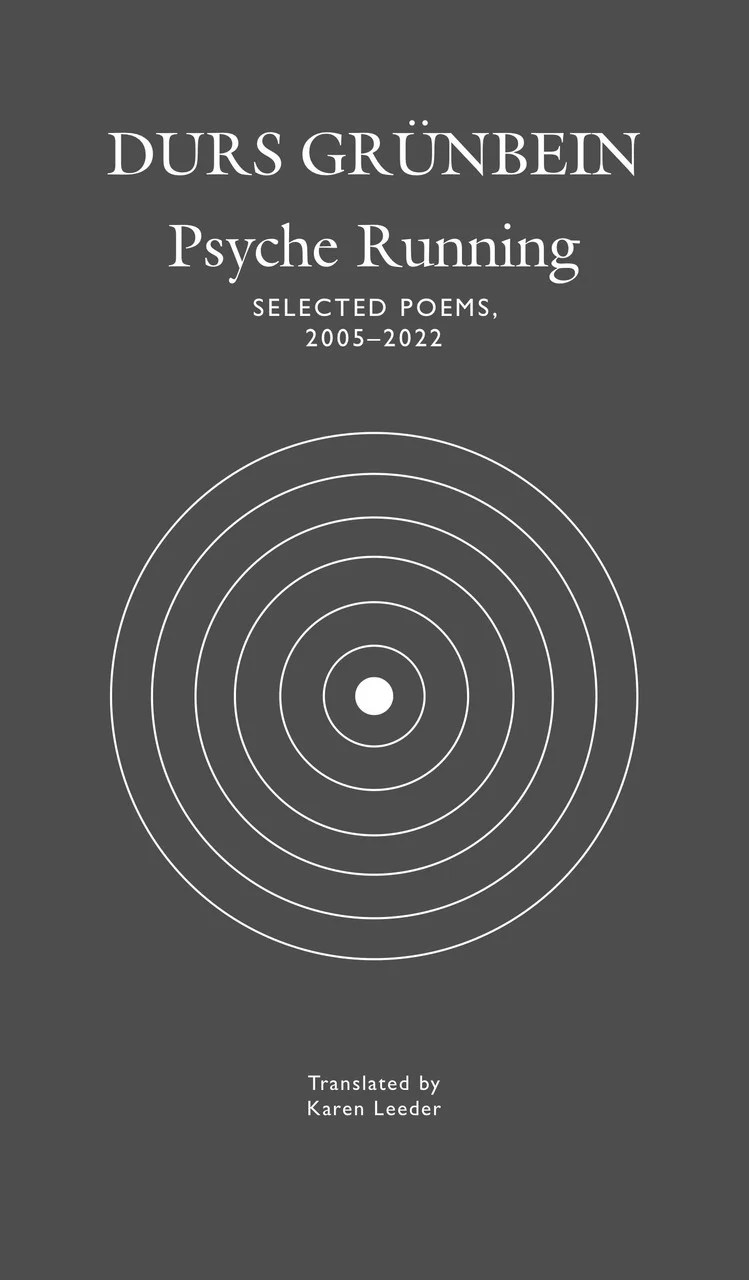 Born in Dresden in 1962, Grünbein moved to Berlin in his twenties to study theatre. Since the fall of the Wall, he has travelled widely and presently he lives in both Berlin and Rome. He has published more than 30 books of poetry, along with translations of classical and contemporary authors, essays, libretti, lectures, and collaborations with artists, composers and filmmakers. His prolific writings cover such a wide scope of literary form and history that he has, as translator Karen Leeder notes in her valuable Introduction, called himself an “unpoet.” Nonetheless, poetry remains central to his work, having won him widespread recognition and a number of major awards. The present collection offers an ample illustration of the breadth and appeal of his poetic vision.
The selections in Psyche Running represent nearly two decades of Grünbein’s output, drawn from ten volumes published beginning in his early forties through to the age sixty. As such, they trace the poet’s growth in mid-life and mid-career, his changes in tone, themes and exploration of form. This collection opens with work drawn from two books published in 2005. Both feature poetry inspired by history, though in very different contexts. Portraits of personalities and scenes from the ancient world figure in The Misanthrope on Capri while his focus turns closer to home with Porcelain: Poem on the Downfall of my City. The latter is a cycle of forty-nine numbered poems, a lament for Dresden, destroyed by Allied bombers in 1945. Yet, even in an elegy, Grünbein’s playful tendencies surface—something that was not necessarily received well by some readers:
Not a rowdy wedding-do. It was The Night of Broken Glass
or, what sharp-tongued folk called: the glazier’s lucky day.
And Ash Wednesday just a hop, skip and jump away.
Fools and Nazis—huzzah!—sure, they had a blast.
What’s that? Innocent? Disgrace came long ago.
Dresden shepherdesses, German bands, where are you now?– from “4”/ Porcelain
Twenty-four of the short poems from this sequence are included in this collection, but the complete work, with photographs and one additional poem, has been published as a separate volume, also translated by Karen Leeder and published by Seagull Books. My own review can be found here.
2007’s Verses for the Day After Tomorrow marks a turn to a more personal focus, exploring themes of memory and human experience, then, after Grünbein began to spend more and more time in Italy, another shift occurs. With Aroma: A Roman Sketchbook (2010) and Colossus in the Mist (2013) classical elements appear, as do poems that draw direct inspiration from Rome and its environs. In a number of the pieces selected from these two works he demonstrates a wonderful sensitivity to the natural world, as in “Island without Sirens,” quoted above, and this magical evocation of a murmuration of starlings moving through the evening skies above Rome in “Aroma XLIX (Starling Swarms)”
How one envied them their nose dives, swooping down on
. gravel lanes,
or taking in Rome from a bird’s-eye view, conqueror style.
In fact, they only wanted a little urban updraft to be transformed
into currents and reflections, as their aureoles appeared
. before
the rosé of the cloud-shading, in a sky painted by Turner.
It was a dance of veils, a stunt performed by thousands of
. points in synch:
something like the sound of bells, visible in silhouette above
. the domes.
The influence of thinkers, ideas, and science on Grünbein’s poetic instincts takes centre stage in the next section, the first published translations from 2014’s Cyrano; or, Returning from the Moon. Each piece in this cycle of eighty-four poems, inspired by Cyrano de Bergerac, “takes its cue from a moon crater” Leeder tells us, “and pays homage to a thinker or philosopher known for their study of the moon.” The poems presented here were selected by the author and I, for one, would love to be able to read this inventive work in full. The mood changes once again with the next selection, the long poem “The Doctrine of Photography” from The Zoo Years: A Kaleidoscope (2015). Presented alongside postcards of prewar Dresden from Grünbein’s personal collection, this piece imagines into being scenes from daily life in the community as darker times close in:
Another spring. Imperial gardens on display:
for six months the magic of flowers
serves to ease the effects of the new
constraints, the new laws.
A hymn to existence, a scared hymn
to the beauty of nature around us,
the newspapers swoon in the
grandiose style of the times.
More powerful than any Olympiad,
closer to a feminine aesthetic sense,
like Hitler’s hands, eunuch-white.
A strong selection of poems have been chosen to represent the final two volumes collected in Psyche Running. Sparkplugs (2017) and Equidistance (published in 2022, marking the poet’s sixtieth birthday) build on imagery, sometimes dreamlike, drawn from science, nature, and everyday life to explore more introspective or existential themes that reflect an increasing awareness of aging and remembrance:
Do I know how many summers we have?
Whether we will recognize them as they were,
these outdoor scenes, where we
slipped quietly past each other like angelfish
in that strange, that golden light?I only know the day that keeps what
will happen next hidden behind glass.
Things grow more distant, swim up close,
in the film light. And the projector is me.– from “The Projector” / Sparkplugs
Altogether, this generous sampling of Grünbein’s poetic work over the better part of the last twenty years, fills in a long overlooked gap—Porcelain notwithstanding—in the availability of his poetry for an English language audience going back to Michael Hofman’s 2005 translation of a selection of poems from his first four collections, Ashes for Breakfast. Karen Leeder, who in addition to Porcelain also translated Grunbein’s Oxford lectures, For the Dying Calves (Seagull, 2022), has come to know the poet well over the years and has a deep affinity for his wry, vibrant spirit. Her informative Introduction and detailed notes provide an overview of the collection, her approach to this translation, and added detail, as required. Although he frequently draws on historical, philosophical, literary, and scientific sources, there is, in Grünbein’s perceptive, witty, and engaging verse, an irresistible quality that naturally invites a closer read. This volume, then, is not only an important addition to his available writing in English translation, but a wide ranging and vital introduction for anyone new to his work.
Psyche Running: Selected Poems, 2005–2022 by Durs Grünbein is translated from the German by Karen Leeder and published by Seagull Books.
 roughghosts