
It was Wolfgang Hilbig’s story collection The Sleep of the Righteous, published in 2015 by Two Lines Press, that brought the late German author and his translator, Isabel Fargo Cole, to my attention. It might seem as if they arrived hand-in-hand, after all her translation of his novel I (Ich) appeared from Seagull Books around the same time, but of course, she has translated works by a variety of German language authors before and since those two titles emerged. But it would be fair to say that her efforts to champion Hilbig, her deep appreciation of his work, and her ability to be able to bring his convoluted sentences and filmic imagery to life in English continue to win him more admirers with each subsequent release. Most recently, she was awarded the Helen & Kurt Wolff Prize for her translation of Old Rendering Plant.

I have had the pleasure of interviewing this gifted translator twice now, and both times, when her generous responses to my questions arrived in my email, I read them with excitement and renewed appreciation. The latest interview was published at Splice this past week. In this piece, we talk about the most recent Hilbig release, The Tidings of the Trees, and the ways in which this work differs from last fall’s Old Rendering Plant. My questions were derived from my own reading of the book and were not sent until my review had been submitted for publication.
In the years since our first contact, I have read and reviewed Isabel’s translations of Klaus Hoffer and Franz Fühmann, and have added the works of several other authors she has translated to my library as well. But Hilbig remains central. So I am thrilled and honoured to be speaking with her in person in San Francisco on Tuesday night, July 24, as the Center for the Art of Translation celebrates her work, her recent award, and the release The Tidings of the Trees.
UPDATE:
The online journal Splice was hosting no longer appears to exist, so I have reproduced the original interview with Isabel as it first appeared below:
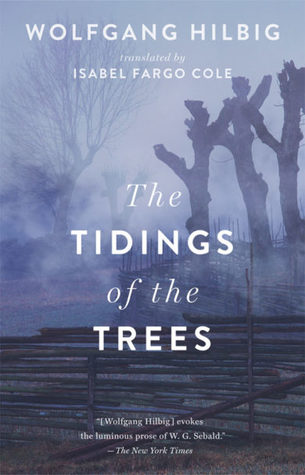
 The Tidings of the Trees. Translated by Isabel Fargo Cole. Two Lines Press. $12.95. Buy direct from the publisher.
Isabel Fargo Cole grew up in New York City and studied at the University of Chicago, but she has lived in Berlin as a writer and translator since 1995. In 2013 she received a PEN/Heim Translation Fund Award to translate Franz Fühmann’s At the Burning Abyss for Seagull Books, and in 2014 her translation of Fühmann’s The Jew Car was shortlisted for the Oxford-Weidenfeld Translation Prize. More recently, she has published several translations of the works of Wolfgang Hilbig, and she won this year’s Wolff Translator’s Prize from the Goethe Institut for her translation of Hilbig’s Old Rendering Plant, published by Two Lines Press. Her latest Hilbig translation is The Tidings of the Trees. Reviewing the book for Splice, Joseph Schreiber praised it as “a tale rich with fantastic imagery that openly explores the ability of fiction to preserve the past, mediate the present, and offer hope for the future.” Concurrent with the publication of Trees, Isabel Fargo Cole generously gave her time to correspond with Joseph via email and offer her take on working with Hilbig’s words.
The Tidings of the Trees, newly released from Two Line Press, is your fourth published Wolfgang Hilbig translation. Would you mind taking a moment to frame this novella within his body of work? When was it released and where does it fit? The German edition (Die Kunde von den Bäumen) first appeared in 1992. It’s the last of a number of novella-length works Hilbig wrote in the 1980s and early 1990s. In terms of subject matter, it fits into a broader complex of works, culminating in the story collection The Sleep of the Righteous (2015), which explore Hilbig’s home town of Meuselwitz and the industrial wasteland around it. Hilbig returns time and again to the same landscape to explore different aspects and develop different metaphorical images. . This novella is described as one of his most accessible works. On the surface, perhaps, relative to the very close, internalised monologue of Old Rendering Plant(2017), it might appear to be a more straightforward, less claustrophobic tale. It’s a multi-level narrative wherein the main character, Waller, is telling his story to an unidentified narrator who records the account. We can place him in time, we know how old he is, and we have passing outside observations of his actions and behaviour as he is speaking. However, as much as time, space, reality, and fantasy are blurred in both novels, Waller is less able to follow and make sense of his own memories, and seems as concerned with touching abstract truths as he is with tracking down his own lost time. Consequently, much is left unresolved, unresolvable even. Can you comment on the similarities and differences between these two novels with respect to the way reality is disrupted, and the challenges raised for yourself as translator? Actually there’s just one narrator who sometimes refers to himself in the third person, as “Waller”. In many of Hilbig’s works — notably in ‘I’ (2015) — the author shifts between first and third person as a way of embodying how his narrators reflect on themselves or relate to their past, how writers observe and fictionalise themselves almost to the point of schizophrenia. In comparison with Old Rendering Plant, the landscape is more minimal, the language is a bit sparer; Hilbig is working with a more reduced and clear-cut palette of imagery and symbolism. This foregrounds the narrative structures, the interplay of perspectives and time frames. This is a story about storytelling, or rather its impossibility: the narrator tries to evoke the chopped-down cherry trees that once lined a road that led to a village that has vanished as well, swallowed by strip mines, and to describe the circumstances of these disappearances. This shifts to an effort to recall the taboo subject of Germany’s division and the disappearances it entailed. On a number of levels, it’s about the difficulty of finding the right place to write from: “A place to sit! I’d lament, circling my empty chair.” Of course, the chair is just a metaphor or an alibi; the question is how to find the right perspective from which to reconstruct the memory or tell the story. And so the narrator shifts into the third person voice, as though that might help, or as though to watch himself writing; or he tries to adopt the perspective of the “garbagemen” who sift through the refuse of the past and seem to possess secret knowledge. Hilbig explores the question of adopting a persona or shifting personae to tell a story from, and the dangerous disorientation this can entail. And he explores how a writer devises and manipulates “figures” to act out his story: Figur in German is the standard word for a fictional character, but Hilbig exploits its literal sense of physical shapes that are seen from outside and remain rather alien, like puppets. Hilbig’s narrators find it difficult to relate to other people at all, and struggle with the sense that, in writing about them, they are producing mere simulations. In Trees, this takes physical form as the narrator arranges discarded store mannequins in tableaux in an attempt to communicate with the inscrutable garbagemen — an absurdist metaphor for storytelling. These senses of simulation, unreality, dissociation, and an unstable “I” goes along with an unstable sense of time. Storytelling both asserts and complicates the notion of a linear timeline with a clear sequence of events bound by cause and effect — a story has to assume these things to some degree to have any coherence, but the very act of telling a story complicates the timeline and the causalities by situating a storyteller somewhere within or outside it. In Tidings of the Trees, Hilbig plays with the tension between the notion of a coherent “story” that exists out there, or within the memory, and simply needs to be recorded, and the teller’s actual struggle to grope toward this story and piece it together out of fragmented bits of time and space. This is a struggle for the translator as well, as the often paradoxical-seeming tense shifts need to be attended to; the labyrinth of nested flashbacks and flashes of déja-vu is very much intended, and just as intentionally left without a resolution. In the end, the narrator comes to see the course of events as cyclical, narrated in “a language of return”, and he cedes the act of storytelling to the trees themselves: “storytelling without motive, a stream of story that followed only the slow rhythms at work in the place where the trees were.” The vanished trees write their story in their own ash upon the narrator’s empty page. . On a related note, I would like to ask you about the prose style in The Tidings of the Trees. In my reading, I sensed more variation in pace and tone than in some of Hilbig’s other stories and novels. There seems to be a more measured tone to much of Waller’s discourse; one finds more short sentences, less of the long, winding, stuttering flow of words. This is perhaps because the protagonist is trying to make himself understood to his audience. However, he has a hard time orienting himself within his own story and has an admitted disregard for reality. And there are many passages of exceptional urgency and poetic energy. How would you describe the differences in this narrative? As you noted above, there is less of the intensely sensual, immediate, stream-of-consciousness style that you find in Old Rendering Plant or The Sleep of the Righteous. Perhaps the narrator of Trees is trying to access that more immediate mode of writing, but failing (at least until the very end, when he lets the trees speak). He has a greater detachment from the writing process; he’s reflecting on the act of writing, or rather his inability to perform that act: “But when storytelling reconstructs — or, in my case, manufactures — the problems of telling stories, it’s the pinnacle of self-circumscription. … I don’t know. Literature like that is unworthy of interest.” He’s ironising the postmodern irony of writing about writing — but taking it so far that irony turns into existential urgency. At the same time, Trees has more actual story, asserts more concrete, external goings-on (however fantastical and jumbled) than, say, Old Rendering Plant, which feels like a pure interior monologue. . Both Waller and the narrator of Old Rendering Plant are drawn to mysterious social outcasts, and, in each case, these elusive characters — the garbagemen who salvage goods from the ash heaps on the outskirts of town and the men who work in the depths of the rendering plant in the abandoned coal factory — are imagined in grotesque, surreal terms, and inspire some of the most exhilarating passages in each work. However, Waller’s identification with the garbagemen is more complicated, at once strange and enigmatic, and yet in their actions he sees a clear model for his intended act of preservation through storytelling. How do you see the roles, political and aesthetic, that these types of characters play in Hilbig’s work? Hilbig was an outsider himself, as a self-taught non-conformist working-class writer in East Germany and as a working-class East German writer in West Germany. So it’s not surprising that he tended to write about outcasts — often his narrators are loners on the margins of society who become fascinated by people even more radically marginal than they are. Those marginal figures seem to represent, or have access to, things that society would prefer to forget, down to the crimes of the GDR and Nazi dictatorships. Interestingly, it’s hard to pin them down either as victims or perpetrators. In Old Rendering Plant, they might be war fugitives from Eastern Europe, or they might be old SS or Stasi men. In Trees, they seem to be in a state of exile from society, sifting through its detritus on the outskirts; on the other hand, they apparently act as an integral part of society’s digestive system, performing a function that remains constant across historical eras. They’re the people who quite literally do society’s dirty work. . Wolfgang Hilbig has a tendency to create narrators or protagonists who share basic biographical details very similar to his own, even if it is not made explicit. Their stories generally explore variations on a common theme — the search for identity in a society that enforces a rigid conformity of thought and action — and yet, each story or novel follows its own distinct path. Tidings is no exception, but this novel is also very explicitly about the responsibility of the writer and the enormity of his (or her) task. Waller’s twenty missing years form, in no small part, a severe case of writer’s block. Here he is, in mid-life, staring at the same sentence: “The cherry trees have vanished!” The question of the missing cherry trees that once lined the road to the nearby village, now also gone, represent a much larger, more vital story — about preserving memory, history, and hope. Would it be fair to say that this portrait of the writer’s task, if not his relative productivity, makes Waller an especially personal alter-ego for Hilbig? I feel he’s actually a less personal and more abstract alter-ego: the Writer. There’s less of the texture of Hilbig’s own memories and biography, and he keeps stepping back from the narrator, referring to him in the third person, seeing him from the outside, actually spotting him in the distance, as a kind of doppelgänger. And he puts him in absurd situations that feel more consciously constructed, with more ironic detachment. I think the cherry trees are in fact central: they are the story — or the storyteller, as the end hints. The cherry lane is one of Hilbig’s rare (but crucial) images of pure, innocent natural beauty, of a small paradise that existed within memory. It may have vanished, but it dominates the story, and in the end it prevails: the eternal, cyclical language of nature takes over the task of the writer. . Finally, you have recently been awarded the prestigious Helen & Kurt Wolff Prize for your translation of Old Rendering Plant. Congratulations! With another Hilbig translation, The Women, due later this year, the appetite for his work among Anglophone readers seems to be solid and growing stronger. There must be considerable satisfaction in this positive reception, and in being recognised for your intuitive and sensitive renderings. How do you feel about his reception? And more critically, in light of the disturbing political trends we’ve been witnessing in the West of late, do you think his message has a new relevance? Thank you! I’m thrilled to see his work finally getting the English-language readership it deserves. I certainly think he has a lot to say to us about the cruel and unsavoury sides of social orders; about the way historical traumas are passed down and continue to do harm even (and especially) as they are denied and repressed; about the sheer mass of depression, anger, and hopelessness that can build up among people who feel alienated from their societies, from each other, and from their natural surroundings; about the (self-)destructiveness that results. I don’t think he has a “message” in the sense that he’s asking us to understand x so we can do y. But perhaps he asks us simply to recognise the dark shadows and the “garbage” on the outskirts of town as something integral to the human experience. Those strange sinister characters out there, whether they’re victims or perpetrators or both, aren’t “the other” — they’re alter-egos, reflections of ourselves and our own potentialities. Facing the darkness won’t perform some kind of therapeutic magic and automatically empower us to transcend it, but it could help us to proceed from a position of humility, a deeper understanding of our own and others’ limitations, absurdities, and burdens. At least that’s the best way I can think of to explain why I personally find his work moving and bracing, if not exactly comforting, at this particular time. . Joseph Schreiber is a writer based in Calgary, Canada. He is Criticism/Nonfiction editor at 3:AM Magazine. His reviews and essays have been published in a variety of literary sites and publications including Numéro Cinq, Quarterly Conversation, Minor Literature[s], and RIC Journal. He also maintains a literary site called Roughghosts and tweets @roughghosts. |

 roughghosts