Of ghosts and angels: The Painted Room by Inger Christensen

Recently re-issued by New Directions, Denise Newman’s translation of Inger Christensen’s 1976 novella The Painted Room might at first appear to be somewhat more conventional than the Danish poet’s experimental prose works like Azorno or Natalja’s Stories. That would, of course, be a premature assessment. Subtitled A Tale of Mantua, this slender three-part volume is set in, and revolves around, the court of Ludovico Gonzaga III and the painting of the famous Bridal Chamber by Andrea Mantegna in the mid-1400s, but it is more than a simple piece of historical fiction. By turns witty, magical, and wise, The Painted Room offers a pointed commentary on art and immortality, power and passion.
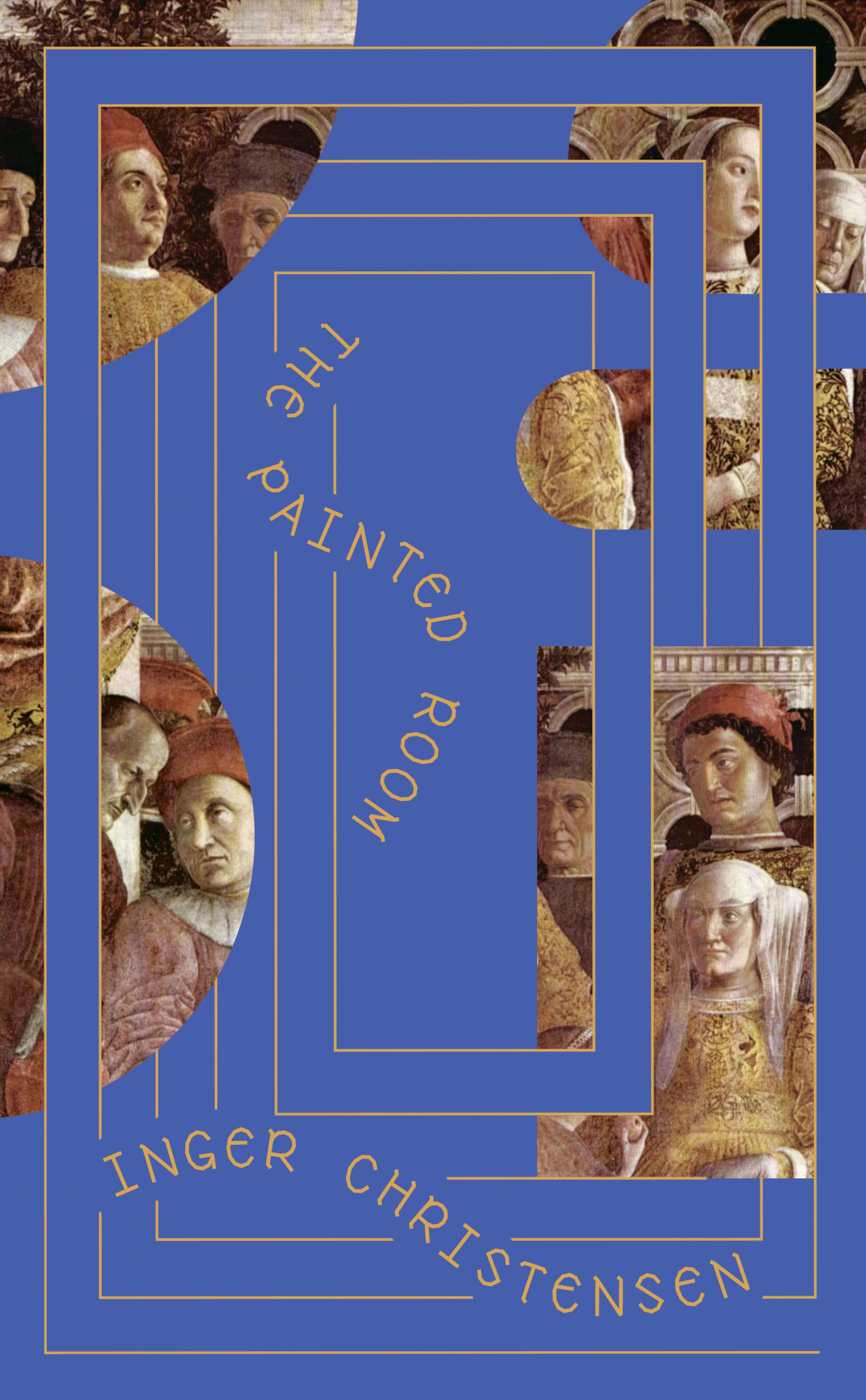
As Italy gradually splintered following the fall of the Roman Empire, it evolved into a patchwork of independent territories over which powerful families battled for control until, by the fifteenth century it was common for each of these regions to be held under the autocratic control of single princes. Mantua in northern Italy, ruled by the Gonzaga’s from 1328 to 1707, was not only a tyrannical, war-focused principality, but, as its ruling family sought to elevate its social status through patronage of the arts, architecture, and music, it would become an important cultural centre in the early years of the Renaissance.  In 1459, acclaimed artist Andrea Mantegna (1431-1506), noted for his striking compositions and innovative studies of perspective,  agreed to enter into the service of Ludovico, the Marquis of Mantua, and the following year he was appointed court painter—a position he would hold for over forty years. His masterpiece would be completed there, the Camera degli Sposi or The Bridal Chamber in the ducal palace, a room decorated with realistic architectural details, frescoes featuring interrelated narratives  and a spectacular illusionary ceiling that appears to be a concave structure with an oculus open to the sky. The painting of this room and its images, offer the inspiration for Christensen’s novel, but the story she weaves extends far beyond these four walls.

The first part, “The Diaries of Marsilio Andraesi: a selection” proports to be outtakes from the personal journal of Ludovico’s devoted secretary, pictured to the far left of the Bridal Chamber’s “court scene” fresco which features members of the Gonzaga family and their attendants. Here Andraesi is leaning in to listen to the prince who has turned to speak to him. From the secretary’s personal account, which begins in March of 1454, we get an unvarnished, if rather biased and often catty, record of events leading up to Mantegna’s arrival at Mantua through to his death in 1506. Andraesi is not impressed with his master’s persistent efforts to woo the celebrated artist and the reason for his resistance is unlikely. It seems that the painter’s wife, Nicolosia Bellini (of the Venetian artistic dynasty), was once his secret love, now forever lost. So he focuses his attention on rumours he’s heard of Mantegna’s reputation as a troublemaker trained in “arrogance, brutality, and the hunt for novelty.” He feels the prince’s idolatry will only lead to shame. But, of course, the offer is accepted and the secretary’s would-be romantic rival arrives, at first on his own, but soon followed by his family:

Today I finally caught a glimpse of Nicolosia. I became deathly pale and could barely move. My brain turned completely white and my heart so drained of blood that it could hardly beat; I froze. An angel in the fire of earthly feelings.
(17th of August, 1460)

Bitterness and jealously continue to colour Andraesi’s reports, especially as progress on decorating the palace room is slow, and his secret confrontations with Nicolosia intensify. Then, when Mantegna’s wife suddenly dies (at least in this version of reality), the relationship between the two men gradually begins to shift toward what will eventually become one of friendship and respect. In the meantime, Mantegna’s young children are devastated by the loss of their mother but comforted by their father’s inclusion of her likeness in his art. After all, in art, the dead live on. When the frescoes are finally completed in 1474, guests are welcomed for a dedication event in what Ludovico calls “The Painted Room,” but which the children have christened the “Ghost Room.” In his reflections on the occasion, Andraesi calls attention to the uncomfortable dynamic that exists between art and immortality:

There is more life in the paintings than in all of these lively and rapturous spectators who simply put on airs because they are afraid of the pictures’ soul which is their own. The pictures are like all great ghosts in Art who calmly and tirelessly wait for their living models to die. All those who have had the chance on this occasion to look at themselves in the light of Art’s exegesis have consequently entered  into a relationship with Death; and they must each conduct  their negotiations with him day by day over the time and place and manner of their dying, and about their measure of anxiety.

In the second part, Christensen’s narrative adopts an even more fantastic examination of life at court and its connections to the broader world. However, immortality continues to be a central theme, not explicitly through art but through children, legitimate or otherwise. Attention turns to the dwarf depicted in the “court scene,” a member of the prince’s entourage, re-imagined as Ludovico’s daughter and given the name Nana (Italian for dwarf). When we meet her she is distraught about her unfortunate fate, imagining that her diminutive height will deny her an opportunity to love and marry. The gardener steps in and arranges for her to marry his beautiful son Piero once they are both old enough.

Nana’s story adds an added dimension to the events recounted in the first part. On the day of her wedding three unknown women appear; no one is certain who they are but coincidentally Mantenga has captured their likenesses among the figures who are seen leaning over the balustrade that surrounds the oculus painted on the ceiling of the so-called Ghost Room. To Nana, they are clearly angels. They tell her that Piero is actually the son of Pope Pius II, and leave her what she calls “The Angel’s Book,” a volume that is in fact the popular erotic novel written by the Pope before his call to the priesthood, when he was known y his birth name, Aeneas Silvius Piccolomini. The Tale of Two Lovers tells of the tragic affair of Euryalus, one of the men waiting on a nobleman and Lucretia, the wife of a wealthy man. Their love is expressed through a series of letters until they are finally able to meet in bed. Variations on the theme of this tale are echoed and played upon as The Painted Room unfolds, along with the revelation of other surprising entanglements.

The final, dreamlike part of The Painted Room takes the form of a “how I spent my summer holidays” school assignment written by Bernadino, the then ten year-old son of Mantega. He details his role in assisting his father in his work on his masterpiece, describing much of the process involved in laying the foundation, and mixing and applying the paints. But then he realizes that he is expected to record some kind of trip or adventure when in truth he has gone nowhere. So taking inspiration from his younger sister, he imagines himself entering the background of one of his father’s paintings and meeting an aged Greco-Roman hero who has forgotten who he is. Yet another glance at the question of immortality through the daydreams of a child facilitated by the magic of art.

Inger Christensen’s fiction—and her poetry for that matter—tends to work with layers, variations, and cross-referenced themes. Her foray into the world of fifteenth century Italian court life is filled with art, intrigue, infidelity, and murder, blending fact and fantasy to create an informative, entertaining, and intelligent tale. And, like any one of Mantegna’s famous paintings, repeated visits and closer inspection promises to offer ever more detail and connections.

The Painted Room by Inger Christensen is translated from the Danish by Denise Newman and published by New Directions.
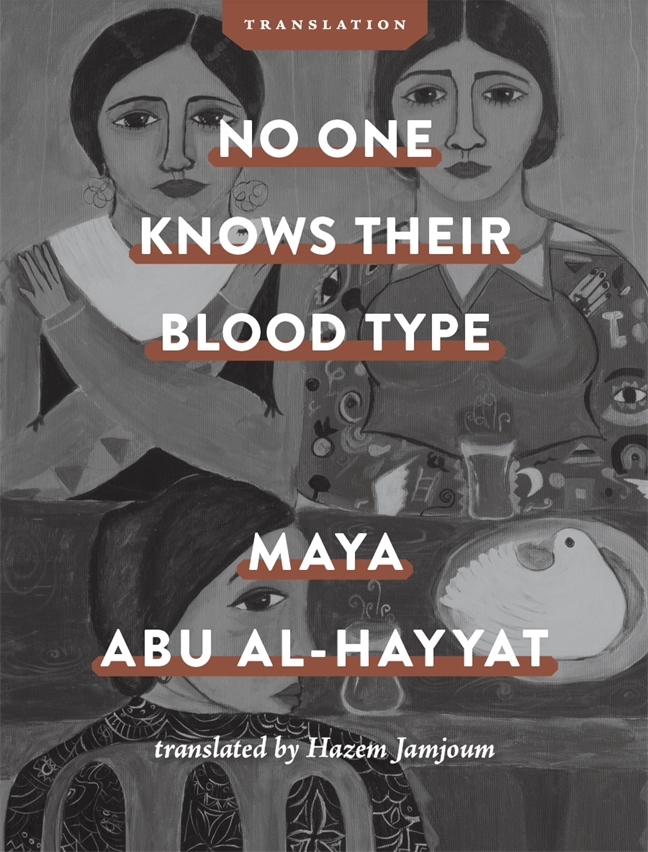
The truths we know and those we don’t: No One Knows Their Blood Type by Maya Abu Al-Hayyat

I don’t know which night I was conceived, but I do know that when nine months had passed, my life started to get complicated. All that I will relate here is not confirmed truth—these are stories I pass on from motley sources. None of them are entirely correct or straightforward, they follow the meandering intentions and motives of the storytellers.

Jumana, the central figure of Palestinian poet Maya Abu Al-Hayyat’s debut novel No One Knows Their Blood Type is,  as she tells us in an account of her early years living with an unloving aunt in 1980s Amman, a collector of secrets. The more she discovers, be it the rumour that her mother did not in fact die in the war in Lebanon, or the unwanted advances of a male cousin, the less certainty there is in her life.  As the story unfolds, shifting speakers and perspective backward and forward across more than three decades, it becomes clear that she is not the only member of her family haunted by secrets, doubts, and insecurity.

This slender, fragmented, nonchronological novel opens in a hospital in Jerusalem in 2007 where Jumana is assisting with the cleansing of the body of Malika, the gregarious midwife who has just passed away. She only knew this elderly Greek woman for less than two weeks—the time that she has been coming to visit her own dying father—but already she has fallen in love with her nephew Suheil, so she is almost family, so to speak.  However, when her father dies shortly after, the shock of attending to his body causes her to collapse and end up in emergency—a detour that will suddenly call into question her own relationship to the family she grew up in. Her father’s death certificate and her lab results reveal his blood type is O positive whereas hers is AB positive. While Suheil calmly shrugs it off as an error, Jumana is not so sure.

From here the novel moves back to Jumana’s account of her childhood in Amman. She and her older sister Yara were born in Beruit, but, at the ages of nine months and three years respectively, they are shipped off to live with their father’s sister in Amman. Their aunt treats them very poorly and the fate of their mother remains a mystery, while their father who in Spain with the PLO, is little more than a voice on the phone and a very occasional visitor. Then, in the early nineties when he has been exiled to Tunisia, the girls are packaged up and sent to join the father they barely know.

From here the narrative shifts to Tunisia in 1993. First, from the perspective of Abu al-Saeed, we see a man struggling with sudden single parenthood, anxious to protect—and if necessary, control—the honour of his two teenaged daughters. He goes to head with the eldest who is as stubborn as he is and, as a result, often incurs his wrath, while Jumana remains an enigma. He can’t figure her out, so he resents her. Meanwhile at work and among his fellow exiles he is frustrated, resentful, at odds with the world, and in turn he carries this frustration back home. When Yara picks up the thread, still in Tunisia, she details the close bond she and her sister have as security against their father, but even she notes, often with jealousy, how different Jumana seems. And then, when the signing of the Oslo Accords cements her father’s intent to return to Palestine, she not only feels despair at the thought of leaving her first love, but she wonders what it means to go “home” to a place she has never been.

Yet another angle to the story of this splintered and displaced family is offered from Amhal, the girls’ mother, as she gives her account of her life in Beruit from 1979 to 1982. She speaks of her unwanted and unhappy marriage to Abu al-Saeed, his disappointment with her failure to produce sons, and her longing to be with Omar, the young Lebanese man she truly loves. When her daughters are sent off to Amman she makes some effort to follow, but borders are difficult to cross and her direct account comes to an end. Jumana will later be in contact with her mother, but answers to the question that haunts her as she marries and has her own child, can only be addressed through DNA testing, but even then the whole question of her identity, not to mention her nationality, will be at risk if her father, or the man she knew as her father, was not related at all.

In his Afterword, translator Hazem JamJoum explians that his immediate attraction to this novel lay not in what was, but what it was not. Rather than writing to make grand statements against colonialism and oppression, or illustrate victimhood, he says: “It just assumes the grotesque facets of the workings of power, and conducts its conversation with whoever recognizes themselves as already in the fight.” He goes on to consider the questions might be more appropriate to ask, including:

Why do we lionize the figure of the revolutionary militant when that militant is, however understandably, transformed into a monster when it comes to those they supposedly love and cherish? Why aren’t questions about motherhood and fatherhood, sisterhood and kinship, love and friendship at the core of conversations about liberty and freedom? If they were, how would that change our notion of emancipation . . . should it change our notion of resistance?

If we ask such questions, and we should, this is a novel that raises more concerns than it settles. Which is okay. It is a story that is inextricable from Palestinian history, occupation, war, and exile, but its focus is on one girl and woman in particular, and the complex and delicate balance of relationships within the extended family network that surrounds her. The fragmented nature of the narrative gives us often conflicting interpretations and perspectives, and as such does not inspire an immediate empathy with any one character, even the primary protagonist. Siblings clash as much as they conspire, mothers struggle to connect with their infants, fathers respond in ways that often reflect their own upbringing, and decisions are made that may or may not be justified. But, in the end, what No One Knows Their Blood Type demonstrates so clearly, is that so often truth is not only relative, but ultimately elusive and perhaps there are times when it is better to leave it that way.

No One Knows Their Blood Type by Maya  Abu Al-Hayyat is translated from the Arabic by Hazem Jamjoum and published Cleveland State  University Poetry Center.

That day was a little bit odd: The Minotaur’s Daughter: Selected Poems by Eva Luka

That day was a little bit odd. After walking down the street
      I stopped in a movement,
at one particular moment of growing older.
And I sensed it (the moment of growing older) like a scientist
     over a microscope:
the precise split-second border between the former and the
      future me.
In that borderline, tangible second, I was nothing; only an echo
of a former self and the germ of the future, the old me.

It lasted for only that one moment. Then the air rustled like
     golden hay
and into the street a horse came.

(from “A Horse Came Into Our Street”)

Odd is one way to describe the poetry of Slovakian poet Eva Luka—deliciously, devilishly, delightfully odd. Her poems open up strange, shimmering vistas filled with fantastic imagery. Born Eva Lukáčová  in Trnava, Slovakia, in 1965, she studied English and Japanese, first in Slovakia and later in Japan. She began publishing poetry under her given name, first in anthologies and then, in 1999, with her first collection Divosestra (Wildsister).  For her second book, Diabloň (Deviltree), published in 2005, she adopted her nom de plume, along with what would become her practice of selecting a poem from each collection to provide the title for the work to follow. In this way, her poems speak to one another within and across collections which also include Havranjel (Ravenangel, 2011) and Jazver (I-Beast, 2019).

With The Minotaur’s Daughter, translated by James Sutherland-Smith, a selection of poetry drawn from her work to date, is now available in English for the first time. In his Afterword, Sutherland-Smith suggests that Lukáčová  may be one of the last great poets of resistance in Europe, citing her:

resistance to conform artistically and [a] resilience against the potential psychological pressures resulting from the circumstances of her life and times. Eva’s resistance to conform to being categorized within a specific poetic movement—particularly those associated with a single gender—reflects the individual nature of her work, and this artistic independence even challenges gender identity in the personae that inhabit her poems.

A transgressive spirit illuminates her poetry, extending beyond matters of gender, to explore questions of personal freedom, sexuality, and desire within a phantasmagorical landscape featuring eccentric figures, mythical creatures, and fabulous flora and fauna. She creates, with her poems, haunting, often dark, scenes or vignettes that can be as intriguing as they are disarming.

Unlike many similar selections that draw from across a poet’s oeuvre, the fifty-nine poems that comprise The Minotaur’s Daughter are not presented chronologically, or divided according to the individual volumes they come from. Rather, the assortment seems to be loosely thematic, with many of the earlier poems coming from more recent collections, and some of the Japanese inspired work from her first book coming later. And, because she sometimes writes companion pieces that appear one or two volumes apart—for example, “Wildsister,” the title poem from her first book, is later answered with “Wildbrother” in her third—here they are presented together. The impact is more powerful this way. It is also evident that Luka appreciates the poetic storytelling potential of triptychs and series, something that may have developed over time, as Sutherland-Smith seems to think that her upcoming fifth collection may include even more.

One of the most developed sequences in this selection begins with an ekphrastic poem inspired by Leonora Carrington’s painting  Portrait of the Late Mrs Partridge. In this piece, the speaker is the artist commissioned to capture the likeness of the wild-haired woman in her odd partridge skirt. He then becomes famous, but is ever haunted by the painting. Four more “Late Mrs Partridge” poems follow, addressing her body, her death, her husband, and finally her wake. Mrs Partridge herself voices all but her husband’s lament from beyond this life, even returning to her own wake, still nursing an internal flame, to drink a toast with the bereaved:

A man sits at the top table, his face,
wrinkled from the tertiary era, with an incalculable expression.
The atmosphere is gloomy, but still audible
is a ubiquitous slurping, gurgling and belching,
as if the whispered stories haven’t had as much power
as unstoppable bodily hunger and thirst.

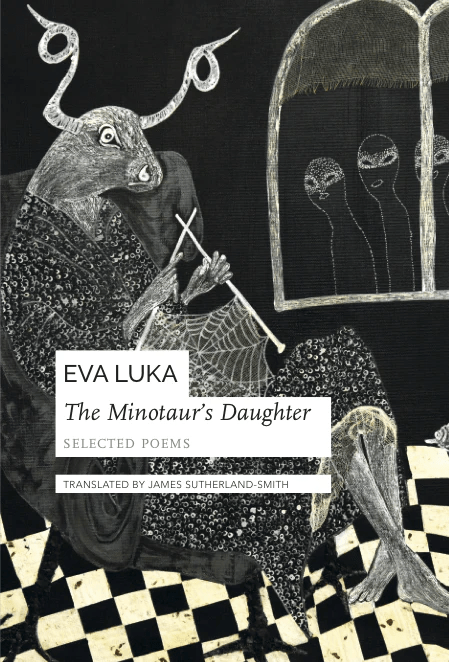
Leonora Carrington’s eerie, fantastic paintings appear again as the stimulus for five other poems in this translation (not to mention the poet’s own artwork which graces the cover). At times, Luka stands as an observer, as in “And Then They Saw the Minotaur’s Daughter”  where she watches  the “two well-behaved boys—somewhere between childhood and doubt” watching the noble horned woman-creature while spirit-like forms fill the room, Elsewhere she animates and engages directly with the scene, even imagining the central figure outside their fixed setting as in the Mrs Partridge quintet and  “Necromancer,”  a poem after the abstracted, surreal painting of the same name.

The images that dominate Luka’s poetry are drawn from nature—water, flowers, birds, reptiles, and animals—but, as with her human beings, the line between the real and the spiritual is fluid. They inhabit a shifting borderland and there is a pagan, pantheistic sensibility at play. Her animals inspire awe and fear, mythological figures speak, and a woman invites an angelic black bird (Ravenangel) into her bed in a dark sequence of desire, longing, and loss. Hers is a magical world, albeit one that accepts that mystery can be tinged with heaviness and pain. But it is not a relentlessly dark place; rather it exists in a kind of intermediate, and yet, ultimately familiar, space:

It’s incomprehensible, that border of yours
between the feverish night and the healing morning; as if you
      didn’t recognize
the differences between frenzied hyacinths and tamed hyenas.
      What you tell me
in the evening, no longer applies in the morning, and vice versa

(from “You and Me When the Cock Crows”)

One might describe the poetry of Eva Luka as akin to richly woven tapestries; the vignettes she crafts are vivid, often disturbing, but they tend to close with a note of promise, that is, with a measure of the resilience that characterizes her work. This quality is evident in The Minotaur’s Daughter. Her striking imagery is well captured in Sutherland-Smith’s translations, while his decision to break with the typical chronological ordering of a “selected poems” collection offers her first English language readers a deeply rewarding introduction to her singular poetic universe.

The Minotaur’s Daughter: Selected Poems by Eva Luka is translated from the Slovak by James Sutherland-Smith and published by Seagull Books.

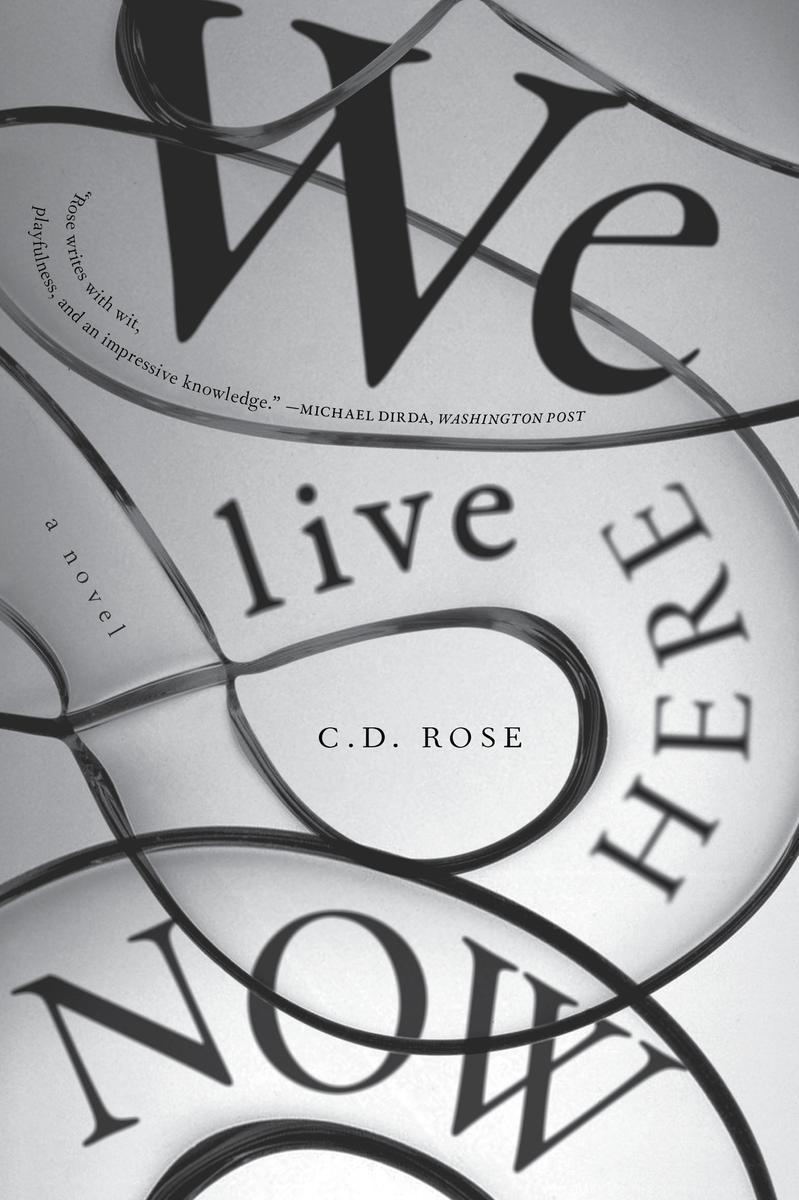
To go with the flow, or not: We Live Here Now by C. D. Rose

In Berlin, a sound artist—or, rather, as she would have it, a silence artist—sits in an Ikea-furnished rental apartment in Berlin. She is waiting to interview for a residency she has never heard of and didn’t apply for, but when an invitation, an advance and address arrived, she decided to follow up on their offer. But what are they really offering? And who are “they”? There are more questions than answers, but even more curious to  Rachel, there was something missing in this space in which she has found herself. An echo.

The sound of her greetings had no echo, as though it had been sucked up into the airlessness of this place, into the rug and the curtains. It should have been bouncing off this floor, these bare walls and the plate glass windows. This place should be all echo but there was none, none at all.

Elsewhere, the MV Atlantic Echo is making its way from the UK to Sri Lanka bearing twelve thousand containers, existing at the intersection of eight different companies and carrying, for the first time since the pandemic, a paying passenger who generally sticks to themself. One night, as the ship is crossing the Mediterranean, the Deputy Positioning Officer, the second in command, experiences an unexplained event during his watch—strange clouds gather, his equipment briefly goes dead, and momentarily the constant  grinding, throbbing, humming and droning of the massive ship falls silent.  It marks the beginning of a series of strange phenomena that will strike the ship and its crew members.

Meanwhile, an artist is commissioned to paint a portrait of an industry leader—though the exact nature of the industry his family has made their name in is shrouded in a complex maze of techno-gibberish—but he is having trouble capturing the essence, in fact any essence of the man. In China, another man sits in a “mid-range hotel of a Tier 3 city” trying to work on his master project, well aware that his identity and his ideas have been stolen and have been replicated into multiple versions of himself, but he is pretty sure he is the original. And, endlessly riding trains on a vast, interconnected web of mostly subterranean rails, a dishevelled man sleeps, dreams, and watches passengers come and go, wondering if he himself actually exists at all.

These are just some of the characters and strange circumstances that you will encounter in C. D. Rose’s surreal take on twenty-first century reality (such as it is), We Live Here Now. This inventive novel opens with an article by a fictional art critic looking back on the work of an elusive conceptual artist named Sigismunda (or Sigi) Conrad, with particular focus on her 2015 installation, We Live Here Now, a radical exploration of space and temporality that sparked controversy when people, a cleaner and several visitors, begin to vanish. The chapters that follow are set post-pandemic, and feature characters somehow connected with her or what is known of her whereabouts since 2015, either directly or indirectly. They read like a series of loosely linked short stories, sometimes intersecting directly, or bouncing off similar themes and motifs. One can find oneself listening for echoes, and tracing the flow, so to speak.

Each chapter adapts its tone, language, and energy to its protagonist(s) and subject matter. Rose’s milieu is the art world, with forays into experimental music and film. He is not only interested in the artist and the precarious nature of their work, but in the network of shippers, dealers, fixers, and those who inhabit the broader realm of intellectual manipulators, systems thinkers, and the beautiful people who want to be wherever something is happening.  There is a sense that, at least until we near the end, each story (again, that is the best way to describe the chapters) is playing out more or less simultaneously, even if a character is recalling events from an indeterminate past. The pandemic is, at least officially, in the rearview mirror and many artists, or those in adjacent businesses, are finding their footing again following a period of disruption that has been productive for some, less so for others. The settings are at once immediate and futuristic. It’s a world, or worlds, of WhatsApp, chat bots, iPads, and AI. It’s also a world where words, especially within certain commercial and intellectual enterprises, say a lot but mean little. When Ryan, the artist commissioned to portray the wealthy business man asks him to explain what it is that he does, the response has a familiar unintelligibility:

‘I direct strategic development and practice management. I work towards high-quality design which brings added value,’ he said. ‘We harness passion, knowledge and expertise to evolve powerful and pragmatic solutions and I inform and direct the ambition and quality of our work.’ He went on, scarcely pausing. ‘I develop strategy, over-seeing legacy, ensuring quality and continuation, while always searching for new possibilities. We are building, developing and ensuring sustainable resilience.’

And yet again it’s a world where objects and recordings go missing, sounds are suddenly either completely absent, or constant and unidentifiable, where light takes on strange distorting qualities, and space defies expectations. Some chapters/stories are more firmly grounded in what we might agree is the “actual” world, while others expand into other dimensions, but most navigate the shifting liminal space between illusion and reality. In other words, they take place where we live now, or will soon.

As a collection of loosely linked short stories that sometimes directly reference one another in unexpected and delightful ways, this book is brilliant fun. Rose is playing with all kinds of ideas about art, commerce, reality, and the banality of modern society. But whether it works as a whole is less certain. The framing of the project, beginning and ending with articles about two major exhibits by the elusive artist who connects all of the intervening stories, though necessary to a point, risks undermining the overall impact which may sound strange to say. What sets itself up as a mystery, offering clues, coincidences, and unlikely connections, is at its best, more a novel ideas, a dynamic map to the myriad interrelationships that connect us in a multi-dimensional universe that exists in theory but eludes us in practice. Or is it? Rose invites us and his extensive cast of characters to traverse a Klein bottle or enter an Escher artwork, but he’s leaving us to find our own way out.

We Live Here Now by C. D. Rose is published by Melville House.

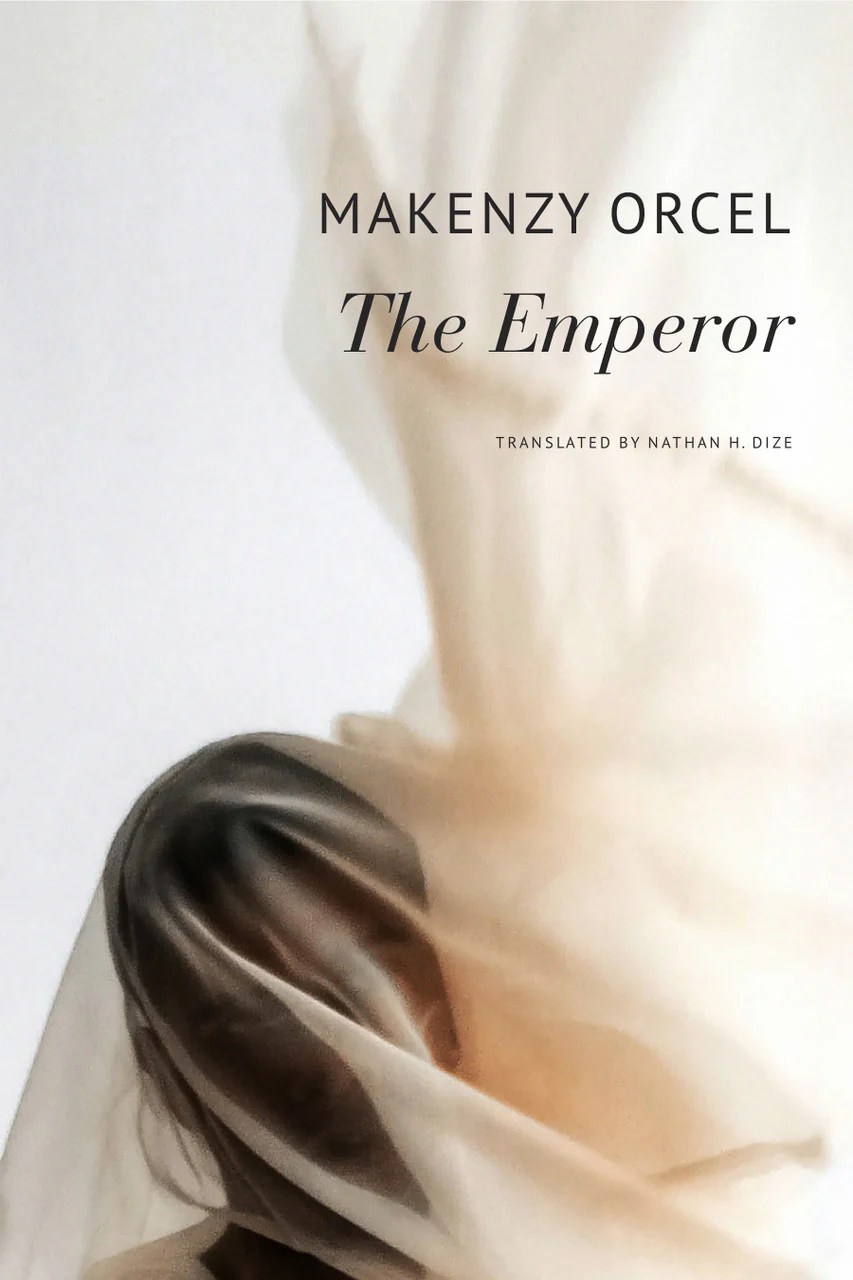
“I never forgot. Everything is there. All I have to do is close my eyes.”: The Emperor by Mackenzy Orcel

I asked for none of this. I was waiting for the bus. I was waiting forever. I think I’ve been waiting since I was born. I sat on the floor for hours, fighting the urge to sleep. Looking beyond the clouds of dust that covered the horizon. The days went by, one looking just like the other. The bus wouldn’t come.

In an apartment in Port-au-Prince, Haiti, a man is waiting. He knows that eventually the police will find him. He has made no effort to hide. In fact, the crime he has just committed leaves him with an eerie sense of satisfaction. He has no regrets and is ready to serve whatever sentence he receives. He has known far worse confinement in his life, he is certain. Even freedom, such it was, offered a different form of slavery and only one brief respite of joy. As he awaits the inevitable, he revisits the events that have led him to this point, beginning as far back as he can clearly remember. The Emperor by Haitian writer Mackenzy Orcel is his story—fractured, pain-filled, and proud.

Our unnamed narrator does not know exactly how he came to be abandoned as a child, left alone by the roadside, but he does know that at some point he was swept up and taken into a rural community, or lakou, where a false vodou prophet—the Emperor—holds sway over a flock of worshippers, his sheep, who like slaves, work his fields and tend to his every need and desire. He demands absolute devotion, and punishes anyone who fails to fall into line. The narrator grows up in this unforgiving environment, identified by a number rather than a name, but he is not alone. He is  guided by the wisdom of a blind old man known as the Very Old Sheep, dedicated to the true traditions of voodoo, and aware of the risk of pretenders, and by his own internal compass,  a motivating force he refers to  as the Voice Within. Together they keep him from losing himself amid the brain-washed, weakened souls who surround the supposed holy man or seek his intervention with the divine:

Only the Emperor is granted the power of the word. To mould them to the shape of heart, his anger or his madness. What words capable of cauterizing wounds are not also accused of being lost or eternal? Yours were difficult to grasp. They reminded us of fond memories of the gods. Their goal was to intercede in our favour. To save us. To destroy us. To bring truth, morality and the past to an end. To transform others into obedient machines. A widespread and lucrative venture. You made a fortune off the penniless and their spoilt crumbs, their ill-gotten gains. You recreated an ancient formula.

Despite the very specific cruelties he dispensed upon his young sheep, it is the Emperor who inadvertently paves the way to his release from the lakou by forcing him to play a drum for the ritual dances. In drumming he finds expression, communication, that reaches others without words. He is punished for his disobedience, but is unable to conform. This ultimately leads to his expulsion from the community and, this time, the bus does come and carries him away to the city. He arrives in Port-au-Prince with no name, no education, and only a little cash he’d spirited away. Here he faces a new kind of brutality, but his past has prepared him for “its tyranny, its inhumanity.” He survives. He finds a job delivering newspapers, one of a crew of downcast men, working for a dishonest boss, but at least he is no longer captive. He is free. Until he falls in love.

With clean, clipped prose, finely translated by Nathan H. Dize, The Emperor is a  contemporary fable with gritty, violent undertones. The narrator’s fragmented monologue, largely addressed directly to the Emperor, moves back and forth in time, from the room where is waiting for that knock, knock, knock on his door, into his past, from his early experiences in the countryside to his hardscrabble life in the city, and, finally, to his criminal act. But it is not a strictly chronological account, nor is it always clear or consistent. It is uncertain how old he is; he seems to be both prematurely aged and preternaturally wise. Details from his time under the Emperor’s control continue to emerge throughout, a function in part of him being his primary audience. Yet, some of what he claims seems strange—there is a sense that he himself does not have as firm a grip on things as he thinks when he claims: “I never forgot. Everything is there. All I have to do is close my eyes.” One senses that he has never truly been free, the anger always simmering at or just below the surface of his narrative betrays him. And now he is waiting to surrender his liberty to the police, calm and unrepentant—he even has the evidence to prove his guilt sitting neatly beside him—but, perhaps, in a strange way, he is finally exercising his freedom by giving it up.

The Emperor by Mackenzy Orcel is translated from the French by Nathan H. Dize and published by Seagull Books.

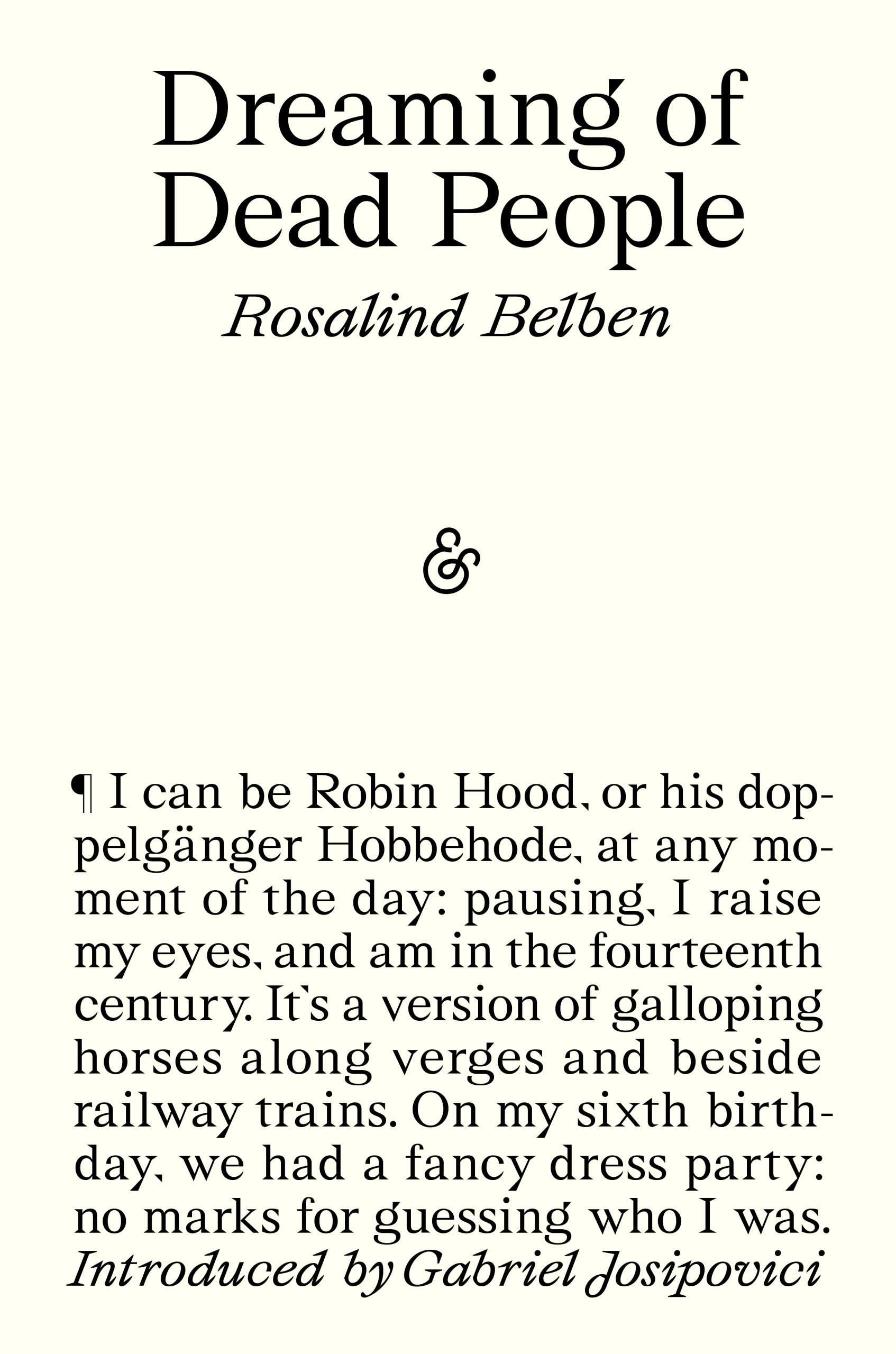
An anguish like ether: Dreaming of Dead People by Rosalind Belben

Abruptly, I was lonely. A slight ache opening into a grand, raw wound, very cutting. Bother it. I was, I am, lonely.

Lavinia, the narrator of Rosalind Belben’s fourth novel, Dreaming of Dead People, is thirty-six years old and, in terms of marriage and child-bearing potential, past her prime. At least in the context of the mid-seventies English society within which she defines herself. Standing on the cusp of spinsterhood, she wonders how she got to be where she is, longing to make sense of the tangle of emotions that beset her as she readies herself to leave the fancies and expectations of her past behind and move on with the rest of her life. Through an extended monologue that shifts between measured reflection, unguarded self-exposition, and fanciful and poetic imaginings, a portrait emerges of an intelligent and introspective woman trying to find her place in the world.

In his introduction to And Other Stories’ re-release of this 1979 novel, writer and critic Gabriel Josipovici describes it as, in his mind, Belben’s finest book. Anyone who has read The Limit (1974, re-issued in 2023) will know that she often writes about the physical needs, desires and sufferings of people and animals with a blunt frankness that can be difficult to read simply because she tends to approach such subjects with a naked honesty that can be alarming. There is some of that here—most notably when her protagonist launches into a an account of her exploration of masturbation that is as graphic as it is wryly funny—but there is so much more. This is a complex, emotionally intense narrative with experimental shifts in style and tone, and vivid lyrical passages. Lavinia is a strong personality that some may find hard to connect with (that was not my experience), but she will likely linger in the reader’s imagination long after the last page is turned.

Truth be told, Lavinia’s tale is a maze of contradictions. Though she speaks of loneliness and a longing for children, she has a defiant and independent spirit that runs counter to what she claims to have wanted. The spectre of the spinster that haunts her, is one very much rooted in her rural upbringing and on characters from books of her childhood like Mary Swainson from Arthur Ransome’s  Swallows and Amazons series. However, Lavinia had never waited at home for a suitor to arrive; her early twenties were filled with travel, adventure, and lovers—even an unwanted pregnancy terminated without regret—but this free-spirited life comes to an abrupt end when her mother is diagnosed with a serious illness and she returns home to be with her, thinking the end is near. When her mother defies expectations, living for five years beyond the predicted two, she stays on in a state of conflicted hope and dismay. Yet, once her freedom is returned to her in full, she finds herself unable to pick up where she left off:

I thought I could resume. It was stupid. A lot of water had gone churning through the mill. I was older. I hadn’t the slightest inclination to sally forth metaphorically and look for a fuck as if I’d been twenty-one again. I didn’t fancy anyone I met, well, hardly anyone. Something had happened to me. I was changed, reclusive, and I daresay unlucky.

Measuring herself against other women, Lavinia admits ato n anxiety about her future self—be that the self “in five years, one year, ten minutes”—and wonders if, one day, she will feel fear or regret, or not much either way. She wonders what she should feel. At thirty-six and untouched sexually for ten years now, she worries that she will one day find herself endlessly feeding on memories of a past when she loved and was loved, watching them recede into the distance as her body wrinkles and ages. Her destiny seems fixed, she acknowledges as much, but she looks for release elsewhere:

I turned to nature. To tracks in the snow. To things that lead somewhere. I love rivers, canals, streams, water which holds the mirror up. I love lakes. I imagine swimming very much. The clasp of water, of glittering liquid. I will squat in my imagination by a loch in the Highlands dabbling my toes and watching my own body as it breaks the ripples, stroking the glass face, into the sun or away from it, toward the motionless invisible heron, stubbing my feet on a submerged tree trunk. I am anxious about drowning; I am not out of reach of help, out of my depth; and the long-tailed tits twitter in the pine tree tops. I wait for the osprey which could change one’s life but which never appears, forever a possible, and its absence.

Belben writes about nature with a poetic intensity that is quite wonderful, revealing a deep connection to the natural world, that her protagonist clearly shares—among a number of biographical details—and, at least for Lavinia, the roots lie not only in her rural childhood, but in an early and passionate identification with Robin Hood.

In the chapter “Cuckoo,” with its integration of ballads from the medieval legends, she depicts her hero without some of the more fanciful inventions which she tends to reject, focusing instead on the degree to which he was an outcast, living outside the law without rights, as a non-person. “Therein a metaphor of myself,” she insists. But then she goes on to invent an erotic encounter between Robin Hood and Hilda, the wife of Sir Richard at Lee, allowing the hero to flee before daybreak, frightened by his conflicting emotions, but ever feeling he’d left something unfinished. A metaphor indeed.

Lavinia’s own emotional world is complicated, though she tries to maintain a hardened, matter-of-fact attitude even when chronicling painful circumstances like the need to let go of a beloved dog, or the tensions of her relationship with her family. After her mother’s death, she moves to the city, in part to avoid the suspicion and pity with which spinsterhood is viewed in the country. London offers her an anonymity she treasures, but it comes with costs. Here she imagines in detail how it would be to raise a daughter she would name Jessie, fretting over the understanding of animals and nature the child would miss out on, and worrying that Jessie would not inherit her mother’s love of language and literature. She is working her way through a parenthood that will never materialize, this vicarious motherhood that stands, perhaps, as a parallel process to grieving her own complicated relationship with her mother. She is also attempting to resolve her state of placelessness, her sense of belonging to neither the city nor the country.

In London no life; no ditches; no hedgerows; no death. No worms, no bugs; no thorns, no wire. No cattle, no stock of any sort. No thrills and no excitement. It is undramatic.

Venturing back into rural solitude she feels invigorated, at least for a few hours:

But the country is a great deceiver. Because it is, of course, no longer there: the land of my imagination. I have been sniffing and sniffing; and the rose is blown. A lot of the country has become ghastly. Bungaloid, obliterated, crowded, and spoiled. It is . . . progress.

She has to venture further to regain the natural connection she craves, returning in memory to a trip to the Highlands as, for a stretch, the narrative becomes a rich and vivid piece of nature writing. And then, following this Scottish reverie, we reach the final, ecstatic, dream-filled title chapter. Herein the reckoning. In her own way, Lavinia comes to make sense of her life.

With an inventive narrative that is ever shifting gears, moving from language that can be blunt and coarse, to the rich and poetic, to the deeply introspective, even obsessive, Lavinia’s monologue can be a little disorienting at times. Form and style are mutable, and it is not always apparent whether she is remembering a real event, re-imagining a memory, or reasoning her way through her own uncertainties. But ultimately this is a novel of grief and loss, of mourning loved ones who have passed and a future that will never exist, thus learning to open oneself up to the freedom that lies beyond defined expectations and roles.

Dreaming of Dead People by Rosalind Belben, with an introduction by Gabriel Josipovici, is published by And Other Stories.

You can listen to Rosalind Belben read from the chapter about Jessie here: