Gendering my bookshelves

A conversation on another bookish refuge of mine about the gender of the authors we tend to read has been both informative and unnerving. It has had me standing before the random selection of bookcases in my house taking stock of the novels lining the shelves. I have conducted no scientific calculation but I would hazard to guess that over 90% of the fiction collected, read and to be read, has been written by male authors. And that is without even digging up my electronic files.
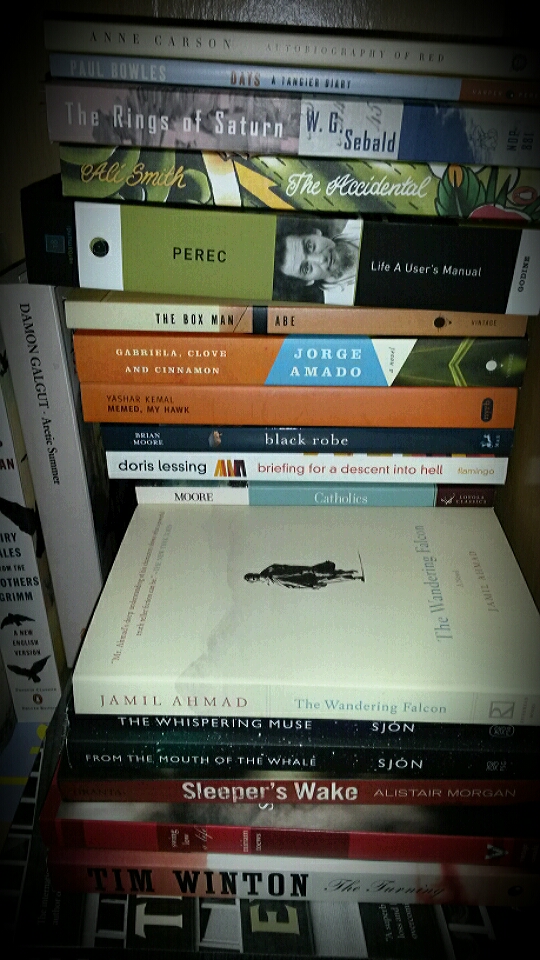
Random pile, one of many, mostly unread.

I console myself by calling to mind a number of women peopling my hypothetical list of intentional reads for the upcoming year. But I know myself. I am idiosyncratic and tangential in my reading proclivities. I find myself unable to create a stack or list of titles and systematically make my way through from top to bottom. And although I do not intend it, novels by women are frequently pushed down the line by something else that comes into view.

Perhaps there is a question of subject and style. I am presently reading with a strong critical intention to exploring a way of telling a story that I have to tell and, for better or worse, the authors who are coming to my attention tend to be men. That may be accidental rather than intentional on my part. But my bookshelves hold a record running back over decades and the gender imbalance is consistent (and, by the way, not reflected in my non-fiction collection which tends to have a much more equal divide).

Now I could launch a defense for this heavily weighted scale. I suspect I do know some of the reasons why I am drawn to certain tales told from a male perspective, reasons rooted in my own differently gendered history, but at the end of the day I am only accountable to myself for that reality. I do not believe that I eschew female novelists on the basis of gender alone, but there are certainly stories and themes that do not draw me in. And I do not feel obligated to read women writers to understand women better, I spent the better part of four decades trying to jam my own square self into that round hole and accept that there are things I am not programmed to learn. I have female friends. I have a beautiful daughter. And it is not like I never read or fall in love with books by female authors. I am open to the opportunity to explore more. But setting a quota is disingenuous.

And feeling guilty wastes precious time that could be spent reading.
Channeling Bernhard in the Balkans: The Son by Andrej Nikolaidis meets Bernhard’s Gargoyles

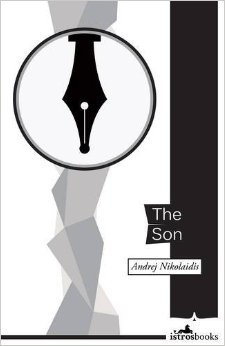
SonThere comes a moment in Andrej Nikolaidis’ novel The Son where the unnamed misanthropic narrator, confronted with a hideously deformed family of lepers who have taken up residence in an abandoned car park in the Montenegrin city of Ulcinj, imagines that he is “a piper with a funny Tyrollean cap, which Thomas Bernhard would find laughable, and (…) dressed in green knickerbockers with suspenders like Heidegger used to wear” who proceeds to march through the streets of his home town gathering a following of the wretched, desperate, and diseased denizens of the streets, dark corners and hovels and leading them right down to the seashore, where he proceeds, walking out across the water, while the “grisly army” he has amassed disappears beneath the waves.

The Son is a dark, unrelenting journey into all the misery and disappointment that life and, those who claim to be your friends, family and lovers can bring. Our anti-hero is not a warm, generous soul. Admitting to his own perverse, gruesome obsessions in the early pages, he reports that his wife has just left him and he is bitterly alienated from his father. He perseverates about the cruelty of the forgiveness his father repeatedly bestowed upon him regardless of the destructive nature of his actions. He manages to vent anger at everyone he encounters, remarking at one point that he was “reminded once again that the nicest things we can say about a person is that one day they will die and cease to bother us.” As readers we are swept along on a scotch fueled odyssey into the heart of the city where a series of old acquaintances and disreputable characters seem to fall into his path where they are treated with a curious mixture of revulsion, pity and disdain. He is, in essence, the most vitriolic Bernhard monologuist transported from Austria to Montenegro and boiled down to the meanest bare essentials. By contrast, my current Bernhard read, his early break through novel Gargoyles, seems airy and light.

LosersPublished in 1967, Gargolyes was given its title in the English translation (the original German translates closer to something like distress or disturbance) presumably drawing attention to the grotesque series of characters encountered by the narrator, a son home from school, as he accompanies his father, a rural doctor, on his rounds to a series of isolated, ill and mentally unstable patients. The themes of madness, isolation and suicide recur as they make their way to Hochgobernitz where the aging Prince Saurau takes centre stage for the second half of the book, embarking on an increasingly intense monologue, mourning his own estranged relationship with his son who is away studying in London, and philosophizing about the hopeless and inevitable destruction and collapse of human society.

For my money, the characters that inhabit the pages of The Son are every bit as grotesque as those in Gargoyles, if not more. In both cases they serve as extreme, cartoon-like voices for exploring themes that are in turn horrific, humourous and deeply human, pivoting coincidentally around the relationships between fathers and sons. Amidst the rants against man’s inhumanity to man and musings about the madness and disease of modern society; a desperate compassion comes through. That is the compulsive beauty of reading Bernhard and, for those curious but afraid of the endless single paragraph style typical of most of his work, Gargoyles is a perfect introduction. For his part, Nikolaidis seamlessly transports the energy of Bernhard to the post Balkan War reality of a country he clearly loves passionately. As with his earlier book The Coming, it is also a dark meditation on Montenegro’s rich, complex past and uncertain future.

In a guest blogpost for Winstonsdad’s Blog (a great resource for works in translation), Andrej Nikolaidis reflected on his love for Bernhard and the influence he has had on his own work. Upon his first encounter with The Loser, (also my first introduction), the Balkan war was raging and he could see timely parallels in Bernhard’s existential analysis of Austrian society in a state of decay and collapse. He also finds in Bernhard the prose response to poet Paul Celan’s famous poem ‘Fugue of Death’ or ‘Todesfuge’. He hears the rhythms of Bach ring through the works of both men – and Bernhard was a musician first – envisioning Celan as a character who could have walked out of a Bernhard novel. With The Son, and a sound track updated to incorporate the noisy sound styling of Sonic Youth, Nikolaidis’ work carries the banner forward.

The Son by Andrej Nikolaidis (trans Will Firth) – Istros Books                                     Gargoyles by Thomas Bernhard (trans Richard and Clara Winston) – Vintage Books

Imagine: A church for those who don’t trust church

“Imagine”

Imagine there’s no heaven
It’s easy if you try
No hell below us
Above us only sky
Imagine all the people
Living for today…

Imagine there’s no countries
It isn’t hard to do
Nothing to kill or die for
And no religion too
Imagine all the people
Living life in peace…

You may say I’m a dreamer
But I’m not the only one
I hope someday you’ll join us
And the world will be as one

Imagine no possessions
I wonder if you can
No need for greed or hunger
A brotherhood of man
Imagine all the people
Sharing all the world…

Copyright JJM Schreiber, 2011
Copyright JM Schreiber, 2011

Church music? Apparently and rightly so. Last week I emerged from the church I have been attending, despairing that a deep ambivalence about my own ability to connect with faith may stand in the way of my search for community. This morning I remembered why, if there is a church that I can connect with, the one I have been attending may be as close as I can get. John Lennon’s Imagine, performed by a soloist set the framework for the reflections of the pastor.

Imagine? Yes, imagine hearing a pastor admit that in the 25 years since his ordination in the United Church of Canada, he never thought he would be looking at the works of Richard Dawkins and Sam Harris and think, maybe they have a point there. One does not have to look far to see how religion is perpetuating hatred, within families and communities, between ethic groups and countries. And it is not a new phenomenon. Is the problem religion? An atheist does not hesitate to answer, but what causes a pastor to ponder? And what does that mean for churches like Calgary’s Hillhurst United? My own anxieties about faith aside, it is a church that practices what it preaches: welcome and advocacy for the poor, the disadvantaged and the marginalized; outreach and full acceptance of everyone regardless of age, ability, sexuality or gender identity. Yet the pastor, John Pentland, is accustomed to meeting newcomers who share that they have no problem telling someone that they are gay, but don’t want anyone to know they go to church.

Is religion always at odds with all that could be positive and affirming about faith?

I am not sure yet. But I did spend Saturday at the church helping set up for a performance by Australian-Canadian queer trans artist, Sunny Drake. In the evening as the church hosted homeless families in the gymnasium, the pews of the Sanctuary were filled with a diverse audience treated to an outrageously funny performance about the trials and tribulations of a gay transgendered man trying to quit his addiction to romance. Honest in language and content that one would not generally not expect to find in a church, but together with the panel discussion that followed, this partnership with the city’s only queer theatre, Third Street Theatre, offers a vital opportunity to improve communication and understanding within and beyond the LGBTQ community. And yet another indication that at this church Affirming means much more than hanging a rainbow flag in the corner.

As someone who often feels as alienated within the LGBTQ community as within a larger community of faith, this weekend was an important indication of just what a church that seeks to embrace rather than exclude, can be.

This Is Paradise, or where does fiction meet real life?

I cannot remember ever really wanting to be anything other than a writer. How then did I get to mid-life believing that my aspirations would never extend beyond the inevitable writing and editing of newsletters and promotional material with every job or volunteer position I have ever held? Why have I been hit with a curious mix of pride and anxiety every time someone has commented on my facility with words?

In truth, there was a point in my late teens or early 20s in which I made the conscious decision to wait until I had lived a little before writing. I assumed a little experience would provide material and perspective. I had not bargained for the complicated experiences that awaited me or how long it would take for me to wade through and unravel it all. And when I did find my way through I found myself unwilling to bare my soul on the page. But every writer has a story they were born to tell, or as James Baldwin said about Go Tell It On the Mountain, the story they have to tell if they tell no other. Frequently it is a coming of age story, a coming out story, a tale of childhood loss or trauma. But that not need be the case. Nor is it necessarily the first story a writer sits down to tell. It can be recounted in fiction or presented as memoir, but the telling is essential, cathartic and close to the bone; even if no one beyond a few friends or relatives ever see the manuscript or hold a copy of a self-published book.

As I look back, I finally understand why I decided to put my writerly aspirations on hold so many years ago. I also understand the barriers I have placed between my impulse to protect myself and my identity and any story I thought I might tell. In this context those reasons are not important. I have also come to recognize the story that I really need to tell is one which I have only recently come to understand myself. So with the unexpected time that my present inability to return to work has afforded me, the gift of introspection and a desperate need to get this story out onto the page and hopefully gain some distance; I want to see what I can do.

But the challenge with stories that find their source close to life lived, is that this same life not only belongs to me. It cannot be divorced from real people. Or real experience. I am not certain how to balance the need to breathe truth into an experience and the desire to protect those I love.

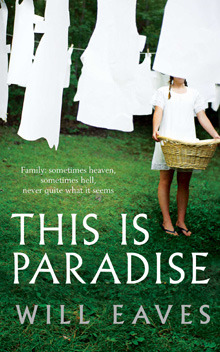
paradiseMy latest read has inspired these questions. After my enthusiastic encounter with Will Eaves’ The Absent Therapist, I turned to his 2012 novel This Is Paradise, which I have had on hand for nearly two years. The right book, at the right moment it seems. A relatively spare novel that is at once intimate and ambitious in scope, this book opens with Emily Allden’s difficult pregnancy with her fourth child, and closes decades later following her death. Benjamin, the youngest, unborn at the beginning is an enthusiastic traveller on his first chance to join his older siblings and parents on their regular holiday trip to France in the first half of the novel. In the second half Benjamin, now grown becomes the lens through whom we see the family – his well meaning but emotionally distant father; his intelligent but volatile older brother Clive (who is clearly dealing with perhaps aspergers or a mental health disorder) and his two sisters, the capable Liz and the delicate Lotte – as they cope with their mother’s increasing dementia, the decision to place her in a care facility, and the lingering final days of her life.

Eaves’ deft ear for the nuances of conversation, sensitivity for the complex social dynamics that bind and divide family, and keen eye for visual detail allow him to create a coherent interplay between the members of this large family and a handful of supporting characters across the decades. He does this by employing a style that is at times fragmentary, sometimes reflectively slipping back into passing remembrances, but always evocative of the way that we tend to think about and experience our lives over time. The result is rich with wonderful moments that add depth and resonance.

Yet as I was reading This Is Paradise, I was especially struck by the pivotal account of Emily’s illness, the details of her physical and mental disintegration, and the mixed emotions that rise and fall between the various members of the Allden clan throughout this process. It rang true in a way that made me wonder if it was grounded in lived experience. It was then no surprise to find that Will Eaves had in fact published an essay in The Guardian about his mother’s struggle with Alzheimer’s. When he recounts an event repeated in the novel I naturally wanted to know where reality and fiction intersect in his story. And how does an author decide what to paint clearly and what to disguise?

To be honest I am not generally drawn to family dramas, especially ones with such a sprawling cast and ambitious reach across the years. Mind you in another writer’s hands this would likely be a book at least 600 pages long. In half that length, we trace a loving portrait of a complex and deeply human family from childhood spats through adult stresses and concerns to the bonding moment of shared loss.

And since it is from my own immediate family that the story I want to tell arises, I suppose I will be paying closer attention than ever to the way such dynamics are played out in literature.

At peace in place, but alone in the world

 Copyright JM Schreiber 2014
Copyright JM Schreiber 2014

An empty bench overlooking the reservoir. Ice and snow have stilled the water. In the far distance the Rocky Mountains fade in the distance. I spend many hours along the shore of below this bench and further to the west where the flatlands spread as the Elbow River enters. In the springtime the water level is kept low to allow birds and waterfowl to nest. Although in warmer weather the parkland that runs along the northern shore of the reservoir is frequently bursting with couples, families, children, reunions and other large group activities, I prefer to pick my way along the water’s edge. I meet few others, mostly birdwatchers and photographers with ungainly long telephoto lenses hanging off their camera bodies.

I prefer a wide angle perspective, capturing the vista but keeping the details and any people in it reduced to a comfortable manageable size.

And I wonder why I feel so alienated and alone? I realize that the roots of that feeling run deep and cannot be divorced from an intense sense of being different at an early age, fractured through the prism of living with a mood disorder. But I have also become an expert at engaging with a wide range of people at a superficial level. In recent years I framed it in terms of maintaining a professional distance from clients and co-workers.

Some have speculated that this sense of alienation is essential to the artistic vision. Colin Wilson’s The Outsider was a popular formulation of this notion, of much interest and mystique to me and my friends back when we thought we knew everything. Much more recently I sensed this essential detachment from others contrasted with a deep affection for place in Orhan Pamuk’s Istanbul.

Copyright JM Schreiber 2011   Same location in the spring
Copyright JM Schreiber 2011              Same location in the spring

So what can I draw from a landscape like this? A space I can return to throughout the year and always see anew?

Moving fast to slow down

With respect to many fellow bipolar bloggers who are weighed down with depression I am fighting a mixed hypomanic state. This is a more common concern for me and although I have only been fully manic twice in my life, I can run at a heightened level for years. Looking back now I probably was running high over the past few years while I took on increasing responsibilities at work in an increasingly unsupported and dysfunctional environment before landing in full manic mode this past June. I have had access to little psychiatric support since then so between my family doctor and a private psychologist I splurge to see once a month I am trying to stabilize my level of agitation. Hopefully before my disability benefits run out.

At the same time this time has allowed me to unpack a lot of baggage and make some critical reassessments at this point in mid-life. On that level I am making progress. But my brilliant experience volunteering at Wordfest last month, meeting and engaging with so many readers and authors was a high risk experiment with respect to my mood regulation efforts. I barely ate or slept for four days after the event ended.

For all the energy these past weeks have added to my creative efforts, I have trouble concentrating and tend to fall into periods of high energy thought processing without being able to channel the ideas productively. I have been making a point of getting out and spending a few hours writing or reading in coffee shops. Being in public spaces forces me to focus.

However, the word is that winter is truly rolling in tonight with snow and temperatures dropping to the minus double digits celsius. Since I haven’t gotten around to getting my winter tires mounted I am not likely to venture far for a few days. So I decided to spend the last temperate afternoon out, not hunched over a coffee cup but walking off some of my pent up energy.

Typically I walk with my camera and my ipod. It is a slow pace as I find myself regularly stopping to capture scenes or flora. However I hadn’t realized how that actually narrows my experience of some of the locations I regularly visit. When I was working such an activity was a great way to relax and unwind. Since I have been off ill, I have had little enthusiasm for photography and little motivation to visit my favourite natural haunts as if one required the other.

Today when I reached the riverside where I planned to walk I felt momentary regret that I had neither my camera nor my ipod with me. But as I set off on a brisk walk in the late afternoon light of this November day I was surprised to find how freeing and meditative the experience was. The movement helped me slow and focus my thoughts while, freed from the viewfinder of a camera, I was able to take in the fullness of the vista. I watched the changing colours of the slowly fading light reflected in the water and on the glass towers of downtown in the distance. I noted the shifting clouds and birds flying in to roost as the depth of darkness and shadow crept across the fir trees that cover the length of the high embankment across the river.

I returned refreshed, relaxed and calmed.

The path I walked today as it is likely to look in a month or so. Copyright JM Schreiber 2012
The path I walked today as it is likely to look in a month or so.
Copyright JM Schreiber 2012

Reflections on the Day of the Dead

For years a small sugar skull sat on one of the bookcases in our house. Eventually it had yellowed and aged to a point that its value as a keepsake was minimal. One day with a last glance I tossed it out. There were two originally so somewhere in the accumulated detritus of twenty years in this house, another little skull is probably decaying.

Inician la temporada de alfenŽiques2_0The skulls were mementos of a special Members-only preview of an exhibition which passed through our city in November of 2002. ¡Viva Mexico! featured a selection of the glorious huge colourful murals of Diego Rivera, striking photography of Day of the Dead celebrations by Graciela Iturbide and a display of shaft-tomb figures. As a family event, there was also a wide range of hands on creative activities for the kids.

I had been, at the time, a single parent for a year or so, my children would have been coming up on 10 and 13 years of age. It was an era of fundamental change and transition in my own life, but it was also a time when my kids were young enough to really enjoy this type of outing. I had a family pass and the museum was a common weekend destination.

However, until that day I had, somehow been unaware of the importance and spectacle of the Day of the Dead. Hallowe’en was fun of course, and a highly anticipated event for the children in their younger years. But the magic and energy of the the Day of the Dead celebrations captured in the photo gallery left a deep and lasting impression on me.

Many years later it all came back when tackled Malcolm Lowry’s classic Under the Volcano. I read it with The Guardian Reading Group, a three or four week monthly on-line opportunity to tackle a book with fellow readers. It is a challenging work to fully appreciate and before the month was out I found myself reading the text on an e-reader with the paper copy open beside me on the sofa so I could readily flip back and forth to cross reference and the link open on my computer to a brilliant website, The Malcolm Lowry Project, which provides chapter by chapter guidance and assistance to the humble reader along the way. Simultaneously long conversations were unfolding on-line within the Reading Group.

Now I can no longer divorce the Day of the Dead from the tale of Gregory Firmin, the alcoholic British consul in a small Mexican town, and his slow, tragic unraveling and demise throughout the course of one November day. Impending celebrations lurk in the air, but his desperate mental waltz with the push and pull of liquor, the reasoning and rationalizations he plays with himself held my greatest fascination. I have been lucky that alcohol has never held a serious allure for me, and my tastes tend to be above my discretionary budget anyway. Dedicated alcoholics don’t care and my family history has known its share. Especially on the side through which the mood disorder runs.

By the time I sat down with Under the Volcano, my son had been a heavy drinker for several years, although there is a long time before he finds himself in a state of crawling across the lawn toward the vision of a half empty bottle like the poor consul. I should hope. The struggle is a delicate matter for us to balance. He is almost 25, gifted and anxious to an extreme and over the years he has been on his own, on the street and now for the past few years increasingly isolated at home. Over a month ago he had a break of honest self recognition and quit drinking. But for many and complex reasons, especially some particularly horrific experiences in what passes for an adolescent mental health system, he has a complete aversion to any counselling or support.

Today, on the Day of the Dead, he is working a couple of beers back into his routine and I am trying to maintain the boundaries. Our relationship as father and son is complicated, we are close, share many character traits and insecurities. With a history working in social services I am also acutely aware of the limitation of practical services out there. And the cost of living in this city currently precludes even his younger sister who has a profession from moving out. But I know I cannot own his issues.

So with this November 1, I will honour the Dead with hope and ambition for all of us trying to pull together and move forward with Life.

Myself included.

Want to write? Start with reading.

It has taken me over a week to come down after volunteering with and attending events at our recent word festival. I entered into the week slightly down and was spiraling up within a few days. If it was a test of my ability to return to regular work, this is clear evidence that my mixed state is still far from stable. But I would not have missed it for the world.

It was an absolute thrill to mingle with people who are passionate about books and listen to Canadian and international authors talk about their craft. Whenever an author was asked about his or her influences, a love of the magic of books and literature shone through in their responses. If asked about advice for want-to-be writers, the common answer was read, read, read… read widely and drink deep from the wealth that books have to offer.

The stash of books I bought at the event, not including the titles I purchased or read in advance. Volunteering in the bookstore can be expensive!

And so there was this man I crossed paths with at various venues throughout the festival. He told me he was a writer. Patting the breast pocket of his jacket he indicated that he felt he was getting ready to pull together his work. He had a gold pass so I saw him a number of times but always alone, ordering a coffee or buying a glass of wine at the bar. He would acknowledge me and we would exchange a few words on whatever interview or panel we was waiting for. But I never witnessed him engaged in animated discussion with fellow attendees.

The solitary man at a venue where excited discussions about books were regularly erupting between strangers is an anomaly.

On Saturday afternoon I encountered him in the lobby. He was carrying a copy of Sweetland by Michael Crummey. I got the impression he was done with the festival regardless of the major authors still to come. He said, “I have decided, this is the one that impresses me. Let’s see if he writes as well as he talks.” I responded that I had recently obtained a copy of his previous work Galore, the novel Crummey described as the one he feels he was born to write and that I wanted to read that first. He looked at me with surprise and said, “You mean you have heard of him?”

Suddenly it dawned on me that this man, the self-described writer, does not read at all. I suppose he thought he he would be able to absorb all the final inspiration and direction from this one book. If he did not know one of the best known Canadian contemporary authors and poets, even if he had never actually read one of his books, I could not help but wonder how he imagined himself ready to pull his accumulated scratchings into a final product.

With a full evening and day still ahead, he had selected his role model. I never saw him at the theatre again.

Even if it left me swinging up on my attempt to stablize this recovery from my recent manic episode, I was deeply inspired by the talks I attended, delighted by the company of fellow book lovers and especially grateful to a few authors who took a little extra time to encourage me as writer. I was regularly reminded that it is never too late to start.

And I am never lacking for books. In fact they seem to multiply in my life on their own as any truly avid reader knows.

Further reflections on the void left by suicide: deeper appreciation for Miriam Toews

Miriam Toews is one of Canada’s most celebrated novelists. She has drawn heavily on her Mennonite heritage filtered through the ability to explore the messiness of ordinary life with a wonderful sense of humour. Recently I reviewed her Giller nominated All My Puny Sorrows, a novel which is deeply inspired her sister’s suicide. The novel itself, while wicked funny in places, left me wanting more of a connection to Elf, the deeply depressed character. Her “healthy” sister, the narrator, never really seemed to understand but rather struggled with her own reactions – the practical and the reckless.

Tonight I had the good fortune to attend a panel called “Darkness Visible” in which Miriam participated. The theme explored by the three somewhat diverse novelists was focused on looking at whether dark themes, personal or political, can be fully examined in literature. The consensus I suppose was that despite the challenges and limitations, the ambition is valid and important.

swing lowBecause I already own a digital copy of All My Puny Sorrows I purchased a copy of Swing Low: A Life for this event. Written in memory of her father, a well loved teacher and pillar of the community who took his own life about a decade before his daughter followed suit, this slim volume deals more explicitly with manic depression and suicide. I only recently became aware of it. Given my own recovery process I am thinking this is more the story I was looking for with All My Puny Sorrows. Coincidentally, an audience member at the event had grown up in the same Manitoba community as Toews. Her father had been his teacher and he began to cry as he shared his shock when he had learned how much pain and sadness the family was going through. Miriam had to dry her eyes as well.

That is the true impact of suicide and it spreads beyond families.

When I had the pleasure to speak to Miriam after the event I confessed my experience with All My Puny Sorrows, explaining that I was reading it in the aftermath of my own breakdown and, sadly, in the light of Robin William’s suicide. I told her I suspect that the book I was hoping for probably lies in part in this earlier, more serious volume. But then we both admitted that unless we are ourselves are burdened with the desperate desire to let go of this life, we can only ever observe from the outside. We also shared our mutual fears for our children inheriting the same genetic disorder.

I am deeply impressed with Miriam Toews’ desire to speak about mental illness and with her wide appeal in this country, hopefully her message will reach an audience that needs to hear it. I am looking forward to finding out how she explores the bipolar disorder in her family through her father’s story, unaware at the time of course, that the same event would strike her family again.

She told the audience that if writing her most recent book taught her one thing it is to hold tight to the joy in life.

A worthy goal for us all.

Haunted by the unanswerable

Under the bipolar microscope, The who am I? question becomes Which me is me?

The depressed world weary me? The hyper productive hypomanic me? The over the edge manic me? Or that nebulous normal, somewhat sponged and effectively medicated me?

Or possibly all or none of the above.

I don’t remember exactly when I first started to swing between up and down, enthusiastic and anxious, outgoing and withdrawn. I suspect I didn’t really begin to articulate the patterns until my early 20s but I am sure the tendencies were there much earlier.

I was an awkward kid, lonely and odd. My brothers had friends in a our rural area but there was no one my age. I was frightfully shy and unpopular at school. I lived for books and music.

And it was music that offered a hint of another world gleaned through the Sunday edition of the New York Times that arrived each week, belated and a little worse for wear. Although I existed in a place where 70s rock bands dominated the radio and occasionally passed through, New York City was home to The Ramones, Patti Smith, Lou Reed and so much more.

For someone so miserably out of step with others, confused by questions of identity and smart when smart was not something to be, New York seemed like mecca. It was, after all, the city my mother came from and where my parents met even if we had ended up in another country some 2000 miles to the west. I was not the only isolated kid hunting out obscure copies of Velvet Underground albums back in the late 1970s, but in my hometown at the time I sure felt like it.

My mother tried hard to provide me with extracurricular activities upon the advice of a guidance counsellor who had picked up on my round-peg-square-hole. I started with drama lessons and moved on to guitar lessons. Not a natural musician like my son, I needed all the lessons I could get. My teacher was patient, guiding me along from “Jingle Bells”, through a year or two of classical, but his heart was with blues. Not a good move. I was too self conscious to jam and too bored to play twelve bar blues runs ad infinitum. So one day he asked me to bring an album and play for him something I really wanted to learn.

I arrived the next week with The Velvet Underground and Nico under my arm and played my favourite tune, “All Tomorrow’s Parties”. My teacher’s face fell.

That’s just discordant, he told me. I can’t do anything with that.

It was my last lesson.

The timelessness of that album and its influence on decades of musicians has amazed me. Both of my children even fell in love with it in their own time. And in honour of Lou Reed’s death an ensemble of Canadian artists from rock starts to opera singers and our own musical astronaut performed a tribute concert.

This most amazing cover of “All Tomorrow’s Parties” takes me back to a space before my mental health started its slow unraveling and reweaving of my self identity to bring me here. When I listen to this I feel like I am beginning to come full circle. Much older, much wiser but still figuring out who I am.

Enjoy.