Personal reflections on identity, for better or worse, on Canada Day

Today, July 1, is Canada Day.

Exactly one year ago I was in Cape Town. I arrived back in the city that day at 5:30 in the morning after seventeen hours on a bus from East London. Dragging my luggage with its maple leaf ID tags I encountered many who would note the flag and say “Ah, Canada, that’s just about the perfect country, isn’t it?” Invariably I was hearing this from black or coloured South Africans and, I have to confess, at that time in my country’s recent political history I was feeling most despondent, embarrassed even, to be Canadian. For the very first time in my life.

What a difference a year makes.

canada-159585_960_720Hard to measure the shifting sands in the glass but while our Federal election last year brought home to the ruling Conservative Party the cost of divisive politics, the limits of denial and disrespect, and the risk of stoking xenophobia to sway sympathies; we now seem more and more like an island in a sea of unrest. And, I don’t pretend that we are immune to hatred, or that we don’t have a legacy of shame four “our” treatment of the First Nations on this land, but this is a huge and vastly underpopulated place so there is greater room to breathe.

At least for now.

As Canadians we also have another advantage: an identity that is relatively amorphous, ambiguous, sometimes even apologetic. A contest held in 1972 on the CBC Radio program, This Country in Morning, famously invited listeners to finish the statement: As Canadian as ________. The winning entry?

As Canadian as possible under the circumstances. And proudly so, I say.

Which leads me to wonder about identity, a question that has been troubling me of late.

There is a series of advertisements running on the television for a company that, for a fee, will analyze your DNA and tell you what your ancestry is, in percentages, no doubt with colourful pie charts to justify the cost. Perhaps you’ve seen them or something similar. You know, there is, for example, a man who always believed he was of German heritage but thanks to a little DNA sleuthing he discovers he is Scottish. He promptly trades his lederhosen for a kilt. And there are other variations but you get the drift.

How can your DNA define your cultural and ethnic identity? It might and then again it might not. Peoples migrate, borders shift, cultures evolve. An aboriginal survivor of the 60’s Scoop that literally pulled First Nations youth out of their homes and communities and deposited them in white foster homes may justifiably have a need for healing and reconnection with their heritage, but a DNA test that simply reflects possible ancestral bloodlines going back centuries or longer does not tell you who you are. Cultural and ethnic identity are complex and cannot be understood divorced from lived experience.

As I find myself, midway upon my life’s journey, to paraphrase Dante, I carry two questions of identity that, to some degree, offer an understanding of myself that reaches back into childhood and adolescence. But even if they are grounded in some understanding of a genetic/epigenetic heritage I own, the degree to which they can and do form part of my identity is troublesome. Identity is, as far as I am concerned, a choice. That is not to say it is not grounded in fact and reality at some level, but what does it mean to say “I identify”? And how is that to be differentiated from “I am”?

I have bipolar disorder (I touch on this in some of my earliest blog posts) and I was born with a pervasive sense of a gendered self that was at odds with the sex/gender that I appeared to be (I address this most explicitly here). I did not begin to understand either of these facts until I was in my mid-30’s. But they are inextricable from my experience of myself in the world, they are formative and I have no idea what it would be like to have existed without either although I have learned, with greater or lesser success, to live with each one. Both are treated, neither is cured. I have written about both, but I would be hard pressed to say that I identify as either bipolar or transgender. Would someone identify as a diabetic? Would you say you identify as brown-eyed?

I know people who do hold a mental health diagnosis or a gender identity with pride. Perhaps I did too at one time. Perhaps I still do even though I don’t want to admit it.

Recently my psychiatrist suggested, having reviewed the only records she had from my past—the report of an inpatient stay during acute psychosis almost twenty years ago, the turning point at which I finally began to unravel the fractured and unhappy state against which I had raged for several years—that she did not believe I was bipolar. That cheerful announcement set off weeks of rumination in which I replayed all of the episodes of depression and hypomania I had surfed for so many years, blaming myself for a failure to commit to any single course of study or employment. I began to appreciate how my understanding of the place I find myself at this point is contingent on having an explanation, an illness to blame. Combined with acute gender dysphoria I can assuage the sense of failure that haunts me. Justify all the paths I took or did not take.

Or, as my therapist challenged me yesterday, have I been using bipolar as an excuse to avoid grieving the losses I have experienced?

I don’t even know how to begin to grieve and the thought terrifies me. And, if I find my way through it all, perhaps I will write about it. But I do believe it may be the one path I have not yet dared to take.

Finally, what of gender? That is a topic for many essays I’m afraid. My differently gendered existence is essential to who I am, but again, it is not my identity. If forced, I “identify” as male, but prefer to understand myself simply as a man, and every time I qualify myself by appending trans* I feel reduced, dehumanized. One only has to exist within the LGBTQ community, such as it is, as a man attracted to men, to feel the full force of transphobia from within. And to have transitioned when I did, before it was fashionable and trendy to be trans, other transgender men were often exceptionally homophobic toward anyone who identified as gay. For everyone who claims to defy gender binaries there is a whole cast of characters propping them back up. I’m probably in there myself.

pride-flag-meaningSo, although I tick three out of the five basic boxes in LGBTQ, I have no Pride. But then I have no shame either. And identify? Well, here I stand I can be no other. Even if I don’t feel I belong. June is always tough for me. This month with all the difficult emotions stirred by the Orlando shootings has been especially hard.

I actually do belong to an LGBTQ community and have good friends there. My very closest friends are all queer. And yet I always feel like I am on the outside looking in. An impostor. But in what way? And who decides who belongs and who does not? Even apparently marginalized groups seem to find a way to splinter and divide.

Which brings me full circle to the angry racist, xenophobic, sexist and homophobic aggression and violence that threatens us all, at a time and in a world in which we should know better.

At least, for now, and on this day, the one thing I can say is: I identify as a proud Canadian.

Reflection: Fishing for memories denied

It is rare that I indulge in sharing a significant quotation simply because it speaks to the space in which I find myself but I keep returning to these words from Intimate Stranger by Breyten Breytenbach (Archipelago Books, 2009).

“Writing is fishing for memory in time. Viscous. Time black. Sometimes you see it flitting just below the surface – memory – miming time. Memory takes on the blackness of time. Memory will be time surfacing. Use word as bait. Beat the water. Beat the weird beat of baited words. Bloated. Wounds. The bleeding words like wounded boats on a black sea. Let the fleet wash up. The coast is the beginning of the sea’s wisdom. It comes with the territory.

Words have their own territory, they return home as in a song. The fish only discovers the water once it is removed from it. This land is a memotory.

But not peaceful. Memory as trigger for territory and tongue. The mind is full of bloody pieces staked out by tongue. Is there room enough? Memory killing memory.”

initmateThis book, a selection of meditations on reading and writing, was waiting for me when I returned home from the hospital just 10 days ago. I have been keeping it close and dipping in and out of it. Breytenbach is a South African poet, writer and painter but his life, his work, his vision is borderless. In this collection he offers practical advice, shares poems and reflections on the power of the word, drawing on his own experiences as well as the wisdom of a legacy of gifted writers.

Memory is the foundation of writing. One draws on experience when putting pen to paper – poetry, fiction, memoir alike. And it is memory that is weighing me down, threatening to drag me beneath the surface; a memory that haunts and obsesses me because although it involves me, I will never access it.

I have lost a space in time. Like a bruise it bleeds beyond the boundary of the injury, reaching backward and forward from the instant a clot in my lung threatened to stop my heart. Days are absolutely gone, the day or two before the incident, the day or so in ICU and the first days after waking. But I can’t let the blackness go. I cannot let it wash out to sea. I want to hold the moments, hours, days in my hands but I cannot. They do not belong to me. They are about me. They will never be mine.

I have read my discharge summary until I know it inside out. I have pestered my anxious son with questions. What was it like to find me in distress? How did you get to the hospital? How did you feel? Stupid questions. I am struck with shocked disquiet to realize that my family did not know if I would survive.

If I had not survived the blackness would be complete. Viscous. Time black. Inanimate from my perspective. My own memories lost. The sole distorted possession of those who knew me, no longer mine.

Sands are shifting. I have some fishing to attend to before the next high tide.

Indian Ocean, Eastern Cape, South Africa Copyright JM Schreiber 2015
Indian Ocean, Eastern Cape, South Africa
Copyright JM Schreiber 2015

Easing back into reading

As soon as I was coming around a few days after my recent near death encounter (and I don’t mean that in any mystical tunnel of light sort of way) I told my kids that I wanted them to bring me books. I could barely stay alert long enough to get an entire sentence out but I wanted books. They obliged me. Wisely I asked for one of the few books on my shelves which might count as a mystery – Lost Ground by South African author Michiel Heyns – which has proved to be fine company indeed though I have only been able to read attentively for a few days now. They also brought along one of my endless stream of incoming purchases, a gem from Twisted Spoon chosen for Women in Translation Month – Primeval and Other Times by Polish writer Olga Tokarczuk. A surreal and fantastic work it looks good but I may have to push it a little further down the month. Reading is tough work after cardiac arrest. Go figure.

Now that I am at home, facing three blood tests each week and a host of other medical appointments all over the city when I have been told I can’t drive for 6 months, I find myself reading and re-reading my discharge report. I am living on warfarin – rat poison – afraid of bleeding too much or worse, clotting too easily and having a stroke. The devious little pulmonary embolism that triggered this whole adventure (a likely souvenir of a hellish 24 hours of flight time packed tightly into 28 hours on my recent return from Cape Town) is still sitting in my lung and will, they say, eventually be absorbed. My left leg is swollen and bruised due to a hematoma, a probable complication of the resuscitation process. I watch people jogging by outside on this hot summer day and feel like some sort of Frankenstein creature, dragging this heavy black and blue leg around.

Even though my friends have been amazing – I had a steady stream of visitors throughout my hospital stay and have no shortage of offers for rides around town – I feel a despair settling in. I don’t know where to turn, where to dig into the towers of books surrounding me. I wonder what would have happened had I slipped off this mortal coil two weeks ago. What would my family say about all these books on which I have squandered my limited funds? For heaven’s sake my open shelved coffee table loaded with books and stacks of journals – Granta, Paris Review, Music & Literature – came apart when the paramedics tried to pull it out of the way. I feel overwhelmed rather than excited about diving in to all the new books I have acquired in the past month. I had to buy an extra bag, after all, to get my haul of books home from South Africa and now they too sit on the shelf taunting me.

Will the magic of reading come back with my health?

2015-08-09 17.37.38I have also wondered if this experience is that final kick in the behind that I need to get serious about my own writing. I’m in my mid-50s. I’m not getting younger. Coincidentally while in the hospital I signed my first contract for the publication of an essay in a book coming out next Spring. It is a niche project – a collection aimed at gay, bisexual and transgender men – but my first professional publication credit all the same. So how much life with all its mess, joy and agony does one have to drag his or her sorry self through before there is enough fodder for a story? I wrote throughout my youth, being a writer was always my dream, a strength in every course I completed in university and every job I have ever held. But when it came down to creative writing I always insisted that I had to live a little first.

At this moment I feel that I lived so much that I don’t know where to begin. And now I have almost died too.

One miserably roughed up ghost, rising from the ashes once more

Sometimes you fool yourself. You believe that you are invincible. You know that bad things happen to good people. You know that they have even happened to you. But time and time again we are caught off guard reminded of the wisdom of Monty Python’s idiom: Nobody expects the Spanish Inquisition.

14701351714_280be514fc_z
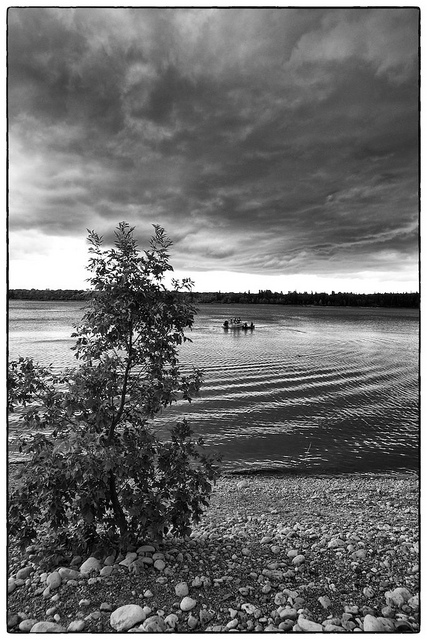
Copyright JM Schreiber Storm clouds over the Reservoir, Calgary, AB

If I had had more experience traveling I might not have made the mistakes that may very nearly have cost me my life this past week. I thought that by focusing my first visit to South Africa to longer stays in two areas, I would limit my travel time. But instead I ended up with long plane flights and interminable bus trips. Next time, and I definitely hope there is a next time  – *the hematologist looks at me askance* – I hope to take longer and fly between major centres once I get to South Africa. The buses have a certain charm and I definitely got to meet and talk to people in a way I might not have otherwise, but to top off my three week excursion with a three leg flight home with very short turnarounds was a major miscalculation  on my part. It sounded great. But I had no idea exactly how tight a three hour stop over is, especially if you have to clear customs. Longer stop overs would have helped. Baby asprins, compression stockings. Everyone has recommendations now.

Yet although I was tired and swollen upon my return, it would take a few weeks before my journey caught up with me. Last Sunday night, or rather, early Monday morning, two and half weeks after I returned home, all swelling and fatigue seemingly gone, I suffered a pulmonary embolism. Well actually, it was not clear what had happened at first. I have very little memory of that day or an evening event I had been to with friends. My 25 year-old son, a creative, troubled but wonderful soul, heard me moaning. Thomas came upstairs to find me disoriented. He called Emergency and started chest compressions.

The kid saved my life. In one of those odd ironies, or twists of fate, toward the end of my time away, Thomas had suffered a couple of acute panic attacks so severe that he twice was taken to the hospital. In the second situation he was referred on to a psychiatric nurse he liked and she suggested a 4 week outpatient program he had just started. Mind you my little detour has interrupted  his plans but they will contact him as soon as there is a good point for him to join back in. Me, I will be in the hospital for at least another week, but the more “functional” I am, the more I can spend time reading.

So good with the bad. Who knows? Maybe the two truly are bound more tightly than we realize.

Looking to distant horizons: A few reflections on reading from afar

It is not entirely clear in my memory, but by this time last year, the stress of trying to hold myself together in the face of mounting pressures in what had become a deeply dysfunctional workplace, was taking a serious toll on my emotional and mental health. I have not been able to return to regular work since last June. I have struggled to gather the energy to attend to many of the regular household tasks that seem to pile up week after week. My cameras, once my faithful companions, have hardly been touched. The unbearable sameness of my city fails to inspire and seems to be closing in on me despite a remarkably mild winter. But one activity has remained undiminished and if anything has flourished with the extra time I have these days. I am talking about reading.

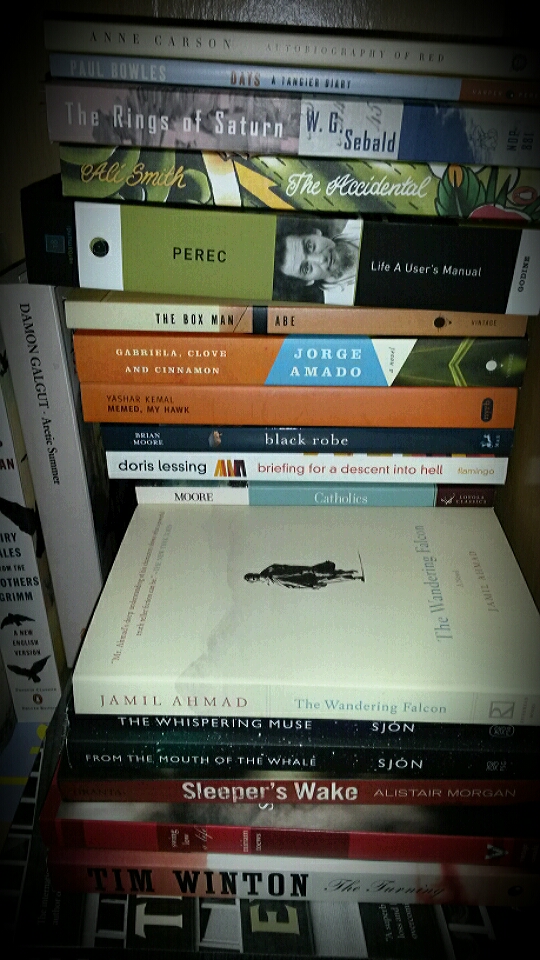
A fraction of my shelves, some read, most not (yet).

Most of the books I read take me elsewhere. As I turn my blog focus more and more toward literary themes, it is clear that I have a few idiosyncrasies. I have a definite interest in South African literature. This owes its genesis in part to my own experiences knowing a number of South Africans over the years, from watching the momentous changes that have taken place in the country during my adult years, and in the understanding that the new South Africa faces challenges that create a context for important discussions that we need to continue to keep open. Discussions we can all learn from in our increasingly global reality. The same holds true for another area with which I have an increasing literary interest – central and Eastern Europe. The political turmoil of the past century has provided ample inspiration for a wide range of exciting  literature, which, thanks to an increasing number of industrious small publishers, is catching the attention of English speaking audiences. Slowly but surely.

Of course, at the core of all great literature, classic and contemporary, is the essential quality of the human experience. We are born, we grow old, we fall in love, we lose those we love, we battle darkness, we face fear, we hope, we reach for those moments of joy. And the more I open myself to the stories of others from around the world, the less alone I feel.

But then there is this nagging guilt. As a Canadian, why don’t I read more Canadian writers? Well I do, but so many leave me unsatisfied and rarely reach my blog. And those I am especially fond of have tended to come from elsewhere; that is, they are Canadian with a hyphen and frequently write from that transitional perspective. I don’t think it was always that way. Maybe I have just been land bound too long. Maybe I crave the exotic just a little after all.

Well until I can travel, I will keep my bags packed, my options open and and a healthy pile of books standing by from near and far.

The fiction of remembering, the realities of forgetting: New Finnish Grammar by Diego Marani

Copyright JM Schreiber, 2014

The damaged hero of Italian author Diego Marani’s first novel New Finnish Grammar, which was originally published in 2000, but only released in English in 2011 (translated by Judith Landry), is a mystery to himself and to those who find him. World War II is raging, when a badly beaten man is found on a dock in Trieste with no clue to his identification beyond a Finnish name sown into the collar of the naval jacket he wears. When emerges from a coma with, what would presumably be a severe traumatic brain injury, he has no memory and no ability to use language. He does know who he is or where he comes from but, by coincidence, the doctor who attends to him is a Finnish-German who has never overcome his own longing for his homeland. He becomes convinced that the best medicine for his amnesiac patient is to send him to Finland so that he can connect with what is assumed to be his land and language, and in doing so, retrieve the past that has escaped him.

maraniAs much as I wanted to love this book, this is where I started to have problems. Firstly, the storytelling approach is awkward. It is the doctor who takes on the task of
curating a selection of notebooks, journal entries and letters belonging to “Sampo”, our erstwhile Finnish patient, to both honour him and make amends. He frames and fills in the tale with his own reflections, corrections and assumptions. Somehow, we are asked to believe that a man with a brain injury severe enough to trigger such a complete loss of memory and language could manage to develop sufficient facility in a notoriously complex language to be able to report his earliest memories post injury, or even find his way around a strange city. Yes, his mastery of the language is never comfortable, he relies on his notebook and endless practice, and he is emotionally lost and eventually unable to find a grounding or the past he seeks. Meanwhile, the language and mythology of Finland were clearly chosen by the Italian linguist author as a template for the exploration of memory and identity, but I could just not suspend disbelief long enough to fully surrender myself to the story.

This is not to imply that there are not breathtaking moments in this novel. There is a heartbreaking sadness and loneliness that haunts our dislocated hero. As war closes in around him, he is the walking wounded, an invisible casualty in a place to which he so desperately wants to belong. But my practical side, the side that spent the last decade working with real survivors of traumatic and acquired brain injury, could not let go of the idea that the main character’s overall functionality did not mesh with his complete loss of identity and language. The assumption is that his memory loss is psychological in nature and that the return of language will release it. In reality though, his injuries would indicate traumatic causes and with such severe long term memory loss some elements would still typically remain intact, while short term memory would be greatly impacted hindering his ability to learn new things easily. A complicated “new” language? I find that especially hard to accept.

I suppose I will have to admit that I am not the ideal reader for this book. I don’t regret reading it and I am sure that there are moments that will continue to linger. Memory is one of the most fertile landscapes for a writer to explore. Even without the added impact of illness or injury, memory is a fleeting, nebulous and fundamentally subjective phenomenon. However, I opened New Finnish Grammar with too much experience with brain injury to fully appreciate the work. And, for that matter, I could not help but wonder how a reader with too much native experience with Finnish language and mythology would respond. Perhaps with an equivalent amount of skepticism.

I don’t know.

Field guide to the post 9/11 landscape: Open City by Teju Cole

“We experience life as a continuity, and only after it falls away, after it becomes the past, do we see its discontinuities. The past, if there is such a thing, is mostly empty space, great expanses of nothing in which significant persons and events float.”                                                  -Teju Cole, Open City

Sometimes a book sits at the corner of your awareness but, for whatever reason it remains there, a title and author you have encountered, and even entered into that mental note space which contains those books you were meaning to read, until one day you finally open it up and think: What took me so long?

OpenAdmittedly, Teju Cole’s Open City, originally published in 2011, is hardly a dusty old tome, but its relevance in the post 9/11 world becomes more acute with each passing day. At the heart of this meditative novel is Julius, a young man of mixed German and Nigerian ancestry who is completing the final year of his psychiatric residency at a New York City hospital. A sensitive and fragile narrator with widely eclectic interests ranging from Mahler to art to a keen eye for urban bird life; Julius spends much of his time walking the streets of New York, and, for one wet winter month, Brussels. He encounters strangers, visits with friends, explores parks and alleys. He is propelled by what seems to be a restless discontent: he has recently broken up with his girlfriend, he has a curious compulsion to see if his German grandmother is still alive, and he carries unresolved baggage from his childhood in Nigeria. Yet, as he nears the end of his psychiatric training, the respect he believes he has for the souls of the patients he treats, does not guarantee that he has any clearer sense of his own than, well, any of us do.

As much as Julius is an engaging, complex companion — at once insightful and shortsighted — it is Cole’s spare and evocative language that pulls the reader along on his journey. The frequent comparisons to WG Sebald are not without merit, both authors manage to create a hypnotic flow of reflective imagery rich with references to history, art, literature and film; but Open City speaks directly to the early 21st century, reframing questions of racial and ethnic identity, collective fear, violence, even mental illness, with a new and immediate relevance. I found myself wanting to linger in the pages, there are so many ideas packed into this slim volume.

In the days following the tragic events in Paris in January, Teju Cole wrote a very measured and sensitive response in The New Yorker, attempting to balance an appropriate reaction to the Charlie Hebdo situation in light the extreme violence committed, historically and presently, around the world. His challenge echoed the conversation his two disillusioned Moroccan intellectuals have with Julius in Brussels. They express their frustration at not being able to talk about Palestine as Muslims without being branded anti-Israel, despairing that no middle ground for dialogue is possible in some situations. The advantage in fiction, is that you can give characters voices to express contradicting, difficult and controversial perspectives. Julius’ encounters with a wide range of people, together with his own musings and self discoveries, provide a framework within which Teju Cole has created a novel that is deep, rich and timely.

Releasing words from the page

In the opening pages of Teju Cole’s Open City, his narrator, the young medical resident Julius, introduces the reader to his own reading habits, setting perhaps the tone and frame of mind for the recollections and encounters that will unfold over the following pages. He explains his fondness for internet classical music stations, commercial free broadcasts from countries where the foreign languages of the announcers blend into, rather than distract from the musical tapestry. Settled with a book on the sofa he confesses that:

“Sometimes, I even spoke the words in the book out loud to myself, and doing so I noticed the odd way my voice mingled with the murmur of the French, German, or Dutch radio announcers, or with the thin texture of the violin strings of the orchestras, all of this intensified by the fact that whatever I was reading had likely been translated out of one of the European languages.”

Assuming I am not in a public space where others would likely look on in askance I am likewise inclined to read aloud to myself at times. Meditative, less conventional, writing forms itself especially to this practice, not only obvious writers like Cole or WG Sebald, but wonderfully spare and introspective works like Damon Galgut’s In a Strange Room or the experimental The Absent Therapist by Will Eaves. And Thomas Bernhard, even though I cannot read him in the original German, flows with energy and intensity against JS Bach. I often stop and read a few pages out loud when I feel that I may be losing my moorings in the book long paragraph structure of his novels. Similarly José Saramago and Javier Marías are authors that more people might be able to connect with by inhabiting the language through reading portions out loud.

I have also had the experience of coming to appreciate a piece of literature in an entirely new way through hearing an author’s reading. Last year I read All My Puny Sorrows by Canadian author Miriam Toews, the story of two sisters, one deeply depressed and suicidal, and the other faced with the dilemma of if and how to assist her beloved sister in achieving her goal. Being much closer to my own recent breakdown and knowing that Toews had drawn on the tragic history of suicidal depression in her own family, I read it seeking insight into the suicidal sister’s perspective. I was disappointed. But hearing Miriam read from her work and having the opportunity to meet her last fall, I suddenly realized that I was expecting something the story could not deliver and had, consequently, missed the self-deprecating black humour in this challenging, compassionate tale of unconditional sibling love.

Cliche shot of a favourite poem, WH Auden's "As I Walked Out One Evening"
Cliche shot of a favourite poem, WH Auden’s “As I Walked Out One Evening”

So if the experience of prose can, at times, be enriched by being read out loud, poetry would seem to be an obvious aural experience. Poetry readings have a long standing literary history, joined now with the likes of slam poetry and rap. What a surprise then to have someone on another readerly space I frequent declare that he is against reading poetry aloud. Assuming he was not typing with tongue in cheek, for who can tell, my immediate response was one of disbelief. Excuse me? I cannot imagine not reading poetry out loud. I even make an effort to commit the poems that I find especially powerful to memory, to recite them, to myself and, on occasion, to others. Hearing authors read their own work has a special value and impact. Listening to a poem shared aloud by a passionate reader can allow the words to be transformed and re-interpreted in a new and personal context.

Have you ever encountered a piece of prose or a poetry so breath taking that you had to stop and re-read it, mark or circle it in the text if you are so inclined, copy it into a journal or print it out to keep close at hand? Do you feel compelled to repeat the words out loud to yourself, inspired to share them with others? For me that is the beauty of being in love with language. Sometimes words just have to spill out beyond the confines of the printed page and be granted a full existence in the world.

Gendering my bookshelves

A conversation on another bookish refuge of mine about the gender of the authors we tend to read has been both informative and unnerving. It has had me standing before the random selection of bookcases in my house taking stock of the novels lining the shelves. I have conducted no scientific calculation but I would hazard to guess that over 90% of the fiction collected, read and to be read, has been written by male authors. And that is without even digging up my electronic files.

Random pile, one of many, mostly unread.

I console myself by calling to mind a number of women peopling my hypothetical list of intentional reads for the upcoming year. But I know myself. I am idiosyncratic and tangential in my reading proclivities. I find myself unable to create a stack or list of titles and systematically make my way through from top to bottom. And although I do not intend it, novels by women are frequently pushed down the line by something else that comes into view.

Perhaps there is a question of subject and style. I am presently reading with a strong critical intention to exploring a way of telling a story that I have to tell and, for better or worse, the authors who are coming to my attention tend to be men. That may be accidental rather than intentional on my part. But my bookshelves hold a record running back over decades and the gender imbalance is consistent (and, by the way, not reflected in my non-fiction collection which tends to have a much more equal divide).

Now I could launch a defense for this heavily weighted scale. I suspect I do know some of the reasons why I am drawn to certain tales told from a male perspective, reasons rooted in my own differently gendered history, but at the end of the day I am only accountable to myself for that reality. I do not believe that I eschew female novelists on the basis of gender alone, but there are certainly stories and themes that do not draw me in. And I do not feel obligated to read women writers to understand women better, I spent the better part of four decades trying to jam my own square self into that round hole and accept that there are things I am not programmed to learn. I have female friends. I have a beautiful daughter. And it is not like I never read or fall in love with books by female authors. I am open to the opportunity to explore more. But setting a quota is disingenuous.

And feeling guilty wastes precious time that could be spent reading.

Channeling Bernhard in the Balkans: The Son by Andrej Nikolaidis meets Bernhard’s Gargoyles

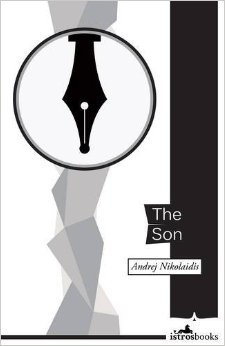
SonThere comes a moment in Andrej Nikolaidis’ novel The Son where the unnamed misanthropic narrator, confronted with a hideously deformed family of lepers who have taken up residence in an abandoned car park in the Montenegrin city of Ulcinj, imagines that he is “a piper with a funny Tyrollean cap, which Thomas Bernhard would find laughable, and (…) dressed in green knickerbockers with suspenders like Heidegger used to wear” who proceeds to march through the streets of his home town gathering a following of the wretched, desperate, and diseased denizens of the streets, dark corners and hovels and leading them right down to the seashore, where he proceeds, walking out across the water, while the “grisly army” he has amassed disappears beneath the waves.

The Son is a dark, unrelenting journey into all the misery and disappointment that life and, those who claim to be your friends, family and lovers can bring. Our anti-hero is not a warm, generous soul. Admitting to his own perverse, gruesome obsessions in the early pages, he reports that his wife has just left him and he is bitterly alienated from his father. He perseverates about the cruelty of the forgiveness his father repeatedly bestowed upon him regardless of the destructive nature of his actions. He manages to vent anger at everyone he encounters, remarking at one point that he was “reminded once again that the nicest things we can say about a person is that one day they will die and cease to bother us.” As readers we are swept along on a scotch fueled odyssey into the heart of the city where a series of old acquaintances and disreputable characters seem to fall into his path where they are treated with a curious mixture of revulsion, pity and disdain. He is, in essence, the most vitriolic Bernhard monologuist transported from Austria to Montenegro and boiled down to the meanest bare essentials. By contrast, my current Bernhard read, his early break through novel Gargoyles, seems airy and light.

LosersPublished in 1967, Gargolyes was given its title in the English translation (the original German translates closer to something like distress or disturbance) presumably drawing attention to the grotesque series of characters encountered by the narrator, a son home from school, as he accompanies his father, a rural doctor, on his rounds to a series of isolated, ill and mentally unstable patients. The themes of madness, isolation and suicide recur as they make their way to Hochgobernitz where the aging Prince Saurau takes centre stage for the second half of the book, embarking on an increasingly intense monologue, mourning his own estranged relationship with his son who is away studying in London, and philosophizing about the hopeless and inevitable destruction and collapse of human society.

For my money, the characters that inhabit the pages of The Son are every bit as grotesque as those in Gargoyles, if not more. In both cases they serve as extreme, cartoon-like voices for exploring themes that are in turn horrific, humourous and deeply human, pivoting coincidentally around the relationships between fathers and sons. Amidst the rants against man’s inhumanity to man and musings about the madness and disease of modern society; a desperate compassion comes through. That is the compulsive beauty of reading Bernhard and, for those curious but afraid of the endless single paragraph style typical of most of his work, Gargoyles is a perfect introduction. For his part, Nikolaidis seamlessly transports the energy of Bernhard to the post Balkan War reality of a country he clearly loves passionately. As with his earlier book The Coming, it is also a dark meditation on Montenegro’s rich, complex past and uncertain future.

In a guest blogpost for Winstonsdad’s Blog (a great resource for works in translation), Andrej Nikolaidis reflected on his love for Bernhard and the influence he has had on his own work. Upon his first encounter with The Loser, (also my first introduction), the Balkan war was raging and he could see timely parallels in Bernhard’s existential analysis of Austrian society in a state of decay and collapse. He also finds in Bernhard the prose response to poet Paul Celan’s famous poem ‘Fugue of Death’ or ‘Todesfuge’. He hears the rhythms of Bach ring through the works of both men – and Bernhard was a musician first – envisioning Celan as a character who could have walked out of a Bernhard novel. With The Son, and a sound track updated to incorporate the noisy sound styling of Sonic Youth, Nikolaidis’ work carries the banner forward.

The Son by Andrej Nikolaidis (trans Will Firth) – Istros Books                                     Gargoyles by Thomas Bernhard (trans Richard and Clara Winston) – Vintage Books