Unwrapping the unwrappable: The Box – A Novel by Mandy-Suzanne Wong

She didn’t laugh. Something about the box precluded laughing. The way it coiled around itself, perhaps. The paradox of the self-contained container self-sufficient as a brick and fragile as a poem. The “air of pandemonium” about it as like a poisonous plant its mere existence “filtered an intrusive, disruptive element into the atmosphere.”

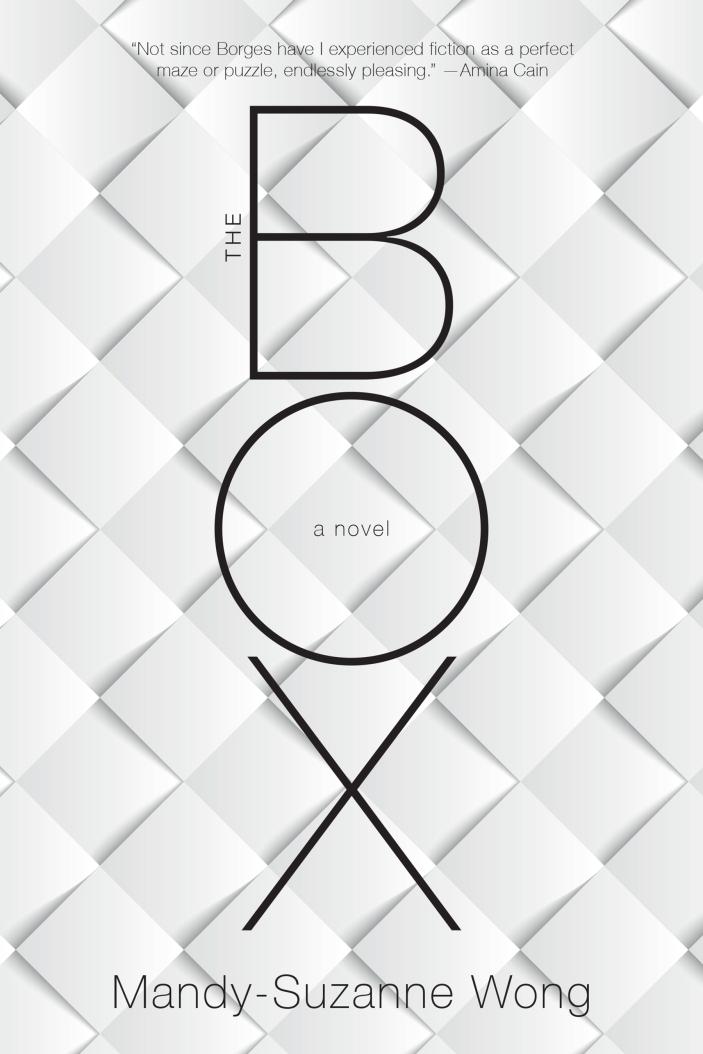
The Box, the latest novel by Bermudian writer Mandy-Suzanne Wong, is an enigma that defies simple classification or clear resolution. Experimental in form, dystopian in setting, it follows, indirectly, the movement of an unusual box constructed of white woven paper through a city trapped in an endless snowfall that has blurred all normal social interactions. A novel of ideas it is entirely composed of interdependent but distinct narratives that vary widely in style and form. Yet, the voices that take turns carrying each chapter are strange and estranged, each projecting a strong character or tone, but in most cases revealing only fragments of their own pasts and hinting at a larger story that stubbornly remains at the edges of the unfolding journey of the unusual little box.
In the first chapter, “Secondhand,” a recently retired, self-described anthrophobe, sees a small item fall from the pocket of a man’s jacket onto the snow covered laneway and, for some reason, is inclined to pick the object up and hurry after him. The narrator, perplexed by their own behaviour, cannot resist temptation and we have our first and clearest description of the box:

that thing, a paper thing, white paper in the snow, exerted forces which I cannot define but which proved stronger than history and all my instincts: the little white box fit in the palm of my hand with perhaps a whisper of a rattle when it moved, was of a size that could’ve accommodated cigarettes or playing cards, a wallet or a slim wad of cash, yet was absolutely self-contained lacking the door or flap of the cigarette or playing-card carton, but then again it was the opposite of self-contained being all-over seams, by which I mean it was constructed of paper strips entangled as if haphazardly, shooting out as if dynamically between one another and diving under one another in all directions, but so tight a weave it was that no strip seemed to have an end, delicate as they were the strips held fast to one another with a tension that resulted in an impenetrable rectangle

In long, winding sentences, the misanthrope recounts the story that the apparent box-owner shares about how he came into possession of this strange thing through the unlikely adventure of his cousin’s first wife’s stepbrother’s eldest daughter and her friend in a bizarre short-term rental apartment decorated with and filled with boxes. The roundabout account introduces images that will reappear, such as the idea that the mysterious object could easily be lost in the persistent blanket of snow that is covering the city, and offers the first appearance of a woman with artificially blackened hair and a chipped tooth who, in her obsessive pursuit of the box, will resurface in the events described in each of the following chapters.

As we move from narrator to narrator, we see the small white box make its way through an art exhibit, a warren of decrepit second hand shops, the peculiar story shared by a hotel guest before becoming an object of near-religious veneration and ultimately passing into the hands of a security guard. Most of its journey is reported through layers of doubt, supposition and even cynical dismissal. Meanwhile, the snow continues to fall at a steady pace just exceeding the rate of evaporation, effectively cutting the city off from the rest of the world. Isolated it becomes an increasingly hostile and unforgiving place, and the narrators become increasingly bitter, intolerant or emotionally injured. The box, by contrast, indestructible and preternaturally white, exudes a kind of innocence that is either attractive or diabolical, depending on the perspective of those who fall under its spell.

Although the mood, energy and prose style shifts with each chapter, the overall tone of The Box is both absurdist and intentionally self-referential. As such, it is not an easy read. Given what looks like a puzzle, a reader naturally looks to find clues and links uniting the stories that are told, but here the mystery is a kind of moebius strip that turns in on itself. Wong includes a list of writers and thinkers whose ideas and images she misquotes and misinterprets along the way, but I I’m not certain how essential a familiarity with these authors is to appreciate this work. The one fundamental, perhaps, is Jane Bennett’s notion of the vitality of matter that ascribes life and agency to all beings—human, nonhuman and seemingly inanimate alike. Various things—works of art, antiquarian books, buildings and other objects—have a particular importance for most of the characters that populate this decaying society, but the little white box that invites both obsession and scorn appears to be of another order altogether.

One is left, then, to ask: What existence and power does the box contain in itself and how is that related to the people who come into contact with it? Is it possible to conceive of an object with independent agency without imagining it in an environment within which the human actors have found themselves with restricted agency due to some impersonal yet impenetrable force of nature? Or is the matter that matters all in the experience of the beholder? Ambitious and original, it will take time for me to put this strange text behind me.

The Box: A Novel by Mandy-Suzanne Wong is published by Graywolf Press in the US and House of Anansi in Canada.
India update: Catching up with old friends, finally meeting others

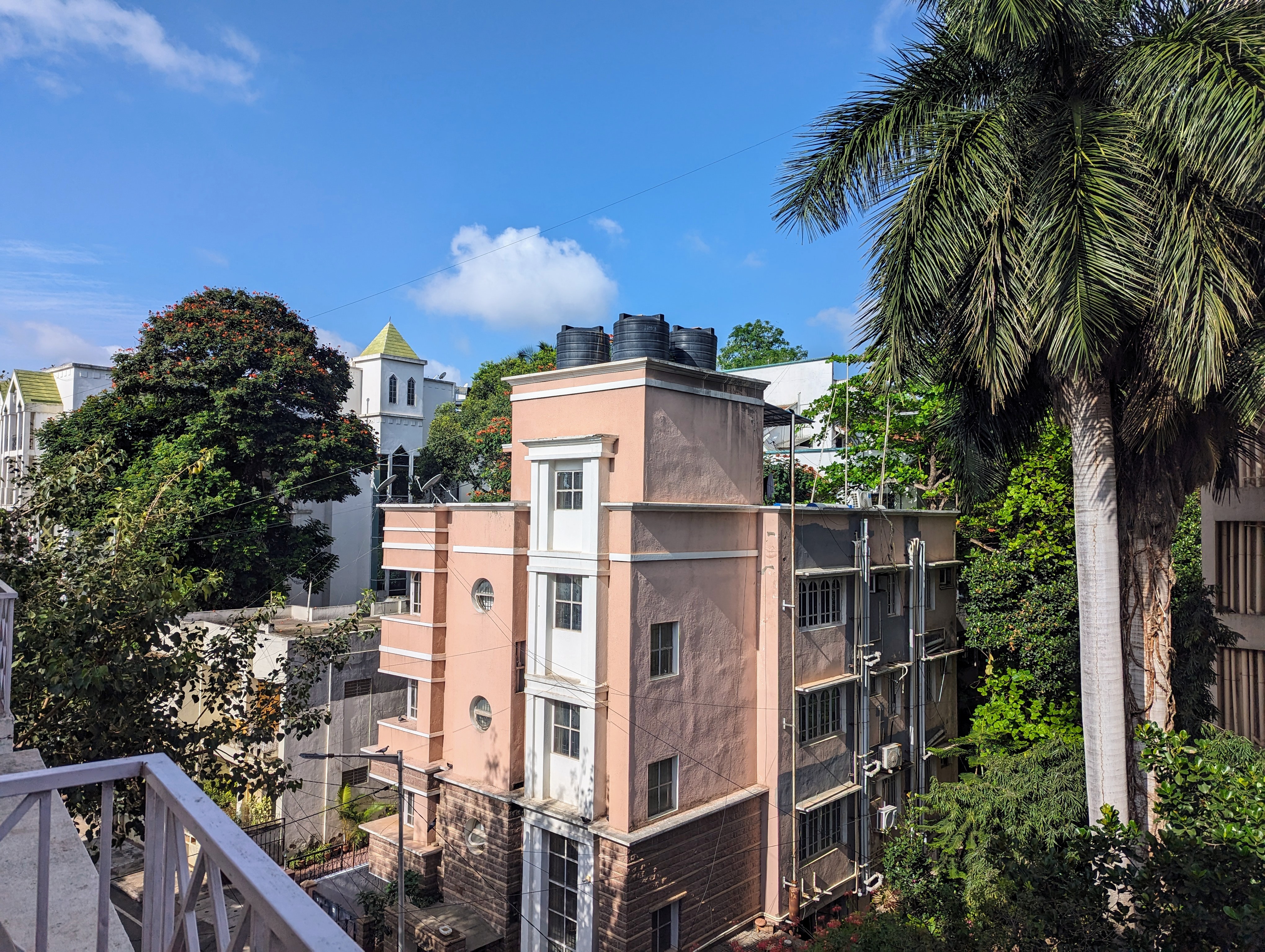
Four years is a long time. Much has happened since I last visited this country. Since I last travelled anywhere as fate and pandemic would have it. Two-thirds into my stay and it feels like it has been a hectic time—not that I haven’t had free time, but I seem to find it hard to stay put on an empty day when a busy vibrant world awaits outside the door. And one doesn’t want to miss the chance to catch up with friends who are normally but a virtual prescience in one’s life. So, less reading and writing has been accomplished than I had anticipated to date.

I started my trip in Bangalore, a city I will return to before flying home to stock up on books. Weight restrictions on internal flights have meant that if I buy books, I risk not being able to get to my next destination. It surprises me how just a few slim volumes will tip the scales! And it’s always a pleasure to spend time with my very dear friends here at either end of my India sojourn.

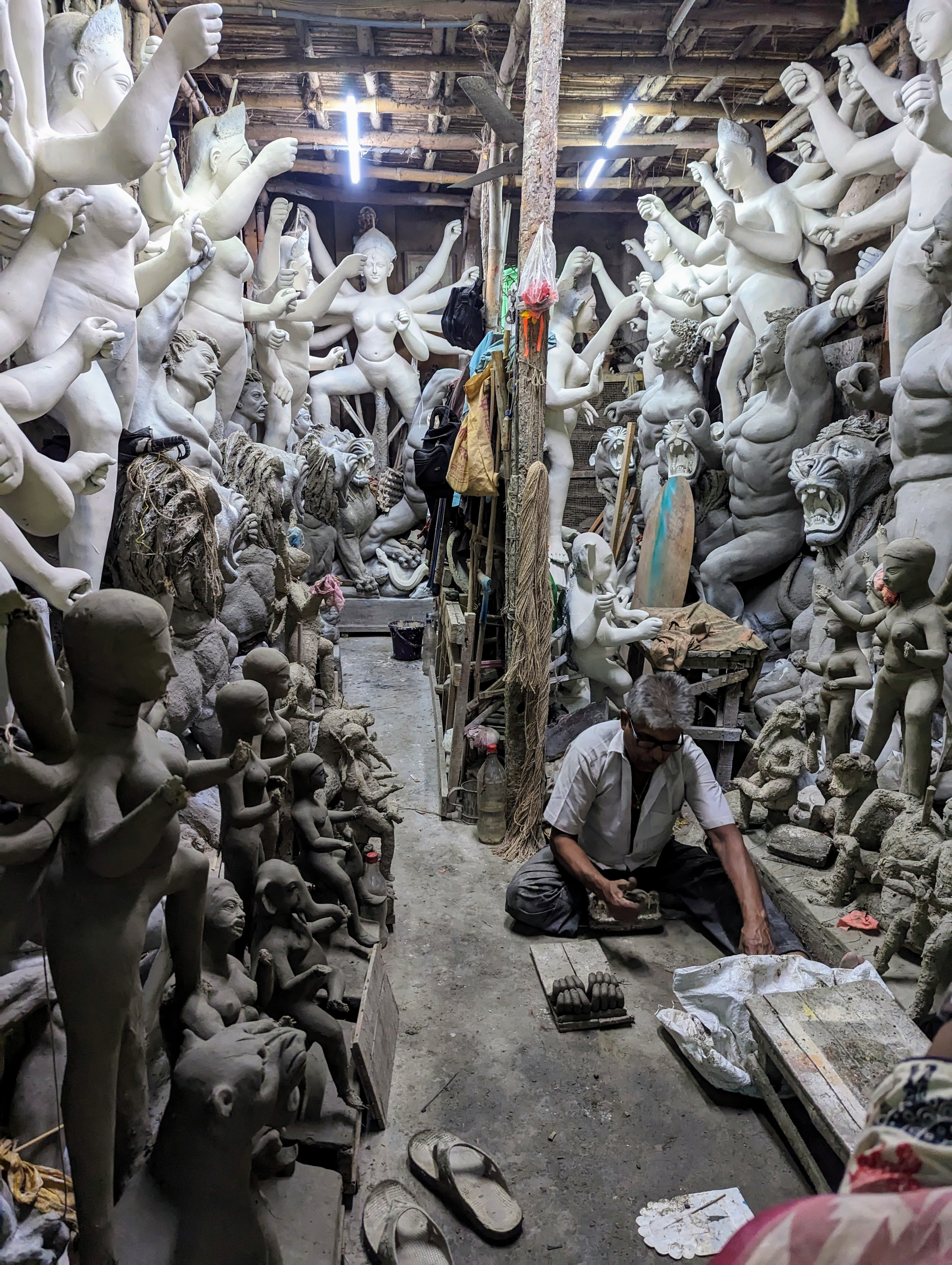
From Bangalore, I was off to the City of Joy, Calcutta or Kolkata, to the place (and the publisher) that first drew me to the subcontinent. Wet and humid beyond measure, it was my first visit outside the drier winter/spring months. But it was wonderful to see my dear friends at Seagull Books where I was able to play a small role in the creation of what will be another spectacular catalogue—this one tackling a vital theme for the times. I also had coffee with the couple who were my first tour guides in the city, this time meeting up with them in an area further south than I had been to date. I also made a pilgrimage to Kumartuli, the potters’ colony where craftsmen are busy making idols for the upcoming Durga Puja, Kolkata’s most important festival.

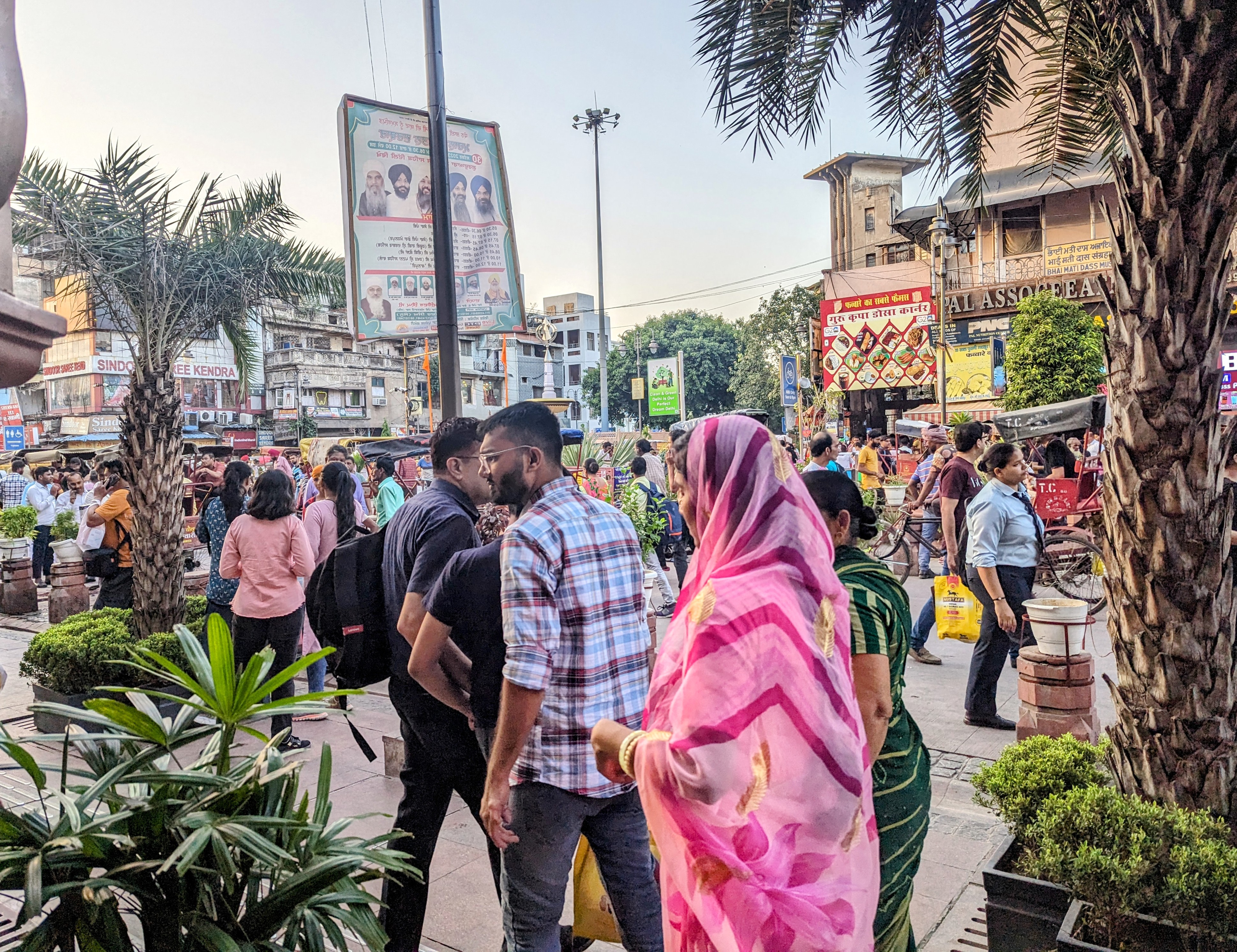
The next stop was Delhi, a short stay, but my first in the nation’s capital. I was met at the airport by a friend which was fortuitous because it proved difficult to get a cab willing to go into the congested area where I was staying. Subsequent forays in and out were facilitated by the Metro. On my first day in the city, the same friend escorted me to the university where he teaches and I gave a talk about writing book reviews. It was a very rewarding experience. The second day another friend took me into central Delhi where we had lunch, walked around, visited temples and enjoyed a most awesome lassi!

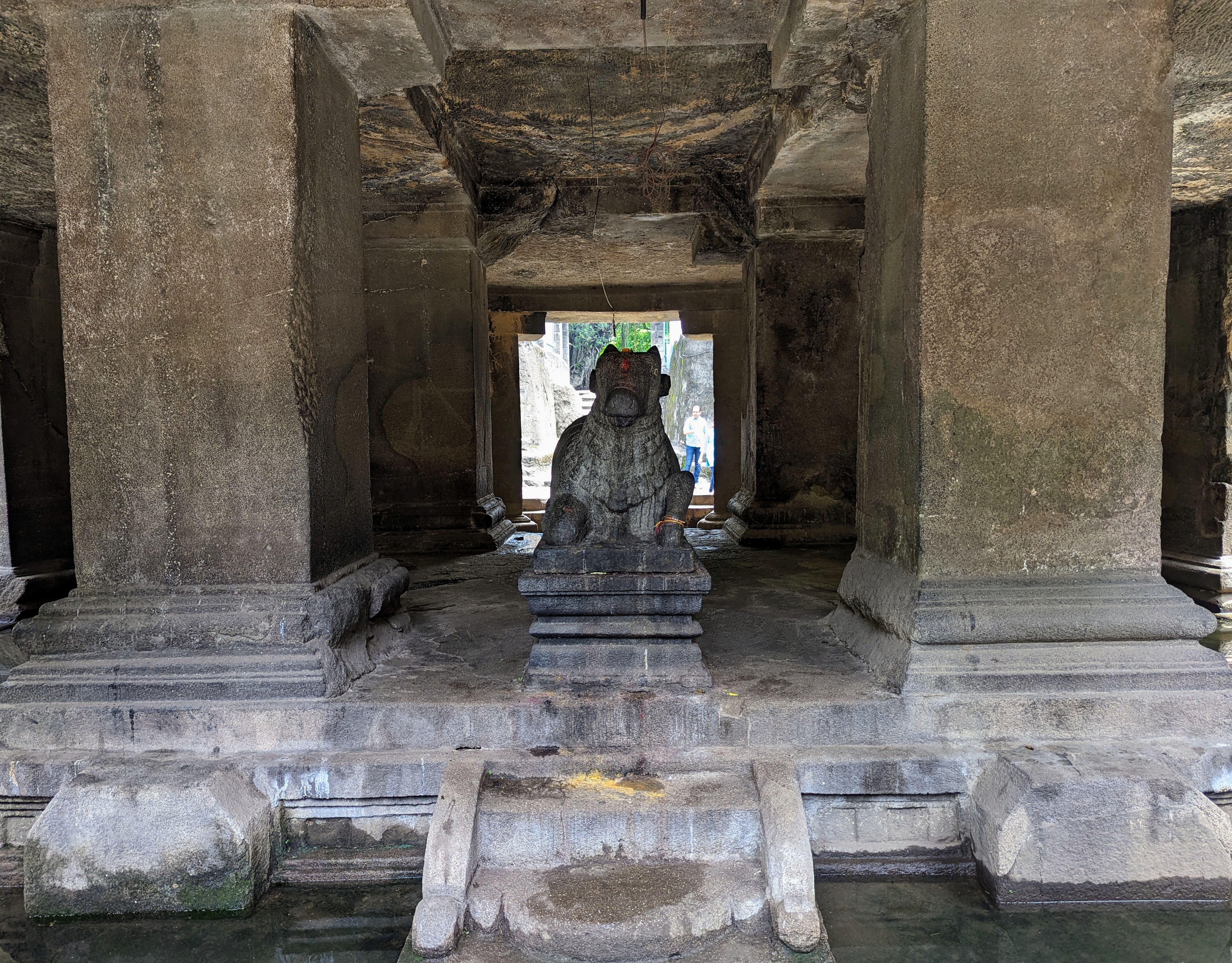
Then on to Pune, where I’m writing this on the final hour of my birthday. Here I caught up with dear literary friends and had a chance to finally meet someone whose friendship has offered solace during these long years of pandemic isolation. I also walked down to see the Pataleshwar Caves, the site of an eighth century Hindu temple carved out of the rock—a sanctuary within a busy city.

Tomorrow I fly to Mumbai for a brief stay then on to Jaipur where I hope to dry out a little after all the humidity of this extended wet season before returning to Bangalore. Whew!

It is good to be back in this hectic, vibrant country, even if I have arrived at a time of some diplomatic discord between my own country and India. I have never felt anything but welcome here.

Songs of the molten rock: Ore Choir: The Lava on Iceland by Katy Didden, Illustrated by Kevin Tseng

Wanderers favor angels;
Bards, obsidian—
.                              rock of old.

Lava IS the dragon

             I clot the sky with gold.  (from “Sing, Lava”)

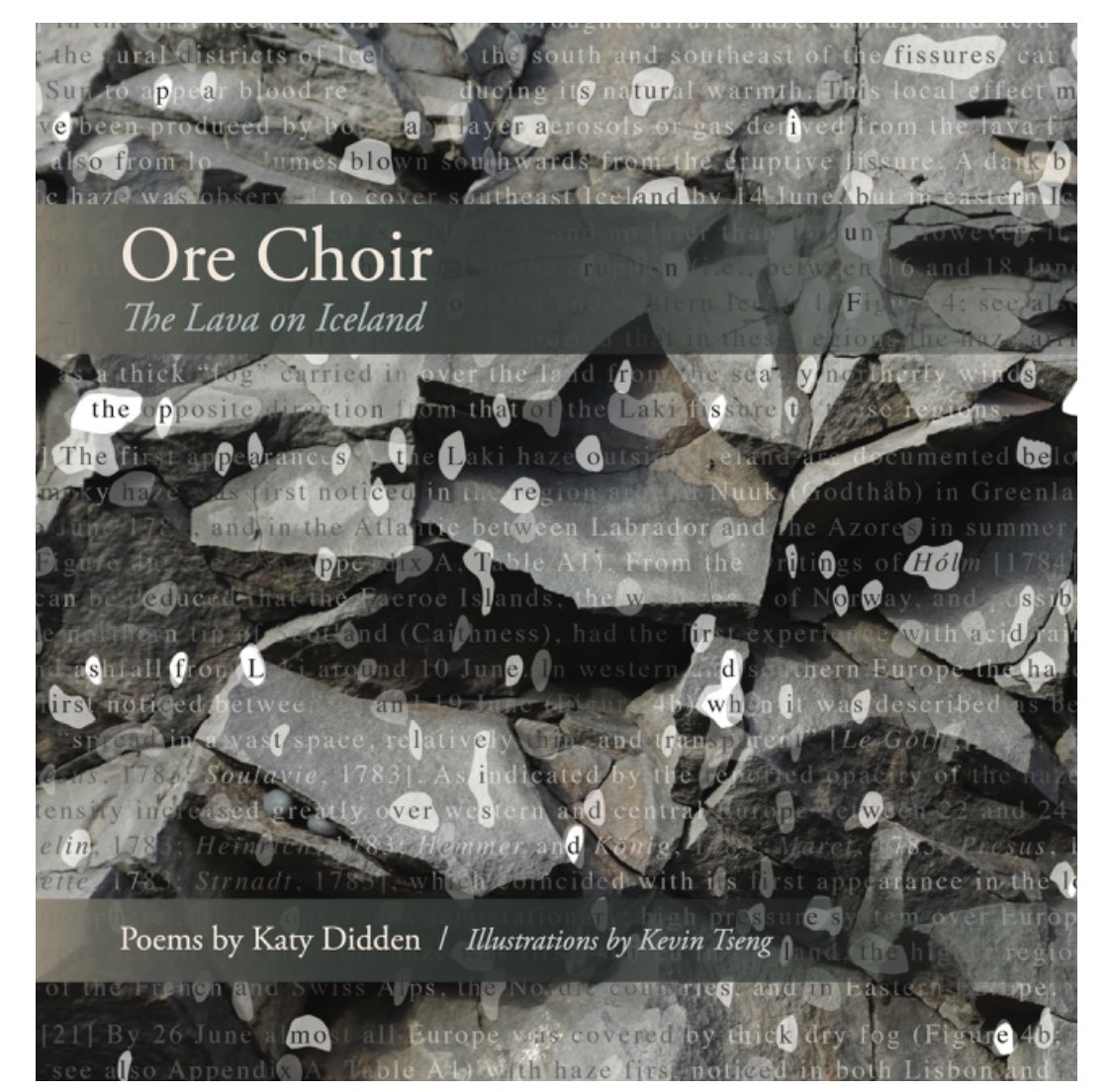
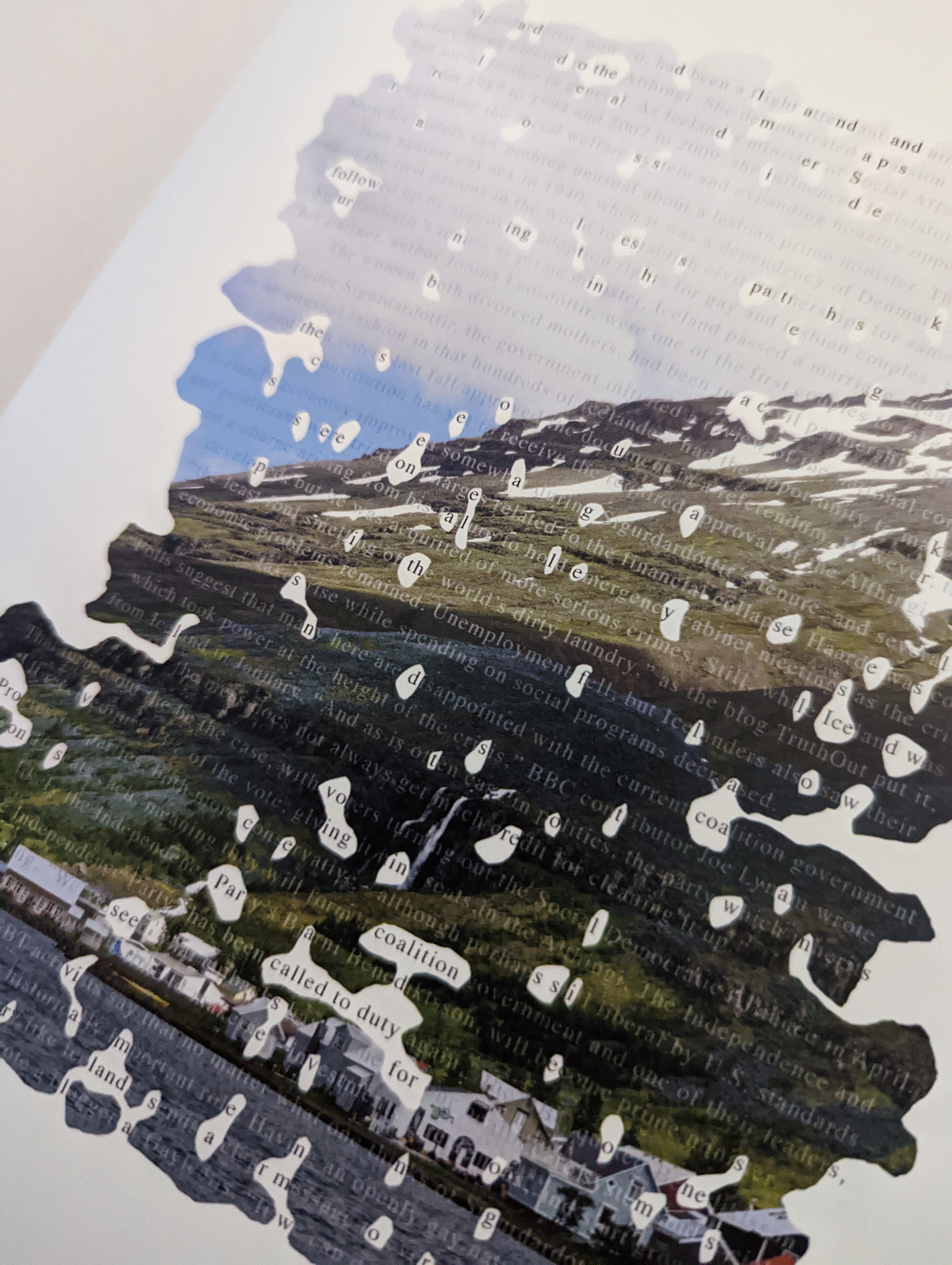
For many, poetry is an arcane art that seems to appear on the page, the product of some elusive tortured process and, as such, it can intimidate as much as it invites. But that need not be the case. With no intention to understate the poet’s craft and dedication, Katy Didden’s Ore Choir: The Lava on Iceland offers unique a poetic experience that allows the reader to “see” how the relationship between a finished poem and its origin evolves. The genesis of this wondrous project arose from the poet’s desire to “write poems in the voice of lava.” To achieve this she turned to the process known as erasure poetry in which an existing text is partially obscured or blacked out to create a new work, often in active conversation with the source material. She “imagined ink flowing over the text in the way lava moves over the land, leaving high features in relief,”  exposing words and letters in its wake.As her thoughts turned to lava, Didden was naturally drawn to Iceland, the complex, geologically dynamic island with a range of volcanic systems, many still active, that produce evolved varieties of lava. An ideal landscape with a wealth of associated textual materials for a poet to draw on. Her source texts range from historical, scientific and literary documents to an interview with Bjork and labels from yogurt and spring water containers. But Didden wished to go further and allow the reader to see the source material and the poem at the same time. In collaboration with graphic designer Kevin Tseng, each poem is presented opposite grayscale versions of the origin texts beneath overlayed landscape photographs shaped and opened up to emulate the flow of lava. The result is original and powerful.

The voice that arises in the poems that comprise this collection is that of the volcanic rock itself, imagined as a vital, fundamental force of nature and a spiritual energy bound to both geological time and modern events. Molten expression of being. It speaks to an ancient past and an uncertain future of climactic upheaval.

Like an animal
I seem to hesitate.

They saw me as a soul—
one who’d listen.

The waves across my red rock
spelled a skin,

filled in
.             blanks of speech,
translating halt by degrees.   (from “Like an animal”)

The haunting illustrations born of word and image are integral to the reading—they invite engagement and as the slow revelation of poetic meaning is captured and mirrored on the facing page. An individual pattern of exploration is likely to develop as one makes one’s way through the book. The Notes at the back include a detailed explanation of Didden’s intention and method and relevant contextual information, followed by a reference for each poem’s source text and a thumbnail of the photograph used with accreditation. I found it most rewarding to begin with the textual reference and image first before turning to the poem and the depiction of its “emergence” from beneath the photograph. It was fascinating to see how the poet uncovered words and passages, sometimes a letter at a time across a wide terrain, other times appearing in small formed segments.

If volcanic forces formed and continue to sculpt Iceland, the sequence of songs in Ore Choir seem to materialize and take shape on the pages of this beautifully realized poetic work. Moving and affecting, it is a multi-dimensional project with broad appeal.

Ore Choir: The Lava on Iceland by Katy Didden with illustrations by Kevin Tseng is published by Tupelo Press.

Celebrating forty years of Seagull Books

I’ve always maintained that I’m an accidental reviewer, writer and editor. These paths, almost exclusively volunteer, opened up when my professional life imploded in my mid-fifties. But I have always been a reader. The best part of this unexpected second-life has been the many enthusiastic readers, talented translators and dedicated small publishers I have come to know from around the world.  Many I’ve been lucky to meet in person as, for the first time in my life, I travelled beyond North America. To South Africa, Australia and India.

A common connection between many of the readers and translators I’ve come to know over the years is the inimitable Seagull Books in Calcutta. Thanks to an intriguing post on a blog I follow, I bought my first Seagull—The Loss Library by Ivan Vladislavić—sometime in 2015 and was instantly impressed by the presentation and the unique content. Before long I was a committed fan and in early 2018 I made my first “pilgrimage” to visit their office. At the time they were coming up on their thirty-sixth anniversary, celebrating a slow and steady climb from very humble beginnings to their present status as world-class publisher of international literature—all while maintaining their humility and remaining  close to their Calcutta roots. An interview I conducted with founding publisher, Naveen Kishore following my visit was published at 3:AM Magazine. One year later I was back and, had Covid not intervened, I would have been back again by now.

Now,in 2022, Seagull Books are celebrating forty years of producing beautiful books, many that would never have been picked up by other publishers, and supporting and encouraging writers, translators and independent publishers in India and around the world. The occasion has been marked by awards, interviews and articles like this recent one about their stunning office and bookstore in Architectural Digest India.

As an avid supporter of my friends at Seagull I also wanted to do something special to honour this milestone. I have, I confess, amassed a healthy collection of Seagull books over the years, many as kind gifts and many more with the assistance of my credit card, so I’ve set myself a reading goal for the balance of the year. Now, to read and review forty books would be ideal, but I’m not that fast a reader and it’s already September. However, I have read and reviewed nine of their books so far this year and I hope to add at least another eleven by year’s end. Twenty for forty. With this little side project I hope to call some attention to the range of books they publish. And enjoy plenty of good reading, of course!

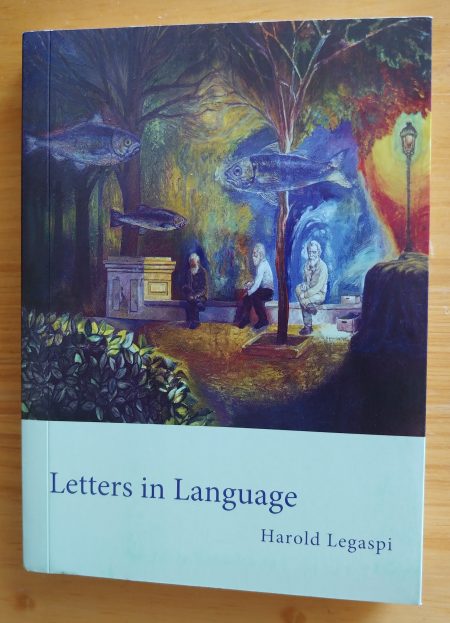
Troubling the alphabet: Letters in Language by Harold Legaspi

What can a language reveal? What can it obscure? If your memories were birthed in one culture, can they be retrieved elsewhere? What is gained and what is lost when you migrate from one land to another, from one language to another? How does this shift affect the spelling and the telling of a life?

Wittgenstein’s aphorism: ‘The limits of my language mean the limits of my world’ is false; there were thoughts that lacked words. We doused ourselves in neologisms. Dorothy repeating ‘there’s no place like home.’ A memory burn: the first time I saw a man kissing another man. (from Chapter 9)

The thirty-nine part prose poem that comprises Australian poet Harold Legaspi’s pocket-sized volume Letters in Language seem to dance around these questions, indirectly entertain them. Flirt and tease. Lean in closely. Look away. Catching, again and again, his own reflection.

Drawing inspiration from American Language poet Lyn Hejinian’s My Life, Legaspi has entered into his own experimental autobiography. Hejinian’s ground-breaking work, as published in 1980,  featured thirty-seven non-narrative prose poems, each thirty-seven sentences long—one for each year of her life at the time of writing. A second edition, revisited the project, growing with the poet, to forty-five pieces of forty-five sentences each. These sentences refuse direct connection to one another, defying the sequential illusion of conventional life writing. How do we remember ourselves? In fragments and moments, yet somehow, through the translation into language, patterns  and a sense of wholeness emerges. But is it real?

To read My Life is to let the words, the sentences, flow over you. There is a continuity of voice, and of the nature of images that interconnect when memories arise—details of a childhood for example may include activities, rooms, sounds, objects, and observations from a mature vantage point—but the intentional corralling of these images into narrative form distorts the truths it endeavours to preserve. The reader is invited, not to interpret and decode, but to respond from their own experiences of life.

Letters in Language mines a similar domain—life lived—but within the context of a Filipino family, a displaced culture, and multifaceted  questions of identity. I don’t know the author’s age at time of writing, but he does not hold to constraints of length. Legaspi’s language is playful, sentences often clipped and short, with images drawn from pop culture, even current realities like Covid-19 tossed in. The lines tumble over one another, appear connected for a stretch and then not, punctuated with aphorisms, self-reflection, rhetorical questions. The sentences have a transitory relation to one another, as if meaning is, at any single moment incidental and yet sensible. Not unlike the way the fragments and pieces of our own lives are shuffled and reordered each time we pull a memory card from the deck. New contexts constantly reshape who we think we are, refashion our ever-fluctuating histories.

Ever present amid the poems that fill these pages is the author’s lola—his memories of his grandmother fuel his own. The opening sentence reads: “My lola swept autumn leaves with walis tiniting, burned them in a can, wearing her grand billowy housedress.” Walis tingting is a Tagalog word for a broom constructed of coconut midribs. It sweeps its way through Filipino households. Likewise, the expression sweeps its way through these poems—a recurring image or an action that seems to signify the way we sweep through our memories, sweeping some to the forefront, others under the rug.

I who thirsted for knowledge. My niche unknown. Underneath the black economy. Where dry spells quelled my dysphoria. Fixed under the shade of a Bodhi tree. Away from air-conditioned air. Reborn. Conquered. A tangential awakening. Slid straight through, vagina dentata. The tip of my bayonet inched in her spine. Folk tales whispered, they got rid of me efficiently, like a baby out with the dingo. My mother, no shrinking violet. Did what was necessary. To cover up the blame. Walis tingting. As for the men, whose words were carefully chosen—passed on their phobias. My uncles. After thirty-nine years of solitude. Raised me like their own. Classed as a freak, unable to procreate like their sons and daughters (from Chapter 26)

So who is the “I” who lurks in this extended prose poem? A poet who exposes himself through his passions—emotional, intellectual, sexual and spiritual—played out against a formative soundtrack of music, films and books; bound by friends and lovers, and framed within a multigenerational Filipino family. Letters in Language never drifts far from the unresolved reality of the migrant existence, from the feeling of being defined by and yet disconnected from a land that is now somehow alien. After his grandmother, his unaltered link to the Philippines, has passed, Legaspi becomes aware of a kind of anchorlessness. One that rests in language, between a present language that cannot contain the loss, and an ancestral one not comfortably in hand: “Where English was an oblique mirror to my alter ego. I found myself faint with anxiety, a fictional object my truth. A truth with no original, veiled, forsaking to journey where it all began.”  The need to acknowledge this fundamental lack of grounding is then reflected in the closing sections of this text. Chapters 34 to 37 are composed almost entirely in Tagalog, a shift accompanied by translated versions. Thus, of all the questions of identity that surface and resurface throughout this poem, it is the poet’s own bilingual identity that troubles the deepest waters. Casting uncertainty on what has come before. What, if anything, has remained unarticulatable? Lyn Hejinian’s original autobiographical project is essentially unfinished, with material appended over time. Like life. What of Letters? That is not a question to anticipate in advance. Like life.

Letters in Language by Harold Legaspi is published by flying island books, ASM, and Cerberus Press.

I am the hard one: Outgoing Vessel by Ursula Andkjær Olsen

destructive is my normal state (37)

Danish poet Ursula Andkjær Olsen is a singular force of poetic vision. Intense, strident, futuristic. Outgoing Vessel, newly released from Action Books, is the follow up to her award-winning Third-Millennium Heart, a powerful reading experience I loved so much that I responded in verse with an experimental review published here (open the PDF to read). Translator Katrine Ogaard Jensen is on board again for this new journey and, as with her previous work, Outgoing Vessel unfolds over a sequence of poetic movements to form a 193-page, book-length poem that is both epic and operatic in scope. I was not surprised to learn that Olsen is also a librettist. As with her earlier project, the “singer” here is an enigmatic narrative force—perhaps the same one, I don’t know, though I hear a companion rather than a continuation myself.

no one except me can hate feelings
anyone else who claims to hate feelings:
let it be known how they still succumb to them
anyone else who claims to hate feelings:
let it be known how they, in weak moments
open up to them and

and become soft with longing

among all time’s winners
i am the hardest (8)

The early suites of Outgoing Vessel seem charged with negative energy, often erupting in harsh declarations of hatred that begin with the self and extend outward.  The voice is hard, constrained. Darkness and destruction are evoked frequently. Yet the motion is self-driven, Olsen owns her language, and the direction she is moving toward (and expecting others to align with) is not symbolic, but it is futuristic. She seems to be intent on encasing her darker, grieving being, containing it inside a container—described as an orb:

which I will send off as the outgoing
vessel that it is
after which the new human can arrive in its

incoming (48)

Third-Millennium Heart built on a tension between the clinical and the organic, pregnant with promise, anger and grief, rupturing ultimately into a powerful post-human feminist vision—one which gives birth to the possibility of a cyborg-like hive-heart existence. Heart’s speaker devoured and contained. Vessel’s is more isolated, inward focused and philosophical. Pain, grief, and an existential disconnection drive her rhythmic reasoning as she moves toward the foundation of a technological ontology, a science fiction solution, and a re-imagining of a new human beingness.

we must assume there is an original alienation:
first the estrangement, a person, a stranger to themselves
stranger to others, the person exists deep inside their
distant interior, without knowing, they must escape to the
surface, from inside, to become human (108)

The futuristic tone becomes more prevalent as the sequence progresses, propelled in no small part by the “technoscientic” poems that close each section of the work. As translator Katrine Øgaard Jensen explains in her note, Olsen “created these poems by piecing together lines from each suite, running the text through multiple languages in Google Translate, translating it back into Danish via Google Translate” then, from the resulting document, the final piece was created employing a cut-up method. This mechanical process allows for a new tone, energy and uncertainty to enter the cycle (not mention an added challenge for the translator to meet in a satisfactory measure):

human nature
in the coffin, a
relic, collection of Bones and Hair
encapsulated and stored in
a humane vacuum

this is
the refuge (94)

The strange brutality of Olsen’s poetry, the slogan-like chants, and the tightly-honed anger can be off-putting, but as with Third Millennium Heart, I find it oddly therapeutic. Anger in its shades and intensities can be a positive force—it is the healing movement of the cycle of grief, it pushes you forward, up and out of the sandpit of sadness that follows loss, trauma, heartache. It sounds counter-intuitive but I saw it many times working with survivors of acquired brain injury. Yet it is hard to allow it in oneself, for fear it will erupt in uncontrollable ways. Through the course of Outgoing Vessel we witness the speaker’s emergence as a voice of concern, intent on invalidating loneliness—through her outgoing/incoming vessel she comes to a radicalizing understanding of empathy and experience.

Olsen is a poet who, as her translator Jensen freely admits, cannot be neatly and directly rendered into English—her work is highly inventive, rife with cultural references, puns, neologisms, and experiments with language. Rather than attempting to produce an exact copy, Jensen aims to stay true to the “spirit of the work,” allowing it to find its own form in translation. This is, it turns out, an ideal approach for a poet who sees her own  work as a “translation of an idea”. As such, she is simply the first translator and Jensen is the second. The result is a sequence of poems that carries its own fresh energy. Tight. Terse. Tender. And ultimately affirming in its futuristic vision.

Outgoing Vessel by Ursula Andkjær Olsen is translated by Katrine Øgaard Jensen. It features stark, spare photographic works by Sophia Kalkau and is published by Action Books.

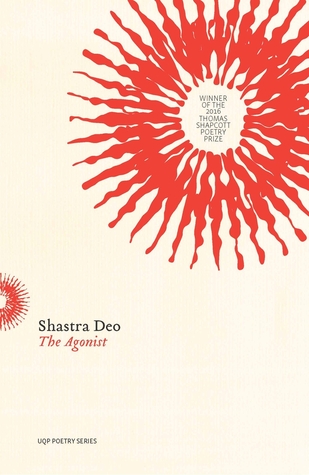
The beauty of bloody fists and broken bones: The Agonist by Shastra Deo

Once again, my attention turns to a work of contemporary Australian poetry, and this time it’s a remarkably gritty, often grisly, exploration beyond the raw edges of physical and emotional endurance. Embodiment. Disembodiment. Lyrical evisceration.

Evoking characters and imagery drawn from diverse, seemingly unlikely sources—anatomy textbooks, World War I poetry, a scout manual, boxing, entomology, ichthyology, divination, tarot cards—Shastra Deo’s debut collection, The Agonist, is an impressive, unforgettable experience. Like a sucker punch to the gut.

But in the best way possible.

Agonist: (n) one that is engaged in a struggle

The narrators that move through these poems—the voices Deo borrows or inhabits—cover terrain familiar to poetry. They speak to pain, love, loss, damage, healing. But they engage with the world at a visceral, cellular level. Their words work their way into and through the hollows of memory, exploring what slips though the passages of the brain, examining what the muscles retain and imagining the intersection between reading the past and foretelling the future.

So what does that entail? The Agonist is divided into three sections, each of which opens with an illustration from Gray’s Anatomy. Many of the poems in the first section deal with relationships, familial or romantic, employing surreal thaumaturgic, and anatomical imagery.

“Arrhythmia,” for example, details the painful, desperate emotions of the partner not ready to accept that a love affair is coming to an end:

             You count the notches of his spine.
His eyelashes flutter and he sighs, his breath
so warm that for a moment you can
pretend you aren’t cold. You want
to crack him open and hold
his heart in your hands, sink your fingers
into the thin membrane of his lungs.
You want to pull back his skin
and curl up inside his ribcage.
You want to know what he is inside.
Find the symptom, the sickness,
the anomaly that let him love you.
You want to be warm again.

Deo is adept at creating a surprising, brutal beauty in her romantic imagery. We see it again with “Cutman,” a graphic, meaty piece that opens the second section of the collection. Here the connection between a boxer and the attendant who cleans and cares for his wounds between rounds is reimagined in intensely intimate context:

He comes home each night with his hands soaked red,
and when he smiles it’s sharp and jagged and his teeth
quake in his wet mouth. You card your cold fingers
through his hair and lead him to bed, wait
for the weight of his arms around your neck, warm
and drowsy, the familiar shape of his bones and tendons
cradling the base of your skull…

In this part, Deo calls on themes drawn from war and boxing to engage in dialogue with other poets and experiment with poetic form. Included are three centos formed from the Index of Titles and First Lines in The Penguin Book of First World War Poetry. Moving into the final section, inspiration is found in, among other things, a Boy Scout manual from 1914 and a deck of Tarot cards. Consider “XIII—Death”:

. . . I live in the present tense,
tensed and present at the wheel
of a car wreck. My name is re-
membered. I apologise too often
for my lack of biography. He
does not yet know what divinity
he belongs to, but he knows I was
not born for this. He takes the
sheets off the mirrors. He escapes
our mythology.

In my experience of this work, which is of course, all I can honestly speak to, The Agonist is a collection in which the sound of the words and the impact of images are central, the point from which a narrative emerges and takes form. These are not autobiographical poems, for the most part. Nor do they read like “stories” so much as they remind me of paintings or photographs out of which vignettes have been abstracted with vivid, scalpel-sculpted, incantatory language.

Reading this book has left me with the sense of having spent time in a gallery. Attending a deliriously disturbing exhibit.

Shastra Deo was born in Fiji and raised in Melbourne. She presently lives in Brisbane where she is pursuing a PhD in Creative Writing. The Agonist is published by University of Queensland Press and, as ever, the indefatigable Tony Messenger has a review and interview with Shastra on his website.

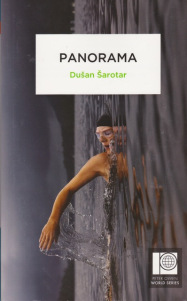
The “Wandering Souls” of Panorama

A sensitive and intelligent review of one of my favourite books from 2016, due to be released in North America on May 1, 2017.

Terry's avatarVertigo

A tiny dot had been flashing and circling slowly over a virtual point beside the road on the Google map until the satellites intercepted and correlated my precise position in the imaginary landscape; then the dot stopped moving, coming to rest on the road precisely where I was standing; that’s me, I thought, and as I slid my thumb and forefinger across the tablet to shrink the map, I saw my pulsating point, the beating of a heart, melt into an ever vaster landscape, as if my eye had separated from my body and was ascending high into the sky, swiftly, to the edge of space, from where I could see the entire planet.

It’s tempting — and partly right — to think of the Slovenian writer Dušan Šarotar as a modernized W.G. Sebald, as a restless, observant wanderer equipped with a streak of melancholy and a notebook, but also with a…

View original post 1,538 more words

A hoard of small treasures: The Inevitable Gift Shop by Will Eaves

Which of the psalms will hear the clouds as
they pass overhead, a stave of wires their nest?
What makes them beautiful? Why do they tear
themselves apart like aging stars or clocks?

Two years ago this month, I read a slender book called The Absent Therapist, by British novelist and poet, Will Eaves. It would become one of my top books of 2014 and remains, to this day, one of my bedside essential texts. This fragmentary tour through the musings and minds of a host of disembodied characters comes together to create a thoughtful, intelligent, and affecting piece of experimental fiction. It’s a book I’ve returned to often.

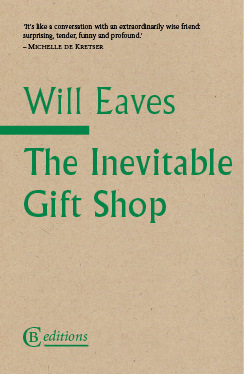
giftshopThe Inevitable Gift Shop, released earlier this year, forms a counterpoint to The Absent Therapist, but whereas Therapist was a project of inhabitation, brief and fleeting, interjected with moments of factual or speculative distancing—the mood of Gift Shop is much more immediate, personal. The text is divided into sections of poetry and prose, with the latter, still fragmentary, moving between memoir, literary criticism, natural science, and even the occasional humorous aphorism. The result is an unclassifiable work that is welcoming, engaging, unpretentious, and wise.

When I first encountered The Absent Therapist, I was deliberately seeking experimental approaches into what I imagined would be a fictional exploration of some aspects of my life story that I wanted to write about. I had, at the time, shared little personal writing beyond this blog, which was still finding its voice. Today, I come to this new work, this curious blend of nonfiction and poetry, as a writer with a number of published pieces to his credit, from in-depth critical reviews, to essay/memoir and prose poetry. If I am a more astute and directed reader now, I feel as if this book has anticipated me, and I find myself once again encountering words that reach out to me and catch me off guard in the way that my favourite passages from its predecessor did. (My review of The Absent Therapist can be found here.)

In particular, the fragments that address the act of writing—especially in its most vulnerable form—echo concerns that continue to haunt me after a year of writing myself “out” in the world. The very first prose piece, in which Eaves shares the insecurities he felt as a late bloomer, physically and sexually, ends with this admission that I recognize so well:

Even writing this is a perilous sort of confession: I will read it over and hear a small voice piping away, an echo that is shaming, and peculiar, because its mental acoustic is also so much to be desired. Because my refuge from all kinds of strange accusation and self-doubt will be the place anterior to the page – inside of my head.

By laying himself open in the earliest pages, Eaves is setting a tone that runs through this work and pulls it together into a cohesive whole. There is something in his voice—a measure of quiet reflection, as if he is thinking aloud and inviting the reader to listen and take from it what he or she wishes without expectation—that is refreshing. In this era of the self-indulgent introspective memoir and its thinly-veiled fictional counterpart, Eaves is, by contrast, slightly self-conscious in his writing. As a result, the memories and reflections he shares take on a special intimacy and personal feel throughout this work, whether he is remembering his mother,  commenting on Madame Bovary, analyzing  Shakespeare’s Sonnets, musing about the nature of consciousness, or  detailing the unfortunate mating habits of captive tortoises.

However, if there is a theme underlying the seemingly disparate fragments of this book, it might be the attempt to understand and capture conscious experience. A psychological imperative permeates the “conversation” that unfolds:

Something is more or less well done but it flows away from me in the doing, and when it’s finished I feel often a mild perplexity at the thing done – at the idea that it had anything to do with me in the first place. Because there is no way back into the work as it happens. Much as we rejoice in the escape from personality, we’re apt to be disconcerted by the experience of liberation – by the irretrievable oddity of what we produce. How was this written, who wrote it?

This unconventional “memoir by other means” is anchored by the poems that grace its pages. They appear like books within the larger book, islands of verse that balance a more conventional literary presentation within an experimental work. And Eaves’ discussions of poets and poetry that occur through the text enhance the experience of engaging with these poems:

Poetry, is the discipline exerted on or by words in order to summon feeling, often very painful feeling, at will. It is powerful because it recognizes that the material world, as far as humans are concerned, exits in psychological flux: no material or brute fact is an island. It survives in an atmosphere of witness…. The messiness of the world as it presents itself to creatures of emotion becomes subject to ordering, but the aim of poetic ordering is not to deny the emotion or regulate the world: it is to stabilize both in a form of words – an incantation, Thom Gunn says – that faces the entirety of the mystery, of why we are here to see and hear and locate these things in every daily particular.

The Inevitable Gift Shop, as its title (taken from the comment of the tour guide at an Icelandic greenhouse called The Garden of Eden) implies, is a collection of oddities, amusements and small treasures that reveal a deceptive depth as one browses its offerings. As a reader and writer, I suspect this is another book that I will return to time and again, fitting well alongside not only The Absent Therapist, but one of my favourite similarly eclectic collections of writerly wisdom and poetry, Breyten Breytenbach’s Intimate Stranger.

Original, undefinable and yet well worth the visit, The Inevitable Gift Shop by Will Eaves is available from CB Editions.

My father’s library: A very personal reflection

It is the Thanksgiving weekend in Canada. We planned to gather, as a family, at my parents’ house to begin the process of determining what will be kept, sold, and thrown out; and to assess the repairs required before the house can be put on the market next year. However, an early taste of winter has caused us to cancel our plans due to road conditions (they lived two hours northwest of the city where my brothers and I all live). With a mixture of relief and an unresolved need to begin the process of closure, I am re-posting an updated version of what was, at the time of its original writing, a premature tribute to my father. The sentiment, now relevant, remains. His library is one of my major concerns.