To translate the human experience: Arabic, between Love and War edited by Yasmine Haj and Norah Alkharashi

We live in a world that is always in flux. Conflict, natural disasters, and political destabilization are continually reshaping our world and threatening our future on an intimate, community and global scale. An element of the universality of the human condition unites us in our response to these factors while privilege, culture, and history set us apart. To begin to understand where others have come from, what they have been through, their trials and their dreams, we must be able to speak to one another, learn to listen, and read their words. This is why translation matters.

The art of literary translation is often said to be both impossible and necessary. Impossible because no linguistic code is commensurable with any other—particularly so in the case of poetic language which, being among the most refined and expressive of literary forms, is expected to have myriad and complex nuances. Yet translation remains necessary. Without it there would be no conversation across linguistic and cultural barriers, no prospect of the mutual understanding that remains a prerequisite for the peaceful, emancipated life towards which we are all striving.

These are the words of translator and scholar Norah Alkharashi from her introduction to arabic, between love and war, a distinctive collection of poetry co-edited with Yasmine Haj and newly released by the independent Canadian publisher trace press. This anthology, which gathers the work of poets and translators from across the Arabic speaking world and its diaspora, arose from a series of creative translation workshops, facilitated by the editors, that allowed translators from varying backgrounds the time and space to explore the “processes of loss and unlearning encountered on their path to translation as critical creation.” This unique collaborative engagement ultimately led to the selection of thirty-seven thematically linked poems, presented alongside their translations—Arabic to English or English to Arabic—that comprise the first release in the trace: translating  [x] series.
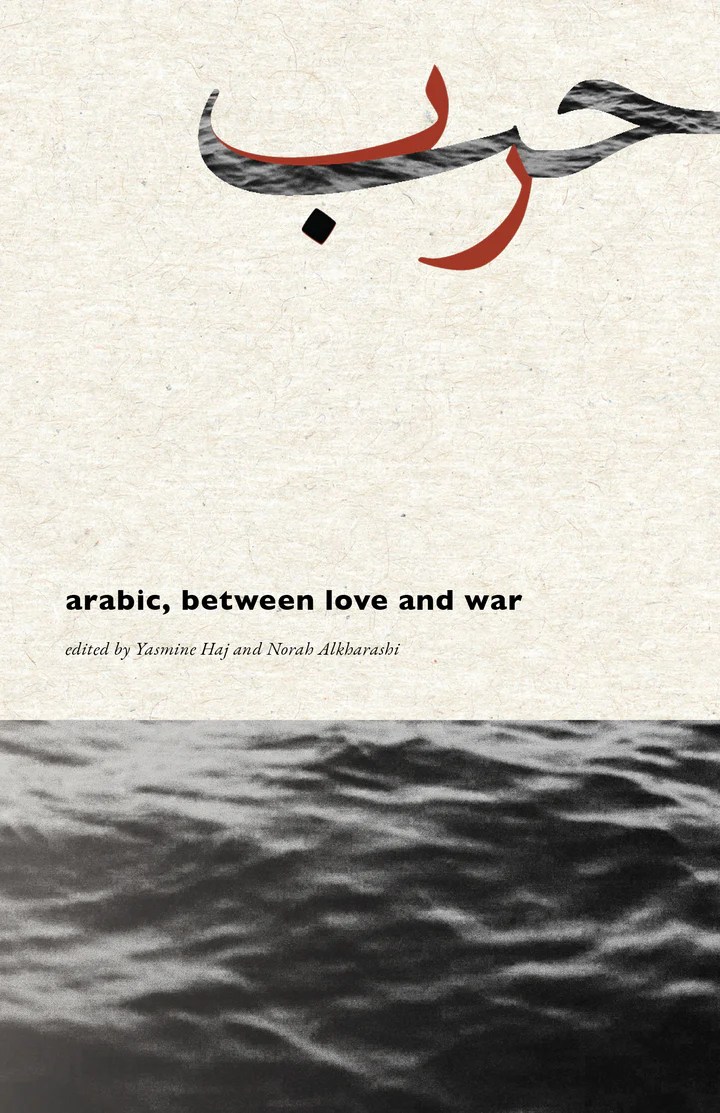
The title and theme of this project illustrates one of the central challenges of the art of translation: how to reflect the nuances implicit in one language within the context of another. In Arabic, only one extra letter separates the word for “love” حب from the word for “war” حرب , a distinction that can have many implications in poetic discourse, especially when the two realities are often so deeply entwined in the lived experience of so many in the Arabic speaking world. Here the collected poems are divided into three sections: Love, Interval, and War, but the boundaries cannot be so clearly drawn. War frequently lingers in the background, even when a poet speaks of love; while love is a persistent life force even in the face of loss, loneliness, and displacement. And once again, the memory and fear of war haunts, even in the quiet in between conflicts—in the interval.

The poems of the first section, “Love,” tend to be tinged with sadness and longing, be it for for an imprisoned child or a lost lover:

I remembered you!
.              I remembered the silence growing slightly wet,
             and the trees that shaded us,
             and the fragrance drawing near.

             I didn’t know
that we were on the edge of everything
and that one word
alone was enough to wither a tree,
             that silence turns into shade,
             and the heart a safe haven for pain.

– from “One Word” by Ali Mahmoud Khudayyir
Translated from Arabic by Zeena Faulk

Meanwhile, the longest section, “Intervals,” casts the widest emotional net, speaking to the most fundamental elements of human experience—birth, death, hope, despair—in a world that can seem to turn without reason, or as the epigraph to this part says, those “liminal spaces where wars of flesh and love—ongoing, past, or yet to pass—have lingered. Holding hearts and words in limbo, with beats yet to be translated.” Lena Khalaf Tuffaha’s “Time Travel,” originally written in English, captures this unsettled sense succinctly:

. . . We travel because
motion is more comfort

than settling, calcifying.
We travel because it means

we haven’t gotten to where
we’re going yet, the story

is still being written and
our fractures aren’t done setting.

There is still a chance
we’ll turn out different

or better or—best of all—
like our parents without

knowing we’ve become
who they were. . .

Finally, it is sadly no surprise that the poems in the “War” section are the most direct and unequivocal. But they are not without a promise, however faint, and hope for a future free from the ravages of war:

I wish I could, I wish it were in my hands
to uproot injustice
and dry the rivers of blood
off this planet.
I wish I could, I wish it were in my hands,
to hold for this man, tired
in the path of confusion and sorrow,
a lamp of prosperity and serenity
and grant him a safe life.
I wish I could, I wish it were in my hands,
yet all I have at hand is a ‘but’.

– from “This Earthly Planet” by Fadwa Tuqan
Translated from Arabic by Eman Abukhadra

These are but three brief excerpts. The poems gathered here represent the work of fifteen poets chosen for translation by fourteen translators (some translate more than one poet or are also poets themselves), and together the contributors come from varied Palestinian, Iraqi, Jordanian, Saudi Arabian, Lebanese, Sudanese, Tunisian, Egyptian, Syrian, Canadian, American and British backgrounds. Some of the poets write in English (and are thus translated into Arabic), whereas some of the translators are scholars specializing in Arabic. This rich range of perspectives and differing Arabic literary traditions must have contributed to a vibrant workshop environment which is distilled in this elegant and vital anthology.

arabic, between love and war is edited by Yasmine Haj and Norah Alkharashi, and published by trace press.
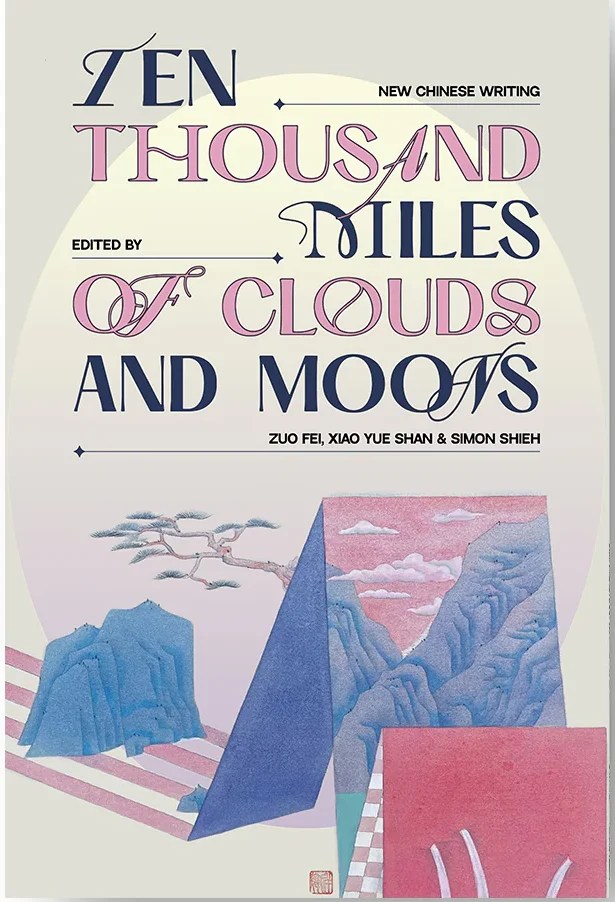
To go where the language goes: Ten Thousand Miles of Clouds and Moons – New Chinese Writing, edited by Zuo Fei, Xiao Yue Shan and Simon Shieh

Grey cloud grasping light,
unrolling the softness of another world
towards the wobbling plane wing; its folds ripple,
someone has scattered seeds in each furrow.

Who’s thinking, underneath the clouds,
how hard it is to restore the life of a flower,
when rain never coincides with favorable winds.

But we have a shred of light.
Today, passing through a mid-gate
as if remembering.

(from “Introspection on a Cloud” by Du Lulu, translated by Dave Haysom)

What exactly does it mean to enter into another world, to open oneself to a landscape at once familiar and strange? That is, one might suggest, one of the functions of literature. But if the map that grants access to that other world with its many artistic and cultural riches is in another language, translation is the key. For the editors of Ten Thousand Miles of Clouds and Moons, a collaboration between Beijing-based Spittoon Literary Magazine, a dual-language journal of contemporary Chinese literature, and Honford Star, the guiding inspiration for this first anthology project is, in keeping with that of the magazine, to seek out and bring into English translation, some of the most original, exquisite, and daring voices—new and established—contributing to the present literary landscape in China.

The introduction lays out the vision that guided their selection of pieces

The work had to be excellent; the writer had to have a point of view that is under-explored in the Anglosphere; there had to be a balance of genders; and the language had to be so special that it has the potential to torture translators. This final aspect came only from our love for the Chinese language—which, like all languages, has a singular soul, a force drawn from its age and its malleability throughout time. The more a writer is able to tap into that soul, the more difficult the piece would inevitably be to translate.

Thus sixteen contributors—eight writers of fiction, six poets, and two essayists—were paired with eighteen translators, to offer readers a journey that covers a wide literary terrain. You will find yourself in a world with a long rich cultural history and traditions, and you will find stories that depict a modern society that Western, English language readers will instantly recognize, with influences drawn from an international well of literary sources. You will find work that pays homage to the China’s past and tales that turn on distinctly futuristic, apocalyptic visions. And surreal, experimental tones alongside traditional Chinese poetic form.

The opening story in the compilation sets the mood perfectly. A piece of dystopian science fiction that  revolves around the fate of the 18th century work considered the greatest of all Chinese novels, “Mass in Dream of the Red Chamber” by Chen Chuncheng (translated by Xiao Yue Shan) is set in the far future—the 4800s—at a time when this great work of literature is not only lost, but any effort to retrieve its contents or storyline are strictly forbidden. There is, at this time, a belief that the text was completed at the peak of the universe’s development, and that all had begun to decline and dissipate since that time. The narrative follows the recorded account of a prisoner, a man born in 1982, who fell into a deep coma for several thousand years, only to miraculously awake and find himself as a specimen in a museum exhibit. He becomes a kind of missing link to the lost masterpiece for a clandestine organization desperate to recreate, as much as possible, the original; its preservation being essential to the continued existence of the universe itself. But that also makes him, and those who come to hear him access his memories of the text, the target of murderous government forces. It is a wonderful meeting of the glory of past achievements and the horrors of a post-apocalyptic totalitarian future, connected with an out-of-time protagonist’s personal recollections of life in the 1990s and 2000s.

The settings of the tales that follow vary, from a contemporary urban environment where bored youth hang out and make trouble, to the account of family history, to a mystical encounter on a mountainside. The energy shifts from story to story, often turning to the unexpected, cracking the fragile veneer of reality. Particularly delightful is the excerpt from Lu Yuan’s novella The Large Moon and Other Affairs (translated by Ana Padilla Fornieles), a piece of weird fiction that reflects, perhaps, in its magical strangeness, the influence of Bruno Schulz whose work the author has translated. As the moon, being pulled toward the earth, grows larger and larger in the sky, the eccentric Mr. Lu struggles with insomnia and troubled dreams. One night, having taken a concoction to aid his sleep, he finds himself carried off on a nocturnal adventure through the skies:

Mr. Lu rose from the valley of dreams and rowed out the window, picturing himself an unthinking mycoplankton or a sea cow, heading back to the Amazon River Delta. Riding upon the clouds and the wind with neither a northeastern wife nor a Vietnamese mistress at his side, the invoices seeking his death yet to arrive, and the murderous plots working their shapeless, invisible night shifts had been temporarily put on hold. There were no cold, mechanical alarms, no greasy company breakfasts, and definitely no covetous relatives, neighbours, acquaintances, or colleagues. The naked Mr. Lu, wearing only a heavy pair of  plastic slippers, flew over the sparse suburban streetlights, bounding towards the corridors of stars spiraling in a snail-shell pattern along the horizon’s towers. A thin sheet of air gently caressed his bulging beer belly, and the city was as far away as a firefly, succumbing to the hallucinatory bird’s eye view of inebriated men.

The two nonfiction pieces add a welcome new dimension to the collection. Hei Tao’s “Three Essays” (translated by Simon Shieh and Irene Chen) paint delicate portraits of southern China, and a lifestyle that is gradually disappearing, while Mao Jian’s “No One Sees the Grasses Growing” is a relatable, and humorous, memoir of her years as a student at East China Normal University in Shanghai in the 1980s and 90s. She recalls a time when students paid less attention to their studies than might have been wise. They were young and in love with a certain literary coolness. Her first degree was in Foreign Languages, but she found it hard to resist the allure of another course of study:

The truth is, in the eighties, it was impossible to resist the passions of the Chinese Department. The notice boards were plastered with adverts promoting literary lectures, and all sorts of clubs and societies adopted the grandiose affectations of belles-lettres, prancing about the center of campus. If someone were to ask you about going corporate after graduation, you’d have to self-reflect on the unrefined impression you must have been giving off. Those years were the golden age of Casanovas, who made names for themselves by proclaiming their undying love for poetry, and any girl who could be moved by Rilke would inevitably enter into a spontaneous fling with one of these campus poets.

It was an era of living away from home, first trips to KFC, young love, and inspiring and unconventional professors. But looking back decades later, now a professor herself at the same institution, she realizes that that time is past, in so many different ways.

Spread out among the prose pieces, are the contributions of the poets, three poems each. This arrangement works very well, offering a change of pace and granting each poet the space to have their unique voice heard. As with the fiction and nonfiction, there is both variety and, of course, precise, evocative imagery that is at once modern, yet with an echo of the long-standing traditions of Chinese verse.

Anthologies can be uneven projects, but this selection of new Chinese writing is strong, varied, and continually fresh and surprising from beginning to end. The contributors range in age, with the youngest in his mid-twenties, the oldest in his mid-sixties. Their work is consistently fresh and vibrant, and the translators all appear to have produced results that feel effortless. It should also be noted that this volume is beautifully presented, with a simple, yet elegant design. This is an endlessly engaging collection for anyone with an interest in contemporary Chinese literature, especially if you are seeking work that challenges expectations.

Ten Thousand Miles of Clouds and Moons: New Chinese Writing is edited by Zuo Fei, Xiao Yue Shan and Simon Shieh, and published by Spittoon Literary Magazine in collaboration with Honford Star

Reimagining the question “Why translate?”— River in an Ocean: Essays on Translation, edited by Nuzhat Abbas

I started reading River in an Ocean: Essays on Translation, a generous and provocative collection of reflections on what it means to live, and work, between languages, places and social and cultural identities and realities, as I was preparing to visit India for the first time in four years. I finished it as violence escalated in the Middle East, with the latest and most violent episode of a conflict that has been part of my consciousness for all of the more than six decades I have been on this planet. It marks the evolution of a troubled history that has taken on added depth and meaning for me through the words of Palestinian poets and writers, that I have been able to access through the work of translators. As a result, my recent travel, not only the open conversations with friends about the schisms we are witnessing in our own nations and communities, but the experience of navigating a vast, multilingual country without the ability to easily communicate in so many everyday situations, combined with the explosive events that have absorbed so much of my emotional attention these past weeks, has enhanced my response to the essays contained in this anthology.

Nuzhat Abbas, founder and director of trace press, has described this project, the Canadian publisher’s first anthology, as one that arose out of a desire to “NOT center whiteness” and to examine translation outside the Western conventions that tend to influence what literature deserves to be translated, and by whom. It is a project of decolonial feminism, one that might not always be a typical context for a reader like myself who, like so many other readers, translators and publishers I know, is passionate about translated literature which, in the broader publishing world, is still undervalued and even suspect. Yet, to listen to the voices of translators from the Global South for whom translation is inextricable from essential questions of identity, history, land, dislocation, gender and sexuality offers an invaluable opportunity to expand one’s understanding of what translation can be. Here, crossing linguistic borders is not simply a possible professional endeavour, it is a way of being in the world, of understanding where one comes from and how one belongs.

In her Editor’s Translation to River in an Ocean, Abbas poses the following guiding questions:

What, and where, is the time and place of translation, and of literary translation, in particular? Of the translator as writer, as attentive listener, as co-creator, responsible to what [Gayatri Chakravorty] Spivak calls “the trace of the other within the self”? Or of the editor-publisher as convenor and gatherer in the project? This anthology emerges from such a questioning, and from curious and communal conversation, to offer a space for the soundings of different trajectories—connecting spaces, times, languages and bodies with origins in East Africa, the Middle East, South and Southeast Asia.

With each one of the essays that follow, these and other questions rise, open up, revolve and return, leading the writers toward a fuller sense of self. No two essays are alike, each is unique in form and expression, yet they all speak to a longing to find, not only Spivak’s “traces of the other within the self,” but reflections of the self within the words of the other.

The collection opens with Khairani Barokka’s buoyant and provocative dual language essay “Ava Kabar, Penerjemah?” Paragraphs in Indonesian are followed by the English translation, moving back and forth between tongues, as Barroka directly addresses her fellow translators, asking if they are alright. Her concern is with the emotional and physical well-being of the translator who is marginalized by race, country of origin, illness or disability. In the second essay, Palestinian-born translator Yasmine Haj begins with the notion that translation is an activity we all engage in from our earliest moments as we learn to communicate with those around us, those who can answer our basic needs. But she moves on to reflect on how her first language, Arabic, remains distinct from the other languages that she has come to know—Hebrew, French and especially English:

To survive, we must translate, almost everything into English—sometimes even the rhythm of our thoughts. And so, it becomes the way we think, the way we write, the way we talk to ourselves. The way we dream. And so, Arabic remains a dreamless jumble of love, melancholy, nostalgia, and an inability to properly express ourselves or anything for that matter—an obsession with accents, stumped travels and halted communal growth, mother tongues and beautiful people that we could never meet.

If, in some sense, Arabic is everything that is lost, translation is a way of remapping a history— personal, political, cultural—and of finding and feeling one’s way along a path filled with uncertain obstacles and unexpected discoveries.

The contributors to this anthology include both emerging and seasoned translators, and their approaches to the central theme—why translate?—include epistolatory essays, memoir and, at times, embedded photographs and documents. Their stories are deeply personal, poetic reflections. A passion and commitment to the power of language shines through, as do the many complex dynamics that arise when one’s identity and experience crosses the boundaries between the Global South and the West.

I can attest that there is not a single essay in River in an Ocean that does not turn in a fresh, fascinating and meaningful direction, but to attempt to summarize each offering in a few sentences would be counterproductive. Rather, I will highlight a few pieces that hint at their range, beginning with Suneela Mubayi’s evocatively titled “The Temple Whore of Language.” Born in New York to an American mother of Jewish origin and a Hindu-Kashmiri father, Mubayi was raised between the US and New Delhi by a host of relatives. She (the pronoun in her bio) claims: “I put the trans back into translation.” In addition to providing an excuse to avoid her own writing, she says that she “inhabits” translation because, as someone who is mixed race and nonbinary, her identity is unsettled:

I translate because I am not stably anchored—neither in my origins, nor in my cultural affiliations, sense of belonging, or in my gender. To translate, for me, is to experience being an outsider, a trespasser, a poser— and to be able to revel in that condition.

As a trans person myself, unsettled on somewhat different grounds, I understand this internal sense of balanced imbalance well. For Mubayi, this unsettledness, along with political factors—9/11, the Iraq war and the Palestinian condition—leads her to learn Arabic, a language to which she has no ethnic or geographic connection. As a translator, her linguistic engagement with the language is informed by her unique perspective as a person who exists on the margins of more than one axis of being, and, as such, leads to some very interesting observations.

By contrast, in her essay, “A Tally of Unfulfilled Longing: Translating Dalit Poetry,” Gopika Jadeja returns, as a translator, to her native language, Gujarati, but crosses another distinct boundary. Her own mother, denied an education, was determined that her daughter have an English education. It was not simply a concern for her future, but the more immediate need to have someone at hand to translate what she could not read. This planted the seeds of her daughter’s future occupation, however:

What I choose to translate is perhaps a world that is not hers, and yet hers. I choose to translate Dalit and Adivasi poetry from western India. As a Hindu upper caste woman in postcolonial India, choosing to translate Dalit and Adivasi poetry raises more questions than it answers—both from those whose works I translate and from myself?

What she realizes, once she begins to read and translate this literature, is the full existential impact of the accepted social hierarchy on those at the very lowest rung. This leads to many open ended questions about the relationship between translation and what can be considered decolonial—especially when translating literature from marginalized communities.

In varying ways, translation as a means to engage with one’s cultural and ethnic identity seems to underlie most of the responses to the why translate question, especially for those who were born in or have immigrated to the West. In “Elegiac Moods—Letters to Agha Shahid Ali,” Rahat Kurd, the Canadian-born daughter and granddaughter of Kashmiri women, engages in a moving correspondence with the late Kashmiri-American poet and translator. She opens her first letter:

Dear Shahid,

I’m bound to begin with translation. Whether I’m working within only one language or between two, if I want to convey an experience or an impression, to inscribe the meaning of a text or an event, I will always have to draw on abstractions, memories, dreams, and fears, and hope to make myself intelligible.

Calling on his poetry, especially those he wrote for his mother, she speaks of the enormity of the loss she senses in his words, the loss of a homeland that has, in more recent years, fallen further into a state of crisis. Although Agha Ali was writing in English, Kurd recognizes translation as a “strong, changeable current” running throughout his poetry, especially the sequence of poems that recount the journey to bring his mother’s body home to India, “From Amherst to Kashmir.” Her intuitive tracing of translation as a vital force in this work had me pulling my own collection from the shelf and returning to these poems anew. She goes on to share her own journey to understand how translating can be a means of responding to and resisting the loss that estrangement from one’s past can bring.

The other contributors to this anthology include Kenyan-born, Ugandan-raised poet and scholar Otoniya J. Okot Bitek, Nedra Rodrigo who was born in Sri Lanka, Ugandan Canadian writer Iryn Tushabe, Tamil poet and translator Geetha Sukumaran, Norah Alkharashi, originally from Jeddah, Saudi Arabia, and Lisa Ndejuru who was born in Rwanda, raised in Germany and came to Canada in her teens. The current of their translations flow between languages, with varying motivations and objectives. As well, the majority of the women involved in River in an Ocean currently live and work or study in Canada and recognize themselves as settlers on traditional Indigenous lands, a reality that adds an extra dimension to the decolonial vision at the heart of this vital project.

River in an Ocean: Essays on Translation is edited by Nuzhat Abbas and published by trace press.

Some measure of an innovative response to Liberating the Canon: An Anthology of Innovative Literature

So I’m sitting here at looking at my copy of Liberating the Canon: An Anthology of Innovative Literature and feeling sick when I think about whether or not I can, or should, write about it. Which makes it sound like I did not enjoy the book. Or that it is not worth reading. I did. And it is.

But, can I talk about the way it also twists me up inside? That a book that I should connect with on a level beyond the written word leaves me wondering if there is a space for me? On the back cover (which on my copy is terribly warped after a fall on snow-covered ice landed me with a concussion) editor Isabel Waidner is quoted:

If there were a literary avant-garde that were relevant now, it would be what the queers and their allies are doing, at the intersections, across disciplines. This avant-garde would be inclusive, racially and culturally diverse, migrants galore, predominately but not exclusively working-class, transdisciplinary, (gender)queer and politically clued up (left).

I like the sound of this. But is this what the queers and their allies are doing? Possibly. I am the ineptest (gosh I didn’t even know “ineptest” was a word, but Word suggested it and I kind of like it) queer writer ever because, off the page, queer is the loneliest reality I’ve ever known, and the many queer writers included here seem to have lives in which their queerness is essential, not accidental. And that makes me feel as alienated as my real life adventures in queer spaces do. I’m awfully pasty white and ordinary, and although my mother’s family were, at one time, potato famine refugees from Ireland, and I was not born in the country where I live, I am a migrant on an axis other than the here-to-there displacement in space. The only true migration I have ever made—the one that I am always making—is the one from female to male.

And I am not even certain how to think about “working class.” If it’s about wage-labour, a blue- and pink- collar, and sometimes white collar existence, then for the exception of about one decade of my life, I’m your man. But I’ve always preferred to think of myself as under-employed, as if the status was temporary, collarless. Over-educated. Just barely keeping my head above poverty level. You know: What are you going to do with an arts degree? Or two? When things are good where I live, blue collar workers can haul in six-figure incomes. Classless, misfit, my work-life fits into no definable category.

At 57, I’m not even under-employed any more. I’m not employed at all. And too old to start over. (Which leads me to wonder, while we’re being all diverse and intersectional, where disability lies in this re-invigorated literary avant-garde.)

But, enough wound-nursing and equivocating. Back to the task at hand.

I do love the idea of literature that is innovative, experimental, and breaks boundaries especially in my arena, that of the essay/memoir. And, did I mention that nowhere in Isabel’s detailed and entertaining introduction (check it out, if you want, at 3:AM) does that over-used term “genre-bending” appear? The writing she invites the reader to envision, “itself must transgress the various structures through which the avant-garde literary canon has perpetuated itself and its exclusiveness.” Okay, now we’re talking. She goes on to say:

To reiterate, the writing needs to work across various systems of oppression (intersectionality), across formal distinction (prose and poetry, critical and creative, and the various genres), and across disciplines. Same goes for publishing, editing, reading, referencing and designing curricula. Change literature (or what is defined as such) and the discipline will diversify. Diversify the discipline and the literature itself will change. Liberating the canon depends on inclusion and formal innovation in equal measures. The two are interrelated.

And the question then becomes: Just how liberated is this canon? How much of a meaningful advancement have we made toward this ambitious goal by the selections gathered in this anthology?

Honestly, I am not so sure. (Maybe I am.)

I already tend to read a fair amount of innovative literature, and have admitted to a hunger for work that pushes the confines of literary style and form, so the more experimental pieces really, uh, turn me on. The contributions from Mojilsola Abedayo, Joanna Walsh, Isabel Waidner, Timothy Thornton, Mira Mattar, Nisha Ramayyar, Richard Brammer (cheating I skipped this having already the entire book from whence it came) and Nat Raha were, for me, standouts. The most explicitly trans pieces were my least favourite, pushing subject more than form, but as an idiosyncratic, fickle reader—a body dysmorphic, ex-gender dysphoric soul—I am looking for a transvant-garde that speaks to trans in a way that would make me say “HELL, YES.”

This canon still needs to be loosened a little further, I suppose. Or rather, the liberation is just starting.

This book could be considered a primer. An Anglophone primer. An anthology of primarily UK based writers with a few US contributors tossed in for good measure. How about round two? With a glance to Canada (where I am), Australia and New Zealand, South Africa, and desi (South Asian and diaspora) writers.

Ah, one can dream. But if this book can exist, anything is possible.

So, there you have it. I have written about Liberating the Canon without really writing about any of the varied pieces contained within. You’ll have to read it, if you dare. Or desire. Or are simply curious.

It’s worth the risk.

Liberating the Canon: An Anthology of Innovative Literature, edited by Isabel Waidner is available from your friends at Dostoyevsky Wannabe.  To be printed at your pleasure, and obtained through a distributor like that place that starts with A.

Listening to Indigenous Voices (part 1), Australia: This country anytime anywhere

Over the past decade, I’d like to think that my reading has broadened in scope. I used to scour and select books from mainstream literary reviews, major award longlists, and end-of-year round-ups. Reading works in translation, turning to smaller independent publishers, seeking more experimental writing, and allowing myself to follow my own idiosyncratic fancies have all served to expand the borders of my attentions (and the limits of my bookshelf real estate). But every now and then it doesn’t hurt to take stock and think: What are the gaps I might want to fill? What voices am I not listening to?

This year, when my friend Lisa of ANZ LitLovers announced her annual Indigenous Literature Week, I immediately thought of a book I picked up in Alice Springs this May: This country anytime anywhere: An Anthology of New Indigenous Writing from the Northern Territory. However, if I was going to read and write about an Australian publication, I promised myself that I would balance my efforts with the work of an Indigenous writer from Canada. That review will follow in a few days.

Published in 2010, This country anytime anywhere is a joint project of the NT Writer’s Centre and IAD Press. The initial phase involved workshops and consultations with over 100 Indigenous people—some established writers, but the majority beginners interested in telling their stories. The resulting collection of poems and stories is diverse, featuring writers who range from teenagers to elders and hail from urban, rural, and remote backgrounds. Critically, eight Indigenous languages and English are represented. There are several bilingual offerings and two submissions for which no comfortable English language translator could be found. This is an indication of the precarious state of some of these Indigenous languages.

The range of offerings in this slender volume is impressive—from family histories, to traditional folktales, to poetic expressions of anger, and narrative songs and stories. The variety of styles and subject matter is impressive. Many evoke a simple, unadorned voice. Magical, or more accurately, spiritual elements are often woven into the fabric of mundane, everyday life, speaking to the connection to a heritage and land that extends back centuries, millennia. But, as one might expect, these poems and stories echo sadness, loss and grief. Fallout from the Stolen Generation, the years (1910-1970) when many children were removed from their families, is still very present. The ravages of alcohol, mental illness, injury, and suicide are not ignored. But there are also stories of hope and survival.

One of the most widely known contributors, writer and poet Ali Cobby Eckermann, is represented with two bilingual (English/Pitjantjatjara) poems and two stories. “Spirit Gate,” which she describes as a “satirical work of fiction based on hope,” imagines the sudden disappearance of all the Aboriginal people from Alice Springs. The main character, Trevor, is awakened in his Melbourne home by the disembodied voice of his grandfather. The Song he hears is a summoning and he promptly leaves for Alice. Light-skinned, he arrives without attracting attention, to a community distraught by the disappearances. At a café, he listens to the clientele—“artists, social and youth workers, hippie-types and government ‘yuppie experts’”—debating the strange circumstances:

Snippets of conversation confirmed that all Aboriginal people had vacated the township region about a week ago. There had been no warning of the exile, no specific signs to the exodus, and most people had failed to notice the blackfellas had gone for several days. People had just assumed they’d gone for another funeral, or collecting royalty money somewhere.

Trevor learns that the non-Indigenous population feels “jilted and hurt.” Business and the tourist trade are threatened. Unruly behaviour on the streets and drinking on public lawns indicate that the Dry Town rules are being violated. It is a world turned upside down. Though the tone is tongue-in-cheek, Cobby Eckermann is taking a pointed stab at the industries that benefit from the Aborginal presence. In the end, the protagonist goes out to join his own people who have gathered beyond a spirit “Gate” to be renewed and regain the dignity they have lost.

Having just been out and spent time in Alice Springs and beyond (observing the town as an outsider but having an opportunity to engage with those who live and work there), this and a couple of the other pieces set in the community had an extra resonance. The desert imagery was also especially poignant for me—even after a short stay, the land gets into your system. The natural world is a common theme in much the poetry in this collection. For example, “Red Desert” by Maureen Nampijinpa O’Keefe opens:

See the thorny lizard walking along the red desert dunes.
See the snake slithering across the red desert sand.
See how high the eagle flies, hovering above the desert.

The spinifex glistens golden in the sun,
as the desert winds blow softly amongst the ghost gums.
See the leaves swaying to the desert wind.
Listen to the leaves rustle as the squawking of the white cuckatoos
breaks the desert’s silence.

This collection offers an interesting insight into contemporary writing from the Northern Territory. The poetry tends to have a plaintive, political undertone, while the prose pieces showcase the legacy of the long storytelling traditions of the Indigenous cultures. However, these are very much stories of the 21st century. And they are often brutal. Of note is “The Tree” (Gloria Daylight Corliss), a short piece that shifts between a third person narrative recounting a man’s memories of playing, camping and fishing beneath a large banyan tree, and a first person tale of personal loss and environmental degradation. What begins with a boy playing on the branches of the tree ends with the grown man hanging from the same tree. The urban-set “The Irony of that…” (Jessie Bonson) is a darkly playful tale of a teen-aged would-be writer who creates horrifying scenarios only to routinely erase them: “Edit – Select All – Delete.” But woven into the tapestry of her fantastic scenes are the very real domestic terrors that haunt her and her mother.

For the participants in this project, writing is healing. Since I traveled to central Australia to take part in a fundraising event in support of an Indigenous Women’s Council, this collection (which happens to feature female writers by a ratio of about 3 to 1) is a fitting complement to that incredible experience.