
The earth was a rose fully opened: Eternidades / Eternities (1916–1917) by Juan Ramón Jiménez

My feeling and the star
were ecstatic in their idyll.

You passed through the garden
and your hand, playing,
paying no attention,
tore off my feeling.

(poem 107, “Flower”)

Winner of the 1956 Nobel Prize for Literature, Juan Ramón Jimenez (1881–1958) is widely regarded as one of the most important Spanish language writers of the twentieth century. But, as is often the case, the popularity of his poetry experienced its ebbs and flows over the course of his lifetime, only to be received with renewed enthusiasm in the decades since his death. Born in Moguer, in southwest Spain, he was drawn to poetry at an early age. Before he turned twenty, he was invited to Madrid by leading writers of the Modernismo style and with their support he published his first two books of poetry in 1900 and 1901. But he soon broke away from this group to develop his own distinct aesthetic, one focused on the ideal of beauty. This new approach would ultimately bring him attention and international fame, with his book of prose poetry Platero and I (1914) being translated into at least thirty languages. However, yet another important stylistic shift still lay ahead.

By the time Jiménez made his first trip to the United States in 1916 to marry his American-Spanish fiancée Zenobia Camprubí Aymar, he was already aware of English-language poets and of a new bluntness and astringency in the more recent works by Yeats, but it was the reading of Emily Dickinson that made the strongest impression on him. He would bring this inspiration, and her capacity to convey the experience of an invisible reality in a concise form, home to Spain. Her inspiration is reflected clearly in the work he composed immediately following his journey and in the years that followed. In Diary of a Newlywed Poet—a poetic memoir chronicling his trip to America composed in 1916—Jiménez introduced a new direction and style and the present volume, Eternities, written in 1916 and 1917, and published in 1918, turned on and refined this stylistic shift to focus on the dynamic relationship between the poem and the self, and between the poetic word and the re-creation of the world.
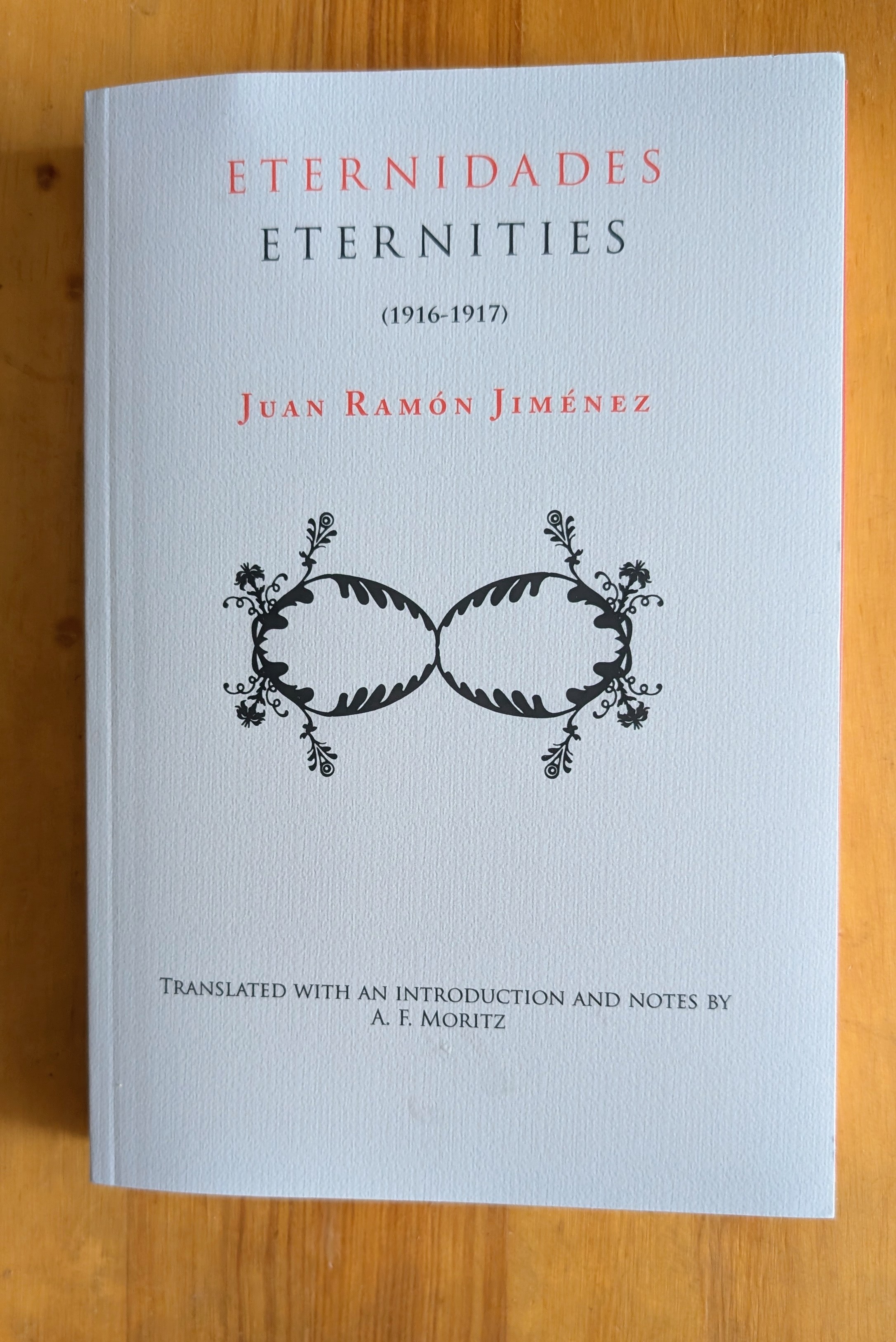
In his thorough introduction to Bitter Oleander Press’ handsome dual language edition of this milestone in Jiménez’s creative evolution, translator and poet A. F. Moritz describes Eternities as “a book that joins—or rather, sees the identity-with-difference of—poetry and Poetry: the making of poetry by the poet, and the presence of Poetry as the inner and greatest reality that is available to everyone and experienced by most.” Notably, in a move from what was known as “pure poetry” to what he would term “naked poetry,” he established a streamlined, yet potentially rich form that would in turn influence the further development of Spanish poetry of the time. In poem 5, “Poetry,” he famously imagines poetry as a woman who comes to him when he is young, but then begins “putting on fashions” to an extent that his initial boyish enthusiasm turns toward hatred and resentment:

. . . But she started to undress.
And I smiled at her.

She stood there in just the shift
of her ancient innocence.
I believed in her again.

And she dropped the shift
and showed herself naked, all . . .
O passion of my life, naked
poetry, mine forever!

This renewed connection to poetry allows the poet to reveal his unveiled self, to speak of the ideas and feelings that are true for himself, knowing that essentially he is speaking to a universal experience of the nature of existence.

Eternidades / Eternities is a sequence of 137 numbered poems, titled or untitled, some several stanzas in length, but many no more than four lines. However, the arrangement of poems appears, at first glance, to be loose, unorganized. But it has its own form. As Moritz puts it:

By the time the first ten poems, say, have been absorbed, a clear if unusual unity emerges that continuously fills itself in. The poems have a radial interconnection rather than a linear, narrative, or logical one. Better said, perhaps, they are constellated. They unite as dispersed points within an area (an orbit or ambit, to use words that Jiménez loved) and with a gradually locatable center of gravity—points that make up a picture and a story.

It is, in the reading, that a natural flow opens, circles, and changes direction as poems complement or contradict one another, even split into two parts separated at some distance across the sequence. Images drawn from nature—dawn, light, trees, flowers, the sky, stars—appear throughout, as do the perennial themes of life, love, death, and the question of time. Moods shift, moving from despair to elation to meditative reflection. A poem that reads:

How I hate the me of yesterday!
How I’m sick and tired of tomorrow
in which I have to hate the me of today!

Oh what a heap of dried up flowers,
this whole life!

(poem 69)

can be followed by one that opens:

I’ll kiss you in the darkness,
without my body touching
your body.

(I’ll run through the shadows,
so that not even the oblivion
of the sky can enter.)

(from poem 70, “World Kiss”)

There is the sense, throughout Eternities, of the poet in conversation with his own insecurities on one level, and with the mysteries of life on another, an echo of existential reality we all can recognize. His curiosity, restlessness, and joy is infectious, and his commitment to the notion of a universality of experience affords the poems in this sequence a startling connection not unlike that which readers often feel with Dickinson.

With meticulous attention to detail, Moritz translated, for this volume, the Nueva y original edición de Eternidades (1916–1917) edited by Professor Emilio Ríos, published in 2007,  including an Appendix consisting of eleven “perfected” versions of poems from the sequence that Professor Ríos appended to his text. He also preserves Jiménez’s distinctive punctuation—exclamation marks, parentheses, and ellipses—features that contribute the intrinsic energy of the poems. The result is an invaluable dual language edition of an important work of Spanish poetry that should readily appeal to a wide audience.

Eternidades / Eternities (1916–1917) by Juan Ramón Jiménez is translated from the Spanish by A. F. Moritz and published by Bitter Oleander Press.

The poet who learned to fly: The Butterfly Cemetery by Franca Mancinelli

In the years when written words were indecipherable signs, entrusted to a world that I couldn’t even reach on tiptoes, a book would be opened only for its illustrations or because my father’s voice was passing through it, over completely unknown roads, although his index finger seemed to trace them out, leaving short trails in which black letters, like objects in a magical night, came to life, silently spelling out in unison the same story which, open and ready to shift and change its pictures, my father was holding on his chest. It was his voice that brought the stories to us as we three were half-lying in the big bed where my little brother was staying up late, with his tiny ears that would soon close, containing a trail of sound and sense in the warm silence.

– from “The Enchantment of Death: Briar Rose”

If the first books read to us as children opened a world of strange symbols, hypnotic rhythms, and elliptical meanings, translations from foreign languages similarly open a doorway to landscapes and experiences at once distant and familiar. They introduce us to the images and words of writers we might not hear otherwise. Their stories. Their ideas. Their poetry.

The work of Italian poet Franca Mancinelli was first formally made available to English-speaking audiences through a small dual language collection of enigmatic, fragmentary prose poems, The Little Book of Passage, translated by John Taylor and published in 2018. These brief pieces which first appear to explore the vagaries of transit, packing, leaving, travel, soon begin to slide toward the examination of an existential space between internal and external reality—seeking form in that wordless, restless terrain of perception and experience. It was, and remains, a book that speaks to so much of my own sense of groundlessness. A collection containing Mancinelli’s two earlier volumes of poetry, At An Hour’s Sleep From Here: Poems (2007-2019), followed a year later. Once again her work is presented in a dual language format. Like her prose poems, her verses tend to be brief, spare, with an openness and space framing  unanswerable questions of identity, self and the insufficience of our connections with other beings.

Her newly released collection, The Butterfly Cemetery: Selected Prose (2008 – 2021), stands as an illuminating counterpoint and companion to Mancinelli’s poetic work. Her most important stories, personal essays and writings about the poetic spirit are gathered here, including several pieces which have not yet appeared in print in Italian, presented, as before in both languages, and completed with a comprehensive assessment of her work written by Taylor, her long-time translator. For someone who has read her poetry, this collection offers further insight into the creative heart and soul of the poet herself—and that is not to imply that she gives herself away, for Mancinelli is a poet who manages to address the intimate and the universal, by speaking from the essential boundaries of experience—because, in her prose, one can begin to feel how her poetic sensibilities were born and nurtured and share in her vision of where poetry comes from.

Of course, it is not necessary to be previously acquainted with her poetry to appreciate the stories and essays contained in The Butterfly Cemetery (although it may well inspire a reader to seek them out), because this work offers its own rich rewards. If Mancinelli’s poems tend to be very open and spare, in her prose there is a profound lyric intensity. Her writing breathes, deeply and slowly, as her images, ideas and reflections rise, disappear and surface again. The book opens with stories and essays that strike a personal note, evoking memories of childhood and early adulthood, some sentimental, some gently fictionalized, and others tinged with aching and longing. In many of these early pieces, one encounters a sensitive, wistful dreamer, as in the title story about a young child fascinated by butterflies who does not realize her desire to touch their wings will kill them, or the exquisitely simple “How the Fire Loves,” a fable of a little girl who escapes to the comfort of the fireplace after supper:

She had curled up alone on the sofa. The television was turned off, and she was watching the fire in the fireplace, shivering as if it were cold. The fire cannot be caressed by anyone. It is always a little distant from the others, in its own space, alongside newspapers and pieces of wood; they will be in its arms, until they become ashes. This is how the fire loves.

The second section moves further away from the childhood home and the confused pain of first love, to explore the self in relation to natural landscapes and urban environments. Mancinelli wanders, on foot, by ferry and by train, observing and meditating on the landscape and communities that have formed and influenced her. There is a branching out and a cycling back to the people and places of her homeland—the hills, fields, and the waters that have cradled her family for generations. The tension between the desire to leave, the pull to return and the attempt to delineate the fragile borders of a personal geography are recurring themes. One senses that the weight of existence in a land with such a long historical, artistic and intellectual legacy both grounds and troubles the questions of identity and belonging that emerge from the shadows cast by her words. She is ever aware, in her prose as in her poetry, of the importance of darkness as a fundamental source of growth and understanding.

And that brings us to the third and final section of The Butterfly Cemetery. Here, Mancinelli the writer turns her focus to the nature of her own personal, creative relationship with words, and, more specifically, with the existential origins of poetic expression. She writes about the absolute urgency with which she first turned to writing, beginning in adolescence, as a means of “speaking” that which she could not find a way to voice, isolated and alone on the edge of her circle of friends. Feeling she was yielding her words to others, she reclaimed them with her pen:

I wrote within myself, on my body so deeply that ever since, I have taken the road on which I now walk. If had brought that sentence to my mouth, today I would be another person. The part of my life that I have spent up to now would have been different. This is why for me, everything continues to be staked on words. With words I have an unsettled account. (“Yielding Words”)

She speaks about the process of writing poetry with honesty, from the tentative beginnings to the frustrated failures—the lines that will never take flight—in “A Line is a Lap and Other Notes on Poetry” and talks about being mistaken for a traffic policewoman as she stands on a street taking notes in the notebook she always has close at hand. But it is the vital connection to poetry as a “practice of daily salvation” that comes through in the most powerful of these essays. Mancinelli is attuned the essential quality of poetic language, tracing its existence to the moment before it comes into being. In the wonderful piece “Poetry, Mother Tongue” she suggest that writing is the act of trying to translate what is already written within us, of looking into the empty space between “the unknown and nothingness”:

I believe that poetry is a voice that passes through us. For this reason I always begin with a lowercase letter when I write. I’m not beginning anything. I’ve only caught something that I stammer into this broken language, which crumbles and breaks in silence.

Before the words there is a rhythm: a cadence that suddenly reaches us, in silence through a hollow space that we carry inside us.

There is a strong sense in Mancinelli’s view of poetics that writing itself is a dangerous act, one that calls us to face the dark and the difficult, one that takes us into our own “darkroom,” that place where we are most vulnerable. “Writing,” she tells us, “is a soul surgery that calls for a steady hand, and a deep place to which uncertainty and tremor can be convoked. It is an act of internal self-surgery.” And yet in the writing, there is a possibility of decentring and being set free. Poetry (and prose) that arises from within, although grounded in direct experience and observation, allows for space and a measure of abstractedness to guide writer, and reader, from the individual toward the universal.

But, to return, once more, to the ability of translation to open doors to those who lack the fluency to read a writer’s work in its original language, John Taylor’s collaboration with Franca Mancinelli, has brought one of the most compelling voices in contemporary Italian poetry to a wider audience. Unexpectedly that has also come to have a special resonance for me. Shortly after I read and reviewed The Little Book of Passage, I had the opportunity to meet and spend time with the poet in Kolkata when a visit I made happened to overlap with her poetry residency in the city. Her English far outpaced my non-existent Italian and although I felt no lack in our conversations, all of the subsequent interviews, poetry and prose that has become available in English has only deepened my appreciation and affection for her sensitivity and vision. Translation truly expands the world as we know it.

The Butterfly Cemetery by Franca Mancinelli is translated by John Taylor and published by Bitter Oleander Press.