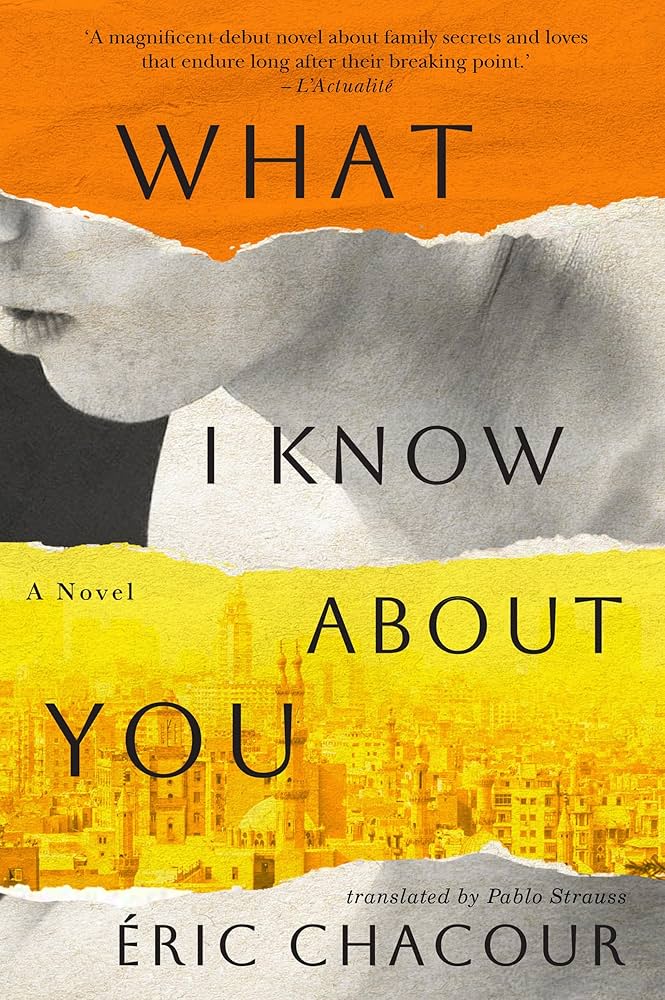
The secrets that define us: What I Know About You by Éric Chacour

Stories of queer love—hidden, unrequited, or impossible—tend to take on a special dimension when the temporal or cultural setting is one that outright forbids the expression of same sex attraction (and often even discourages public displays of opposite sex affection). A further challenge when bringing such a stories to life though, is the question of approach: can this tale be told in a manner that sets it apart from the burgeoning LGBTQ romance genre? Narrative is key, a metafictional twist perhaps, a less than reliable narrator, or an indirect angle through a spouse who never reveals what he or she knows. What I Know About You, by Québécois writer Éric Chacour, employs an inventive and surprisingly effective method to expose a story that spans forty years, from 1961 to 2001, and moves between Egypt and Montreal.
The novel opens in Cairo, or rather the narrative begins there, when the protagonist, Tarek Seidah, is twelve years old. He is out in the city with his father and his younger sister Nesrine. Their playful banter reveals that a certain order reigns. Even at this point, Tarek already senses that his life is set to follow an inevitable course laid out by fate and circumstance. As a member of a respected Levantine Christian family, there could be little debate. His father was doctor. He would be one too. In time he would marry and have a family, continue the family lineage, and the family practice.

It’s not hard to imagine that something or someone will threaten the ideal realization of this destiny, but what immediately sets this account apart is the perspective. It is a second person narrative, directed to Tarek, by a narrator whose identity will not be revealed until midway through the book, and at that point only to the reader, as the now-first person narration continues to be addressed to Tarek who has no idea it is even taking shape. It is a story—his own—that he wants to believe he has put far behind him.

As expected, Tarek does become a doctor and, by the age of twenty-five, he has taken over the family clinic after his father’s sudden death. The responsibilities to his legacy, his patients, and his mother weigh heavily, but he has his own project on the side that gives his life and career personal value away from home. He has established a weekly clinic in Cairo’s Mokattam slum area where he brings care attention to those who have little. It provides him with a great deal of satisfaction, but it also where Ali comes into his life.

By the time he meets the young man, Tarek is in his early thirties and has been married to Mira for less than a year. At first Ali approaches the doctor to ask if he will come see his mother who is ill but refuses to come to the clinic. These “house calls” soon become a regular practice, and, in time, Tarek invites Ali to come assist him on clinic days. For someone with little formal education, the boy is quick to learn and becomes a reliable assistant. As to how he earns money otherwise, Tarek does not ask, but there are insinuations that it is less than reputable employment. By the time he finds out, he has already started to become aware of his own feelings—attractions that defy the norms of age, sex and class. Their affair will threaten to destroy everything and everyone he cares for. His solution will be to escape, to emigrate to Canada, and leave his family behind. Even if it might have been possible to salvage his marriage:

What did you have to offer her in return? No real apology or explanation. A collection of monosyllables, I don’t knows and What can I says. You had long ago relinquished your duties as a husband. She wanted to know where you stood – as if the two of you were plotting geographical coordinates. Did you even know where you stood? Were there even answers to these questions? You observed her pain without trying to meet it halfway; your suffering and hers had grown so far apart they would never again meet. She didn’t mention Ali’s name, perhaps hoping you might broach the subject. The subject was never broached.

Once he is settled in Montreal, after retraining to meet Canadian standards, Tarek’s life continues with quiet dedication to medicine, alone and with little contact with his Egyptian past. Until it comes to confront him.

The second person narrative of the first section “You,” affords a certain spareness to the account of Tarek’s life in Cairo, events move swiftly and, at moments, possible details are surmised where the narrator does not dare to guess what might have done or felt. In fact, there is little direct insight into Tarek’s thoughts throughout the entire text. This is someone else’s version of the story, sometimes empathetic, sometimes tinged with bitterness. There’s also a peculiar sentimental note that slips in here and there, the echo of a piece of cliched wisdom perhaps. All of this will begin to make sense in the section, “Me,” wherein the narrator reveals their connection and motivation for the story they are telling. This is where the tension starts to build, as the long term implications of an attempt to bury the past are explored. Of course, given the clever way it unfolds, this is a book best not spoiled with too much advance detail.

Chacour was born in Montreal to parents who emigrated from Egypt, his family background likely allowing him to recreate the social and political mood of Cairo in the 60s, 70s and early 80s so seamlessly. This debut novel has won or was shortlisted for a large number of French language prizes, and now, in Pablo Strauss’s attentive English translation, it is again garnering attention. But, like many other queer novels that have ventured to entertain the possibilities for love when all the cards are stacked against it, a sadness and loneliness lingers.

What I Know About You by Éric Chacour is translated from the French by Pablo Strauss and published by Coach House Books.

“Things are always ever only about to happen”: Falling Hour by Geoffrey D. Morrison

We all know the Sebaldian trope—man/woman goes for a walk and thinks about “stuff.” In Canadian poet Geoffrey D. Morrison’s debut novel, Falling Hour, a man takes a picture frame to a park on a summer day, the outside world mysteriously recedes, and he spends the rest of the day thinking about “stuff”—or so it seems. Over the course of this oddly distended day, the narrator who introduces himself gradually as Hugh Dalgarno will reflect on, among other things, his life, his criticisms of Canadian political history and the audacity of colonial ventures in the Americas in general, his thoughts on literature, and a series of tales of less than illustrious (in his mind) historical figures, most of them Scotsmen as, for his sins, is he. Hugh is, by his own admission, an odd fellow, isolated and adrift within the murky reaches of his own existence:

The dark sea of myself existed in unclear relation to my brain and its brokenness: was my brain the sea, or a vessel on this sea, or the navigator in the cabin, or her instruments? Or was my brain the wind and rain and bitter crosscurrents that churned the sea’s surface like a fearsome avenging hand? I did not know then, in the park. Wherever it is I am now I continue not to know.

Did I mention that his brain is broken? It is, or was, or perhaps may still be, but he reminds us, his listener/reader/audience, of this fact on a regular basis.

The story begins with a rather mundane premise. Hugh has come to the park on a hot summer day to meet a stranger who has, through emails, agreed to purchase a picture frame that he found hanging off a fire hydrant. While he waits, his mind begins to wander and, when the stranger fails to materialize, he begins to wander as well, making his way across the eerily empty park, into the forest on one side and back again. As the hours stretch on, uncounted because his cellphone has died, Hugh becomes aware that he has seen or heard no signs of human or domestic animal life for hours; his only company are birds, insects and amphibians. He also comes to realize that he is unable to leave. He is, in essence trapped within the rectangular frame of a large park in a “suffering inland industrial town” in Ontario that he never directly names, but only barely disguises.

Hugh’s personal history is a curious one. He was born in Scotland but his parents, about whom he knows little, apparently struggled with addiction so, at the age of four, it is deemed best that he be shipped off to Canada to be raised on the west coast by his great aunt and uncle. Although they were in their sixties when he came into their lives, theirs is a loving home within which he is steeped in socialist values. Meanwhile, in the outside world, he is a bit of a outsider, not quite fitting in with his peers. That misfit nature seems to accompany him, to a greater or lesser degree, until, at the age of thirty-one, he finds himself lingering on in the city he moved to for grad school, a loner content to work from home, missing the seaside of his youth but unable or unwilling to return.

For someone so socially isolated with a brain he describes as “broken” without ever making it explicit whether that brokenness has a psychiatric basis of some sort, Hugh’s endlessly divergent account of his day in the park reveals a man with a wide range of interests, questions, doubts and opinions. He dissects the opening scene of the movie The Conversation, takes Keats to task for any number of shortcomings as expressed his letters, examines the impact of Calvinism on the Scottish working class and Methodism on Canadian history, and marvels at the unique appearance of the arbutus tree and the seductive call of the red-winged blackbird. His discourses fall in and out of rants, and branch off into fascinating historical asides that somehow link back to earlier themes and obsessions. He quotes poetry and song, and philosophizes about the nature of reality—a reality that becomes more slippery as the day goes on:

But without waiting to resolve the metaphysics, I passed under the door shape in the leaves anyway and out into the open space of the park. The forms and shapes I had passed on my way to the forest were present as before: the toilets, the benches, the baseball diamond. Only they weren’t those things now. They too were in some sense visible but not real.

The game of baseball had never been played. There were no games. There were arbitrary geometric dances across temporary lines in the sand. Nothing on earth was truly the name we called it by. Nothing. So I felt in that moment, and which second that passed, the workings of a certain familiar mind virus grew stronger inside of me. It often came to me after I reached the heights of an enthusiasm and my enthusiasm crested and I was left panting and ragged like a defeated army on a plain. Enthusiasm, that nineteenth-century word. The virus was a strange hypercorrection to enthusiasm, a dousing in the coldest and deepest waters of the inner sea the former flames of my broken belief.

Oh yes, Morrison is fashioning anew the mechanics of the man/woman-walking-and-thinking internal monologue by giving it to a mildly absurd narrator who is intelligent, sensitive, opinionated and somewhat paranoid. And one who is not entirely in control of his own story, even in the telling. We see this in the measure of uncertainty running through Hugh’s narrative—it’s a double stranded quality, one strand tied to the ongoing strangeness of the day he is describing, the other stemming from his attempts to place himself “wherever it is that I am now” against the “now” of the story unfolding in a past, be it near or far. He loses his place, retraces his steps, and acknowledges that he is holding off on particular subjects for a time, yet it’s unclear whether the digressions that arise belong to his thoughts on the day in question, or to his effort to reconstruct it, or a little of each. When he reaches a discussion of “stream of consciousness,” assuming his listener/reader has likely wondered why it has not already emerged, he details his attraction to and skepticism of the concept while the text itself takes on the form of chapter-long unbroken paragraphs until, several chapters later, a pattern of paragraph breaks resumes as Hugh once again attempts to step outside himself to assess his progress and circumstances. It is probably fair to view the entire novel as a “stream of self-consciousness” but, no matter how one wishes to imagine it, Hugh’s strange day in the park with an empty frame packs a wealth of interesting and entertaining  “stuff” into one rectangular space—this book, that is.

Falling Hour by Geoffrey D. Morrison is published by Coach House Books.

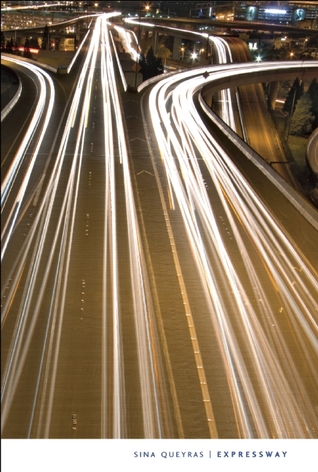
Multi-lane manifesto: Expressway by Sina Queyras

My hometown does not do expressways very well. In places where it would be obvious to have them, we are late to the game. And each one is a crap shoot, even if you know it well. The first time you have to exit and cross three lanes of traffic in very short order, your head swivelled 180 degrees, just to travel from the expressway to the road you were trying to access you have to wonder: did anyone try this out before they opened it to the public?

When I was still in university I had a summer job where I sat in a building the size of an outhouse, just off the Trans-Canada highway and tourists, just entering the city limits, could pull over and ask for directions. This was long before the era of google maps, GPS, even cell phones. We’re talking printed maps and a highlighter pen. I did my best to give instructions but, to be honest, there was—and still is—so little consistency I was often at a loss to say more than: Watch for the signs. I developed a theory that year that I still hold to. I reasoned that every civil engineering student at risk of a failing grade was given a chance to redeem themselves by designing a single interchange along one of the major thoroughfares. And that’s why no two are alike and some simply defy the imagination.

Canadian poet Sina Queyras completed her 2009 collection Expressways while here at the University of Calgary on a residency. I’m curious as to whether our ad hoc roadway system coloured this poetic critique of the social and ecological impact of the spreading network of asphalt arteries and veins that criss-cross our nations.  Her poems speak to the memory of a romanticized landscape of the past on a collision course with an increasingly isolated, technologically driven future. The opening piece “Solitary” sets the tone, with the call to consider what is a risk with the continued push to interconnect places, at the cost of connection to the land and to one another. The final stanzas read:

Wagon train, trail of tears, what aggregate composition,
What filleted history, what strata, what subplates,
What tectonic metaphor, what recoil, what never

Having to deal with the revulsion of self, only
The joy of forward, the joy of onward, then endless fuel:
The circles, the ramps, the fast lanes, the clover leaf,

Perspective of elevation, the royalty of those views,
The Schuylkill, the Hudson, the Niagara, the skylines,
The people in their houses, passing women, men

Dressing, men unearthing, smoke pluming, what
Future? What the apple tree remembered? Not
Even the sound of fruit. If a body is no longer a body,

Where is memory? If a text is no longer a text,
Where is body? If a city is no longer a city, what road?
If future no longer has future, where does it look?

She snaps her cellphone closed: no one. Alone.
The century is elsewhere. She turns her back.
Swallows her words. She will do anything for home.

As ever, I am not an effective critic of poetry. I like it, I read it. Sometimes, but entirely by accident, I write it. But I do know when poet’s work works for me. This collection is a strong, cohesive, and passionate manifesto evoking the poem as a means to challenge the ethics of the expressway—in its concrete and abstract context. A call to recognize what is at stake:

This poem resembles urban sprawl. This poem resembles the freedom to charge a fee. The fee occurs in the gaps. It is an event. It is not without precedent. It is a moment in which you pay money. It is a tribute to freedom of choice.
(from “Acceptable Dissociations”)

At times Queyras echoes of the Romantic poets, even borrows their words. The text of Dorothy Wordsworth’s Grasmere Journals provides the material for “Lines Written Many Miles from Grasmere” which, falling mid-way through the collection, casts a pastoral mood, a look back to the dream of a simpler time, closer to nature. But it is an ideal. The Industrial Revolution was, by 1800, set the groundwork for the technological and economic developments that would ultimately allow for the building of major roadways, and the vehicles to fill them. Other pieces are firmly bound to the present, most notably “Crash” which is assembled from fragments salvaged from google searches. Others stare directly at the future—here darkly, there with a vision of reclamation.

Expressway works as a rhythmic, lyrical cautionary tale. A call to undo harm. But, roads seem to be growing wider, interchanges multiplying. Especially here in North America where spaces are wide and the car is still king. That is, Queyras argues no reason not to strain to hear above the din of the traffic.

I am weary. I walk and walk and meanwhile the expressway hums . . .

What for weary? We all hum.

I am weary. I have so little hope.

Weary, maybe. But, no hope? For that there is never an appropriate time.

Sina Queyras lives in Montreal. Last fall I had the opportunity to hear her read from her latest work. This reflection/review was written in recognition of National Poetry Month in Canada and the US.

Expressway is published by Coach House Books.

A modern day folktale: Baloney by Maxime Raymond Bock—my Rusty Toque review

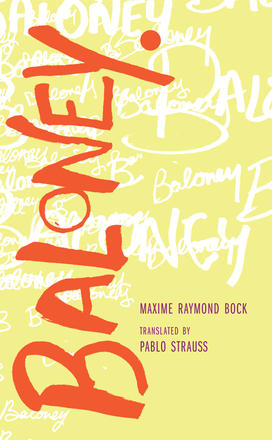
baloneyOne of my favourite books of 2015 was Atavisms, a collection of short stories by Quebec writer, Maxime Raymond Bock. I was especially impressed by his ability to employ a wide range of styles and genres, from historical to speculative fiction, in a multi-faceted exploration of Québécois history, society, and identity. His newest release, Baloney,—now available from Coach House Books and translated, like Atavisms, by Pablo Strauss—offers further evidence of Bock’s versatility. This novella evokes the spirit of a traditional folktale, with its tragic-comic hero whose larger-than-life adventures are immortalized by a disillusioned young writer drawn to the aging, eccentric would-be poet. By turns funny, sad, and wise, this simple story is surprisingly moving and thoughtful, and stands as yet another fine example of a new generation of Quebec writers who deserve to be more widely read in English-speaking Canada and beyond.

My review of  Baloney can be found in the current issue of The Rusty Toque—my first contribution to this fine Canadian online literary and arts journal.