walk on the perimeter
of your dreams. it’s not
that the roads are blocked
but that the hearts have
given into the violence of the wind
“Friday, March 25 at 4PM”
Etel Adnan, translated by Sarah Riggs
Into the second week of February and here we are, still living in interesting times, as the apocryphal expression goes. The past three years have brought disease, war and natural disaster, and have, sadly, served to demonstrate just how little we can care for one another. For many of us, it has also been a time of deepening isolation, especially for those with fragile connections to the community and outside world.
For days now I have debated putting my feelings into words, uncomfortable, as always, in talking about myself, even if most of my non-review related writing falls into the sphere of the personal essay. Of late, I have mostly written about how even that avenue feels fraught with barriers and challenges that my own sense of self worth cannot overcome. Then, when I turned to look at some of my occasional journal notes, I found that what I am feeling now I had already clearly articulated two years ago. Little has changed, except that the despair runs deeper and the mental health resources that were so important to me are now gone. I had overstayed my welcome in a system that is buckling under the pressures currently crushing healthcare services here and elsewhere.
Since the pandemic started, I have crossed into my sixties, encountered new medical challenges—none especially serious, as far as I know, and as of yet, no Covid—but I have not been outside the city limits and, apart from my immediate neighbours and my children, I have engaged in little social interaction. Finances have been a major factor, as have problems at home, yet I fear I have become increasingly withdrawn over this period. Trapped even. I go out every day, marking kilometres on the trails but the satisfaction that used to come with a good outing is increasingly elusive. I want to travel again and yet I cycle between anticipation and anxiety and keep pushing possible departure dates back.
I feel old, I feel tired and overwhelmed by loneliness. I fear I am drifting. It’s hardly a new sensation but it somehow seems that the past few years have made me feel at once anchored and anchorless.
I am also troubled by a continuing anxiety about my identity. Or lack thereof. At a time when identity has become such a loaded term, for better or worse, I can’t understand how people take some measure of pride, even comfort, in being queer or trans or something. I feel that the layers of my fundamental identity—sex, gender, sexuality, nationality, politics, religion—have all been stripped away. I am worse than naked. I am emotionally and socially flayed. Who am I now? Better yet, what am I? I have no job, no title, no vocation, no partner, no value.
I read. I write about the books I read and publish my thoughts in this space, typically trying to remain to the sidelines of my reviews. Any other words I try to write spiral into the void. I distract myself with little satisfaction, little connection, and a meagre measure of confidence. What do I have to show for sixty-two years? A differently gendered past rendered invisible on the outside that has left me in a body I will forever be at odds with? And a chronic psychiatric condition that has robbed me of the freedom of trusting my own worth, my own sense of self, my own existence.
There are far more books dealing with gender identity and mental illness on the shelves these days than there were twenty-five years ago when I was navigating crisis after crisis on both counts, but at this point in my life most of them seem to be speaking to someone alien to me. Rarely do I hear a discussion on either subject and think: Ah, yes, that’s so familiar. I wonder who I might be today if an understanding of the two separate and yet interwoven conditions that set me apart from such an early age had been available when I needed it. I might have had a different life, but I’m not convinced it would have been better. By the time one reaches sixty, the tangled complications of a life lived are impossible to unwind and reimagine. One can only look ahead.
In recent weeks I’ve been reading Etel Adnan’s collection Time. Published when she was well into her nineties, the poems in this handsome volume would have been composed when she was in her late seventies and early eighties. Clear and precise, her poetry crosses borders and time, touching again and again on myth, memories of war, desire, the body and the inevitability of death. With wisdom and grace, the poet untangles, reimagines and reminds me that life is marked with beauty and longing even as the end looms closer.
So where should one write? Back to the past or into the future?
I have published very little work outside my blog over the past year. For a long time I struggling with a serious writer’s block, something I have addressed here before. That had started to ease considerably while I was in India earlier this year, but when I came back, a period of editorial upheaval at 3:AMMagazine left me with increased editing responsibilities that have consumed much of my time and creative energies and, well, here we are.
Lately I have made an effort to claw some of that time back. I have contributed an essay for a book, pitched a critical piece I’m very excited about and even published a poem—my third piece to appear at Burning House Press.
This poem, “No (New) Man’s Land,” actually had its genesis in an earlier imperfect form, perhaps two years ago. I recently pulled it out again and worried over it until I was happy with the results and sent it in for consideration for this month’s theme: “Secrets&Lies.” It always thrills me to publish a poem or poem-like piece because I am an accidental poet. Occasionally I will go through a fit of scribbling down bits of random verse which then take years to ferment and maybe grow into a poem.
Here I am, once again, writing the body—a subject that is never far from my personal essay writing. “Your Body Will Betray You,” my first published piece, continues to attract a lot of attention three years after it was first published, and even if I would now use somewhat different language, I am proud of that odd little essay. But writing the body, especially when one is as dysmorphic as I am, is a vulnerable process. Catharsis is transitory. I’m finding that poetry offers a way to step back, pare the language, distort the imagery and grant a little distance to a story that is still entirely and inevitably mine. Employing third person (something that was a disastrous misstep in early stages of writing “Your Body Will Betray You”) can also make all the difference for me. That is what I chose to do with this new piece.
“No (New) Man’s Land” can be found here. With thanks to Robert Frede Kenter.
This Mother’s Day marks the third that I have faced alone since my mother’s passing in 2016. Last year was painful; this year, the passage between her birthday on May 2nd and today has been even more difficult. I have been angry, frustrated, agitated, depressed. Beset with a loneliness that is bone-deep, existential, wordless. I debated whether I should even attempt to express it because my specific pain is coloured not only by my loss of a beloved parent, my own mother, but because, although I face the world as a male person, understood as a man even to those who know otherwise, I am also a mother. Mother’s Day opens itself to women who have longed for motherhood (including those born male) or taken on motherlike roles in a wide variety of contexts, but holds no space for a mother like me. Even my own children tend to overlook my desire for just a moment’s recognition.
The only person who fully understood, honoured and respected this incongruous aspect of my being in the world was my own mother. And she is gone.
Up until the week she died, my mother called me, like clockwork, every Saturday night at 7:00 pm. I’m not sure when this pattern was established, but it extended back for decades. We were so very close. I listened to her joys and trials; she listened to mine. But there was never a exchange more difficult than my call, almost twenty years ago, to tell her that, after nearly forty years of trying to make myself into the woman she naturally assumed I was, I could no longer fight a persistent agonizing sense that I was not really female. My thirties had been, she was well aware, a decade of peculiar turmoil; that behind the birth of two children and a dutiful effort to craft a home that resembled the one I’d grown up in, something darker was brewing. I was increasingly, obviously miserable. I had experienced a serious manic psychosis and spent the better part of a month on the psychiatric ward. But nothing could have prepared her for my revelation. I had never shown the slightest masculine tendencies or interests and “transgender” was only just beginning to become a topic of conversation. However if gender roles and experiences—including pregnancy and childbirth— could a woman make, I could have managed to quell the dysphoria. I could not.
My mother, bless her, responded to the news that I was planning to divorce and transition to a life as male, with the promise that she would always love me unconditionally. She asked for no more than a few weeks to adjust to the idea. She became my advocate, quietly, faithfully, unstintingly. If she had her own doubts and grief over the loss of her daughter, she never let me know. And I never got the chance to ask. It was a subject left unaddressed in death.
My mother died from complications of osteoporosis and, as we learned in the final days of her life, post-polio syndrome. In eighty-two years the markers of exposure to that disease had never been detected, but together these conditions had gradually reduced her body to a hunched, frail, crippled cage. Until the very last month, when the lack of adequate oxygen exchange began to impair her thinking processes, she remained alert, intelligent and fresh. When I spoke to her, her age was ambiguous, eternal. Every time I saw her in person, I would be shocked anew. She spent her final years trapped in a delicate, fragile frame that constrained the spirit of a woman who had been so active and physically vital most of her life.
Her body betrayed her.
My mother’s death, followed eleven days later by my father’s death from the complications of a head-on collision, unravelled my reality in ways I am only beginning to fully appreciate. My parents spent their final years in a cottage in the woods outside a small village about two hours northwest of the city I live in. It was the final destination of lives that had started in large urban centres—New York and Toronto—and ended in a place in which they had few, if any connections. To everyone who knew them in this ultimate location, I was the oldest son. To most of the distant and scattered friends and relations I was tasked with notifying of their passing, I was their only daughter. For my brothers, never entirely at ease navigating the decade and a half between my two opposed public identities, I will always be a sister.
My parents’ final home.
For my own two children, I am the parent who transcends and defies gender, who struggled to raise them alone from the ages of eight and eleven, with little financial and emotional support, with one identity at home, but hidden, vague and uncertainly defined to the outside world. I referred to myself as their parent, only explicitly defining the biological reality when medical or educational situations commanded more specific terms. To do so was to invite the question of how much my issues were or were not impacting my son or daughter who each had their own challenges. No one ever asked how the practical emotional distance of their father played a role. I looked like a father and it is difficult for others, even if they are fully aware of my past to hold mother as a reality in the existence and life of someone who looks like a man. I was, more often than not, reduced to that oddity that, even today, is poorly appreciated—a single male parent.
I would be asked: Where is their real parent? Who? Their mother? What could I say? She’s dead? And yet, I resisted revealing my identity unnecessarily. I have long known single fathers, not widowed but left with the care and responsibility while mothers moved on, and I felt it was important to call attention to the fact that not all single parents are women. I also feared negative fallout. As a closeted transgender person I stood in isolation.
Yet raising children through their difficult adolescent years gave my life meaning, value. My own parents stood by me, pitched in, built strong and vital relationships with their grandchildren while the other side of their family, maintained a distance. Only their stepmother, their father’s new wife, made an effort. As I built a new identity and a new history as a man in the world, my children and my parents provided essential continuity. They allowed me to feel whole, to carry motherhood and manhood as part of who I was.
Who I was.
The last few years have not been so easy. The artificiality of this assumed completeness was shattered when I became ill and lost my job. The scaffolding provided by my short-lived career, the years I spent working in social services fully and completely accepted as male, was stripped away leaving me defenseless. By this time, my children were in their twenties, both dealing with their own serious issues, and I had no friends, community or support to fall back on.
In retrospect, the sharp jolt into recognition of the limitations of transition to address the longstanding dislocation of gender dysphoria, has been a blessing. I could have continued to imagine that my artificial existence was sufficient for some time, but in truth, cracks in my carefully tended armour were showing long before the tentacles of mania pried them open. Career success was only a passing indication of achievement. My failure to make friends or forge a sexual identity spoke much more acutely to the truth that I could live as a man, but would never really be a man. Yet, as transgender, my own experience—past and present—is never echoed in the endless stream of gender different narratives that have become so ubiquitous in queer and public discourse. My personal efforts to find comfort, community or safety in LGBTQ space have been a dismal tribute to the heartache of finding oneself doubly alienated among the alienated. I sometimes feel like I have never fit in anywhere.
So I sought to find myself where I had no reason or expectation of fitting in. Where I once sought to ensure protection by building walls between myself and the world, I now seek escape. Through reading, writing , and travel. South Africa. Australia. India.
And again, India.
My mother only lived to know of the first of these journeys, one that in my complete ignorance about the risks of long haul sedentary travel, very nearly cost me my life—blood clot to pulmonary embolism to cardiac arrest—saved against incredible odds, by my son who found me and started CPR. But I know she would never have discouraged my continued travel. In her lifetime she managed to visit Cairo with a friend and Russia and New Zealand with my father, but had she not been constrained by an increasingly brittle body and an increasingly eccentric and intransigent husband, she would have travelled longer and farther. Perhaps I have inherited some of my restlessness from her.
That restlessness is growing. I have never felt “at home” in the city where I have lived for most of my life. I was not born here. I have no roots or connections here. Both of my brothers are married to women with deep histories in this part of the country. But my ex was of the first generation born to migrants, refugees. My own mother was a migrant and, back only two generations of a family of refugees herself. I feel this eternal disconnect enhanced by the embodied dislocation I feel as someone who has navigated womanhood and manhood, but belonged to neither. In this present #MeToo era I am even more adrift. I am torn between a genuine empathy for men—informed by living as a male person in society keenly aware of the ways testosterone has altered my mental and emotional engagement with the world—and the feeling that my own experiences as a girl and woman have lost their currency. I look like a middle-aged white man and that is all that I am allowed to speak to. There isn’t even a language which can adequately address my dual life and my role as a parent. Transgender men who opt to have a child at the beginning of the transitional process engage a queer parenthood that is unlikely to ever be labelled “motherhood” as language now tends to be gender neutralized, distorted. Which is fine for them, but it silences and disowns the reality of my, admittedly less common, hybridized experience.
I want to speak for no one but myself. I do not regret the decision to transition, I am entirely comfortable with the face I see in the mirror. I am male and enjoy a hormonal rightness that grants me a certain completeness. The body, well that is another possibly unsolvable matter. However, of late I find myself wanting to claw back some sense of dignity for my early, pre-transition life. It isn’t easy. It is unsettling, even with my most generous and supportive friends— those who fully accept me but have only known me with this present name, this current appearance. And very often it angers transgender activists because it defies the accepted discourse. I can’t help but fear that the only person who might have ever come close to truly understanding, who might have been able to walk with me through this unending, evolving, shifting, and ever ill-defined journey is no longer here. My mother contained all that I am—all that I have ever been, and all that I ever will be. My absolute alpha and omega. Her love was whole, at times skeptical perhaps, but expansive and complete.
And for that reason, on this Mother’s Day, I miss her with all my heart and soul.
Back from a month in India, I am struggling to reorient myself. The jet lag and the cold I thought I had shaken that has now morphed into a different version of moderate misery do not help. My brain is foggy. My body is trying to adjust to the twelve and a half hours I just gained back. My heart is sick with a longing to grasp again, just for a minute, whatever it is that I left behind. That I leave behind every time I return.
India has a strange charm. One I can’t quite place. I never imagined I would go there; I cannot pinpoint when the seed was sown. I do know that for years it was a secret wish, not bound to any particular calling but simply a desire to go there. Last year’s chance decision to visit Seagull Books in Calcutta was an opening, this year I expanded my time and orbit, and met so many more people along the way. Had so many great conversations.
How is it, I ask myself again and again, that I can travel halfway around the world, and make more solid connections—new or renewed—in four weeks, than I can manage in an entire year in a city I have lived in for most of my life? Is it, perhaps, that I am able to be myself in a strange land, relax into a comfort with who I am in a place where I do not naturally belong? Why can I not bring that person back with me? Or at least feel at ease with him when I come home.
What is home, then? And why does this place fail to complete me? Why do I feel a home-away-from-homesickness weighing on me? I envy those who belong someplace.
As long as I can remember, I have felt that I was out of step, out of sorts, a misfit. Marriage, moving, midlife metamorphosis—nothing has ever completely eased the discomfort. Only in travelling do I find relief. Only in upsetting the equilibrium do I feel whole.
At least for a while.
Toward the end of my visit, an unexpected event challenged this temporary relief. I went out to visit a friend at a school in Andhra Pradesh. Here, in a rugged and breathtaking location with only the faintest internet signal, the world was out of reach for the night. In the morning, as I climbed into the car, my driver greeted me with news he had just received. “India attacked Pakistan,” he reported with enthusiasm, “people are celebrating in Bangalore!” I politely responded that I wasn’t sure that was a good thing, but all the way back into the city I contemplated what it would mean to be in a country at war. I was not unaware of the tensions that had been building, but I had no clear grasp of the historical context. As an outsider, I am cautious to hold to a respectful neutrality, but somewhere along the way a line is crossed. I have become attached to people and places. I am not simply a visitor.
Once again I am aware of a sensation similar to what I feel as a person without a coherent gender history. A neither-here-nor-thereness defines my life. Always has, always will. Only now it is slipping across other boundaries, opening new possibilities.
After this recent trip to India, and the many rewarding and validating encounters that I was fortunate to have, I am beginning to believe that if I can learn to embrace an inherent disequilibrium as a fundamental and vital part of who I am, I can finally move ahead to tell the story that has been eluding me. My own story.
August has passed, it seems, with little to show for itself. Smoky skies and an air quality rivalling that of some of the most polluted cities of the world curtailed much outdoor activity here. Further to the west, where the smoke originated and forests burned, it was worse. Now, as skies clear, temperatures are dropping and summer’s fading fast. Leaves are turning yellow. Autumn nears.
Two years ago today, September 1st 2016, a dear friend took her life. A second attempt after years of trying to fight off crushing bipolar depression. Unable to work and living on savings, treatment often meant driving to a public hospital, an hour each way. She lived in a small village in the Eastern Cape Province of South Africa. We only met once. I spent a week with her in 2015, but from the moment we first met online, it was as if we had known each other forever. We could joke and riff off each other, falling into a regular routine as a dysfunctional divorced couple that often fooled others. In truth, we were bound by queerness, books, and bipolar disorder. Soul mates shipwrecked in our own lives.
But, of course, I couldn’t save her.
In the months before Ulla died I held a certain distance. I was reeling from the recent death of my mother, followed closely by that of my father. Knowing that she was fragile, and, after three years, still grieving her own mother, I was unable to reach out to her to seek or offer support. We were both drowning, but her sea was darker and more deadly. It had been for a long time.
With my parents’ sudden and tightly timed deaths, I had imagined the possibility of an exercise of writing immediate grief—echoing Barthes and Handke—but the burdens of being an executor distorted and distended the mourning experience and, for the most part, these losses remain unwritten. Then again, my parents were in their eighties with long lives, well-lived, behind them. My friend’s death, at forty-six, was more complex. I knew it had to be addressed, not simply for myself but for a community of followers who responded to her actions intently and personally. It took three months to salvage words and craft a 300-word piece which was published, with my own photographs, in late November of 2016. Each time I come back to this eulogy I realize how much of my immediate grief is contained there, perfected and concise.
Who, and what, in the end, do we write grief for? If we are looking for catharsis, a way to move beyond grief, we may be disappointed. Perhaps grief simply moves with us, evolving and softening over time.
If Ulla’s death sits especially heavily at this time of year, at the moment there is an extra weight. Earlier this month, my son’s best friend lost a difficult battle with opioid addiction. He had been at our house quite a bit in the last weeks, and although clean at the time, he was really struggling. My son is devastated. He’s been seeking refuge in alcohol and routinely breaks down in a flood of tears and despair. His sister and I feel a loss too; Dylan was a common presence in our lives over the past twelve years, but to be honest, in recent times I wasn’t always happy to see him on the doorstep. He and Thomas have both, at twenty-eight, been fighting their own mental health and addiction issues for a long time. And they were not always good for each other. They could be up all night arguing—usually about politics, but sometimes about really “important” matters like the difference between a canon and fugue. Things could get violent. One morning Thomas broke his hand on Dylan’s head (and glasses). But music was their real bond. They wrote and recorded songs together and spent hours busking on street corners over the years. They believed in each other when neither could believe in himself.
As a parent it is agonizing to watch my child in pain and know that his is a mourning song I cannot write.
*
As September begins, I am aware more than ever that we are surrounded by a constant procession of ghosts. I’ve bought a two-bed flat and, at the moment, I’m deeply engaged in the process of emptying out closets, cupboards and rooms of accumulated stuff so that, by October 1st, my house will be empty and I will be settling into a much smaller space. The sheer volume of junk that needs to be dumped, donated, or moved is overwhelming. And with it, reminders of the losses of the last few decades keep resurfacing when I least expect it.
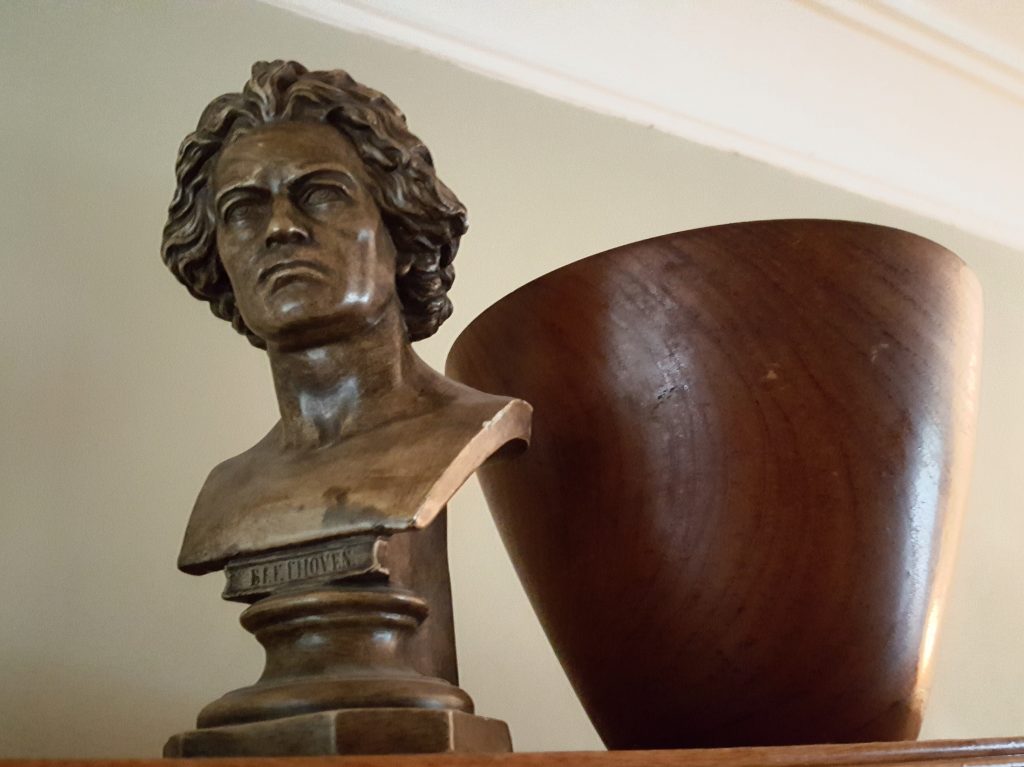
Out in my unfinished garage where I have amassed a mound of old, damaged furniture and broken objects waiting for pick up, I found a windshield propped against the wall. I have no idea what it was for or why it is there, but I know it was something my father must have picked up and forgotten. I’m surprised how much of him I couldn’t part with after his death—his Russian literature, a bust of Beethoven, a grandfather clock—all tangible reminders of a man who was so elusive, so hard to know.
Of my mother, there are few objects I wanted to bring home but her presence permeates so much of my life. Especially the one I tried to live in her image. As a girl and woman. Packing up children’s clothing for donation I find the beautiful outfits she crafted for her precious granddaughter—lined coats, fancy dresses—her attentions to Ginny’s wardrobe becoming ever more feminine as I, her only daughter, transitioned to male. I also unearth all the outfits I myself made for both my children in their early years when I was still determined to play the part birth had granted me. A part that, ultimately, has nothing to do with gender at all. I truly enjoyed creating beautiful things for my children. It just didn’t alter the sense that I wasn’t female.
And so, this house is also haunted by ghosts of myself, the selves I wanted to be, the self I became while living here. The self I still don’t know what to do with. I haven’t even uncovered the boxes filled with all my childhood photographs or angst-ridden adolescent writing. But documents with my old names, once-treasured possessions, and even a wedding dress have been revealed. Some will be retained, others hastily stuffed in bags and carted off to Goodwill.
Then last night, another more recent, unresolved ghost emerged. In a closet I found a manual from a leadership workshop I took a number of years back. At that time I was confident, more secure in my sense of self than I would ever be. My transition, in my mind, was complete and a success. But within a few years, my brief, yet promising, career in not-for-profit management would be destroyed by circumstance and my own mental illness. A loss I still have not come to terms with and yet it seems like something that belonged to another person. As if my life has just been a series of reincarnations that seem to leave me no wiser or further ahead.
And no more certain who I am.
And then there is my own addiction: books. Spread through three rooms, with most shelves double stacked, I shudder to think how many boxes there will be. No mercy for old magazines and outdated textbooks. They are bound for the recycling bin. But every time I scan my bookcases to collect charity sale donations, my decisions about what to hold on to shift. My anthropology and ecology texts are now gone, but my philosophy, classics and ancient Near Eastern history volumes remain. I notice that so many of the books I bought during my years of bookstore employment in the early 80s are still valued, even if I didn’t appreciate some for decades after purchase, whereas the literary bestsellers I devoured in my thirties and forties have been, and are, regularly pruned and sent off to new homes. Some of the obsessive tangents reflected in my collection are held dear, others are an embarrassment.
The books we read, and perhaps even more tellingly, the books we buy with the intention to read them, reveal a lot about who we are, who we want to be, and who we want others to imagine we are. More ghosts in our own lives.
And I suppose moving is one more opportunity to encounter, reshape, and even resolve a few of those ghosts—our own and those of others whom time, distance, or death have taken away.
I have accepted an offer on my house and, if all goes well, I will be moving. Knowing that I’ll be looking to purchase a much smaller space, there is, after twenty-four years here, an urgent need to reduce the collected detritus and all the unwanted belongings that have accumulated over time. Two children, a dissolved marriage, and my own double-folded existence have left a mass—no, make that a mess—of stuff to sort through and clear out.
One evening I uncovered a shoebox of cards and letters tucked into the most unlikely cupboard in the basement. I brought it upstairs and sat down to sort through the contents. Anniversary cards celebrating a marriage that ended seventeen years ago; longer than that if you count the painful years of unravelling that preceded the formal separation. Birthday cards addressed To a Beautiful Daughter. And letters. From friends. From my mother. From another time and life. Some I kept, others I tossed into the recycling box. I opened none of them. It seems one cannot bury the self, but one can put it aside—until a later date.
My mother’s death, two years ago today, opened a raw vein, exposed a deep insecurity that I believed I had moved beyond. As a result, my faint efforts to articulate my loss have continued to come up against an impenetrable wall of guilt and shame. That box of old cards and letters troubles old wounds. Likewise, yesterday’s the discovery of nearly two decades of prayer journals uncovered in a container stored at my brother’s place compounds the pain. When I suggested that the journals be burnt, unopened, my other brother admitted he had read some and that her prayers had been focused on our father—no surprise there—and me. It seems I had been her pressing concern. Me. The daughter who failed her. The daughter who could not be a woman.
I have always insisted, to myself at least, that my mother was my one and only unconditional support through the years of my transition and beyond. That when she died, I lost the one person who really believed in me. But, in truth, we never got the chance to properly address the impact of the shift in our relationship. We always talked around the subject.
In the last month of her life, when I was finally beginning to try to confront the extent of the loneliness and grief my own tangled life journey has caused me—when I needed more than ever for her to assure me I was a good person and that she still loved me—she was already slipping away. As her lungs became constricted within her shrinking frame, her energy and cognitive abilities declined rapidly. We thought she needed rest, a break from our father. We didn’t know she was on her way out.
On July 6, 2016, one day after my dad was in a serious accident that would ultimately claim his life, my mother was rushed into the city with critically low oxygen levels. She ended up in ICU in one hospital while her husband lay unconscious on the stroke unit of another. I saw her the next day, and although disoriented, she was hungry and joking with the nurses. One day later she was barely responsive. The respirator was not helping as we’d hoped. On the third day, Saturday July 9, I received a call from the hospital. A family member was needed. Both of my brothers were out of town, so my daughter and I went down. Ginny was twenty-three at the time and had been very close to her grandmother. We spoke to the doctor and agreed that the respirator should be removed, but requested that we wait until my brothers could be there—one was a few hours away, the other six.
So Ginny and I kept vigil. Held her hands. Told her we loved her. My son was too distressed to come. When my brothers and their wives arrived, the respirator was removed and we kept her company through her final hours. Eleven days later, our father would follow her. Throughout those troubled weeks, I sat many hours by my parents’ bedsides. To my brothers though, whatever I do, whatever I have done, is never enough. I am the oldest and the odd one out. Always wrong. But as they’ve been supported by their wives and extended families, I’ve been alone with two adult children, the three of us shocked and bereft.
It has been a long two years now. My mother’s absence still sits heavy—an empty space inside me. I cannot address her yet. I have no words. I’d like to think she would be proud that I am writing, but she never wanted to read anything I wrote. It might have been too painful. Perhaps that’s why it’s so hard to write my grief now. We were, it seemed, so close. We spoke on the phone every week, shared our hopes and concerns. But what of what was left unsaid?
And what of the daughter she lost, the one in the cards and letters in the shoebox, did she mourn her? She saw me happy, for a while at least, in this new masculine form. If I could trust that she remembered that person, her unexpected son, in her last hours, could I move on and begin the grief process?
For the longest time I have entertained a writing project. Memoirish, I described it. I put time and money aside to facilitate this activity. I’ve been going through the money, but have little to show for my time. It has been more than a year since I’ve written anything serious of a personal nature beyond a few small prose pieces or random blog posts. I’ve written about writing and not writing and all manner of writerly insecurity. I regularly hear from people who, much to my surprise, enjoy what I do write, appreciate what I share. Yesterday, after submitting an overdue review, for better or worse, I told myself that I must finally get serious about trying to pull together a more significant effort.
Yet, I woke up today fearing that I can no longer tell my story. The only story I have to tell and I cannot share it. The cost is too great.I don’t know how others do it. Detail their personal lives, their vulnerabilities, their victories. Perhaps there is a part of ego that has no filter, a point of pride that longs to disclose. But that’s not me. In real life, I’ve come to understand that my existence can only begin to affect some measure of authenticity if I refrain from attempting to have full expression of all that I am. All that I have been. It’s one thing to write. I have published a few raw and honest pieces that have been well received, that can be searched online, and I am happy with each one. And here at home, for the past three years, I have been more intentionally out and involved in LGBTQ and affirming spaces in a way I never dared before. However, more often than not, I’m left feeling defeated. It’s all okay, it seems, until I try to have my voice heard. My history validated. My pain respected.
I would to dream that writing could heal the loss and grief I carry. Yet, too much loss and too little gain makes for a story no one would want to read. Life stories are supposed to show recovery, strength, hope. But that’s wishful thinking. Real life itself just goes on. I am afraid that attempting to write now would only reveal the anger and despair that I can’t get past.
This is not to say that there have not been many positives in recent years. I’ve a network of good friends across the globe. I’ve travelled to some amazing places. I still love writing—reviewing, interviewing, and editing. I am producing work that I am truly proud of. And I’m not ashamed of who I am. But I think I have reached the limit of what I want to explore on a deeply personal level in writing.
Perhaps some stories are better left untold. Some transmythologies are better left uncontested. And some lives are more coherently lived by keeping the closet doors at least partially closed.
This weekend I realized that, in no uncertain terms, it is one thing to be “accepted” as long as you don’t talk about yourself, or your life, in any way that others do not want to hear. This simple truth has finally extinguished my intention to continue this memoirish fantasy.
I wish I was a poet.
Sometimes I think poetry offers the only hope that one could touch the truth but keep the self intact.
It’s Pride Week here. For me it’s the worst week of the year. An opened wound. I wake with chest pains, panic attacks. Always the same. No. The more I try to get involved the worse I feel.
I have been out for nearly twenty years, but I always feel out of place and alone during Pride.
And each year is more difficult. I have no pride.
I used to believe that it would get better. Then I believed that it didn’t matter. But it hasn’t gotten better. And it does matter.
Things have changed. I have changed.
Yet I’m not sure if the cost has not been too high.
You might as well haul up
This wave’s green peak on wire
To prevent fall, or anchor the fluent air
In quartz, as crack your skull to keep
These two most perishable lovers from the touch
That will kindle angels’ envy, scorch and drop
Their fond hearts charred as any match.
Seek no stony camera-eye to fix
The passing dazzle of each face
In black and white, or put on ice
Mouth’s instant flare for future looks;
Stars shoot their petals, and suns run to seed,
However you may sweat to hold such darling wrecks
Hived like honey in your head.
—from Sylvia Plath, “Epitaph for Flower and Fire”
I have known mania, and the imagery in this poem sparks with an intensity that excites and disturbs. When I encounter the words of one of the many poets known (or thought) to share (or have shared) the same affliction, I often find an undercurrent that causes me to flinch for just a second. Not that it diminishes the beauty or power of their words in any way—it is rather an echo in the dark, a faint recognition flashing by.
Image copyright Joseph Schreiber, 2012
It is World Bipolar Day, and this is the first time I have stopped to recognize the fact. I have spoken in, and around, my own bipolar diagnosis, but I have never addressed it formally in my writing. Even now I find myself uncomfortable discussing it. On the one hand, I am fortunate. I respond well to medication. I am, to use that distasteful term, “high-functioning.” But I do harbor a deep anger toward this condition that was part of my life many years before I finally careened through a brutal month of manic psychosis and found myself committed, and ultimately diagnosed, at the age of 36. I was, in classic bipolar fashion, the last person to suspect that I had a mental illness. Even though I, and those around me, knew something was terribly wrong, the stigma and lack of understanding around mood disorders—not to mention the radically impaired insight the sufferer has when they are ill—stands as a barrier to timely intervention. And then there is the matter of actually accessing care. One almost has to crash completely—by which time it can be too late.
Between my first manic episode in 1997 and the second in 2014, I experienced more than sixteen years of stability. I transitioned, became a single male parent, built a career out of nothing, and eventually became the Program Manager at an agency dedicated to working with survivors of acquired brain injury. I loved my job. Looking back, I can now see how the last few years of that period were marked by an increasing tendency toward hypomania. With my psychiatrist’s support I cut my medication back. And then things started to fall apart at work—things beyond my control, but it fell to me to try to pull things together. Then I started to fall apart at work, until I spiraled into full blown mania. Not psychotic, but it matters little. The damage was done.
The agency I worked for, dedicated as they are to supporting clients with disabilities including co-morbid mental illnesses, treated me with distrust bordering on contempt. My only contact with them has been conducted through a workplace advocate and my insurance worker. When return to work was discussed they refused to consider any possibility that I could work there again. Almost three years later with long term disability finally at an end, they still have my personal belongings.
Nine years of employment and dedication to that job now stand as a gaping hole in my life—a life already filled with gaping holes. And that is one of the reasons I hesitate to talk about mental illness (although I have never hidden my diagnosis). What can I say? Bipolar is not my identity any more than transgender is. Both fuck up your life. Leave wounds that do not heal. Find you fumbling through mid-life with little to show for your years but a lot of things you can’t talk about. And periods of time you cannot even remember.
So this is why I find it hard to write about my experience with mental illness. There was a time, following my diagnosis, that I devoured everything I could find, just as, a year later I hunted for books on gender identity. Two pieces of a puzzle I had inhabited—the periodic mood swings and the persistent, life-long feeling that I was not the female person everyone else knew me to be—had finally fallen into place. I had two, if you wish to be specific, explanations that come neatly labelled and defined within the covers of the DSM. It was, for a while, a source of relief.
Today I rarely read any literature that deals with mental illness or gender. But I am aware, more than ever, of being doubly stigmatized. And, most painfully, within the spaces where you would expect acceptance—in the human services profession and within the queer community. Thus the anger.
And what is this anger? Grief. The deep griefs I carry, layered now with more recent bereavements. It has become, for me, an existential bitterness that plagues me, an inauthenticity that defines the way I intersect with the world.
The legacy of mental illness is this: after diagnosis I was advised not to dwell on the disease, not to talk to others with bipolar; I was not deemed “sick” enough to warrant outpatient support or psychiatric follow up. I was left, like so many others, to flounder in the dark. It would take seventeen years and a spectacular career-destroying crash before I was able to access proper psychiatric and psychological support. I am still lucky. I am stabilized. And the forced detour into what may become an early semi-retirement has afforded me a space to write.
Now I need to find a way to write my way through this weight of grief. And begin to heal.
I’ll leave the last word to Sylvia Plath, with the final (fifth) stanza of the poem quoted above:
Dawn snuffs out star’s spent wick,
Even as love’s dear fools cry evergreen,
And a languor of wax congeals the vein
No matter how fiercely lit; staunch contracts break
And recoil in the altering light: the radiant limb
Blows ash in each lover’s eye; the ardent look
Blackens flesh to bone and devours them.
—You can find out more about the International Bipolar Foundation here, and a prose poem I wrote to honour a dear friend who lost her desperate and brave battle to bipolar last year can be found here.
Words are lumpy, awkward, and unwieldy these days. Frozen, they neither form nor flow. I would like to blame it on the times, the weather—anything but this emptiness I can’t shake.
I used to say: I’m a loner, but I’m never lonely.
These days I’m lonely, even when I am not alone.
I am reluctant to write about this. I can remember listening to others complain about being lonely—even when their lives were filled with activities and people—and wonder how they could talk that way. More critically, I blamed them. It must be something in them, I reasoned, a bitterness or despondency that drives others away.
And now that person is me.
I understand the sense of alienation—and the way it can so easily be reflected in a coldness borne of anger and pain. Loneliness engenders a void that fills the space between the self and others. A space that grows and pushes the lonely person farther away.
I’ve been reading about loneliness of late. In an essay published on Aeon last July, Cody Delistraty argues that for all its pain, loneliness can build character. It can be a positive experience.
Assuming one emerges, that is.
Depression, cognitive damage, and suicide are very real risks for those for whom loneliness becomes chronic. Delistraty’s thesis is self-serving. He goes to Paris seeking a period of solitude and finds himself irritated by a lonely woman who desperately craves someone to talk to. Choosing to isolate one’s self for a period of time—to recharge, to create, to write—is a deliberate, and hopefully productive, act. In The Lonely City, for example, Olivia Laing chronicles her experience being alone in New York City. I read it last year and related to her observations, but at that time I was still grounded by two important people in my life. One year later, both of them are gone.
And loneliness is very hard to bear.
As a loner, I was always careful to balance my tendency to isolate against work that was people focused. When I unexpectedly had to leave my workplace several years ago, I instantly became aware of the void that had developed over years of living closeted, as a man with no past. Unable to work, I sought to find a community where I could be out, be myself, but that seems to be a space that exists most authentically only when I write. In my experience, the LGBT “community”—at least in my age range, in my city—is not as supportive of diversity as one might imagine.
So if it is in writing that I find the freedom to be myself, how to exist beyond the page? Alone?
I will have to find a way to write through, above and beyond this loneliness, I suppose.

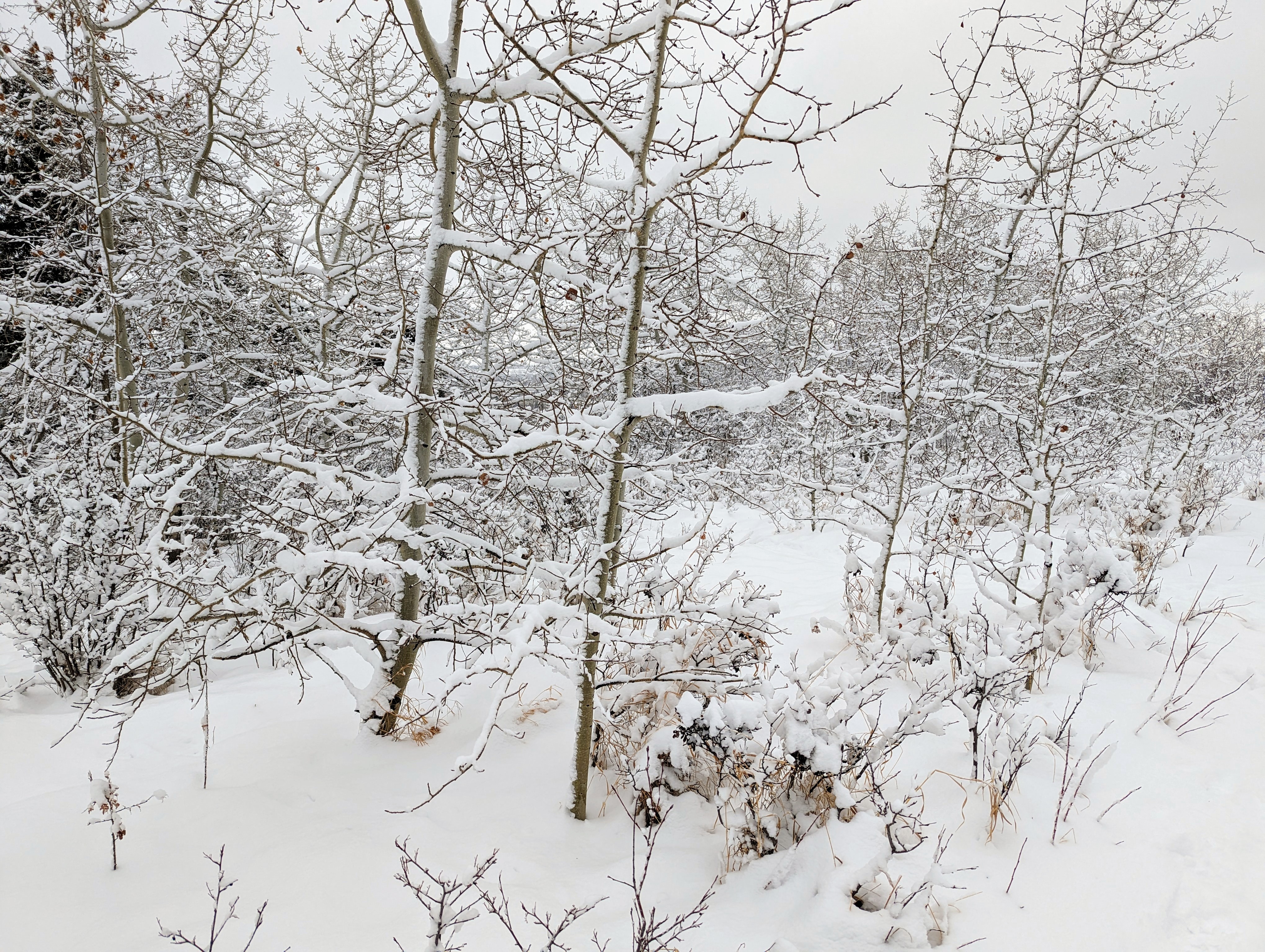 Since the pandemic started, I have crossed into my sixties, encountered new medical challenges—none especially serious, as far as I know, and as of yet, no Covid—but I have not been outside the city limits and, apart from my immediate neighbours and my children, I have engaged in little social interaction. Finances have been a major factor, as have problems at home, yet I fear I have become increasingly withdrawn over this period. Trapped even. I go out every day, marking kilometres on the trails but the satisfaction that used to come with a good outing is increasingly elusive. I want to travel again and yet I cycle between anticipation and anxiety and keep pushing possible departure dates back.
 There are far more books dealing with gender identity and mental illness on the shelves these days than there were twenty-five years ago when I was navigating crisis after crisis on both counts, but at this point in my life most of them seem to be speaking to someone alien to me. Rarely do I hear a discussion on either subject and think: Ah, yes, that’s so familiar. I wonder who I might be today if an understanding of the two separate and yet interwoven conditions that set me apart from such an early age had been available when I needed it. I might have had a different life, but I’m not convinced it would have been better. By the time one reaches sixty, the tangled complications of a life lived are impossible to unwind and reimagine. One can only look ahead.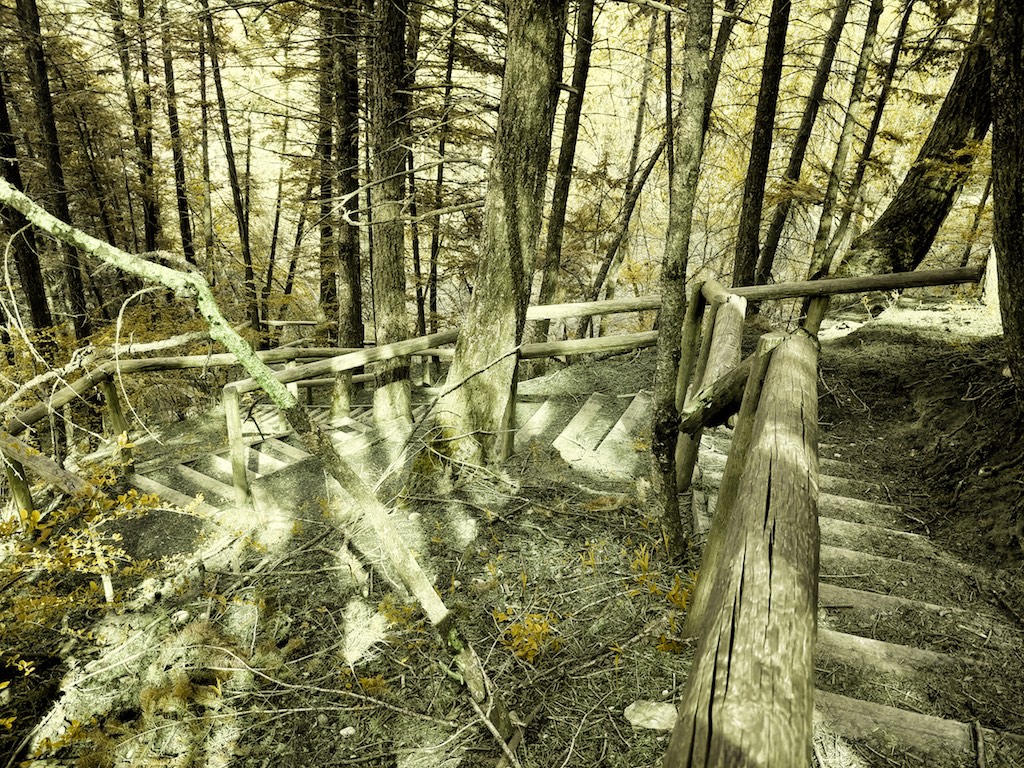





 roughghosts